
人工智能芯片

Search documents
寒武纪-U大宗交易成交0.85万股 成交额1142.40万元
Zheng Quan Shi Bao Wang· 2025-12-12 15:45
两融数据显示,该股最新融资余额为145.50亿元,近5日减少7.46亿元,降幅为4.88%。(数据宝) 12月12日寒武纪-U大宗交易一览 | 成交量 (万股) | 成交金额 (万元) | 成交价格 (元) | 相对当日 收盘折溢价 | 买方营业部 | 卖方营业部 | | --- | --- | --- | --- | --- | --- | | | | | (%) | | | | 0.85 | 1142.40 | 1344.00 | 0.00 | 国泰海通证券股份有限公司总部 | 机构专用 | | | | | 注:本文系新闻报道,不构成投资建议,股市有风险,投资需谨慎。 | | | 进一步统计,近3个月内该股累计发生12笔大宗交易,合计成交金额为2.03亿元。 证券时报•数据宝统计显示,寒武纪-U今日收盘价为1344.00元,下跌2.75%,日换手率为2.19%,成交额 为125.03亿元,全天主力资金净流出20.96亿元,近5日该股累计下跌0.81%,近5日资金合计净流出30.04 亿元。 (原标题:寒武纪-U大宗交易成交0.85万股 成交额1142.40万元) 寒武纪-U12月12日大宗交易平台出现一笔 ...

摩尔线程:拟使用75亿元闲置募集资金进行现金管理
财联社· 2025-12-12 11:00
摩尔线程今日公告,为提高募集资金使用效率,合理利用部分闲置募集资金,在不影响募集资金投资项目建设实施、募集资金使用计划和保证募集 资金安全的情况下,合理使用部分闲置募集资金进行现金管理,提高募集资金使用效益。 公司及实施募投项目的子公司计划使用最高不超过人民币750,000.00万元(含本数)的闲置募集资金进行现金管理,使用期限自董事会审议通过之日 起12个月内有效。在上述额度及期限范围内,资金可以循环滚动使用。 资金来源方面,根据公告,2025年10月30日,中国证券监督管理委员会发布《关于同意摩尔线程智能科技(北京)股份有限公司首次公开发行股票 注册的批复》(证监许可〔2025〕2423号),公司首次公开发行人民币普通股(A股)7,000.00万股,发行价格114.28元/股,募集资金总额人民币 799,960.00万元,扣除发行费用后,公司实际募集资金净额为人民币757,605.23万元。本次募集资金于2025年11月28日全部到位。 投资产品品种方面,公司及子公司将按照相关规定严格控制风险,拟使用部分闲置募集资金购买包括但不限于协定存款、通知存款、定期存款、结 构性存款、大额存单、收益凭证等安全性高、 ...

科技资本,相互成就
Bei Jing Shang Bao· 2025-12-10 12:00
无论是"国产替代"还是"AI+",资产重估的核心在于打破预期。而当下A股的预期差,早已不是白酒的 品牌护城河,而是可以改变产业竞争格局的创新。 8月29日,是今年A股的历史性时刻。 国产AI芯片龙头寒武纪的股价超越贵州茅台,成为新的"股王"。 公司股价暴涨,逻辑并不复杂。当前中国和全球处于历史性的AI大浪潮下,而中国的人工智能芯片国 产化是大势所趋。 股王"喜芯厌酒"背后,代表了基于新的技术、新的叙事、新的预期,资本去挖掘那些被传统估值体系所 低估的、隐藏的价值,并重新定价。 和年初DeepSeek一鸣惊人类似,来自国产芯片、具身智能、创新药等领域的诸多公司,成为这场价值 重估的受益者。 它们股价攀升、密集融资、火速上市,成为引爆资本市场的"科技牛"。 尽管DeepSeek不是一款完美的产品,寒武纪也不是一家完美的公司,但它们重新为中国资产注入想象 力,从而提升整个新质生产力板块的价值权重。 资本市场通过对关键要素和资产定价,可以激发企业家精神和人才创新创造活力,带动人才、技术、数 据等生产要素有机融合。 资本市场同样需要向科技张开双臂。科创板时隔两年重启亏损企业上市,港股推出科企专线,A、H两 市争抢硬科技 ...
关注AI上游供给变动
Hua Tai Qi Huo· 2025-12-10 05:48
1. Report Industry Investment Rating - No information provided 2. Core Viewpoints - The report focuses on the upstream supply changes in AI and also presents the overall situation of the production and service industries, as well as the industry overview from upstream to downstream [1] 3. Summary by Related Catalogs 3.1. Meso - level Event Overview Production Industry - On December 9th, at the regular press conference, in response to the question about the US President Trump's approval to sell NVIDIA H200 AI chips to China, the Chinese Foreign Ministry Spokesperson Guo Jiakun stated that China advocates mutual - benefit and win - win cooperation between China and the US [1] Service Industry - On December 9th, Premier Li Qiang met with the President of the World Bank, the Managing Director of the International Monetary Fund, and the Secretary - General of the United Nations Conference on Trade and Development. He said China will adhere to the strategic basis of expanding domestic demand [1] 3.2. Industry Overview Upstream - Non - ferrous metals: Copper prices continue to rise - Energy: Liquefied natural gas prices continue to decline - Chemical industry: Chemical product prices have recently shown small collective fluctuations [1] Mid - stream - Chemical industry: The operating rates of PX, PTA, and polyester have decreased; the urea operating rate remains stable at a three - year high - Energy: Coal consumption of power plants has increased - Infrastructure: Asphalt production is in the off - season [1] Downstream - Real estate: The sales of commercial housing in first, second, and third - tier cities have been warming up recently - Services: The number of domestic and international flights has decreased [1] 3.3. Key Industry Price Index Tracking | Industry Name | Index Name | Frequency | Unit | Update Time | Value | YoY | Past 5 - day Trend | | --- | --- | --- | --- | --- | --- | --- | --- | | Agriculture | Spot price: Corn | H | Yuan/ton | 12/9 | 2237.1 | 0.51% | | | | Spot price: Eggs | Daily | Yuan/kg | 12/9 | 6.5 | - 0.46% | | | | Spot price: Palm oil | H | Yuan/ton | 12/9 | 8628.0 | - 1.98% | | | | Spot price: Cotton | H | Yuan/ton | 12/9 | 15022.5 | 0.06% | | | | Average wholesale price: Pork | Daily | Yuan/kg | 12/9 | 17.6 | - 0.96% | | | Non - ferrous metals | Spot price: Copper | Daily | Yuan/ton | 12/9 | 92270.0 | 3.98% | | | | Spot price: Zinc | Daily | Yuan/ton | 12/9 | 23154.0 | 1.91% | | | | Spot price: Aluminum | H | Yuan/ton | 12/9 | 21933.3 | 0.97% | | | | Spot price: Nickel | H | Yuan/ton | 12/9 | 120600.0 | 0.14% | | | | Spot price: Aluminum | H | Yuan/ton | 12/9 | 17231.3 | 0.25% | | | Ferrous metals | Spot price: Rebar | H | Yuan/ton | 12/9 | 3199.7 | - 0.99% | | | | Spot price: Iron ore | Daily | Yuan/ton | 12/9 | 802.8 | - 1.24% | | | | Spot price: Wire rod | Daily | Yuan/ton | 12/9 | 3395.0 | 0.07% | | | Non - metals | Spot price: Glass | H | Yuan/square meter | 12/9 | 13.7 | - 0.51% | | | | Spot price: Natural rubber | Daily | Yuan/ton | 12/9 | 14858.3 | - 0.50% | | | | China Plastic City Price Index | H | - | 12/9 | 765.3 | - 0.10% | | | Energy | Spot price: WTI crude oil | Daily | US dollars/barrel | 12/9 | 58.9 | - 0.74% | | | | Spot price: Brent crude oil | H | US dollars/barrel | 12/9 | 62.5 | - 1.08% | | | | Spot price: Liquefied natural gas | H | Yuan/ton | 12/9 | 3862.0 | - 4.74% | | | | Coal price: Coal | H | Yuan/ton | 12/9 | 808.0 | - 0.86% | | | Chemical industry | Spot price: PTA | H | Yuan/ton | 12/9 | 4682.9 | - 0.55% | | | | Spot price: Polyethylene | Daily | Yuan/ton | 12/9 | 6803.3 | - 1.66% | | | | Spot price: Urea | Daily | Yuan/ton | 12/9 | 1717.5 | 0.88% | | | | Spot price: Soda ash | H | Yuan/ton | 12/9 | 1205.7 | - 0.30% | | | Real estate | Cement price index: National | H | - | 12/9 | 135.4 | 0.01% | | | | Building materials composite index | H | Points | 12/9 | 115.0 | - 0.79% | | | | Concrete price index: National index | Daily | Points | 12/9 | 90.4 | 0.00% | | [40]
专访田轩:一家有12项核心专利的AI芯片企业却贷不到款,怎么解?
经济观察报· 2025-12-09 10:21
Core Viewpoint - The core positioning of finance should shift from being a provider of funds to becoming a co-creator of value and an ecosystem builder, deeply participating in the incubation and integration of the industrial innovation chain [1][3][4]. Group 1: New Quality Productivity - New quality productivity is driven by revolutionary technological breakthroughs, innovative allocation of production factors, and deep industrial transformation, enhancing total factor productivity through qualitative changes in labor, materials, and objects [2]. - The cultivation and growth of new quality productivity require a financial system to provide systematic support, with precise matching and efficient allocation of financial resources at every stage [2]. Group 2: Financial Ecosystem Transformation - Traditional financial models focus on collateral assessment and financial metrics, driven by risk aversion, while finance that empowers new quality productivity must integrate deeply into the innovation chain, making forward-looking value judgments based on technological evolution and industrial transformation trends [3][4]. - The financial ecosystem should be built around scenario-based financial product design and an open financial platform that integrates research institutions, industry chains, and venture capital, facilitating the efficient circulation of innovative elements [3][4]. Group 3: Structural Challenges in Financing - There is a structural mismatch between traditional financial practices and the characteristics of technology companies, which often have high R&D costs, low fixed assets, and lack of collateral, making it difficult for traditional credit assessment systems to accurately measure their true value and growth potential [4][5]. - A case study of an AI chip design startup illustrates this issue, where the company was denied a loan due to insufficient collateral despite having significant intellectual property and revenue, highlighting the need for innovative financing solutions [5]. Group 4: Comparison of US and Chinese Market Structures - The comparison of the top ten listed companies in the US and China reflects differences in economic structure, industrial policy, and innovation ecosystems, with the US favoring technology giants and long-term capital support, while China remains focused on traditional economic pillars [7]. - The US capital market has a higher tolerance for long-term, high-risk investments, encouraging disruptive innovation, whereas China's financial system is primarily based on indirect financing, limiting the growth of technology companies [7][8]. Group 5: Financial System Challenges and Reforms - The financial system faces challenges in adapting to structural changes in the economy, particularly in serving technological innovation and industrial upgrading, with traditional risk assessment models being rigid and regulatory frameworks lagging [9]. - Proposed reforms include optimizing credit structures, deepening interest rate marketization, and enhancing the efficiency of financial resource allocation to ensure funds are directed towards key areas like technological innovation [9]. Group 6: Government Investment Funds and Risk Management - Government investment funds should have clear functional positioning, employing a "negative list + due diligence" approach to manage investment risks while maintaining market-oriented operations [10]. - Innovative funding models, such as "mother fund + sub-fund" structures, can help balance fiscal safety and investment risks, focusing on cluster investments to mitigate the impact of individual project failures [10].

地平线首曝BPU「黎曼」架构,用数学流形重构AI计算
机器之心· 2025-12-09 08:41
Core Viewpoint - The article discusses the evolution and advancements of Horizon Robotics under the leadership of founder Yu Kai, highlighting the transition from digital intelligence to physical intelligence and the development of new AI architectures and algorithms aimed at enhancing autonomous driving capabilities and robotics [1][2]. Group 1: Company Evolution and Milestones - In December 2012, a significant auction for a deep learning team took place, where Yu Kai represented Baidu, competing against Google, Microsoft, and DeepMind, marking a pivotal moment in AI history [1]. - Horizon Robotics was officially registered on July 14, 2015, coinciding with NASA's New Horizons mission, symbolizing the company's commitment to reaching new heights in AI computing [2]. Group 2: Technological Advancements - At the 2025 Horizon Technology Ecosystem Conference, Horizon Robotics unveiled its full-scene intelligent driving (HSD) production capabilities and introduced the new BPU "Riemann" architecture, aiming to build a foundational "Wintel" ecosystem for physical AI [4]. - The BPU architecture has evolved significantly, with a tenfold increase in key operator performance and a tenfold increase in high-precision operator support, targeting L4/L5 level autonomous driving [7]. - The new Riemann architecture aims to simplify complex real-world structures, enhancing efficiency and performance in AI applications [7]. Group 3: Compiler Innovations - Horizon Robotics introduced the fourth-generation compiler "OpenExplorer 4.0," which incorporates AI-driven optimization strategies, including reinforcement learning and Monte Carlo tree search, to overcome traditional compiler limitations [8][9]. - The new compiler has reduced compilation time from hours to minutes and improved model performance by 20%, optimizing end-to-end latency in HSD applications [12]. Group 4: Business Model Transformation - Horizon Robotics launched the HSD Together model, transitioning from a traditional chip-selling approach to providing a comprehensive algorithm service, allowing partners to leverage a validated intelligent driving system [13][14]. - This model aims to significantly reduce costs and time for partners, enabling them to focus on integration and differentiation while lowering operational expenses by up to 90% [14]. Group 5: Market Accessibility - Horizon Robotics aims to democratize advanced driving assistance systems, targeting the 100,000 RMB market segment, which constitutes a significant portion of the Chinese automotive market [16]. - The company demonstrated that a single Journey 6M chip can effectively handle complex urban driving scenarios, emphasizing cost-effectiveness and adaptability for both electric and traditional fuel vehicles [18][19]. Group 6: Robotics Ecosystem Development - Yu Kai emphasized the importance of mastering autonomous driving as a foundation for future robotics, defining intelligent driving models as the starting point for physical AI [21]. - Horizon Robotics introduced open-source initiatives for its robotics business, including HoloMotion and HoloBrain, aimed at enhancing motion and operational intelligence in robots [20][25]. - HoloMotion has been made available on GitHub, with institutions like Stanford and Tsinghua already utilizing it, indicating a strong interest in developing embodied intelligence [27].

冰火两重天!AI算力才是真主线?突发利好,光模块持续狂飙!五粮液十年首次降价,白酒何时止跌?
雪球· 2025-12-09 08:06
Market Overview - The three major A-share indices showed mixed results, with the Shanghai Composite Index down 0.37% at 3909.52 points, and the Shenzhen Component Index down 0.39% at 13277.36 points, while the ChiNext Index rose 0.61% to 3209.60 points [2] - The total trading volume in the Shanghai and Shenzhen markets reached 1.904 trillion yuan, a decrease of 132.7 billion yuan from the previous day [2] - Most industry sectors experienced declines, with commercial retail, communication services, and photovoltaic equipment sectors leading the gains, while non-ferrous metals, pharmaceutical commerce, precious metals, steel, energy metals, fertilizer, and coal sectors saw significant declines [2] CPO Concept Stocks - The CPO concept stocks experienced a significant surge, with a trading volume exceeding 270 billion yuan, and notable stocks like Shenghong Technology rising nearly 11% and Dekeli hitting a 20% limit up [4] [6] AI Chip Sales to China - The U.S. government has allowed Nvidia to sell its H200 AI chips to China, imposing a 25% fee per chip, which is expected to boost domestic capital expenditure in the technology sector [6] - Analysts suggest that advancements in technology will continue to drive capital spending, particularly in server chains, AIDC chains, and computing service chains, indicating a positive outlook for the industry [6] Precious Metals and Non-Ferrous Metals - The precious metals and non-ferrous metals sectors faced significant pullbacks due to external market influences, with gold stocks and industrial metals showing notable declines [7][10] - Gold prices have been volatile, with recent trends indicating a potential bubble risk as retail investors have driven prices up, deviating from traditional safe-haven behavior [12] Baijiu Industry Dynamics - The high-end liquor brand Wuliangye is set to adjust its pricing strategy, reducing the invoice price from 1019 yuan to 900 yuan per bottle, which is seen as a significant marketing decision [16][17] - The company reported a revenue decline of 10.26% year-on-year for the first three quarters, marking its first revenue drop since 2015, raising concerns about the overall performance of the baijiu sector [17]



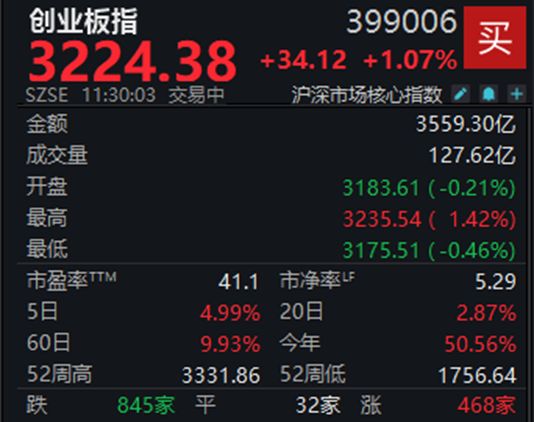
三大股指略有分化,创业板指半日涨1.07%
Mei Ri Jing Ji Xin Wen· 2025-12-09 04:25
Market Overview - The A-share market showed divergence on December 9, with the Shanghai Composite Index down 0.13% to 3918.83 points, while the Shenzhen Component Index rose 0.09% and the ChiNext Index increased by 1.07% [1] - The total trading volume in the A-share market reached 1.26 trillion yuan [1] Industry Developments - Nvidia is expected to re-enter the Chinese market, as the U.S. government announced it would allow Nvidia to sell its H200 AI chips to China, imposing a 25% fee per chip. This arrangement will also apply to other AI chip companies like AMD and Intel [3] - The Fujian Province's action plan for the electric ship industry (2026-2028) supports the construction and operation of electric sightseeing boats and ferries, particularly in the Xiamen-Kinmen route [3] - The Xiamen municipal measures to promote the integrated circuit industry include subsidies for companies involved in core equipment and key materials for semiconductor manufacturing [3] Sector Performance - The CPO concept stocks saw a resurgence, with companies like Shaanxi Huada and Dekeli leading the gains, while Fujian local stocks such as Anji Food and Longzhou Co. also experienced significant short-term increases [4] - The telecommunications sector led the market with an average increase of 3.82%, while coal and non-ferrous metals sectors saw declines of 1.87% and 1.72%, respectively [5] Company Insights - China Shipbuilding is recognized as the largest and most comprehensive listed shipbuilding giant globally, positioning it well to capitalize on the upturn in the global shipbuilding industry [8] - China Power's low-speed machinery products are essential for ocean-going vessels and are expected to benefit from the improving shipbuilding industry [8] - China Marine Defense, a leader in underwater defense equipment, is anticipated to expand its business in the context of rising demand for unmanned technologies [9] - China Shipbuilding Defense's products related to marine engineering platforms and wind power installation vessels are expected to benefit significantly from the national "deep-sea economy" strategy [9]



CPO杀疯了!半小时500亿元!重磅利好彻底引爆!
Zheng Quan Shi Bao Wang· 2025-12-09 03:43
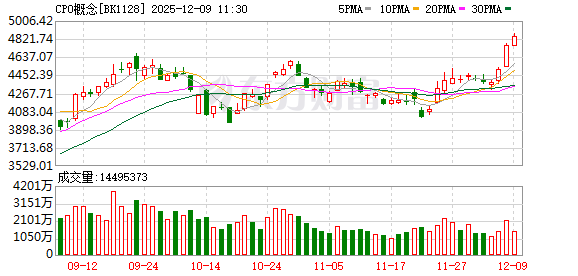
来自国盛证券的最新点评指出,所有科技进展仍然指向算力,Gemini3.0PRO跃迁式进展、 DeepSeekV3.2进展迅速但指出不管预训练、后训练有更多算力会更进步,字节手机展现出超级自定义 Agent场景,可能其他巨头不会再沉得住气。上述事件,对国内资本支出是好事,全行业支出有望进一 步提升,服务器链、AIDC链、算力服务链是明确利好。 对模型进步与应用形成亦是积极因子,DeepSeek证明国内厂商各类创新实际非常多,在有限算力情况 下仍然颇有亮点,更多的算力有可能带来更多的惊喜。另外,自主国产仍然是大浪潮,实际上H200也 是在RUBIN、BLACKWELL后2代,且国产顶尖厂商进步迅速,相信会快速逼近H200。且自主国产是保 证持续供应链稳定的基础,这也是产业、政策方的重点考虑因素,供参考。 外围的扰动 CPO再度杀疯! 继昨日(12月8日)疯狂抢筹之后,今日(12月9日)早盘,算力板块再度大爆发,CPO概念头半个小时 成交近500亿元,中际旭创、新易盛、胜宏科技等大幅拉升,并带领创业板指走强。 消息面上,据环球网援引路透社、彭博社等媒体报道,美国总统特朗普当地时间12月8日在社交媒体上 发文宣布,美 ...
国产AI芯片超节点、产业链以及行业格局演变
2025-12-08 00:41
Summary of Conference Call on Domestic AI Chip Industry Industry Overview - The domestic AI chip industry is rapidly evolving as internet companies in China shift towards domestic AI chips to counter restrictions on high-end products from NVIDIA. Major players like ByteDance, Tencent, and Alibaba are increasing their procurement of products from companies such as Cambricon, Suiyuan, and their own TPUs and Pingtouge products to meet large-scale training needs and localization requirements [1][5]. Key Points and Arguments - **Performance Comparison**: Domestic AI chips are gradually approaching NVIDIA's high-end products, specifically targeting the A100/A800 series. The next generation is expected to achieve 60%-80% of the performance level of the H200 series, with inference capabilities already comparable to the H20 series [1][3]. - **Supply Chain Challenges**: The domestic AI chip industry faces a bottleneck in 7nm process capacity, necessitating multi-chip interconnects to enhance performance. Power management improvements are required, with air-cooled modules needing to reach 800-1,000 watts and liquid-cooled modules 1,200-1,500 watts [1][4]. - **Diverse Solutions**: Different companies have varying approaches to supernode solutions. For instance, Kunlunxin uses Ethernet switches, while Cambricon employs ByteDance's proprietary protocol. Other companies like Muxi and Tianshu rely on established solutions like P3E [1][9]. - **Market Demand**: The demand for domestic AI chips is increasing as companies like ByteDance plan to scale their operations significantly, with expectations of reaching 200,000 cards by 2025 and doubling to 500,000 by 2026. The overall market shipment is projected to be between 500,000 to 800,000 cards [2][5]. - **Ecosystem Development**: The general GPU route has advantages due to CUDA compatibility, while proprietary routes face ecological bottlenecks. Continuous updates are necessary to keep pace with the latest versions [4][6]. Additional Important Insights - **Government Initiatives**: The construction of government intelligence computing centers has slowed down, leading chip manufacturers to focus more on industry applications and internet demands. Key regions include Shanghai, Hefei, Hangzhou, Shenzhen, and Beijing [10][11]. - **International Operations**: Some domestic internet giants have established computing centers overseas to utilize advanced chips for model training, subsequently bringing the trained models back to China for fine-tuning and inference [16][17]. - **Competitive Landscape**: Companies like Huawei, Cambricon, and Haiguang are competing in the chip market, with Huawei's 910C currently holding an advantage over others like Haiguang's BW1,000 [19]. - **Future Trends**: The demand for domestic GPUs is expected to rise, particularly in sectors like finance and energy, as restrictions on imported products increase [7][8]. This summary encapsulates the key discussions and insights from the conference call regarding the domestic AI chip industry, highlighting the competitive landscape, performance benchmarks, and evolving market dynamics.