
农牧业

Search documents
聚焦乡村振兴!嫩江亮相第六届乡村振兴发展大会
Yang Shi Wang· 2025-09-13 13:10
Group 1 - The sixth Rural Revitalization Development Conference was held in Beijing, focusing on "Technology Empowering Agricultural Modernization and Industry Leading Rural Revitalization" [2] - Nenjiang City has a cultivated land area of 9.88 million acres and maintains an annual grain output of over 3.5 billion pounds, receiving multiple honors such as "National Agricultural Green Development Pilot Zone" and "National Seed Production County" [2] - Nenjiang City has implemented various preferential policies in land security and financial services, ranking high in total funding within Heilongjiang Province, which supports agricultural production [2] Group 2 - Nenjiang City prioritizes rural revitalization as a strategic task, achieving significant results in food security, cultivation of specialty industries, and improvement of rural living environments [3] - The Nenjiang delegation actively engaged in understanding rural revitalization policies and the role of technology in modernizing agriculture during the conference [3] - The city aims to leverage the conference to focus on industrial revitalization, enhance advantageous agricultural industries, and promote the integration of primary, secondary, and tertiary industries for comprehensive rural revitalization [3]


黑土地上绘“丰”景 莫力达瓦乡村振兴注入“新动力”
Zhong Guo Xin Wen Wang· 2025-09-12 08:45
Core Viewpoint - The establishment of the National Modern Agricultural Industrial Park in Moqi is a significant driver for rural revitalization, focusing on soybean as the leading industry and promoting high-quality, integrated agricultural development in the region [1][2]. Group 1: Industrial Development - The Moqi National Modern Agricultural Industrial Park is designed with a comprehensive industrial system that includes soybean seed research and development, standardized large-scale planting, soybean processing, storage logistics, and leisure tourism [1]. - The park aims for high-quality and cluster development of the soybean industry, leveraging brand creation and digitalization to drive regional integrated development [1]. Group 2: Farmer Income and Participation - Since its establishment, the industrial park has seen 22 enterprises involved in leading industry production, including 4 regional agricultural industrialization leading enterprises, and has 793 farmer cooperatives and 2,070 family farms [2]. - The park has achieved a 97% coverage rate of quality seeds and has established a technical promotion system, training 5,000 professional farmers annually [2]. Group 3: Sustainable Practices - The industrial park promotes green circular production, implementing black soil protection on 210,000 acres and conducting actions for reducing chemical fertilizer and pesticide usage [2]. - The comprehensive utilization rate of crop straw and livestock manure exceeds 85%, showcasing the park's commitment to sustainable agricultural practices [2]. Group 4: Technological Innovation - The park has established a 400-acre soybean seed technology innovation demonstration base, completing the selection and screening of 84 new soybean varieties and conducting various technical services and trials [3]. - An e-commerce platform has been launched, with a dedicated 1,000 square meter live streaming hall, generating 5 million yuan in sales through live streaming [3]. Group 5: Future Plans - The park plans to continue optimizing its functional layout and improving resource utilization efficiency, aiming to build a high-efficiency, environmentally friendly, and sustainable modern agricultural industrial park by the end of the planning period [3].

“先挂牌,后升级”:聪明企业的高性价比赴美上市策略
Sou Hu Cai Jing· 2025-09-12 02:03
Core Viewpoint - The article discusses a strategic approach for companies considering listing in the U.S. capital markets, emphasizing a "step-up" listing strategy that begins with the OTC market, allowing for a more cost-effective and efficient path to higher capital market stages [2]. Group 1: Listing Strategy - The "step-up" listing strategy is not merely a shell acquisition but a strategic entry into the OTC market, facilitating gradual advancement to higher capital market platforms [2]. - Companies can significantly reduce compliance risks and historical disputes by utilizing clean and compliant shell companies, which have no litigation or debt [5]. - The flexible equity structure of preferred and common stocks meets the needs for large-scale financing and provides tools for future capital operations such as mergers and refinancing [6]. Group 2: Cost and Services - The cost of acquiring a shell company is under $300,000, allowing businesses to inject assets without operational concerns, thus streamlining the integration process [7]. - Huayi Capital offers comprehensive services, including shell selection, acquisition of controlling interests, information changes, stock trading, asset injection, OTC level upgrades, and subsequent market value management [7]. Group 3: OTC Market Transition - Huayi Capital provides tailored services for companies planning to transition from OTC to higher market levels, assisting with compliance, financial metrics, and SEC communications [8][12]. - A recent case involved a successful upgrade of an agricultural company from the OTC expert market to the PINK market and then to the OTC ID market, enhancing its compliance and capital foundation for future NASDAQ listing [9]. Group 4: Market Examples - Acorn International Energy Company successfully transitioned from the OTC market to NASDAQ, raising approximately $7.8 million at a 35% valuation increase compared to its OTC period [13]. - The article highlights the advantages of OTC transitions, such as lower thresholds, stable valuations, and flexible timing for companies not yet meeting traditional IPO requirements [12]. Group 5: Company Support - Huayi Capital aims to provide rapid and seamless support for companies seeking to optimize their valuations for significant capital decisions, leveraging its extensive industry experience [14]. - The SHELL WORLD platform by Huayi Capital focuses on offering high-quality shell resources and comprehensive services to facilitate efficient connections with international capital markets [14].
把资源优势转化为发展优势(记者手记)
Ren Min Ri Bao· 2025-09-07 22:10
Economic Growth and Development - The GDP of Tibet has increased from 327 million yuan in 1965 to 276.5 billion yuan in 2024, representing a growth of 155 times with an average annual growth rate of 8.9% [1] - Central government transfer payments to Tibet have exceeded 1 trillion yuan over 60 years, providing solid support for modernization [1] Financial Sector Evolution - The financial sector in Tibet has evolved from basic banking services to sophisticated financial institutions, with total deposits and loans exceeding 600 billion yuan [1] - Since 2011, banks have provided over 130 billion yuan in preferential interest rates for loans to Tibetan enterprises, benefiting 235,000 business entities [1] Policy Initiatives and Support - The China Securities Regulatory Commission has implemented favorable policies for IPOs of Tibetan enterprises since 2016, facilitating immediate review and approval [2] - The "Galsang Flower Action" initiated in 2023 aims to promote the growth of Tibetan enterprises by attracting talent, technology, and capital [2] Resource Utilization and Industry Development - Tibet's unique ecological, clean energy, mineral, and cultural tourism resources are becoming attractive for investment, necessitating further financial and fiscal policy support [2] - There is a need to enhance product service innovation and diversify financing models to better utilize natural resources for economic development [2] Infrastructure and Livelihood Improvement - Major projects like the Yaluzangbu River hydropower project and the Sichuan-Tibet Railway present historical opportunities for economic growth and improved livelihoods [3] - Continuous financial support and effective use of policies are essential for sustaining development momentum and ensuring that all ethnic groups benefit from modernization [3]
2025年上半年蒙古国国内生产总值同比增长5.6%
Shang Wu Bu Wang Zhan· 2025-09-04 05:24
Economic Overview - Mongolia's GDP reached 40.3 trillion tugrik (approximately 11.216 billion USD) in the first half of 2025, reflecting an increase of 3.3 trillion tugrik (approximately 918 million USD) and a growth rate of 5.6% year-on-year [1] Sector Performance - The service sector generated a value of 17.4 trillion tugrik (approximately 4.843 billion USD), with a year-on-year increase of 1.89 trillion tugrik (approximately 526 million USD), marking a growth of 12.2% [1] - The mining sector's output was 10.3 trillion tugrik (approximately 2.867 billion USD), experiencing a decline of 849.9 billion tugrik (approximately 237 million USD), which represents a decrease of 7.6% [1] - The agricultural and livestock sector produced 4.87 trillion tugrik (approximately 1.355 billion USD), showing a significant increase of 1.47 trillion tugrik (approximately 409 million USD), resulting in a growth of 43.5% [1] - The industrial and construction sector achieved a value of 3.69 trillion tugrik (approximately 1.027 billion USD), with a year-on-year increase of 544.9 billion tugrik (approximately 152 million USD), reflecting a growth of 17.4% [1]
西藏山南:发展动能加速转换
Zhong Guo Jing Ji Wang· 2025-09-02 03:55
Core Viewpoint - The news highlights the significant progress made by Shannan City in Tibet over the past 60 years, focusing on high-quality development through the expansion of characteristic industries, energy production, and tourism [1][2]. Group 1: Economic Development - Shannan City has seen rapid growth in its agricultural and pastoral industries, with a steady increase in grain production and notable achievements in building highland characteristic agricultural brands [1]. - The industrial system is centered around clean energy, which now accounts for one-third of Tibet's total installed capacity [1]. - The service industry, particularly tourism, is emerging as a crucial driver of economic growth [1]. Group 2: Clean Energy Sector - The total installed power capacity in Shannan has increased from 2.19 million kilowatts in 2020 to 5.92 million kilowatts, representing a growth of approximately 171% [2]. - Fixed asset investment in the energy sector has surged from 1.05 billion yuan in 2020 to 3.62 billion yuan by 2024, exceeding a 200% increase [2]. - Shannan has established itself as a leader in clean energy development, with significant projects such as the first county-wide rooftop distributed photovoltaic demonstration project in Tibet and the first ultra-high-altitude wind power project connected to the local grid [1][2]. Group 3: Project Management and Implementation - The Development and Reform Commission of Shannan has implemented a project-focused approach, launching 501 key annual projects and employing strict monitoring mechanisms to ensure timely progress [2]. - The emphasis on project construction is seen as a vital strategy for stabilizing investment and providing strong support for economic development [2].
通辽市“人才创新创业周”十九项活动纳贤聚智
Nei Meng Gu Ri Bao· 2025-09-01 03:05
Group 1 - The core theme of the event is "Attracting Talents and Promoting Innovation for High-Quality Development" with a focus on building a talent and industry connection platform through 19 key activities [1] - The event includes three main sections: high-level talent exchange, expert services for grassroots, and talent recruitment and promotion [1] - Key activities such as the 6th China Aluminum Industry High-Quality Development Forum and "Gemini Talent Exchange" aim to attract high-level innovative teams and enhance the integration of talent and industry chains [1] Group 2 - The "Doctor Industry Service Team" provides technical consultations and joint problem-solving for enterprises, contributing to rural revitalization and modernization of agriculture and animal husbandry [1] - Various recruitment events, including a summer practice program for students from prestigious universities, are designed to create efficient connections between enterprises and talents [1] - To foster a talent-friendly environment, Tongliao City has implemented supportive measures such as free public transport and scenic area visits, along with one-stop living guarantees like talent apartments and convenient medical services [2]

智库要览丨区域经济高质量发展呈现新态势
Sou Hu Cai Jing· 2025-08-26 08:14
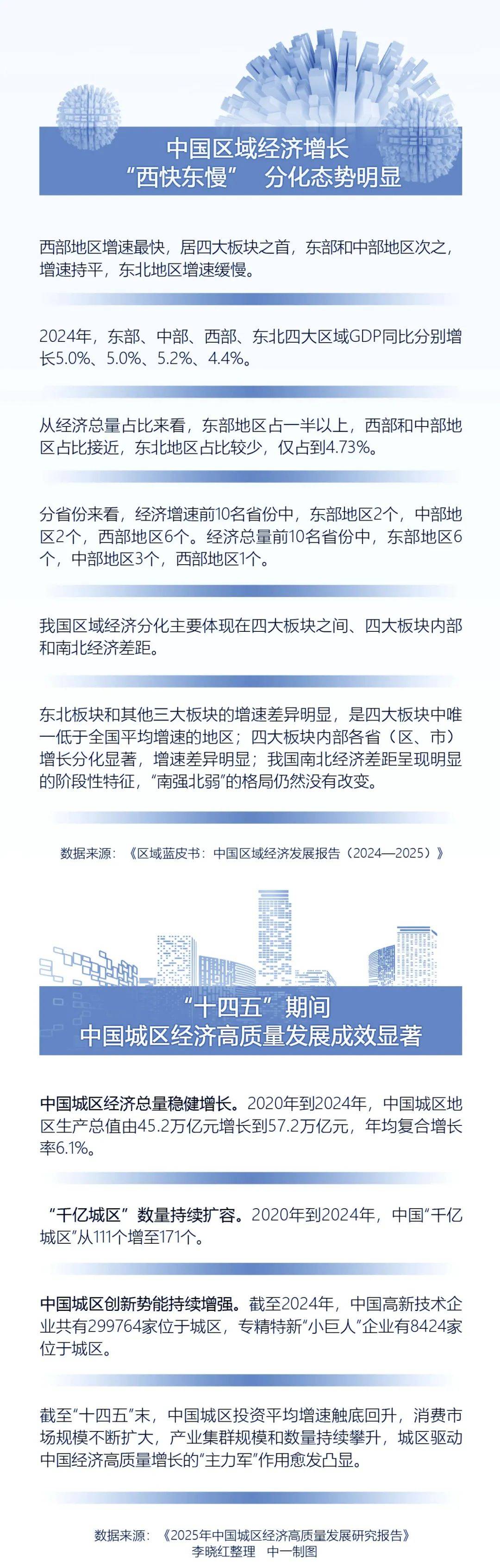
Core Viewpoint - The article emphasizes the significant progress in regional economic development in China, highlighting the coordinated and balanced growth across various regions, which is essential for achieving high-quality economic development and modernization [1][19]. Group 1: High-Quality Development in Regions - The high-quality development of regional economies is a necessary requirement for achieving Chinese-style modernization [2][27]. - The Chengdu-Chongqing economic circle is identified as a dual-core engine for development, with Chengdu and Chongqing as the main urban centers showing strong performance in innovation and ecological sustainability [3][4]. - The evaluation of 17 national urban agglomerations categorizes them into four levels: benchmark, leading, developing, and growing, based on innovation, coordination, green development, openness, and sharing [5][6]. Group 2: Economic Growth and Trends - From 2020 to 2024, China's urban GDP is projected to grow from 45.2 trillion yuan to 57.2 trillion yuan, with an average annual growth rate of 6.1% [8][15]. - The number of "billion-yuan cities" increased from 11 to 171 during the same period, indicating a robust urban economic expansion [16][32]. - Urban areas are becoming the main drivers of China's economic growth, with a focus on innovation and high-tech industries [8][32]. Group 3: Strategic Recommendations - The report suggests enhancing regional cooperation mechanisms, focusing on technological innovation, and building a high-end, green, and intelligent industrial system [4][21]. - It emphasizes the need for a coordinated development strategy that integrates urban and rural areas, promoting a new pattern of urban-rural integration [20][21]. - The report outlines five key paths for high-quality urban economic development during the 14th Five-Year Plan, including deep integration of technology and industry, advanced manufacturing, and green transformation [10][38]. Group 4: Regional Disparities and Challenges - There are notable disparities in economic growth rates among different regions, with the western region showing the fastest growth, while the northeast lags behind [12][30]. - The report highlights the ongoing challenges of unbalanced regional development and the need for effective resource allocation and market mechanisms [25][37]. - The article points out that the southern regions continue to outperform the northern regions, maintaining a "strong south, weak north" economic pattern [12][30].
今年以来鄂尔多斯市新增3个对蒙投资项目
Nei Meng Gu Ri Bao· 2025-08-24 12:29
Group 1 - In 2023, Ordos City has added 3 new investment projects in Mongolia with a total investment of 469 million yuan, bringing the cumulative number of projects to 36 and total investment to 3.72 billion yuan [1] - Ordos City has established a stable investment and trade cooperation relationship with Mongolia in the energy sector, leveraging their respective resource advantages for mutual benefit [1] - In agriculture and animal husbandry, Ordos City has combined its advanced breeding technology and modern farming practices with Mongolia's vast grassland resources, enhancing agricultural production levels in Mongolia and supporting the extension of Ordos' agricultural product supply chain [1] Group 2 - Ordos City is a significant energy city with over 50 types of mineral resources, holding one-sixth of the country's coal and one-third of its natural gas reserves, making it a crucial energy and strategic resource base [2] - In 2024, Ordos is projected to produce nearly 900 million tons of coal and 31 billion cubic meters of natural gas, accounting for one-fifth and one-third of the national totals, respectively [2] - Ordos City is also an important agricultural and livestock product production base, with 76 million acres of quality grassland and five leading industries, including grain, cashmere, beef cattle, sheep, and dairy, contributing to its status as the largest cashmere production area in China [2]

内蒙古累计建成6000多万亩高标准农田
Xin Hua She· 2025-08-21 14:41
Core Viewpoint - Inner Mongolia has significantly improved agricultural production conditions by establishing over 60 million acres of high-standard farmland, aiming to enhance grain production and farmers' income [1] Group 1: Agricultural Development - Inner Mongolia has built a total of 60.83 million acres of high-standard farmland, transforming unsuitable land into productive farmland [1] - The region is focusing on the construction of high-standard farmland and improving black and saline-alkali land, with a goal to convert all permanent basic farmland into high-standard farmland by 2032 [1] Group 2: Grain Production Enhancement - Inner Mongolia is implementing a large-scale grain yield improvement initiative, creating 49 demonstration counties to increase grain production [1] - The establishment of a 10 million-acre yield improvement demonstration area aims to expand the "ton grain field" area to approximately 10 million acres [1] Group 3: Infrastructure and Resource Management - The region emphasizes high-efficiency water-saving practices in high-standard farmland construction, ensuring the integration of eight essential components: land, soil, water, roads, forests, electricity, technology, and management [1]