酒店

Search documents
A股收评:三大指数分化,沪指跌0.06%创指涨超1%北证50跌0.37%,机器人、卫星互联网板块走高!超3800股下跌,成交1.56万亿缩量1219亿
Sou Hu Cai Jing· 2025-12-04 07:17
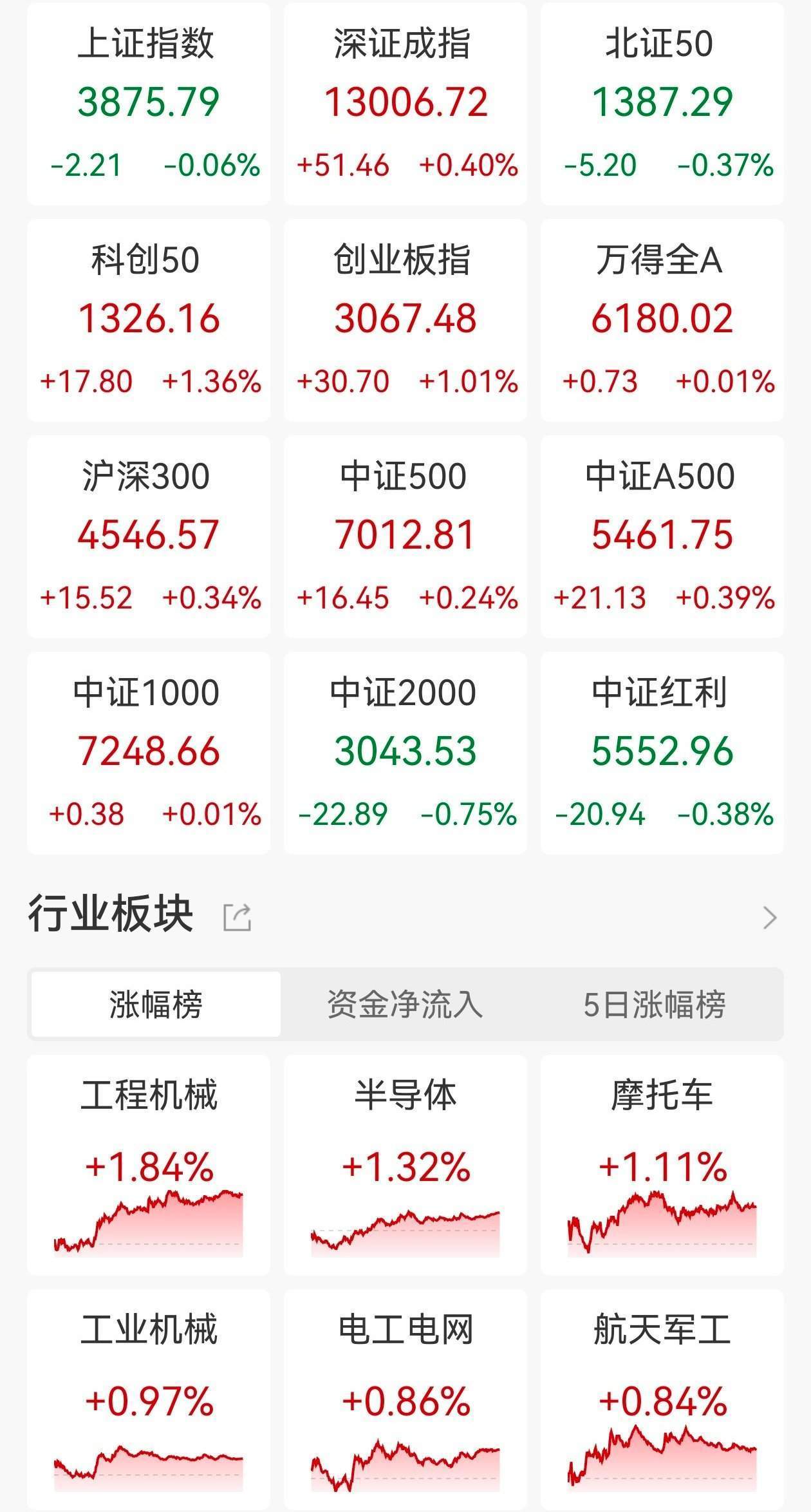
Market Overview - The A-share market showed mixed performance with the Shanghai Composite Index down by 0.06% closing at 3875 points, while the Shenzhen Component Index increased by 0.4% and the ChiNext Index rose by 1.01% [1] - The total market turnover was 1.56 trillion yuan, a decrease of 121.9 billion yuan compared to the previous trading day, with over 3800 stocks declining [1] Index Performance - Shanghai Composite Index: 3875.79, down by 2.21 points or 0.06% [2] - Shenzhen Component Index: 13006.72, up by 51.46 points or 0.40% [2] - ChiNext Index: 3067.48, up by 30.70 points or 1.01% [2] - Other indices such as the STAR Market 20 and the CSI 300 also showed positive movements [2] Sector Performance - The robotics sector surged following the Trump administration's focus on the field, with multiple stocks hitting the daily limit [4] - The satellite sector also saw gains, with several stocks reaching the daily limit [4] - The aerospace sector experienced a rise, highlighted by Aerospace Huanyu hitting the daily limit [4] - Conversely, the shipbuilding sector fell sharply, declining over 11%, while the Hainan sector and dairy stocks also faced significant losses [4]


研报掘金丨华西证券:维持君亭酒店“买入”评级,资产注入可能与资源支持预期打开想象空间
Ge Long Hui A P P· 2025-12-04 06:40
Core Viewpoint - The controlling shareholder of Junting Hotel will change to a leading state-owned cultural tourism group, which may open up potential for asset injection and resource support, accelerating franchise expansion and international brand collaboration [1] Group 1: Shareholder Change and Implications - The new controlling shareholder, Hubei Cultural Tourism, possesses multiple high-quality hotel assets, scenic spots, and ongoing cultural tourism park projects, indicating a possibility of asset injection into Junting Hotel [1] - The new shareholder is expected to provide comprehensive support for Junting Hotel's front and back-end operations and capital operations, leading to an overall enhancement in capabilities while maintaining the existing management team [1] Group 2: Business Expansion and Strategic Partnerships - Junting Hotel has joined the "Bafang Alliance Digital Symbiosis Platform," establishing strategic cooperation with several leading regional hotel groups and Hangzhou Luyun Software Co., Ltd., promoting member sharing and reducing reliance on a single traffic channel [1] - The first phase of the alliance has already covered over 50 million members, indicating significant growth potential in customer engagement and market reach [1] Group 3: Financial Outlook - Despite the uncertainties regarding asset injection direction and the previously established expectations for hotel management business advancement, the company maintains its profit forecast unchanged and retains a "buy" rating [1]

美国马里兰州一酒店发生枪击致1人死亡
Zhong Guo Xin Wen Wang· 2025-12-04 05:28
纳德尔表示,枪击案造成一人死亡,未有其他伤者。嫌犯在作案后开车逃离现场,警方目前正在寻找嫌 犯。 当地警方表示,该酒店内有众多摄像头,将有助于警方找到嫌犯。据警方判断,嫌犯为20多岁的男性。 目前,米高梅酒店的美食广场已被关闭,该酒店其他区域仍正常开放。酒店周边多个学校处于封锁状 态。 国家港湾位于波托马克河畔,是华盛顿附近著名的休闲度假区,有众多酒店、餐厅、商店等。(完) 美国马里兰州一酒店发生枪击致1人死亡 中新社华盛顿12月3日电 (记者 沙晗汀)美国马里兰州乔治王子县国家港湾(National Harbor)一酒店当地时 间3日发生枪击案,造成1人死亡。 据美媒报道,枪击案发生在美国首都华盛顿郊区的马里兰州国家港湾米高梅国际度假酒店。该酒店距离 白宫约10英里(约16公里)。 乔治王子县警方负责人纳德尔(George Nader)在当天的新闻发布会上说,枪击案发生在当天午时左右, 嫌犯似乎有特定目标。嫌犯当天进入酒店美食广场找到受害人后向其射击,受害人当时正在点餐。嫌犯 在开枪前未与受害人交谈。 编辑:张澍楠 广告等商务合作,请点击这里 本文为转载内容,授权事宜请联系原著作权人 中新经纬版权所有,未经 ...
创业板公司融资余额减少11.16亿元,13股遭减仓超10%
Zheng Quan Shi Bao Wang· 2025-12-04 03:44
资金流向方面,融资余额环比增幅居前个股中,12月3日主力资金净流入的有12只,净流入资金居前的 有上海瀚讯、达嘉维康、华兰疫苗等,净流入资金分别为3.91亿元、4195.85万元、3597.35万元,主力 资金净流出的有7只,净流出资金较多的有爱克股份、清水源、华人健康等,净流出资金分别为7509.11 万元、3215.20万元、3081.93万元。 融资余额增幅居前个股 | 代码 | 简称 | 最新融资余额(万 | 融资余额环比增减 | 收盘价 | 当日涨跌幅 | 所属行 | | --- | --- | --- | --- | --- | --- | --- | | | | 元) | (%) | (元) | (%) | 业 | | 301073 | 君亭酒 | 18778.75 | 42.23 | 27.45 | -2.31 | 社会服 | | | 店 | | | | | 务 | | 301148 | 嘉戎技 | 15189.09 | 30.93 | 51.20 | 7.63 | 环保 | | | 术 | | | | | | | 300762 | 上海瀚 | 159332.28 | 21.68 | 30.5 ...

迈点研究院:三季度51家文旅上市企业净利润合计约226亿元 33家盈利、18家亏损
Cai Jing Wang· 2025-12-04 03:07
Core Insights - The total revenue of 51 listed cultural tourism companies reached 83.993 billion yuan in Q3 2025, highlighting significant leadership from top companies and notable internal differentiation [1] Revenue Breakdown - Two companies exceeded 10 billion yuan in quarterly revenue: Trip.com Group-S (18.3 billion yuan) and China Duty Free Group (11.711 billion yuan), showcasing a strong leading advantage [1] - Four companies reported revenues between 5 billion and 10 billion yuan: Yuyuan Inc. (9.287 billion yuan), Huazhu Group-S (7 billion yuan), Overseas Chinese Town A (5.708 billion yuan), and Tongcheng Travel (5.509 billion yuan) [2] - Six companies fell within the 2 billion to 5 billion yuan range, including Jin Jiang Hotels (3.715 billion yuan) and China Youth Travel Service (3.161 billion yuan), with hotel companies making up half of this group [2] - The majority of companies (31 out of 51) reported revenues below 1 billion yuan, indicating a concentration of smaller firms in the industry [2] Profitability Analysis - The net profit of the 51 listed cultural tourism companies totaled approximately 22.6 billion yuan, with 33 companies profitable and 18 companies reporting losses, indicating a predominance of profitability (about 65%) [2] - Trip.com Group-S reported a net profit of 19.9 billion yuan, significantly contributing to the overall profit of the listed companies, accounting for 88% of the total [3] - Other notable profitable companies include Huazhu Group-S with a net profit of 1.5 billion yuan and Tongcheng Travel with a net profit of 976 million yuan, benefiting from the ongoing recovery in tourism consumption [3] - Among the 18 companies reporting losses, significant losses were noted for Overseas Chinese Town A (-1.499 billion yuan) and Yuyuan Inc. (-551 million yuan), attributed to factors such as weak real estate sales and operational challenges [3]
酒店行业会议交流
2025-12-04 02:21
Summary of Hotel Industry Conference Call Industry Overview - The hotel industry is experiencing a price-volume strategy in 2024, leading to a RevPAR increase of approximately 2%, while ADR decreased by 1.5% and OCC improved by nearly 2.8% [1][2] - The RevPAR data for November showed fluctuations, with the first week benefiting from events leading to a 4.1% increase, followed by a decline of 1.5% at the end of the month [1][3] Key Insights - Leisure travel, off-peak tourism, and wellness groups are positively impacting the hotel sector, with cities rich in tourism resources attracting visitors through events [1][6] - The partnership between Junting Hotel and Hubei Cultural Tourism is seen as a model to mitigate market risks, similar to the Shou Travel model, but the actual improvement in ADR and OCC needs monitoring [1][6] - Mid-range chain hotels are facing market pressure due to increased chain rates, with limited project expansion potentially leading to a "broken window" effect [1][7] - High-end brands benefit from stronger consumer spending, while mid-to-high-end brands rely on business travelers and event traffic, showing varied recovery speeds [1][9] Company-Specific Performance - Atour's high-end brand is recovering well, particularly the Sahe series and Atour 4.0/3.6 products, although the number of stores is limited [1][10] - Mid-to-low-end products like All Seasons and Orange Crystal show stable performance with strong ADR and OCC [1][10] - The hotel market in North and East China is recovering significantly, with both business and leisure markets rebounding [1][11] Future Projections - Atour plans to add 450-500 new projects in 2025, extending into third and fourth-tier cities, with 152 new stores opened and 90 projects signed in Q3 [1][4][12] - The membership growth rate is outpacing store growth, with a significant increase in members compared to the number of stores [1][14] - The self-owned channel accounts for approximately 62% of Atour's bookings, with seasonal variations in OTA channel share [1][16] Challenges and Strategies - The light stay brand aims to replicate the All Seasons model but faces challenges in market competitiveness and investment returns [1][17][18] - The overall ADR and occupancy rates are expected to decline as Atour expands into more third and fourth-tier cities, indicating a natural adjustment rather than a deliberate price-cutting strategy [1][13] Additional Notes - The integration of retail customer management is a key strategy for Atour, although detailed updates on retail business progress are pending [1][19]

瑞银展望2026:经济互联互通:中国与泰国
瑞银· 2025-12-04 02:21
Investment Rating - The report does not explicitly provide an investment rating for the industry Core Insights - China is Thailand's third-largest source of foreign direct investment, with approximately $3 billion invested in the first half of 2025, primarily driven by Chinese automotive manufacturers in the electric vehicle sector [1][3] - Over 70% of respondents in a UBS survey indicated increased availability of Chinese products, with 60%-70% purchasing them more frequently, particularly in consumer electronics and retail, due to value for money, promotions, and quality [1][4] - Thailand's tourism industry faces challenges from safety concerns of Chinese tourists and changing travel preferences, leading to a shift towards attracting higher-value tourists and promoting cultural soft power [1][6] - The hotel industry in Thailand is expected to see a decline in RevPAR in 2026, with high-end hotels facing pricing pressure, although government strategies for high-end positioning could benefit the industry in the long term [1][7] - China's dominance in global chemical and petrochemical production significantly impacts Thailand's chemical market, with potential benefits for Thai companies if China reduces overcapacity [1][8] Summary by Sections Economic Connectivity - China has become Thailand's largest trading partner, with about 25% of Thailand's intermediate goods imports coming from China, particularly in electronics, machinery, and steel [3] - Chinese investments in the electric vehicle supply chain are increasing, prompting significant land sales by Thai industrial park operators [3] Chinese Brand Influence - Chinese brands have gained a competitive edge in the ASEAN market, especially in Thailand, with over 70% of respondents noting increased availability of Chinese products [4][5] - In the retail sector, brands like Miniso and Pop Mart excel in fashion and quality, respectively, meeting consumer demands for value and style [9] Tourism Industry Challenges - Thailand's tourism sector is at a crossroads, with a decline in inbound tourism, particularly from China, due to safety concerns and changing preferences [6][13] - The government aims to reposition Thailand as a high-end tourist destination, focusing on cultural and niche tourism, although significant impacts may not be seen until 2028 [6][14] Hotel Industry Outlook - A decline in RevPAR is anticipated for 2026, with domestic tourism providing some support, but high-end hotels may face pricing pressures due to oversupply [7][13] - Successful government strategies for high-end positioning could create long-term benefits for the industry [7] Chemical Market Dynamics - China's policies on reducing overcapacity in the chemical sector could lead to a more balanced global supply-demand environment, benefiting Thai companies [8][15] - The potential exit of older Chinese chemical plants could improve global operational efficiency and support a cyclical recovery [8] Retail Market Performance - Chinese brands dominate the low-priced segment in Thailand's electronics and home appliances market, with Xiaomi leading in brand recognition [10][11] - Local brands maintain strong positions in dairy, grocery retail, and beverages, reflecting consumer trust in domestic products [12]
2026消费年度策略新消费无惧质疑,逆流而上
2025-12-04 02:21
Summary of Conference Call Records Industry Overview - The new consumption sector shows higher growth elasticity compared to traditional consumption, particularly in high-end gold jewelry and IP retail segments, benefiting from structural track dividends and emerging categories [1][2] - Traditional consumption recovery relies on demand improvement and supply-side optimization, but current data indicates limited supply-side improvements [2] Key Companies and Their Performance Lao Pu Gold - Lao Pu Gold has increased prices three times in 2025, with a cumulative increase exceeding 40%, and expects further price elasticity in 2026 [1][6] - The company has improved user penetration among middle and high-net-worth individuals through local brand positioning and traditional cultural elements [1][4] - Membership growth has been significant, with a 74% increase in loyal members in the first half of the year, reaching 480,000, and expected to reach 600,000 by year-end [8] - The company faces cash flow pressure due to rapid expansion and rising gold prices, necessitating potential capital raising strategies [10] Luckin Coffee - Luckin Coffee has achieved same-store growth by increasing the proportion of private domain customer acquisition and core user repurchase frequency, although high delivery subsidies may negatively impact profit margins [3][15] - The company needs to assess the impact of delivery subsidies on profitability and same-store growth continuity for 2026 [3][15] Pop Mart - Pop Mart's North American market has shown a slowdown in growth but overall performance remains better than expected, aided by product channel adjustments and IP updates [11][12] - The company faces challenges in operational strategy adjustments and needs to optimize channel and product structures to improve market performance [12][14] - Future growth will depend on significant improvement signals from the North American market and the development of new independent product categories [14][13] Atour Hotel - Atour Hotel has integrated retail business operations, with retail accounting for 30%-40% of revenue, and expects revenue to approach 4 billion RMB by the end of 2025 [19][20] - The company focuses on member value experience and has successfully expanded its retail business through loyal user engagement rather than supply chain advantages [19][21] Market Trends and Future Outlook - The 2026 consumption market will focus on category dividends and the secondary utilization and monetization of user value, with growth continuity being crucial [3][22] - New consumption companies should demonstrate strong growth certainty to mitigate market uncertainties, with high-end gold jewelry and IP retail being key growth areas [5][22] - The overall consumer landscape is expected to show resilience, with potential growth rates of 20%-30% in certain sectors, particularly in low-frequency consumption industries [18][22]
多地出实招促冬季文旅消费市场“热气腾腾”
Zheng Quan Ri Bao· 2025-12-03 16:26
Group 1 - Various regions in China are launching consumer promotion initiatives to boost tourism and consumption as the year-end approaches, including a 15 million yuan "Winter Travel Tibet" card in Tibet [1] - Cities like Yinchuan are planning a series of unique consumer activities from December 2025 to March 2026, with over 500,000 yuan allocated for tourism benefits [1] - Northern cities such as Beijing and Harbin are initiating diverse winter consumption activities, leveraging their ice and snow resources to stimulate spending [1] Group 2 - The rise of the ice and snow economy reflects a shift in consumer behavior in China, moving from material consumption to experiential consumption, with health and spiritual needs becoming central [2] - Many cities, including Chongqing and Guangzhou, are starting winter consumption seasons, utilizing "ticket roots" as a key strategy to activate the market [2] - Changchun is innovating with an "ice and snow joint ticket" that integrates various resources, promoting cross-regional collaboration and discounts [3] Group 3 - The "ticket root economy" is seen as a more precise and efficient way to stimulate consumption compared to traditional subsidies, linking tickets to create a multi-industry win-win scenario [3] - The shift from single subsidies to multi-industry integration in winter consumption activities enriches consumer experiences and continuously releases consumption potential [3] - As holidays like New Year's and Spring Festival approach, more integrated and quality-driven consumer offerings are expected to emerge, further heating the winter consumption market [3]
湖北国资5天拿下2家上市公司控股权
Di Yi Cai Jing Zi Xun· 2025-12-03 12:50
Core Insights - The enthusiasm of local state-owned enterprises (SOEs) in acquiring control of listed companies has become a focal point in the capital market, particularly in Hubei province, where the number of companies controlled by the Hubei State-owned Assets Supervision and Administration Commission has reached 15 [2][4] Group 1: Recent Acquisitions - On December 2, 2023, Junting Hotel announced that Hubei Cultural Tourism acquired 29.99% of its shares for a total price of 1.499 billion yuan, changing the controlling shareholder to Hubei Cultural Tourism and the actual controller to the Hubei State-owned Assets Supervision and Administration Commission [2][4] - Just five days prior, the actual controller of Chaozhuo Aerospace also changed to the Hubei State-owned Assets Supervision and Administration Commission, indicating a trend of increasing control by Hubei SOEs [3] Group 2: Strategic Focus and Business Integration - Hubei Cultural Tourism's main business includes cultural tourism, commercial trade, and sports health, with assets exceeding 100 billion yuan and ownership of 44 scenic spots and 46 hotels [4] - Following the acquisition, Hubei Cultural Tourism plans to inject quality lodging assets into Junting Hotel and support its financing activities, aiming to establish it as a benchmark in the hotel industry and cultural tourism integration [4] Group 3: Broader Trends in Hubei SOEs - The acquisition wave by Hubei SOEs began in 2023, with significant control gained over companies like Tianfeng Securities and Shuanghuan Technology through various means [6] - Hubei SOEs are diversifying their investments into traditional sectors like chemicals and energy, as well as emerging industries such as semiconductors and new energy, enhancing their strategic positioning [5][6] Group 4: Future Opportunities and Reforms - The change in actual controllers to the Hubei State-owned Assets Supervision and Administration Commission is expected to provide new development opportunities under the "Three Assets" reform, which focuses on resource assetization, asset securitization, and financial leverage [7] - Companies like Chutian Expressway and Junting Hotel may leverage their assets for financing through real estate investment trusts (REITs) or commercial mortgage-backed securities (CMBS), enhancing their operational efficiency and capital utilization [7]