
建筑业

Search documents
小非农大幅不及预期,美国经济又添危险信号?
美股研究社· 2025-03-06 10:32
Core Viewpoint - The recent ADP employment data indicates a slowdown in private sector job growth, raising concerns among economists and investors about the overall economic environment [2][4]. Employment Data Summary - In February, the ADP reported an increase of 77,000 jobs, significantly below the expected 140,000, with the previous month's figure revised up to 186,000, marking the smallest increase since July 2024 [2]. - Job losses were primarily concentrated in the services sector, particularly in trade, transportation, utilities, education, and healthcare [2]. - Employment changes by sector in February: - Trade/Transportation/Utilities: Decreased by 33,000 jobs, following an increase of 56,000 in January [2]. - Construction: Increased by 26,000 jobs, up from 3,000 in January [2]. - Professional/Business Services: Increased by 27,000 jobs, compared to 14,000 in January [2]. - Manufacturing: Increased by 18,000 jobs, reversing a decrease of 13,000 in January [2]. - Financial Services: Increased by 26,000 jobs, up from 13,000 in January [2]. Economic Outlook - ADP's Chief Economist Nela Richardson noted that uncertainty in policy and a slowdown in consumer spending may have contributed to the recent layoffs and hiring hesitance [4]. - The rising number of unemployment claims and concerns about future unemployment rates are indicative of a cooling labor market [4]. - Market attention is focused on the upcoming government non-farm payroll report, which could further confirm fears of an economic slowdown and influence Federal Reserve monetary policy decisions [4][5]. - Economists expect the non-farm payroll report to show an increase of 153,000 jobs, with the unemployment rate remaining at 4% [5].


中采PMI|制造业景气保持较好状态(2025年2月)
中信证券研究· 2025-03-02 11:02
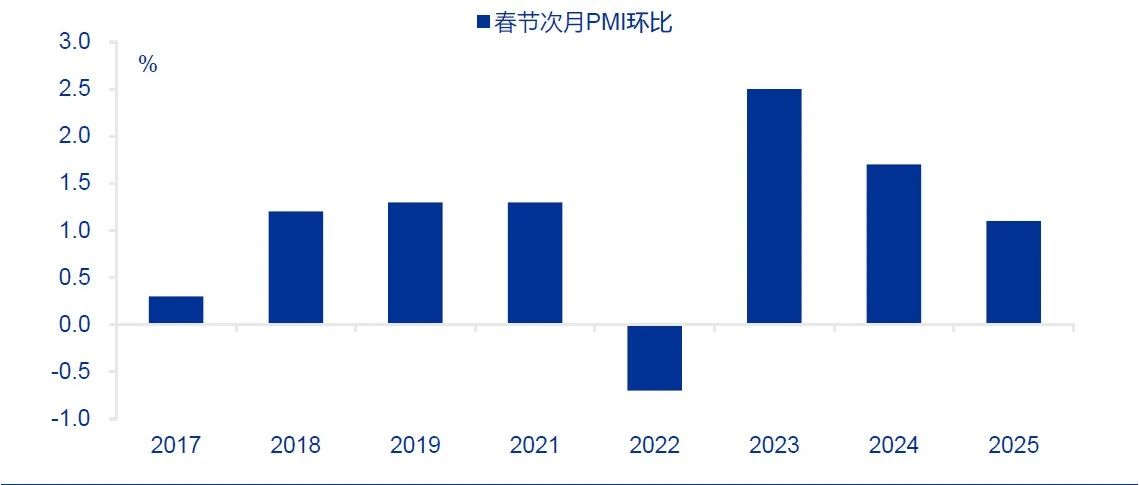
Core Viewpoint - The manufacturing PMI for February returned above the threshold, indicating a relatively good state of manufacturing prosperity, with the average PMI for January and February overall better than in 2024 [1][3] Manufacturing PMI Analysis - The manufacturing PMI for February is 50.2%, an increase of 1.1 percentage points from the previous month, and 0.1 percentage points lower than the average of the past five years [2][3] - The average PMI for January and February is 49.65%, which is higher than the 49.15% in the same period of 2024, reflecting a better recent manufacturing climate [3] Economic Supply and Demand - Both supply and demand sides of the economy are performing well in the short term, with a potential short-term rebound in PPI readings [4] - The production index for February is 52.5%, up 2.7 percentage points from last month, and the average operating rate for six major industrial sectors is 71.0%, which is 2.0 percentage points higher than the same period in 2024 [4] Sector Performance - Among 15 major manufacturing industries, 7 have PMIs above the threshold, with the equipment manufacturing sector performing relatively well, such as electrical machinery at 57.1% and automotive manufacturing at 53.1% [5] - Conversely, some low-value-added industries are underperforming, such as non-metallic mineral products at 43.4% and petroleum processing at 42.6% [5] Non-Manufacturing PMI Insights - The non-manufacturing PMI for February is 50.4%, an increase of 0.2 percentage points from the previous month, driven mainly by seasonal recovery in the construction industry [6] - The service sector PMI decreased to 50.0%, while the construction PMI increased to 52.7%, indicating a seasonal rebound in construction activities post-Spring Festival [6] Future Economic Outlook - The overall economic performance is benefiting from previous consumption-boosting policies, tariff expectations, and the concentrated issuance of special bonds in the fourth quarter [7] - Future attention should be paid to the details of macro policies from the Two Sessions, the effects of consumption promotion on large items, and the impact of tariffs on exports [7]

PMI:无喜无忧、结构分化
赵伟宏观探索· 2025-03-01 12:16
Core Viewpoint - The February PMI shows a mild recovery post-Spring Festival, with a clear "strong-weak" differentiation in structure [2][9]. Manufacturing Sector - The manufacturing PMI rose to 50.2%, up 1.1 percentage points from the previous month, indicating a recovery, albeit moderate [5][16]. - Key sub-indices such as production and new orders showed significant recovery, with production index increasing by 2.7 percentage points to 52.5% and new orders index rising by 1.9 percentage points to 51.1% [5][16]. - The new export orders index remains in contraction at 48.6%, despite a 2.2 percentage point increase [5][17]. Non-Manufacturing Sector - The non-manufacturing PMI increased by 0.2 percentage points to 50.4%, with construction PMI showing a notable rise of 3.4 percentage points to 52.7% [5][18]. - Service sector PMI declined by 0.3 percentage points to 50.0%, with significant drops in consumer-related sectors such as retail, accommodation, and catering [4][19]. Industry Observations - Capital-intensive industries like high-tech and equipment manufacturing show higher PMI levels, while labor-intensive sectors such as consumer goods and high-energy industries remain below the expansion threshold [3][12]. - In the construction sector, the increase in the construction PMI indicates accelerated infrastructure work, while real estate performance appears weaker [3][13]. Future Outlook - The economic recovery foundation remains fragile, with potential export risks increasing. Continuous monitoring of incremental policy changes is necessary [4][15]. - The manufacturing PMI's slight recovery above the neutral line suggests a moderate recovery level, with ongoing export pressures evident [4][15].
浙江交科(002061) - 2024年第四季度建筑业经营情况简报
2025-01-24 16:00
证券代码:002061 证券简称:浙江交科 公告编号:2025-011 浙江交通科技股份有限公司 2024年第四季度建筑业经营情况简报 本公司及董事会全体成员保证信息披露的内容真实、准确、完整,没有虚假 记载、误导性陈述或重大遗漏。 根据《深圳证券交易所股票上市规则》《深圳证券交易所上市公司自律监管 指引第 3 号——行业信息披露》等相关规定,浙江交通科技股份有限公司(以下 简称"公司")现将子公司浙江交工集团股份有限公司(以下简称"浙江交工") 2024 年第四季度建筑业经营情况简报如下: 一、订单情况 1. 项目概况 | 第四季度 | | 第四季度 | | 本年累计新中标 | | 本年累计新中标 | | 截至报告期末历年累 | | | --- | --- | --- | --- | --- | --- | --- | --- | --- | --- | | 新中标且签约项目 | | 新中标未签约项目 | | 且签约项目 | | 未签约项目 | | 计已签约未完工项目 | | | 数量 | 金额 | 数量 | 金额 | 数量 | 金额 | 数量 | 金额 | 数量 | 金额 | | (个) | (亿元) | ...

静待满园花开
半夏投资· 2024-12-05 15:54
感谢新浪财经,给出一个这样的机会,让二级市场投资和研究的同行们可以在年底相聚在一起。在现在这个行业的冬天,我想跟 大家分享一些我最近的思考,研究和心得体会。 最近有一件让我特别开心的事情,就是李子柒的回归。2021年李子柒停更后,基本上资本市场就进入了熊市,她现在一回来,市场碰巧也热了不少,希望 这是冥冥注定的巧合。 我是李子柒的长期粉丝。为什么我喜欢李子柒? 首先因为我跟李子柒一样,也是园艺爱好者,我也自己打理花园。这是我的花园,我认为我的花园也很好看。 我也喜欢做美食,以前我甚至自称 陆家嘴李子柒 我在打理花园的过程中,发现养花跟投资其实非常相似,有很多共通的地方。 第一个共通点是: 颜值最高的花在冬天都特别丑,这就类似于强周期行业,有可能实现暴利的行业,周期底部都特别惨。 花园爱好者都知道有三种颜值特别高的花,被称为花园三宝:月季、绣球和铁线莲。图左边是铁线莲是冬天的样子,很像已经枯死。大部分新手看到那个 状态,会把它扔掉,实际上它并没有死掉,春天它重新恢复生机会变成右图那样的盛世美颜。 月季和绣球也是如此,冬天都特别丑,到了春天就特别美。这与周期性行业很相似,无论是航运钢铁、房地产以及我们自己的证券行 ...