
金融

Search documents
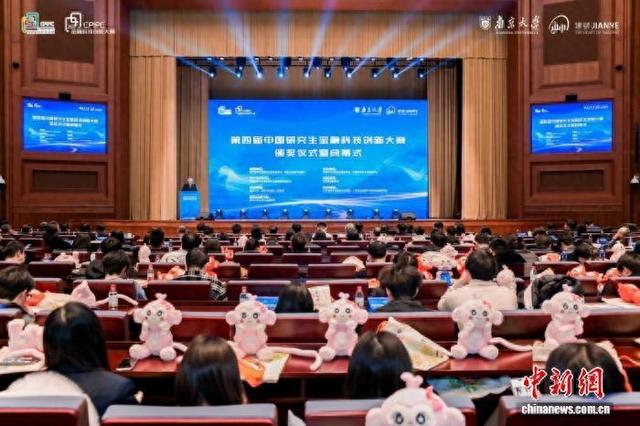
第四届中国研究生金融科技创新大赛在南京收官
Xin Lang Cai Jing· 2025-12-31 06:33
Group 1 - The fourth China Graduate Financial Technology Innovation Competition recently concluded in Nanjing, with 112 teams competing in the national finals, leading to the selection of champions and other awards [1][4] - The competition attracted 1,377 teams and 8,089 participants from 226 universities and research institutions, showcasing its strong brand influence and social recognition [2] - The competition introduced an innovative "problem-solving" main track, where 10 financial institutions presented 15 real business scenario challenges, significantly enhancing student engagement and collaboration across disciplines [3] Group 2 - The event aligns with regional development strategies, with Nanjing's Jianye District serving as a key financial center, providing a broad practical scene for the competition [3] - The competition has evolved into a distinctive brand event in China's graduate innovation practice competitions, serving as a benchmark for financial technology in universities [4] - Tsinghua University's Wudaokou School of Finance will continue to enhance the talent cultivation function of the competition, exploring integrated development paths in education, technology, and talent in the financial sector [5]

香港股市2025收官:恒指全年涨27.77%创八年最佳,科指涨23.45%创新高
Jin Rong Jie· 2025-12-31 05:38
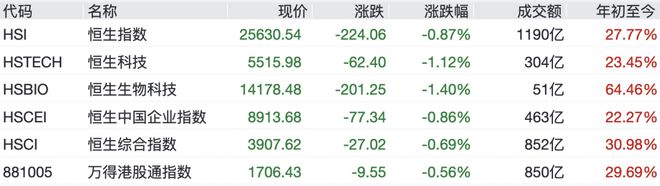
Core Insights - The Hong Kong stock market experienced significant performance in 2025, with the Hang Seng Index rising by 27.77%, marking its best annual performance since 2017 [1] - The Hang Seng Tech Index recorded a 23.45% increase for the year, representing its highest annual growth since its inception in 2020 [1] Market Performance - On the last trading day of the year, the Hang Seng Index fell by 0.87%, while the Hang Seng Tech Index decreased by 1.12% [1] - The sectors that saw the largest declines included healthcare, finance, and consumer industries, whereas the metals sector showed resilience with an upward trend [1]
港股提前收市,恒指全年涨27.77%
Di Yi Cai Jing Zi Xun· 2025-12-31 04:58
Core Viewpoint - The Hong Kong stock market closed early on December 31 due to the New Year holiday, with the Hang Seng Index falling by 0.87% and the Hang Seng Tech Index declining by 1.12%. Despite this, the overall performance for 2025 was strong, with the Hang Seng Index up 27.77%, marking its best performance since 2017, and the Hang Seng Tech Index up 23.45% [1]. Group 1: Market Performance - The Hang Seng Index closed at 25,630.54, down by 224.06 points or 0.87%, with a total trading volume of HKD 119 billion and a year-to-date increase of 27.77% [2]. - The Hang Seng Tech Index ended at 5,515.98, decreasing by 62.40 points or 1.12%, with a trading volume of HKD 30.4 billion and a year-to-date increase of 23.45% [2]. - The Hang Seng Biotech Index saw a decline of 1.40%, closing at 14,178.48, with a year-to-date increase of 64.46% [2]. Group 2: Capital Inflows - Southbound capital net purchases of Hong Kong stocks reached over HKD 1.4 trillion this year, setting a record high [2]. - The total net inflow for the year amounted to HKD 14,013.95 million, with contributions from both the Shanghai and Shenzhen stock connect programs [3].
港股“子”曰 | 2025年收官在即 超300只港股翻倍 你满意吗?
Mei Ri Jing Ji Xin Wen· 2025-12-31 04:40
进入四季度后,几乎天天都有朋友在骂港股,说港股差,个股"垃圾",天天亏钱。但事实真是这样吗? 明天只剩半个交易日,港股市场即将完成2025年的全部行情,是时候对今年的个股表现打个总结了。 截至今天(12月30日)中午收盘,笔者初步做了一个统计,汇报如下:据WIND统计,目前全部港股数量为2688只,从年初到现在,股价实现翻倍的个股数 量多达386只,占个股总数的14.3%。 其中,股价翻了10倍的有13只。今年涨幅最大的是基地竞标集团(HK08460),涨幅超过37倍。另外,涨幅超过30倍的还有粤港湾控股(HK01396),年度 涨幅超过30倍。当然,这些涨幅超过10倍的港股中,有好几只都是香港创业板的公司,比如基地竞标集团、九福来、首都金融控股等。香港创业板公司,基 本上内地投资者都不会参与,所以暂且不提。 单就港股主板公司来说,放眼望去,今年涨幅翻倍公司也是多达333只,占2375只主板公司比例也有14%。其中,还有8只个股涨了超过10倍。当然,港股的 主板公司,也不是所有内地投资者都能买的,对南向资金来说,一般还是只能参与港股通标的。 那么,我们再来看港股通标的。 目前,港股通标的一共565只,423只 ...
港股元旦假期提前收市 恒指全年涨幅27.77%
Zheng Quan Shi Bao Wang· 2025-12-31 04:21
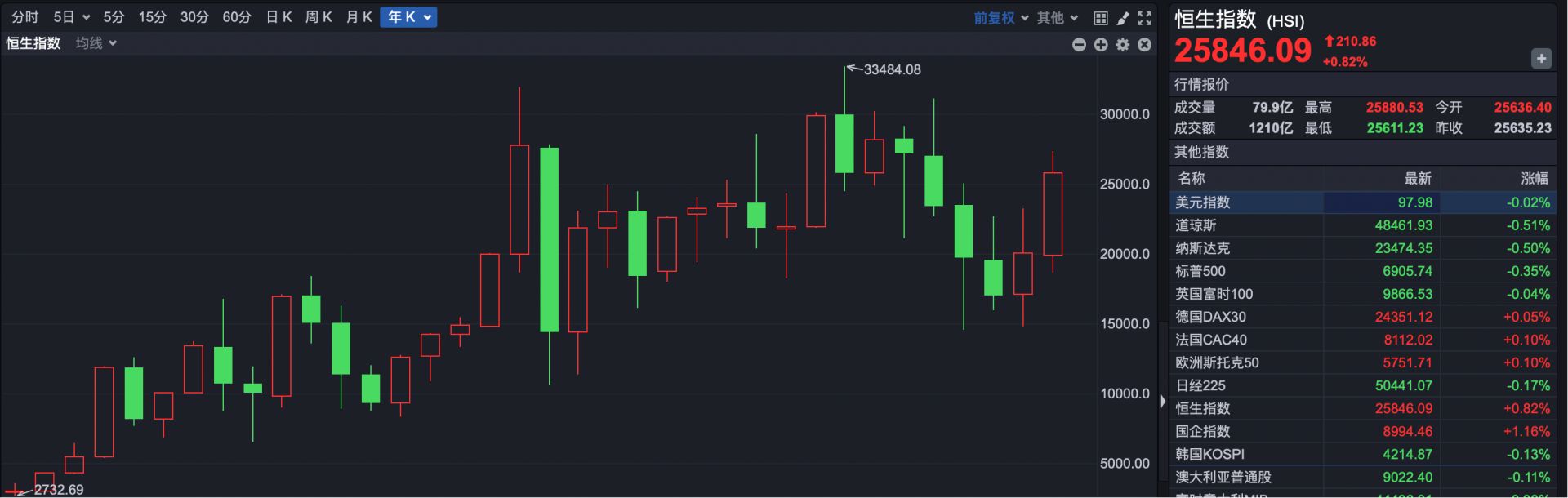
人民财讯12月31日电,港股年末最后半日交易日,恒指收跌0.87%,恒生科技指数跌1.12%。医疗、金 融、消费行业跌幅居前,有色股逆势飘红。恒指全年涨幅达27.77%。 ...
起航2026 赋值你我的“确定性函数”丨证券时报新年献词
证券时报· 2025-12-31 03:37
Group 1 - The article emphasizes the importance of adapting to complex variables in the global economy, highlighting the need for a "certainty function" to navigate uncertainties [1][5] - Technological advancements are showcased, with AI applications like DeepSeek and domestic GPU developments contributing to industry confidence and security [1][2] - The capital market is experiencing growth, with A-shares surpassing 100 trillion yuan in total market value and Hong Kong IPOs leading globally, indicating a robust investment environment [2][4] Group 2 - The article discusses the dual approach of external openness and internal potential, which is crucial for solidifying economic foundations, as seen in the response to U.S. tariffs and the promotion of high-quality development in various sectors [2][3] - The focus on domestic demand is highlighted, with policies aimed at increasing income and enhancing the supply of quality goods and services to stimulate economic activity [3][4] - The narrative stresses the importance of individual growth through technology, particularly AI, and the need for investment in human capital to adapt to the evolving job landscape [4][5] Group 3 - The article outlines the significance of reform and innovation in driving high-quality development, with a consensus forming around the need for healthy competition and core technology investment [2][5] - It mentions the upcoming APEC meeting in Shenzhen as an opportunity for China to showcase its contributions to global growth, with expectations of delivering replicable solutions for shared prosperity [4][5] - The call to action encourages individuals and businesses to actively participate in shaping their "certainty functions" through reform, innovation, and commitment to societal well-being [5]

2026年新年献词|顺流逆流,守护我们内心的罗盘!
Zheng Quan Shi Bao Wang· 2025-12-31 02:44
Core Insights - The article reflects on the past year, emphasizing the intertwining of technology and personal experiences as society navigates through challenges and opportunities in 2026 [3][4][6]. Group 1: Technological Developments - The emergence of DeepSeek marked the beginning of a transformative year characterized as the "year of large models" and "year of applications," indicating a significant shift in AI's role across various industries [3]. - AI technologies are reshaping production and sales logic, bringing them closer to individual lives, highlighting the importance of emotional value and personalized connections in consumer services [3][4]. Group 2: Economic Environment - The global macroeconomic landscape is marked by unilateralism and geopolitical tensions, which test the resilience of economies, with China expected to achieve record import and export figures [4]. - The capital market has become a keen observer of these changes, with the Shanghai Composite Index surpassing 4000 points for the first time in a decade, and the total market capitalization of A-shares exceeding one trillion yuan [5]. Group 3: Consumer Trends - There is a growing demand for services that provide emotional resonance and tangible experiences, as seen in cultural events and consumer behaviors that prioritize personal connections over digital interactions [3][5]. - New consumption models that cater to offline experiences and emotional companionship are being revalued in the market, indicating a shift in consumer preferences [5]. Group 4: Future Outlook - The essence of resilience is portrayed as a proactive growth mindset, embracing future challenges with clarity and caution, reflecting a long-term commitment to innovation and development [6]. - The narrative emphasizes the importance of collective effort and shared experiences as society moves into 2026, suggesting that the future is shaped by collaborative actions and mutual support [7].
三亚中央商务区积极探索、主动作为,推动园区党建工作走深走实
Hai Nan Ri Bao· 2025-12-31 02:08
Core Viewpoint - The Sanya Central Business District (CBD) is actively exploring and implementing high-quality party building to drive high-quality development in the park [2][3][7]. Group 1: Development and Achievements - The Sanya CBD has established itself as a modern financial industry cluster, with 31 Fortune Global 500 companies, 51 Chinese Fortune 500 companies, and 242 foreign enterprises registered [2][3]. - In the first week of the Hainan Free Trade Port's closure, the park saw a 24.4% year-on-year increase in newly registered enterprises [2]. - The park has successfully launched various initiatives, including the first international cruise voyages and the establishment of the first foreign art gallery and auction house in Sanya [2][3]. Group 2: Party Building Initiatives - The Sanya CBD management has initiated a brand-building campaign for party building, creating a system that includes five major actions: organizational strengthening, industry enhancement, enterprise service, talent development, and work style construction [3][7]. - A total of 16 sub-brands have been developed under the party building initiative, aimed at enhancing project construction and investment attraction [3][7]. - The party organization has expanded from 2 to 26, covering various types of institutions and enterprises, thus enhancing its role in the Hainan Free Trade Port construction [8]. Group 3: Economic Growth Projections - By 2025, the park anticipates a 12% increase in revenue, a 27% increase in tax revenue, an 18% increase in investment, a 57% increase in service trade, and a 38% increase in goods trade [12]. Group 4: Talent Development and Support - The Sanya CBD is focusing on talent recruitment and development, establishing a three-pronged approach that includes policy-driven talent attraction, platform-based talent gathering, and internal talent development [17][19]. - The park has created a supportive environment for talent, including the establishment of innovation and entrepreneurship incubation bases and streamlined services for foreign talent [19]. Group 5: Service Optimization - The management has launched initiatives like "Warm-hearted Enterprises, Service to Home" to address business challenges and improve the overall business environment [13][16]. - A comprehensive service system has been established, including a service window for enterprises and a detailed service checklist, resulting in the efficient handling of over 720 business-related tasks this year [14][16].
从“铺渠道”到“锚行业”:2026营销人的思维升维
Sou Hu Wang· 2025-12-31 01:25
Core Insights - The digital marketing industry in China is experiencing significant growth, with the market size expected to reach approximately 1.2 trillion RMB by 2025 and 4.8 trillion RMB by 2030, despite challenges faced by brands due to intense competition for traffic [3][4] - The rise of the HarmonyOS ecosystem, which has captured an 18% market share in the smartphone operating system market, presents a new opportunity for brands to escape the cycle of traffic competition and regain growth [4][9] - The gaming industry is facing increasing user acquisition costs, with a reported 86.6% year-on-year increase in spending on user acquisition for the top 100 mobile games in the first half of 2025, while user retention and conversion rates have not kept pace [6][14] Industry Challenges - Brands are struggling with resource misallocation and declining conversion efficiency due to a focus on traffic competition, leading to a paradox where market growth does not translate to individual brand growth [3][4] - The e-commerce sector is experiencing a disconnect between traffic costs and profits, with high public traffic costs eroding already thin margins, while private traffic engagement is hindered by platform barriers and user attention fragmentation [6][14] - Various industries, including finance, tourism, and lifestyle services, are in need of innovative solutions to address unique user value challenges and break free from traditional traffic-driven models [6][14] Solutions and Strategies - The "Whale Harmony Dynamics" initiative aims to provide tailored solutions for five key industries: gaming, e-commerce, finance, tourism, and lifestyle services, enhancing commercial growth logic within the HarmonyOS ecosystem [8][17] - The transition from a "traffic mindset" to a "value mindset" is emphasized, with a focus on understanding user intent and leveraging data science to create a comprehensive digital life map for brands [10][11] - The implementation of AI-driven insights and decision-making processes is set to transform marketing strategies, allowing for real-time data feedback and a shift from traditional advertising to contextually relevant service delivery [11][12] Growth Methodology - A replicable growth methodology is proposed, focusing on deep user insights, precise scene engagement, and long-term asset management, aiming for continuous user interaction throughout their lifecycle [14][15] - Case studies demonstrate the effectiveness of this methodology, such as the gaming industry example where targeted strategies led to a 48% increase in conversion rates and significant user engagement [14][15] - The Whale Harmony Dynamics initiative is positioned as a bridge between developers, users, and the commercial value ecosystem, leveraging AI and data science to build sustainable competitive advantages for partners [16][17]

万联晨会-20251231
Wanlian Securities· 2025-12-31 00:41
Core Viewpoints - The A-share market showed mixed performance with the Shanghai Composite Index closing flat, while the Shenzhen Component Index rose by 0.49% and the ChiNext Index increased by 0.63%. The total trading volume in the Shanghai and Shenzhen markets reached 21,424.47 billion yuan. The leading sectors included oil and petrochemicals, automobiles, and non-ferrous metals, while retail, real estate, and public utilities lagged behind [2][8] - The Hong Kong market saw the Hang Seng Index rise by 0.86% and the Hang Seng Tech Index increase by 1.74%. In contrast, major U.S. indices experienced declines, with the Dow Jones down by 0.2%, S&P 500 down by 0.14%, and Nasdaq down by 0.24% [2][8] Important News - The "Two New" policy for 2026 was released by the National Development and Reform Commission and the Ministry of Finance, outlining support for large-scale equipment updates and consumer goods replacement. A total of 625 billion yuan in special bonds will be allocated for this initiative, with a subsidy rate of 15% for certain household appliances and a maximum subsidy of 1,500 yuan per item [3][9] - Changes to the value-added tax policy for personal housing sales were announced, effective January 1, 2026. Homes sold within two years will incur a 3% VAT, while those sold after two years will be exempt from VAT [3][9] Market Analysis - The A-share market saw active trading in the sci-tech sector, with significant interest in commercial aerospace, terahertz technology, and controllable nuclear fusion. The market liquidity decreased in December, influenced by year-end fund recovery and reduced risk appetite among investors. However, a recovery in investor confidence was noted in the latter half of December due to positive signals from national economic meetings [10][11] - The overall economic environment remains stable, with improvements in fixed asset investment growth and a rebound in import and export growth rates. The CPI has shown an expanding year-on-year increase, while the decline in PPI has narrowed. The macroeconomic policies are expected to continue supporting economic stabilization and growth [12]