数码智能

Search documents
深圳:购买手机、平板、智能手表手环、智能眼镜等4类产品按产品销售价格的15%给予补贴
Xin Lang Cai Jing· 2026-02-28 02:43
Core Viewpoint - The Shenzhen Municipal Government has introduced a special long-term bond program to support the upgrade and efficiency of consumer goods through a subsidy scheme for replacing old products with new ones, particularly focusing on digital and smart products [1] Group 1: Subsidy Details - Consumers purchasing mobile phones, tablets, smartwatches, and smart glasses priced at no more than 6,000 yuan will receive a subsidy of 15% of the product price, with a maximum subsidy of 500 yuan per item [1] - Each consumer is eligible for one subsidy per product category [1] Group 2: Smart Home Products - The program also supports subsidies for smart home products, including those designed for the elderly, with specific categories and subsidy standards to be determined by the Municipal Bureau of Commerce based on local product advantages and national and provincial guidelines [1]
政策协同配合 激发消费市场新活力
Jin Rong Shi Bao· 2026-02-25 02:02
Group 1 - In 2025, China's total retail sales of consumer goods exceeded 50 trillion yuan for the first time, reaching 50.1 trillion yuan, with a year-on-year growth of 3.7% and a contribution rate of consumption to economic growth at 52%, an increase of 5 percentage points [1] - The central economic work conference emphasized the importance of domestic demand and building a strong domestic market as a key task for economic work in 2026, with various policies being implemented to boost consumption [1] - Experts suggest enhancing the coordination between monetary and fiscal policies to amplify policy effectiveness and guide social capital in supporting consumption and investment [1] Group 2 - The implementation of the old-for-new policy since 2025 has significantly boosted sales in related categories, with sales reaching 2.61 trillion yuan and benefiting 366 million people [2] - Retail sales of home appliances, communication equipment, and furniture saw increases of 11%, 20.9%, and 14.6% respectively, while passenger vehicle retail volume grew by 3.8% in 2025 [2] - A new notification for 2026 aims to enhance the effectiveness of the old-for-new policy by focusing on key consumer goods and expanding the scope of subsidies [2] Group 3 - The integration of consumer credit products with the old-for-new policy is expected to enhance the actual effects of the policy, with financial institutions collaborating with merchants to improve consumer convenience [3] - The focus on automotive, home appliance, and digital products in the old-for-new scenarios will promote the development of financial services in these areas [3] Group 4 - By the end of 2025, the balance of loans in key service consumption sectors reached 2.8 trillion yuan, with a year-on-year growth of 6%, indicating a steady recovery in consumer willingness and capacity [4] - The People's Bank of China established a 500 billion yuan re-loan facility for service consumption and elderly care, with a re-loan rate of 1.5%, to encourage financial support for key service sectors [4] Group 5 - In August 2025, the Ministry of Finance introduced a loan interest subsidy policy for service industry operators, providing a 1% subsidy for loans in various service sectors [5] - In January 2026, the People's Bank of China announced an expansion of the re-loan support areas and reduced the re-loan rate to 1.25%, while the Ministry of Finance optimized the subsidy policy to include digital, green, and retail sectors [5] - The combination of re-loan and interest subsidy policies reflects a deep integration of monetary and fiscal policies, aimed at reducing financing costs in the consumption sector [5]
多地密集发布细则 因地制宜激活新消费
Xin Lang Cai Jing· 2026-02-05 19:12
Core Insights - The "Two New" policy, aimed at large-scale equipment updates and consumer goods replacement, has seen rapid implementation across various regions in China, with a focus on digital and smart products [1][2][3] Group 1: Policy Implementation - Regions such as Shanghai, Jiangsu, and Zhejiang have introduced detailed guidelines to align with central policy directives while addressing local development needs [1][2] - The first batch of 625 billion yuan in special government bonds for consumer goods replacement and 936 billion yuan for equipment updates has been allocated, supporting approximately 4,500 projects and expected to drive over 460 billion yuan in total investment [2] Group 2: Local Adaptation - Local governments are encouraged to tailor their subsidy categories and standards based on regional characteristics, enhancing the alignment of national policies with local demands [3][4] - For instance, Jiangsu has added new categories for smart home products, while Inner Mongolia has adjusted its subsidy categories for agricultural machinery based on local agricultural needs [4][5] Group 3: Economic Impact - The "Two New" policy is expected to stimulate consumer spending and investment, with a notable increase in the smart glasses market projected to reach 4.5 million units, reflecting a 77% year-on-year growth [7] - The policy aims to create a dynamic balance between supply and demand, driving high-quality development through structural reforms that leverage China's vast market potential [7]


贷款贴息“红包”更大了
Ren Min Ri Bao Hai Wai Ban· 2026-02-04 22:59
Core Viewpoint - The Chinese government is enhancing financial support through interest subsidies for consumer loans and small and micro enterprises, aiming to stimulate domestic demand and support the real economy [8][9][12]. Group 1: Consumer Loan Policies - The upgraded consumer loan subsidy policies will provide a 1% interest subsidy on personal consumption loans and service industry loans, benefiting both consumers and businesses [9][10]. - The policies have been optimized to include credit card installment payments, allowing more consumers to benefit from the subsidies [11]. - The implementation period for these policies has been extended to December 31, 2026, with potential for further extensions based on effectiveness [17][19]. Group 2: Support for Small and Micro Enterprises - A new interest subsidy policy for small and micro enterprises will provide a 1.5% subsidy on loans, with a maximum loan amount of 50 million yuan and a subsidy period of up to two years [14][16]. - The policy targets key industries such as new energy vehicles, industrial robots, and medical equipment, aiming to alleviate financing difficulties for private enterprises [14][16]. - The equipment update loan subsidy policy has been expanded to include fixed asset loans related to equipment updates and technology innovation [15][16]. Group 3: Implementation and Efficiency - The government aims to streamline the process for accessing these subsidies, ensuring that consumers and businesses can benefit from the policies with minimal bureaucratic hurdles [18][19]. - There is a focus on making the subsidy process more efficient, with an emphasis on automatic recognition of eligible transactions to facilitate immediate benefits for consumers [18][19]. - The policies are designed to create a favorable consumption environment by reducing credit costs and enhancing consumer purchasing power [19].
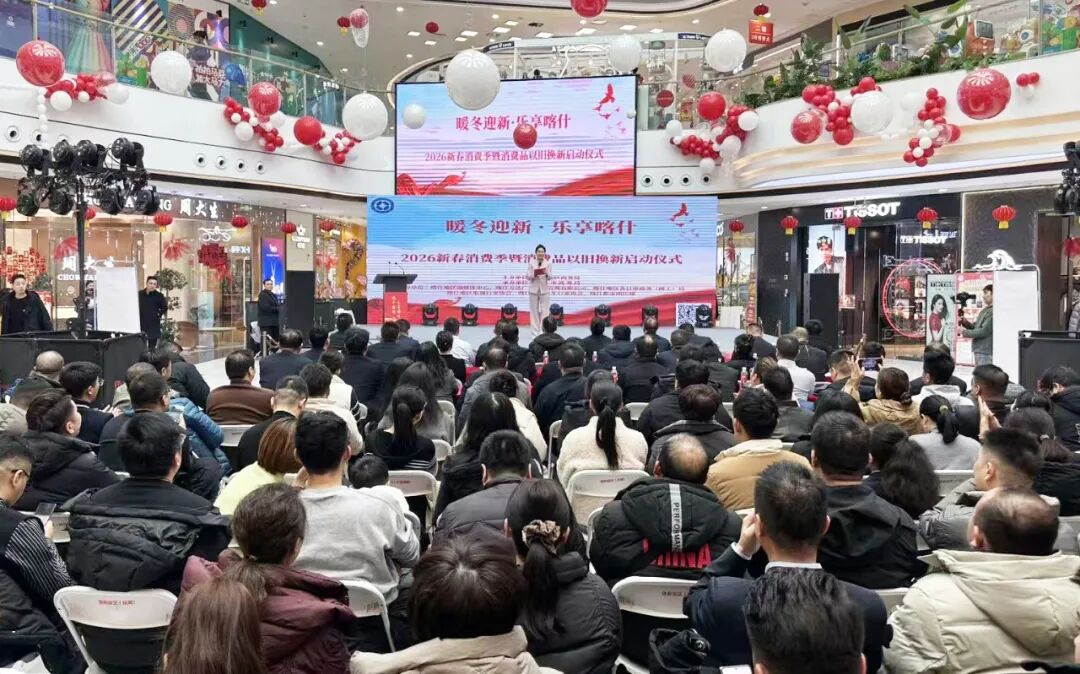
“新国补”落地!喀什各地消费市场迎来“换新”热潮
Ren Min Ri Bao· 2026-01-28 13:04
Core Viewpoint - The implementation of the "old-for-new" policy for consumer goods in 2026 aims to stimulate economic activity in the Kashgar region, with a focus on key sectors such as automobiles, home appliances, and digital smart products, enhancing consumer engagement and market vitality [1][3]. Group 1: Policy Details - The "old-for-new" policy continues to provide substantial subsidies, covering six categories of energy-efficient home appliances with a 15% subsidy on the final price, capped at 1,500 yuan per item [3]. - Digital smart products, including smartphones and tablets, are eligible for a maximum subsidy of 500 yuan, with a price limit of 6,000 yuan [3]. - The introduction of smart glasses as a new subsidized category aligns with consumer upgrade trends, representing a potential growth area [3]. Group 2: Automotive Sector Support - The automotive sector receives enhanced policy support, with up to 20,000 yuan for scrapping old vehicles in exchange for new energy vehicles and an 8% subsidy on the purchase price for replacing with new energy vehicles [5]. - Additional incentives are provided for 2.0-liter and below fuel vehicles, along with relaxed registration restrictions for new cars, aimed at lowering purchase barriers [5]. - A monthly balanced implementation mechanism is established to ensure fair and efficient distribution of subsidy qualification vouchers through the "old-for-new" section of the Cloud Flash Payment APP [5]. Group 3: Market Response - The consumer market in Kashgar is experiencing increased activity, with significant foot traffic in stores, particularly for digital products, following the launch of the new consumption season [9]. - The combination of subsidies and store promotions has led to a notable increase in sales of essential home appliances, with discounts reaching up to 50% [9]. - County-level markets are becoming crucial for consumption upgrades, with local businesses reporting doubled customer traffic and significant sales growth in new energy and smaller fuel vehicles [10]. Group 4: Broader Economic Impact - The consumption season integrates various aspects of life, including food, accommodation, travel, and entertainment, creating diverse consumer experiences [14]. - Events such as local markets and cultural activities are designed to enhance community engagement and stimulate economic activity, contributing to a positive economic outlook for the year [14].
“新国补”落地两周 各地消费市场迎来“换新”热潮
Zhong Guo Chan Ye Jing Ji Xin Xi Wang· 2026-01-18 23:58
Core Viewpoint - The implementation of the "old-for-new" national subsidy policy has sparked a surge in consumer demand across various sectors, including automobiles, home appliances, and digital products. Group 1: Automotive Sector - In Jiangsu, the new subsidy policy offers a 12% subsidy (up to 20,000 yuan) for purchasing new energy vehicles under scrapping scenarios, and a 10% subsidy (up to 15,000 yuan) for traditional fuel vehicles [2] - For replacement scenarios, the subsidy is 8% (up to 15,000 yuan) for new energy vehicles and 6% (up to 13,000 yuan) for fuel vehicles [2] Group 2: Home Appliances and Digital Products - The policy mandates that participating home appliances must meet "first-level energy efficiency" standards, covering six categories such as refrigerators and washing machines, with a subsidy of 15% of the final price, capped at 1,500 yuan per item [2][6] - Digital products, including smartphones and tablets priced under 6,000 yuan, are eligible for a 15% subsidy, with a maximum of 500 yuan per item [2][6] - The new subsidy policy has significantly increased consumer purchasing intentions in the home appliance sector [2] Group 3: Market Impact - The launch of the subsidy program has led to a notable increase in sales, with over 1.3 billion yuan in subsidies utilized in Hebei province alone from January 1 to 9, resulting in sales exceeding 9.2 billion yuan [7] - Retailers are enhancing consumer experience by offering "one-stop" services for old product recycling, which provides additional discounts on new purchases [4]
“新国补”激发消费新活力
Sou Hu Cai Jing· 2026-01-15 01:42
Core Insights - The new round of "national subsidies" has been launched at the beginning of the year, providing a significant boost to the consumer market for 2026 [1] - The "old-for-new" policy for consumer goods has shown remarkable effectiveness in expanding domestic demand, stabilizing growth, promoting transformation, and benefiting people's livelihoods since its implementation in 2024 [1] - The recent central economic work conference emphasized the need to optimize the "two new" policies to enhance the effectiveness of the "old-for-new" policy [1] Group 1 - The subsidy program in Shanxi Province officially started on January 9, 2026, leading to increased consumer engagement in both physical and online retail spaces [1] - The new subsidies focus on six categories of energy-efficient or water-efficient home appliances and include smart glasses for the first time in the digital product category [1] - The automotive subsidy has shifted from a fixed amount to a percentage of the vehicle price, aiming to create stable expectations for consumers through quarterly and balanced funding distribution [1] Group 2 - The "old-for-new" policy is a key strategy for expanding domestic demand and optimizing supply structure, emphasizing the importance of combining benefits for people's livelihoods with consumption promotion [2] - The implementation process must address issues such as fraudulent claims and price inflation prior to subsidies to ensure the integrity of the program [2] - The transformation of policy benefits into tangible welfare and consumption vitality is crucial for injecting strong momentum into the Shanxi consumer market [2]
视频|“新国补”落地近两周 各地消费市场迎来“换新”热潮
Yang Shi Xin Wen Ke Hu Duan· 2026-01-13 23:48
Core Insights - The new "National Subsidy" policy for trade-in of old consumer goods has been implemented, leading to a surge in consumer activity in various regions [2][11] Group 1: Automotive Sector - In Jiangsu, the subsidy for purchasing new energy vehicles is 12% of the vehicle price, with a maximum of 20,000 yuan, while traditional fuel vehicles receive a 10% subsidy, capped at 15,000 yuan [6] - For trade-in scenarios, new energy vehicles receive an 8% subsidy, with a maximum of 15,000 yuan, and fuel vehicles receive a 6% subsidy, capped at 13,000 yuan [6] Group 2: Home Appliances - The policy mandates that participating home appliances must meet "first-level energy efficiency" standards, covering six categories including refrigerators and washing machines, with a subsidy of 15% of the final price, limited to 1,500 yuan per item [8][15] - Consumers are showing increased willingness to purchase due to the subsidies, as evidenced by positive feedback from customers who have benefited from the discounts [8] Group 3: Digital Products - Digital products such as smartphones and tablets priced under 6,000 yuan are eligible for a 15% subsidy, with a maximum of 500 yuan per item [8][15] - The introduction of subsidies has led to a noticeable increase in sales of digital products, as consumers are eager to take advantage of the financial incentives [13] Group 4: Market Impact - The implementation of the subsidy policy has significantly boosted consumer spending, with over 1.3 billion yuan in subsidies utilized in Hebei province alone, driving sales exceeding 9.2 billion yuan from January 1 to 9 [18] - Retailers are enhancing consumer experience by offering "new for old" services, where old appliances are collected upon the purchase of new ones, further incentivizing purchases [10]
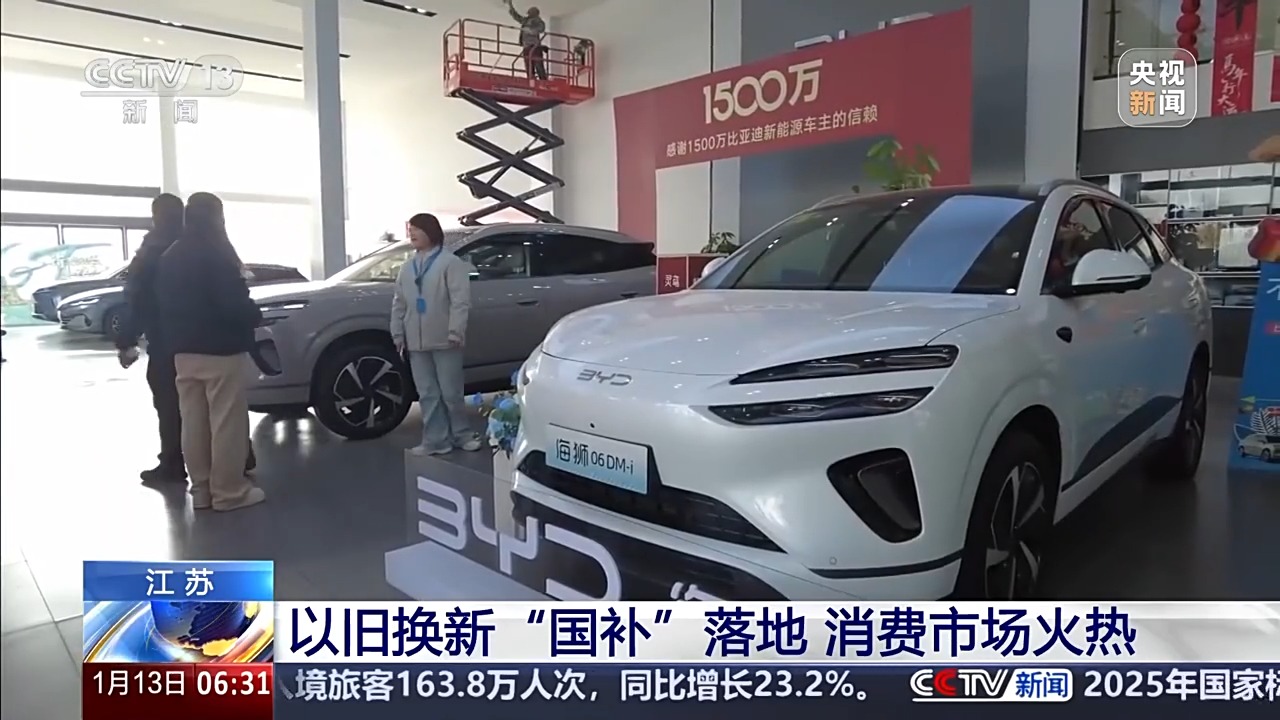
视频丨“新国补”落地近两周 各地消费市场迎来“换新”热潮
Yang Shi Xin Wen Ke Hu Duan· 2026-01-13 03:44
Core Viewpoint - The implementation of the "old-for-new" national subsidy policy has sparked a surge in consumer spending across various sectors, including automobiles, home appliances, and digital products. Group 1: Automotive Sector - In Jiangsu Province, the subsidy for purchasing new vehicles is calculated based on a percentage of the vehicle price, with electric vehicles receiving a 12% subsidy (up to 20,000 yuan) and traditional fuel vehicles receiving a 10% subsidy (up to 15,000 yuan) under scrapping scenarios [3] - The "new national subsidy" has been in effect for nearly two weeks, leading to a "replacement" boom in the consumer market [4] Group 2: Home Appliances and Digital Products - The subsidy policy for home appliances requires participating products to meet "first-level energy efficiency" standards, covering six categories such as refrigerators and washing machines, with a subsidy of 15% of the final price, capped at 1,500 yuan per item [6][12] - Digital products like smartphones and tablets priced under 6,000 yuan are eligible for a 15% subsidy, with a maximum of 500 yuan per item [12] - The implementation of the "old-for-new" policy has significantly increased consumer purchasing intent, as evidenced by consumer feedback on discounts received [6][10] Group 3: Market Impact and Consumer Behavior - In Shanxi, the subsidy program for home appliances and digital products commenced on January 9, 2023, further boosting sales in these categories [10] - In Hebei Province, the new subsidy policy has led to over 130 million yuan in subsidies utilized from January 1 to 9, driving sales exceeding 920 million yuan [15]
“新国补”落地近两周 各地消费市场迎来“换新”热潮
Yang Shi Xin Wen· 2026-01-13 03:44
Core Viewpoint - The new "National Subsidy" policy has been implemented for nearly two weeks, leading to a surge in the consumption market in Jiangsu, particularly in the automotive sector [1]. Group 1: Automotive Sector - The subsidy for automobiles is calculated based on the vehicle price, with consumers able to receive up to 20,000 yuan for purchasing new energy vehicles and 15,000 yuan for traditional fuel vehicles under specific conditions [2][5]. - In the context of scrapping and updating, new energy vehicles receive a subsidy of 12% of the vehicle price, while traditional fuel vehicles receive 10% [5]. Group 2: Home Appliances and Digital Products - The policy mandates that participating home appliances must meet "first-level energy efficiency" standards, covering six categories including refrigerators and washing machines, with a subsidy of 15% of the final price, capped at 1,500 yuan per item [7][11]. - Digital products such as smartphones and tablets priced under 6,000 yuan are eligible for a 15% subsidy, with a maximum of 500 yuan per item [11][12]. - The implementation of the "National Subsidy" has significantly increased consumer purchasing intent, as evidenced by consumer feedback on the benefits of the subsidies [7]. Group 3: Market Impact - The launch of the subsidy program has led to a notable increase in sales, with over 1.3 billion yuan in subsidies utilized in Hebei province alone, driving sales exceeding 9.2 billion yuan from January 1 to 9 [12]. - Retailers are enhancing consumer experience by offering "one-stop" services for old product recycling, which further incentivizes purchases [9].