家装

Search documents
002713 停牌核查!
Shang Hai Zheng Quan Bao· 2025-11-13 16:04
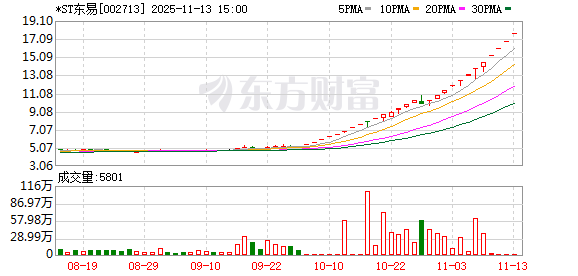
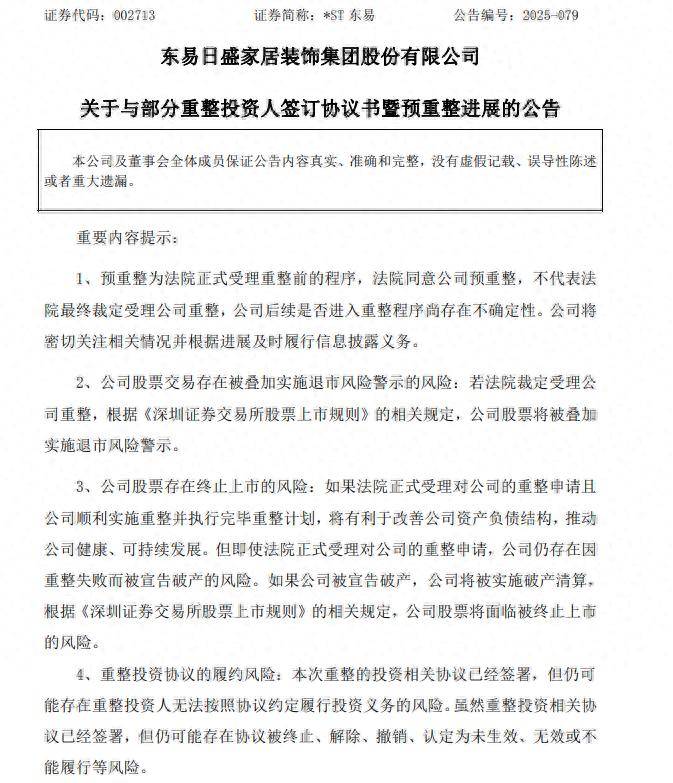
Core Viewpoint - *ST Dongyi has experienced a significant stock price surge, with a cumulative increase of 241.59% over 28 trading days, prompting the company to apply for a trading suspension for stock price fluctuation investigation [2][5][7]. Group 1: Stock Performance and Trading Suspension - The stock price of *ST Dongyi rose from a low of 1.96 yuan in July 2024 to a suspension price of 17.66 yuan, marking nearly a tenfold increase [2]. - The company announced a trading suspension starting November 14, 2024, for up to three trading days to investigate the stock price fluctuations [2][5]. Group 2: Financial and Operational Background - *ST Dongyi has been facing operational challenges, with a negative net asset value projected for the end of 2024 and three consecutive years of negative net profit [6]. - The company’s revenue for 2024 was reported at 1.296 billion yuan, a year-on-year decline of 55.84%, while the net profit attributable to shareholders was -1.171 billion yuan, a significant drop of 461.88% compared to the previous year [14]. Group 3: Restructuring Efforts - The company initiated pre-restructuring work in October 2024, with 40 potential restructuring investors expressing interest, ultimately selecting Beijing Huazhu Technology Co., Ltd. as the chosen investor [7]. - The restructuring plan includes focusing on the home decoration business and leveraging AI and digitalization to create an innovative business model called Dongyi AI Smart Home [9]. Group 4: Risks and Uncertainties - The restructuring process remains uncertain, as the company has not yet received court approval for its restructuring application, which poses a risk of delisting if not completed by December 31, 2025 [8][16]. - The success of the restructuring and the potential integration of new business lines depend on various factors, including regulatory compliance and market competition, which could affect profitability and operational synergy [11][13].


“家装第一股”东易日盛明起停牌核查,重整方案发布以来股价大涨241.59%
Xin Lang Cai Jing· 2025-11-13 14:55
Core Viewpoint - The company *ST Dongyi (002713.SZ) plans to suspend trading for investigation due to significant stock price fluctuations and a substantial increase of 241.59% since September 26, 2025, which deviates from its fundamentals [1] Group 1: Company Background - *ST Dongyi was established in November 1996 and primarily engages in overall home decoration design, engineering construction, and material agency services [1] - The company became the first listed home decoration company in A-shares in 2014 [1] - The departure of founder Chen Hui's ex-wife Yang Jin in 2021 marked a turning point, leading to a breakdown of the established management system and internal chaos [1] Group 2: Financial Performance - The company has reported consecutive losses over the past three years, with net losses of 744 million, 208 million, and 1.171 billion for the years 2022-2024, totaling 2.123 billion [1] - For the first nine months of 2025, the company recorded a net loss of 58.26 million [1] Group 3: Restructuring Efforts - On October 16, 2024, creditors applied for the company's restructuring, which was initiated by the Beijing First Intermediate People's Court on October 18 [2] - The restructuring aims to transition the company towards a dual business model focusing on "AI home decoration" and "computing power" [2] - As of November 11, 2025, the company signed agreements with several selected restructuring investors, receiving over 1.412 billion in total investment and performance guarantees [2] Group 4: Risks and Uncertainties - The company indicated that the success of injecting computing power business depends on the successful implementation of the bankruptcy restructuring and compliance with legal regulations [2] - There are uncertainties regarding the timing, scale, and future profitability of the asset injection, along with risks of intensified market competition and prolonged cost recovery cycles [2] - If the court accepts the restructuring application, the company's stock will face additional "delisting risk warnings," and failure to complete the restructuring by December 31, 2025, could lead to termination of its listing [3] Group 5: Stock Performance - As of the close on November 13, 2025, *ST Dongyi's stock price increased by 4.99%, reaching 17.66 yuan per share, with a market capitalization of 7.409 billion [4]
东易日盛重整倒计时
Jing Ji Guan Cha Wang· 2025-11-13 10:13
Core Viewpoint - Dongyi Risheng Home Decoration Group Co., Ltd. is undergoing a judicial reorganization process, with a significant investment of 1.413 billion yuan received, marking a critical phase in its restructuring efforts aimed at debt resolution and business transformation [1][4]. Financial Overview - As of October 2024, Dongyi Risheng reported total assets of 1.339 billion yuan, a market valuation of 1.511 billion yuan, total liabilities of 1.856 billion yuan, and a negative net asset of -517 million yuan, resulting in an asset-liability ratio of 117.98% [2]. - The reorganization plan categorizes debts into five types, with secured debts at 57 million yuan, employee debts at 335 million yuan, tax debts at 15 million yuan, and ordinary debts at 1.16 billion yuan [2]. Restructuring Plan - The restructuring plan includes cash payments for secured, employee, and tax debts, while ordinary debts exceeding 80,000 yuan will be converted into equity at a conversion price of 14.97 yuan per share, with a repayment rate of 11.24% [2]. - The plan involves a capital increase through capital reserves, diluting existing shareholders' rights, with new shares distributed to industry and financial investors, as well as ordinary creditors [3]. Investment and Obligations - The industry investor consortium, led by Beijing Huazhu Technology Co., Ltd., will receive 150 million shares, representing 15.77% of the total shares, in exchange for a cash investment of 345 million yuan [3]. - The industry investors are obligated to donate equity in a computing center and ensure a minimum of 500 million yuan in renovation orders over three years [3]. Future Development Strategy - The company aims to transform into a technology-driven enterprise with two main business lines: the "AI Smart Home" model and a computing center operation [8][9]. - The "AI Smart Home" model will integrate AI design tools and establish an experience center, while the computing center will focus on high-performance computing services [9]. Financial Projections - The restructuring plan sets ambitious revenue targets, aiming for 800 million yuan in 2026, 1.2 billion yuan in 2027, and 1.8 billion yuan in 2028, with profitability expected by 2027 [10]. - Approximately 400 million yuan of the restructuring funds will be allocated for employee and small debt repayments, with the remainder supporting operational recovery and market promotion [10].
东易日盛14亿卖身!华著科技借壳上市?
Sou Hu Cai Jing· 2025-11-13 09:51
Core Insights - Dongyi Risheng is undergoing a critical restructuring phase, having signed agreements with several restructuring investors and received a total of 1.412 billion yuan in investment and performance guarantees [1][7][10] Financial Performance - Dongyi Risheng's financial performance has deteriorated significantly, with net profit declining by 1041.31% since 2022, leading to losses exceeding 1 billion yuan in 2024 [3][4] - Revenue figures show a downward trend from 42.92 billion yuan in 2021 to an expected 12.96 billion yuan in 2024, reflecting a 55.84% year-on-year decline [4] Restructuring and Investment - The restructuring agreement involves Huazhu Technology becoming the controlling shareholder, with Zhang Jianhua as the actual controller of the company [1][7] - Huazhu Technology, which focuses on integrated services for intelligent computing centers, will lead Dongyi Risheng's transformation towards a dual business model of "AI home decoration + computing power" [6][7] Government Involvement - The restructuring plan includes significant involvement from state-owned enterprises, with Shenzhen招商平安资产管理 leading the investment platform, holding nearly 70% of the investment share [8] - The participation of state-owned assets is seen as a potential stabilizing factor for Dongyi Risheng amid its financial struggles [8][12] Future Outlook - If the restructuring is successful, Dongyi Risheng may transition from a traditional home decoration company to a "new home decoration + industrial service" platform, similar to the early model of Red Star Macalline [7][12] - The company faces challenges in regaining market trust and ensuring the successful implementation of its new business model, which will be crucial for its recovery [11][12]
中信银行携手领匠装饰上线家装资金存管服务
Jiang Nan Shi Bao· 2025-11-13 08:18
Core Insights - The event marked a significant step towards addressing the pain points of the home decoration industry by introducing a transparent new consumption trust system through a "funds custody service" [1][2][5] - The collaboration between CITIC Bank and Lingjiang Decoration aims to enhance consumer trust and ensure the safety of funds in home decoration transactions [1][3] Group 1: Event Overview - The "Transparent New Consumption Creation Demonstration Project and Home Decoration Funds Custody Launch Ceremony" took place in Changzhou, China, with the participation of various media and industry experts [1][2] - The initiative is guided by the China Interior Decoration Association and aims to create a healthier home decoration market [2] Group 2: Industry Challenges and Opportunities - The home decoration market is at a critical juncture, facing both challenges and opportunities, with a national push to optimize the consumption environment and boost consumer confidence [2] - Lingjiang Decoration is taking proactive steps to address core consumer pain points, aiming to eliminate information asymmetry in the industry [2][4] Group 3: Funds Custody Service Details - The funds custody service allows consumers to pay renovation funds into a dedicated account managed by CITIC Bank, ensuring that funds are released only upon meeting specific project milestones [3][4] - This model aims to prevent early fund misappropriation by decoration companies and enhances transparency in fund usage [3][4] Group 4: Commitment to Consumer Rights - The introduction of the funds custody service reflects a commitment to safeguarding consumer rights and ensuring that funds are used appropriately [3][4] - Lingjiang Decoration emphasizes the importance of building long-term trust with consumers, transitioning from a contractor-led to a customer-led approach in the industry [4] Group 5: Symbolic Launch - The launch ceremony was attended by representatives from CITIC Bank, Lingjiang Decoration, and the China Interior Decoration Association, symbolizing the start of a new era in home decoration consumption [5] - The initiative is expected to accelerate the formation of a positive consumption ecosystem based on funds custody [5]

敏华控股联手井木装饰 推出一站式设计型模块化整装
Huan Qiu Wang· 2025-11-13 02:24
Core Insights - A milestone collaboration has been established between Minhua Holdings and Beijing Jingmu Decoration, aiming to create a "one-stop design-oriented personalized renovation" model in the home decoration industry [1][3]. Strategic Upgrade - Minhua Holdings, founded in 1992, has evolved from a global home product supplier to a one-stop home ecosystem builder, leveraging its extensive international network and product strength [1][3]. - The partnership with Jingmu Decoration is a strategic extension of Minhua's "big home ecosystem" strategy, combining Minhua's manufacturing and supply chain capabilities with Jingmu's local design and service expertise [3][8]. Strong Alliance - The collaboration focuses on creating a value loop of "good products, good design, good service," aiming to deliver a comprehensive "good home" strategy [3][8]. - Minhua's global perspective in design and product development will be complemented by Jingmu's deep understanding of local market needs and consumer preferences [4][5]. One-Stop Product and Service Integration - Minhua offers a comprehensive product supply matrix covering various home spaces, while Jingmu provides a professional service system that includes design, budget control, and quality inspection [8][10]. - This integration aims to resolve traditional renovation issues related to product-service disconnection, ensuring a seamless consumer experience [8][10]. Value Commitment - The partnership promises consumers a superior experience by eliminating brand premiums and ensuring competitive pricing through a direct supply model [10][12]. - Jingmu's "one-on-one service manager" model enhances transparency and coordination throughout the renovation process, providing a single point of contact for clients [12][14]. Modular Construction System - Jingmu has introduced a modular delivery system that standardizes construction processes, improving efficiency by over 30% and ensuring quality through direct responsibility from top suppliers [14][16]. - This approach allows for a controlled construction timeline of 55 working days, enhancing overall project management [14][16]. Long-Term Brand Commitment - Minhua Holdings emphasizes brand reputation and customer satisfaction, integrating a "long-termism" philosophy into Jingmu's operations to ensure sustainable growth [16]. - The collaboration represents a comprehensive upgrade in industry practices, aiming to meet modern consumer expectations for a beautiful and functional home [16].
贝壳旗下品牌被窝胜诉 家装行业侵权乱象仍在
Bei Jing Shang Bao· 2025-11-12 15:47
Core Viewpoint - The case of trademark infringement and unfair competition involving Beike's brand "Beiwow" highlights the increasing challenges of brand protection in the home furnishing industry, with a growing number of similar disputes emerging in recent years [1][2][3] Group 1: Infringement Cases - The court ruled that Shangqiu Beiwow Mingsai Decoration Engineering Co., Ltd. must cease its infringing activities and pay economic damages of 50,000 yuan for violating Beike's trademark rights [2] - Similar infringement cases have been reported in the home furnishing industry, including a 3.8 million yuan compensation ruling against a defendant infringing on the "Jiumu" brand [3] - Other brands like Sophia, Shangpin Home, and Meike Home have also faced trademark infringement issues, indicating a rising trend in such disputes within the industry [3] Group 2: Causes of Infringement - The primary driver of frequent brand infringement is profit motivation, as counterfeit brands can quickly attract consumers and reduce market entry costs [4] - Some infringing companies directly copy the names and branding of legitimate brands, exploiting consumer trust for profit [4] - The unique business model of the home furnishing industry, which often involves extensive dealer networks, complicates brand management and increases infringement risks [4] Group 3: Consumer Awareness and Market Environment - Consumer lack of awareness regarding genuine brand identification exacerbates the issue, as many rely solely on brand names and appearances when making purchasing decisions [5] - The prevalence of counterfeit brands is particularly pronounced in smaller cities and offline markets, where consumers may unknowingly choose imitation products due to price considerations [5] - Industry leaders emphasize the need for a clean consumption environment and call for the expulsion of counterfeit sellers from retail spaces [5] Group 4: Regulatory and Industry Response - There is a call for enhanced regulatory measures to strengthen intellectual property protection, including improving trademark registration processes and increasing penalties for infringement [6] - The "Intellectual Property Protection System Construction Project Implementation Plan" aims to establish a comprehensive protection network by 2027 [6] - Companies are encouraged to proactively develop comprehensive brand protection strategies as part of their long-term development plans [6] Group 5: Collaborative Efforts - Addressing the issue of infringement requires a collective effort from consumers, industry associations, and the media to promote awareness and report violations [7] - The establishment of a secure payment system by Beike, in collaboration with CITIC Bank, aims to protect consumer funds during renovation projects [7] - Experts suggest that a collaborative approach among businesses, government, and society is essential to foster a fair competitive environment and promote high-quality economic development [7]
深圳家装补贴带动消费超139亿元
Xin Hua Wang· 2025-11-12 10:00
记者11月12日从深圳市住房和建设局了解到,自今年3月7日启动以来,深圳2025年度住宅装修改造补贴 活动持续释放惠民利企效能,截至11月11日,惠及市民约33万人,累计产生销售订单近500万单,直接 带动的家装消费金额超139亿元。 (文章来源:新华网) 今年深圳家装补贴单户最高补贴额度提升至5.2万元,覆盖旧房装修与厨卫改造、智能家居两大领域, 并推出"政府补贴+银行优惠+商户折扣"三级叠加让利模式。消费者在活动商户购物时,补贴资金"即买 即享"、直接抵扣。 活动吸引了全市超过5000家线下门店加入,参与商户数量是去年的3.3倍,服务网络覆盖全市60余个街 道,涵盖建材卖场、智能品牌、装饰公司、全屋定制等多元业态。 深圳市零售商业行业协会调查显示,参与活动的专业卖场和头部企业呈现购销两旺态势。其中,专业卖 场客流量平均增长超35%,商户销售额平均增幅超25%;重点品牌企业和头部装饰公司营业额普遍实现 两位数增长,增幅在13%至25%之间。 ...
深圳2025家装补贴已惠及33万人,带动消费超139亿元
Nan Fang Du Shi Bao· 2025-11-12 07:15
Core Insights - The Shenzhen residential renovation subsidy program has significantly benefited citizens and businesses, with approximately 330,000 residents participating and generating nearly 500 million sales orders, leading to a total home decoration consumption exceeding 13.9 billion yuan [1] Group 1: Policy Enhancements - The maximum subsidy per household has been increased to 52,000 yuan, covering old home renovations and kitchen and bathroom upgrades, along with a tripartite discount model combining government subsidies, bank benefits, and merchant discounts [2] - Consumers can enjoy immediate discounts at participating merchants, enhancing their satisfaction and experience [2] Group 2: Participation and Market Dynamics - Over 5,000 offline stores have joined the program, representing a 3.3-fold increase from the previous year, with a service network covering more than 60 districts [3] - A wide range of products, including custom home solutions and smart home devices, are in high demand, reflecting consumers' desire for quality and personalized living environments [3] Group 3: Business Confidence and Industry Growth - The policy has translated into strong business momentum, with participating retail venues experiencing an average customer traffic increase of over 35% and sales growth of over 25% [4] - Major brands and leading decoration companies have reported double-digit revenue growth, ranging from 13% to 25% [4] Group 4: Regulatory Framework and Future Plans - The program has established a robust regulatory framework to ensure fairness and sustainability, with over 400 inspections conducted to safeguard financial resources and maintain policy credibility [5] - The Shenzhen Housing and Construction Bureau plans to summarize the program's experiences to further stimulate the home decoration market and enhance residents' living conditions [5]
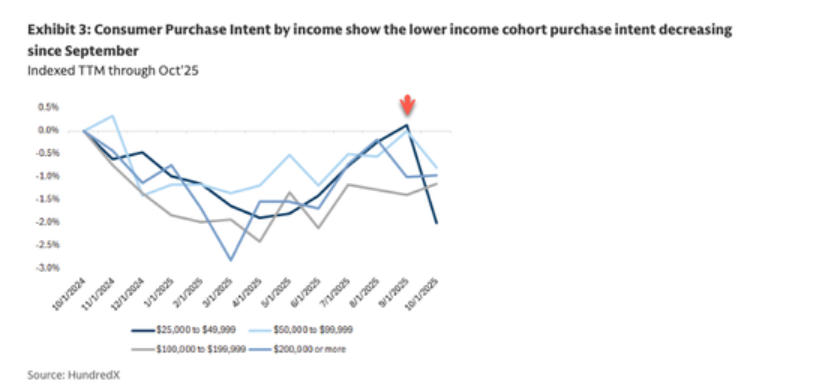
值得美股警惕的信号:美国低收入和年轻人群的消费意愿急速下降
Hua Er Jie Jian Wen· 2025-11-12 03:40
Core Insights - The spending willingness of young and low-income consumers in the U.S. is sharply declining, indicating a potential slowdown in consumer spending overall [1][4] - This trend is linked to the "student loan default cliff" and negative sentiment surrounding a potential government shutdown, which are pressuring consumers' financial situations and future expectations [4] Group 1: Consumer Spending Trends - Low-income and younger consumers, particularly Gen Z and Millennials, are showing a significant decrease in discretionary spending across various sectors including dining, apparel, beauty, home improvement, electronics, and travel [1] - The data is collected weekly from thousands of consumers to gauge spending likelihood in key areas [1] Group 2: Economic Implications - The reduction in spending willingness among these demographics could signal a broader consumption slowdown, posing challenges for the performance and stock prices of related public companies [4] - The U.S. economy heavily relies on consumer spending, making this trend a critical early warning for investors [4] Group 3: Government Policy Impact - In the context of low consumer sentiment, President Trump announced a plan suggesting that every American would receive a $2,000 "dividend" from tariffs, excluding high-income individuals [5] - The estimated cost of this "tariff refund" plan is projected to reach $600 billion, significantly exceeding the expected tariff revenue of approximately $300 billion, raising concerns among economists about potential inflation [5]