民航运输

Search documents
今年7月交通固定资产投资超三千亿,逾六成为公路投资
Nan Fang Du Shi Bao· 2025-08-27 06:47
Group 1 - The transportation economy in July continued to show a recovery trend, with stable growth in freight volume and inter-regional personnel flow [1][2] - In July, the operating freight volume reached 4.97 billion tons, a year-on-year increase of 3.4%, with a month-on-month acceleration of 0.5% [1] - Port cargo throughput reached 1.54 billion tons, a year-on-year increase of 6.9%, with a month-on-month acceleration of 2.2% [1] Group 2 - Inter-regional personnel flow in July reached 5.71 billion person-times, a year-on-year increase of 2.2%, with a month-on-month acceleration of 0.7% [2] - The scale of fixed asset investment in transportation remained high, with 306.1 billion yuan invested in July, including 200.5 billion yuan in road investment [2] - Railway investment in July was 77.1 billion yuan, waterway investment was 17.3 billion yuan, and civil aviation investment was 11.2 billion yuan [2]
交通运输部:前7个月完成交通固定资产投资1.95万亿元
Sou Hu Cai Jing· 2025-08-27 04:52
Economic Performance Overview - The transportation sector in China has shown a continued recovery trend in July, with stable growth in freight volume and inter-regional passenger flow, as well as rapid growth in port cargo throughput and high levels of fixed asset investment [1][3]. Freight Volume - In July, the operating freight volume reached 4.97 billion tons, representing a year-on-year increase of 3.4%, with a month-on-month acceleration of 0.5 percentage points. By mode, freight volumes increased by 4.5% for rail, 3.3% for road, 3.4% for waterway, and 15.3% for civil aviation. From January to July, the total operating freight volume was 33 billion tons, up 3.8% year-on-year [3][4]. Port Cargo Throughput - Port cargo throughput in July was 1.54 billion tons, marking a year-on-year growth of 6.9%, with an acceleration of 2.2 percentage points compared to the previous month. In terms of structure, domestic and foreign trade throughput increased by 7.6% and 5.5% respectively, with respective accelerations of 1.5 and 3.6 percentage points. The total port cargo throughput from January to July was 10.44 billion tons, up 4.4%, and container throughput reached 20 million TEUs, a year-on-year increase of 6.2% [3][4]. Inter-Regional Passenger Flow - Inter-regional passenger flow in July totaled 5.71 billion person-times, reflecting a year-on-year increase of 2.2%, with a month-on-month acceleration of 0.7 percentage points. By mode, passenger volumes increased by 6.6% for rail, 2.1% for waterway, 3.9% for civil aviation, and 1.8% for road. From January to July, the total inter-regional passenger flow was 39.46 billion person-times, up 3.9% year-on-year [4]. Fixed Asset Investment - Fixed asset investment in the transportation sector remained high, with July investments totaling 306.1 billion yuan. By mode, investments included 77.1 billion yuan for rail, 200.5 billion yuan for road (with 98.1 billion for expressways, 52.9 billion for national and provincial roads, and 31.7 billion for rural roads), 17.3 billion yuan for waterways, and 11.2 billion yuan for civil aviation. The total fixed asset investment from January to July was 1.95 trillion yuan [4].


交通运输部:7月完成交通固定资产投资3061亿元
Zheng Quan Shi Bao Wang· 2025-08-27 03:58
Core Insights - The transportation sector in China is experiencing a positive trend in economic operations, with steady growth in freight volume and inter-regional personnel movement [1] - Port cargo throughput has seen rapid growth, indicating increased activity in logistics and trade [1] - Fixed asset investment in transportation remains high, with a total of 306.1 billion yuan invested in July alone [1] Investment Breakdown - In July, the investment in transportation infrastructure was distributed as follows: - Railways: 77.1 billion yuan - Highways: 200.5 billion yuan - Waterways: 17.3 billion yuan - Civil Aviation: 11.2 billion yuan - Specific highway investments included 98.1 billion yuan for expressways, 52.9 billion yuan for ordinary national and provincial roads, and 31.7 billion yuan for rural roads [1] - Cumulatively, from January to July, the total fixed asset investment in transportation reached 1.95 trillion yuan [1]
40万家、4330亿元、148亿吨公里 乘“数”而上 经济“稳”“进”步伐铿锵有力
Yang Shi Wang· 2025-08-17 06:53
Data Industry Overview - The data industry is an emerging sector and a new growth point for the digital economy, encompassing various business forms such as data collection, storage, circulation, transaction, development, and infrastructure construction [3] - By 2024, the number of data enterprises in China is expected to exceed 400,000, with the industry scale reaching 5.86 trillion yuan, representing a 117% increase compared to the end of the 13th Five-Year Plan [5] - A number of companies engaged in data labeling, governance, and transaction services are rapidly growing, with third-party data service institutions emerging and deepening their specialization [7] Regional Development - The Yangtze River Delta has formed a multi-layered, full-chain data industry ecosystem, with its data industry scale accounting for 22.6% of the national total in 2024, housing over 100,000 data enterprises, making it a significant growth pole for China's data industry [8]

交通运输部:上周国家铁路运输货物7869.7万吨,环比增长1.29%
Jing Ji Guan Cha Wang· 2025-08-11 03:31
经济观察网 据交通运输部微信公众号消息,国务院物流保通保畅工作领导小组办公室监测汇总数据显 示,8月4日—8月10日,全国货运物流有序运行,其中:国家铁路运输货物7869.7万吨,环比增长 1.29%;全国高速公路货车通行5330万辆,环比增长1.34%;监测港口完成货物吞吐量2.69亿吨,环比增 长10.87%,完成集装箱吞吐量679.2万标箱,环比增长19.58%;民航保障航班13.7万班(其中货运航班 4808班,包括国际货运航班3211班,国内货运航班1597班),环比增长1.26%;邮政快递揽收量约35.25 亿件,环比下降1.97%;投递量约35.14亿件,环比下降2.52%。(编辑 刘睿) ...
辉煌60载 魅力新西藏丨西藏民航赋能雪域腾飞
Yang Guang Wang· 2025-08-03 01:19
Group 1 - The core viewpoint is that the development of civil aviation in Tibet, through new flight routes, infrastructure upgrades, and improved service quality, is significantly contributing to the high-quality economic and social development of the region [1][2] - The passenger throughput at airports in Tibet is projected to exceed 7 million by 2024, with nearly 70% of this traffic attributed to tourism [1] - The opening of Linzhi Airport has led to a dramatic increase in local tourism, with visitor numbers and total tourism revenue growing by 34 times and 103.8 times, respectively [1] Group 2 - Lhasa Gonggar International Airport is enhancing both passenger and cargo services, facilitating the rapid distribution of local products to mainland markets [2] - The airport's cargo throughput is expected to reach 26,000 tons by the first half of 2025, reflecting a year-on-year growth of 7.9% [2] - Future plans for Tibet's civil aviation include the construction and expansion of 10 major projects, aiming for an annual passenger throughput of 9.8 million and a cargo throughput of nearly 66,000 tons by the end of the 14th Five-Year Plan [2]
上半年我国人员出行持续旺盛 跨区域人员流动量超337亿人次
news flash· 2025-07-25 09:10
Core Insights - The transportation industry in China has maintained stable economic operations in the first half of the year, contributing to employment and market stability [1] - There has been a significant increase in personnel mobility, with a total of 33.76 billion trips made, reflecting a year-on-year growth of 4.2% [1] - International air travel has seen a remarkable growth, with a year-on-year increase of 28.5% in international passenger volume [1] Transportation Modes - Railway passenger volume increased by 6.7% year-on-year [1] - Waterway passenger volume decreased by 2.5% year-on-year [1] - Road passenger flow grew by 4.0% year-on-year [1] - Civil aviation passenger volume increased by 6.0% year-on-year [1] Investment in Transportation - Fixed asset investment in transportation reached 1.6474 trillion yuan, maintaining a high level [1] - Investment breakdown includes 355.9 billion yuan for railways, 1.1291 trillion yuan for roads, 109.3 billion yuan for waterways, and 53.1 billion yuan for civil aviation [1]
“十四五”期间 我国高铁营业里程增加1万公里 国家综合立体交通网加快构建
Yang Guang Wang· 2025-07-22 01:11
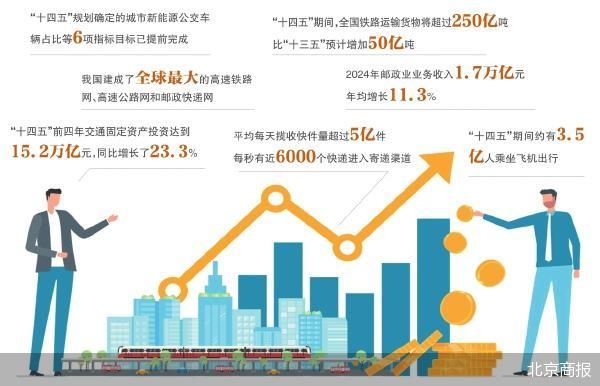
Core Insights - The Chinese government is accelerating the construction of its transportation system during the "14th Five-Year Plan" period, achieving significant milestones in high-speed rail, highways, and postal express networks [1][2] Transportation Infrastructure - The total railway operating mileage is expected to increase by approximately 16,000 kilometers by the end of 2024, with high-speed rail accounting for 10,000 kilometers of this increase [1] - The total length of highways will reach 5.49 million kilometers, an increase of about 290,000 kilometers, including an addition of 30,000 kilometers of expressways [1] - The number of ports with a capacity of over 10,000 tons will increase by 379, and the number of certified civil aviation transport airports will rise to 263, an increase of 22 [1] Civil Aviation Developments - The civil aviation sector has invested over 100 billion yuan annually in infrastructure during the "14th Five-Year Plan," with major airport clusters in Beijing-Tianjin-Hebei, Yangtze River Delta, Guangdong-Hong Kong-Macau, and Chengdu-Chongqing reaching significant development [2] - The total number of civil transport airports is expected to reach around 270 by the end of this year [2] Railway Operations - The current railway operating mileage has reached 162,000 kilometers, covering 99% of cities with populations over 200,000, and high-speed rail exceeds 48,000 kilometers, covering 97% of cities with populations over 500,000 [2] - The railway freight transport volume is projected to exceed 25 billion tons during the "14th Five-Year Plan," an increase of 5 billion tons compared to the previous plan [2] Postal and Express Services - The volume of express delivery services in China has grown from 83 billion items in 2020 to 175 billion items in 2024, with an average annual growth rate of around 20% [2] - China has maintained its position as the world's largest express delivery market for 11 consecutive years, with a peak daily collection volume of 729 million items [2]
多个全球第一 “十四五”交通运输成绩单出炉
Bei Jing Shang Bao· 2025-07-21 16:19
Core Insights - China has achieved significant milestones in transportation infrastructure during the "14th Five-Year Plan" period, establishing the world's largest high-speed rail network, highway network, and express delivery network [1][3][4] - The comprehensive transportation system has made remarkable progress, with 17 key indicators related to transportation infrastructure construction, six of which have been completed ahead of schedule for 2024 [3][4] Transportation Infrastructure - The "eight vertical and eight horizontal" high-speed rail network has been completed at 81.5%, with operational mileage reaching 48,000 kilometers, accounting for over 70% of the world's total high-speed rail mileage [4] - The national highway mileage has reached 191,000 kilometers, covering 99% of cities with populations over 200,000 [4] - Urban rail transit operational mileage is approximately 11,000 kilometers, ranking first globally, while urban public transport lines total 1.75 million kilometers [4] Passenger Travel Trends - Daily self-driving trips average about 130 million, representing over 70% of cross-regional travel [7] - Daily rail passenger volume is projected to reach 3.272 billion in 2024, accounting for 75.9% of total railway passenger volume [7] - The civil aviation sector serves over 2 million passengers daily, with 40 airports handling more than 10 million passengers annually [7][8] Express Delivery Sector - China has maintained the world's largest express delivery volume for 11 consecutive years, with an average of over 500 million packages collected daily [9] - The express delivery business revenue is expected to grow from 1.1 trillion yuan in 2020 to 1.7 trillion yuan by 2024, with an annual growth rate of 11.3% [9] - The volume of express deliveries is projected to increase from approximately 83 billion packages in 2020 to 175 billion packages by 2024, reflecting an annual growth rate of around 20% [9] Logistics and Supply Chain - The logistics sector is enhancing efficiency through AI and automation, with the highest daily collection volume reaching 729 million packages [9][10] - The railway sector is expected to transport over 250 billion tons of goods during the "14th Five-Year Plan," an increase of 50 billion tons compared to the previous plan [10] - Cold chain logistics and new supply chain models are being developed to support the distribution of high-quality agricultural products and e-commerce [10]
决战决胜“十四五” 交通强国建设结硕果 “流动中国”活力澎湃
Yang Shi Wang· 2025-07-21 07:36
Core Viewpoint - The construction of a comprehensive and integrated transportation network in China is accelerating during the "14th Five-Year Plan" period, with significant progress in various transportation sectors [1][10]. Group 1: Transportation Infrastructure Development - By the end of 2024, the railway operating mileage is expected to reach 162,000 kilometers, an increase of approximately 16,000 kilometers compared to the end of the "13th Five-Year Plan," with high-speed rail accounting for 10,000 kilometers of this increase [3][13]. - The total length of highways will reach 5,490,000 kilometers, an increase of about 290,000 kilometers [3][13]. - The number of certified civil aviation transport airports will rise to 263, an increase of 22 [3][13]. Group 2: Investment and Economic Impact - During the first four years of the "14th Five-Year Plan," fixed asset investment in transportation reached 15.2 trillion yuan, reflecting a year-on-year growth of 23.3% [3][15]. - The logistics costs for the entire society are expected to save over 400 billion yuan in 2024, with transportation costs reduced by approximately 280 billion yuan [15]. Group 3: Connectivity and International Cooperation - The "Six Corridors, Six Roads, Multi-Country, Multi-Port" connectivity framework has been largely established, enhancing international trade routes [10]. - The China-Europe Railway Express now reaches 229 cities in Europe and over 100 cities in Asia, while the "Air Silk Road" has expanded to 83 countries and 213 cities [10]. Group 4: Rural Transportation Development - By the end of 2024, the total length of rural roads will reach 4,640,000 kilometers, accounting for nearly 85% of the total highway mileage in the country [5][7].