
数据标注

Search documents
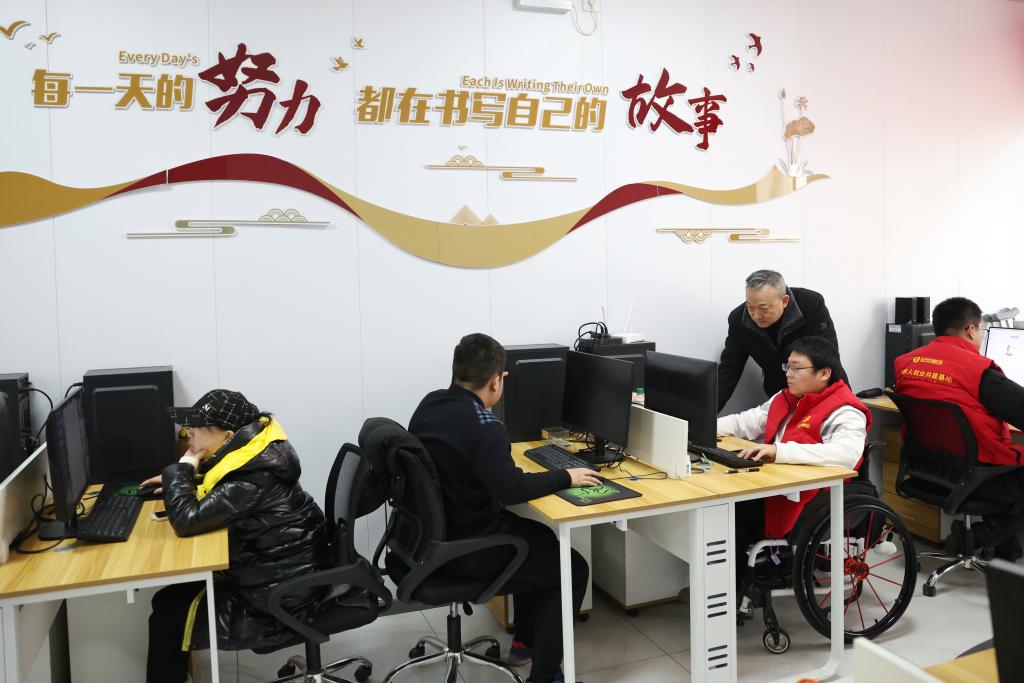
新春走基层丨探访残疾人“AI就业工坊”
Xin Hua She· 2026-02-04 08:23
Core Viewpoint - The establishment of the AI Employment Workshop for disabled individuals in Lanzhou, Gansu Province, represents a significant shift in employment opportunities for this demographic, leveraging technology to create new job roles that accommodate their needs [3][5]. Group 1: Employment Opportunities - The AI Employment Workshop trains disabled individuals as AI trainers, a role that has gained recognition since being included in the national occupational classification in 2020, providing a low-physical-demand job that can be done remotely [3][5]. - The workshop has successfully trained 19 individuals who have obtained vocational skill certificates, enabling them to secure employment in various sectors including automotive, catering, and information services [3][5][6]. Group 2: Personal Impact - Participants like Yang Zhiwen, who suffered a severe leg disability, have found meaningful employment through the workshop, earning a monthly income of 3,000 to 4,000 yuan, which has significantly improved their quality of life [5][6]. - The workshop fosters a supportive community environment, providing free equipment and facilities, which has positively influenced the mental well-being and motivation of participants [5][6]. Group 3: Future Prospects - The demand for AI-related jobs is increasing, with several companies actively seeking to hire trained disabled individuals, indicating a growing recognition of their capabilities in the digital economy [5][6]. - The Gansu Provincial Disabled Persons Vocational Education and Employment Service Center plans to expand training in emerging fields such as artificial intelligence, online customer service, and drone repair, aiming to enhance the employment prospects for disabled individuals [6].

东兴区集中签约10个项目
Xin Lang Cai Jing· 2026-02-01 22:24
Core Insights - The signing ceremony for manufacturing projects in Dongxing District, Neijiang City, took place, resulting in the signing of 10 projects with a total investment of 7.58 billion yuan [1] Group 1: Investment Opportunities - The signed projects cover various sectors including new materials, artificial intelligence, energy equipment, and food and pharmaceuticals [1] - Jiangsu Dinaco Fine Materials Co., Ltd. plans to collaborate with Dongxing District to develop a distinctive fine materials industry cluster [1] Group 2: Strategic Focus Areas - Dongxing District aims to strengthen its manufacturing sector by attracting projects related to lithium battery materials, polymer materials, adhesive materials, and new energy battery recycling [1] - The district intends to enhance its artificial intelligence industry by focusing on cloud computing, chips, robotics, and smart logistics across the industry chain [1] - There is a push to elevate the service outsourcing industry by developing data labeling, content review, and e-commerce, with a goal of increasing both total output value and workforce size in the park [1]
上海浦东软件园·贵阳园揭牌
Xin Lang Cai Jing· 2026-01-17 22:51
Core Viewpoint - The establishment of the "Shanghai Pudong Software Park·Guiyang Park" marks a significant step in the collaboration between Shanghai and Guizhou in the digital economy sector, aiming to leverage Shanghai's brand and operational experience to activate Guizhou's data and computing power advantages [1] Group 1: Park Establishment and Objectives - The park was officially opened on January 16 and is located in the Guiyang National High-tech Zone, focusing on artificial intelligence, large models, data labeling, and computing power services [1] - It is a collaborative effort between the Guizhou Provincial Big Data Development Administration, Guiyang Municipal Government, and Shanghai Pudong Software Park Co., Ltd., designed to create a new highland for intelligent industrial development [1] Group 2: Strategic Importance - The park is positioned as an innovative platform integrating industry introduction, enterprise incubation, ecological cultivation, and professional services, combining resources from the Pudong Software Park with Guizhou's data industry foundation and policy environment [1] - The establishment of the park is seen as a crucial initiative to support the high-quality development of the digital economy in Guiyang and Guizhou, exploring new paths for replicable and promotable East-West industrial collaboration [1] Group 3: Government Support and Future Plans - The park will be included in the provincial smart industry park cultivation system, with policy support for industry aggregation and talent development, focusing on data labeling and artificial intelligence [1] - The goal is to accelerate the establishment of a provincial-level smart industry park and strive to create a national digital industry aggregation area [1]
岗位没有消失,但好工作更难找了
虎嗅APP· 2026-01-08 13:50
Core Viewpoint - The employment situation in 2025 is characterized by a paradox where macroeconomic indicators show stability, but individual experiences of employment are increasingly negative, leading to a perception of a declining availability of desirable jobs [4]. Group 1: Structural Challenges - The transformation of industrial structure is deepening, with traditional labor-intensive sectors losing their capacity to absorb employment, while new industries like AI and digital economy are still in a phase of selective hiring [6]. - Economic growth is slowing down, and uncertainty is increasing, causing companies to adopt more cautious hiring practices, leading to a conservative and flexible employment demand [7]. - Weak consumer recovery is limiting the expansion of traditional employment sectors, with rising operational costs squeezing profit margins for small service businesses, resulting in a trend of "less hiring, slower hiring, and short-term hiring" [7]. Group 2: Key Facts - In 2025, the number of college graduates reached 12.22 million, marking a record high, with projections indicating this number will remain above 12 million for the next decade [9]. - The youth unemployment rate for those aged 16-24 is persistently high, fluctuating between 16% and 18%, significantly above the overall unemployment rate of around 5% [9]. - There is a notable increase in risk-averse choices among youth, with 3.718 million candidates applying for national civil service exams in 2026, surpassing the number of graduate school applicants for the first time in over a decade [10]. Group 3: Employment Mismatch - The current employment issue is fundamentally one of mismatch rather than disappearance, with a significant portion of the workforce unable to find suitable positions due to skill and expectation mismatches [14]. - Skills mismatch is evident as the demand for complex, integrated skills rises, while the supply of general skills remains abundant, leading to difficulties for highly educated workers to find appropriate roles [14]. - Expectation mismatches are also prevalent, with young people seeking job stability and security that many available positions do not offer, leading to a concentration of talent in stable but less innovative sectors [15]. Group 4: AI's Impact on Employment - AI is reshaping the employment landscape, leading to job polarization where high-end positions are expanding while middle-skill jobs are being systematically compressed [20][21]. - New opportunities are emerging in AI-related fields, with a growing demand for technical roles such as algorithm training and data annotation, indicating a shift in the types of skills that are valued in the labor market [22]. - The rise of flexible employment and new job forms is becoming a significant channel for income generation, with the government actively promoting these trends as part of its long-term economic strategy [24]. Group 5: Rural Employment Trends - The early return of migrant workers to rural areas in 2025 is attributed to weak demand in construction and manufacturing, leading to increased job insecurity and financial pressures on families [29]. - The trend of declining inter-provincial migrant workers is evident, with the number dropping from 78.67 million in 2014 to 68.4 million in 2024, reflecting changing attitudes towards urban employment [30]. - The employment risks for migrant workers have shifted from merely finding work to concerns about job security and fair compensation, highlighting the need for policies that address these emerging challenges [31].

让算力成为贵州核心竞争力
Xin Lang Cai Jing· 2025-12-28 22:35
Core Insights - Guizhou is transforming into a "digital highland" by leveraging its leading computing power, which is becoming a key indicator of economic and social development in the digital economy era [1][2] - The province has achieved a fundamental leap in its digital economy during the 14th Five-Year Plan period, with an annual growth rate of 16.2% in the intelligent industry, reflecting strategic optimization of computing power structure [2] - The collaboration between Guizhou and Shenzhen exemplifies a successful model of resource synergy, enhancing the efficiency of computing power utilization and supporting technological innovation in the Greater Bay Area [3][4] Industry Development - Guizhou's computing power capacity is projected to reach 150 EFLOPS, with over 97% of its computing power now being intelligent computing, positioning it as one of the strongest regions in the country for intelligent computing capabilities [2] - The province is actively promoting the integration of computing power into the real economy, leading to rapid growth in the digital industry and significant revenue increases in software and information technology services [2] - Guizhou is not only focusing on resource output but is also advancing the market-oriented allocation of data elements, creating a new ecosystem for data value extraction and enhancing the scale of the computing power market [4] Strategic Initiatives - The "East Data West Computing" initiative is being implemented to facilitate regional coordination and development in the digital age, showcasing a new logic for regional collaboration [1][2] - Guizhou has introduced policies such as the "computing power voucher" to lower the barriers for enterprises, enabling efficient cross-province resource matching and fostering a collaborative path of "Eastern demand + Western supply" [3][4] - The province's efforts in data collaboration and application innovation are expected to provide solid support for optimizing and reorganizing industrial and innovation chains across a broader scope [4]
“十四五”期间贵州数字产业规模年均增速16.2%
Xin Hua Wang· 2025-12-17 08:54
Core Insights - During the "14th Five-Year Plan" period, Guizhou's digital industry is expected to reach approximately 280 billion yuan by the end of this year, with an average annual growth rate of 16.2% [1] - The province has seen the emergence of competitive industries and enterprises, with 54 companies generating over 100 million yuan in revenue and 14 companies listed [1] - Guizhou is actively promoting digital transformation through initiatives like the "Ten Thousand Enterprises Integration" program, providing over 100,000 assessment reports to nearly 20,000 enterprises [1] Group 1 - Guizhou's digital industry has established a strong foundation with 50 key data centers, making the Gui'an data center cluster one of the strongest in the country in terms of intelligent computing capabilities [2] - The province has maintained a leading position in data sharing and openness, ranking among the top tier in the nation for several consecutive years [2] - The growth of the digital industry has created significant employment opportunities, with over 10,000 new jobs added in the data annotation sector this year alone [2] Group 2 - The total number of employees in Guizhou's digital industry has surpassed 163,000, with approximately 475,000 big data professionals in the region [2] - The digital industry has become a crucial engine for economic growth and job stability in Guizhou [2]
五部门:研究增设数据采集清洗、数据标注、数据合规、数据运营等专业
Bei Jing Shang Bao· 2025-12-02 08:11
Core Viewpoint - The Chinese government has issued opinions to strengthen the construction of data-related academic disciplines and the digital talent workforce, emphasizing the need for optimized academic program settings and collaboration between educational and data management departments [1] Group 1: Academic Program Development - The opinions call for the establishment of data science and engineering, as well as digital economy and management programs at degree-granting institutions [1] - There is a focus on creating a talent cultivation mechanism that connects undergraduate, master's, and doctoral programs in data-related fields [1] - Vocational schools are encouraged to adjust data-related programs dynamically based on industry development needs, including the addition of courses in data collection, cleaning, labeling, compliance, and operations [1]
贵州打造数据标注产业“引力场”
Zhong Guo Jing Ji Wang· 2025-12-01 01:09
Group 1 - The core viewpoint of the articles emphasizes the rapid development of the data industry in Guizhou, particularly focusing on data annotation as a key area for growth and investment [1][2][4] - Guizhou has introduced significant financial incentives for data annotation companies, with rewards up to 10 million yuan for eligible enterprises [2][3] - The province aims to create a favorable business environment for data enterprises, with policies designed to reduce administrative burdens and enhance operational efficiency [5][6] Group 2 - Guizhou's data annotation industry is supported by a young and abundant talent pool, with 53,000 graduates in data-related fields annually, contributing to a competitive workforce [7][8] - The region has established a solid data infrastructure, housing 50 key data centers, which generates substantial demand for data annotation services [8] - Guizhou plans to expand its data annotation workforce significantly, targeting 20,000 employees by 2026 and 50,000 by 2028, to bolster its digital economy [8]
昆明呈贡赴杭“秀”数字经济实力 引百余家滇浙企业关注
Zhong Guo Xin Wen Wang· 2025-11-15 02:01
Core Insights - The event "Green Computing Power Digital Silk Road Hangzhou-Chenggong Win-Win" was held in Hangzhou, attracting over 100 representatives from government, universities, digital economy enterprises, and financial institutions from Yunnan and Zhejiang [1][2] - Chenggong District is positioned as a leader in Kunming's digital economy, with a projected GDP of 71.9 billion yuan in 2024 and a significant industrial value-added growth rate of 34.1% [1][4] - The digital economy in Kunming is expected to generate 60.835 billion yuan in revenue by mid-2025, accounting for 47.32% of the province's total [1] Group 1: Strategic Collaborations - Strategic cooperation agreements were signed between Yunnan Digital Economy Development Zone and companies like H3C Technologies and Softcom Intelligent Computing [2][4] - Other partnerships include agreements between Juyetech and Zhejiang Qingsiao Technology, and Kunming Smart City Construction Investment Co. with Hangzhou Anheng Information and Zhejiang Shuqin Technology [2][4] Group 2: Infrastructure Development - The Kunming Wanjichong Intelligent Computing Industrial Park has established 193,000 square meters of data center space, accommodating 21,000 standard racks and achieving a computing power of 2935P [4] - Future plans for the "Cloud on Cloud: Yunnan Information Center Project" aim for a computing power of 8885P, which will serve as a significant hub for government and Beidou satellite applications in Southwest China [4] Group 3: Industry Ecosystem - The park hosts 47 large-scale enterprises and over 105 innovative entities, including global giants like Huawei and China Mobile, creating a collaborative industrial ecosystem [5] - The presence of 10 universities, including Yunnan University and Kunming University of Science and Technology, provides a talent pool of over 200,000 students, supporting the development of various industries [5] Group 4: Future Prospects - The digital economy revenue in the park is projected to reach 8.432 billion yuan in 2024, nearly a sevenfold increase since 2021 [5] - The Chenggong Data Industry Base is set to become a demonstration zone for data annotation, fostering local digital enterprises and creating a closed-loop industry model of "local data annotation and local computing application" by September 2025 [5]

贵州推出10项举措支持数据产业发展
Zhong Guo Jing Ji Wang· 2025-09-15 01:25
Group 1 - Guizhou Province has issued several policies to encourage the development of the data industry, aiming to strengthen and optimize the digital economy by implementing 10 support policies by the end of this year [1] - The province will focus on developing the data labeling industry, cloud services, and promoting AI technology innovation, while also accelerating the development of digital products in areas like film rendering, animation, and gaming [1][2] - Guizhou aims to cultivate key specialized small and medium-sized enterprises in the data industry and improve the business environment to attract growth-oriented data companies with core technologies [1][2] Group 2 - The province will support the introduction of high-level talent and encourage employment for graduates and skilled workers, while also rewarding core technology development teams [2] - Guizhou will promote the construction of national and provincial data circulation infrastructure and enhance data governance and quality management capabilities among enterprises [2] - The digital industry scale in Guizhou is projected to reach 254.94 billion yuan in 2024, representing a year-on-year growth of 18.3% [3]