铜矿开采

Search documents
美国正式公布新版关键矿产清单:首次纳入铜,银铀钾肥也入列
Hua Er Jie Jian Wen· 2025-11-07 00:00
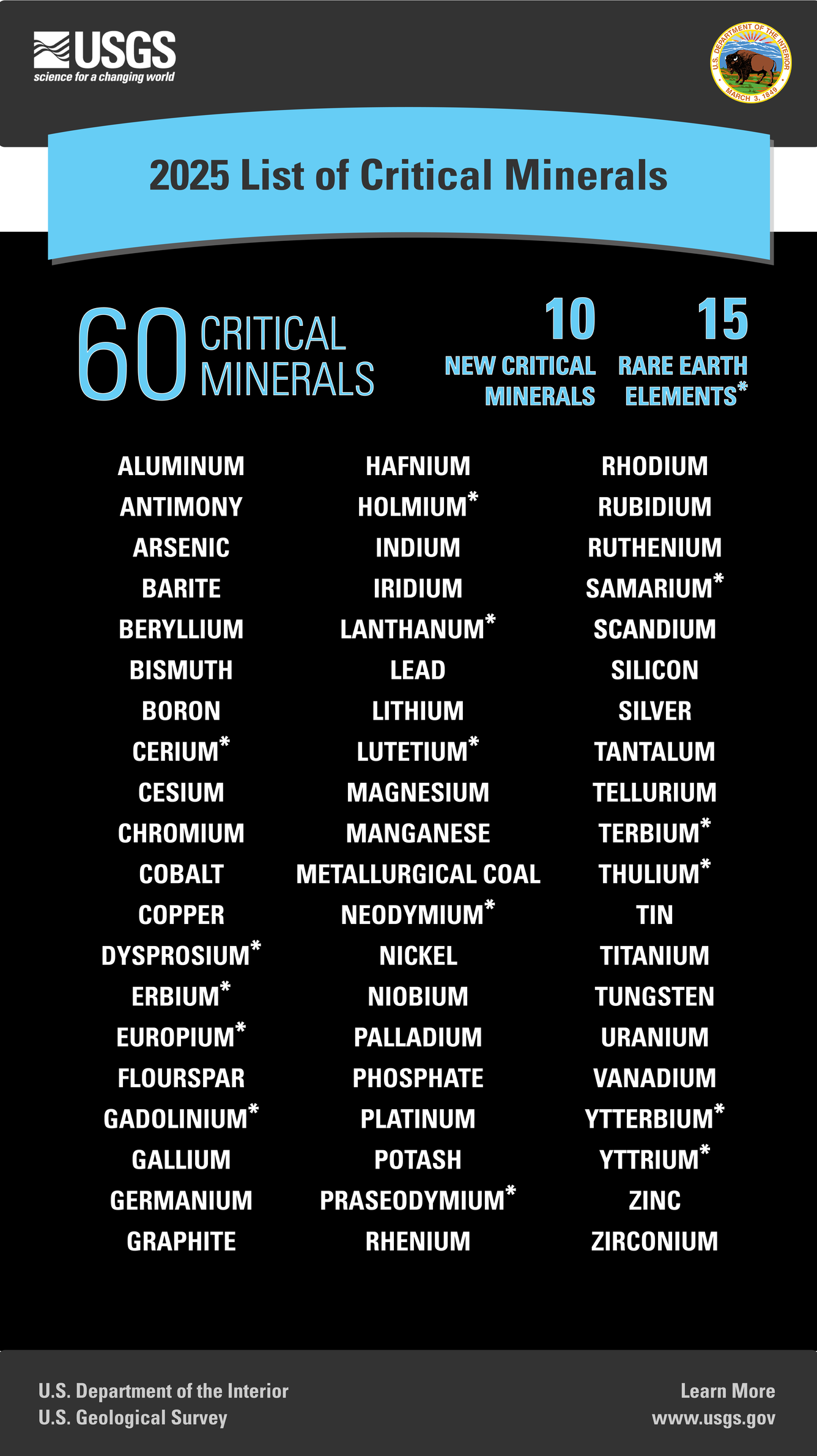
Core Points - The U.S. government has made its largest adjustment to the critical minerals list since its inception, directly impacting the Section 232 investigation announced by the Trump administration in April, which may lead to tariffs and trade restrictions on related products [1] - The updated list now includes copper, uranium, silver, metallurgical coal, potash, rhenium, silicon, and lead, marking a significant change from the 2022 version [1] - This adjustment aims to reduce U.S. reliance on imports and expand domestic production, as stated by U.S. Secretary of the Interior Doug Burgum [1] Group 1 - The inclusion of copper and potash addresses supply chain risks, with copper being crucial for electrification, defense, and clean energy [4][5] - The U.S. imports nearly half of its copper consumption, primarily from Chile, Peru, and Canada, while most global copper refining capacity is concentrated in China [5] - Potash, used mainly for fertilizer production, is largely imported from Canada, with 80% of U.S. usage coming from there [5] Group 2 - The addition of silver has raised concerns among precious metal traders and manufacturers reliant on the material, as the U.S. heavily depends on imports to meet domestic silver demand [6] - Silver's inclusion is a response to potential supply disruptions from Mexico, with the U.S. Geological Survey (USGS) categorizing minerals by risk levels for the first time [6] - The new assessment method considers economic consequences of supply shocks and highlights vulnerabilities from reliance on single domestic producers [6] Group 3 - Metallurgical coal and uranium were added to the final list despite not being included in the draft published in August, indicating a comprehensive evaluation process [7] - Metallurgical coal is essential for steel production, while uranium serves as fuel for nuclear power plants [7] - The USGS removed arsenic and tellurium from the critical minerals list due to decreased supply disruption risks and increased domestic production [7]

赞比亚与坦桑尼亚之间重要的非洲铜贸易通道重新开放
Wen Hua Cai Jing· 2025-11-06 12:41
Core Viewpoint - Tanzania has reopened its border with Zambia, restoring the flow of goods between the two major copper-exporting countries in Africa after a period of disruption due to post-election unrest [1] Group 1: Trade and Economic Impact - The border reopening allows for the resumption of trade, with authorities managing to release an average of 250 trucks in each direction daily to reduce cargo backlogs [1] - The port of Dar es Salaam in Tanzania serves as a crucial hub for transporting copper and cobalt from the Democratic Republic of Congo and Zambia to China, as well as being a significant fuel import terminal for the region [1] Group 2: Political Context - The situation has improved since President Samia Suluhu Hassan took office, following a controversial election that was marred by violence [1] - Neighboring Malawi, an uranium exporter, has attributed its fuel shortages to the regional trade disruptions caused by the unrest in Tanzania, highlighting the interconnectedness of regional economies [1]
9月智利铜产量环比回升 仍不及去年同期
Wen Hua Cai Jing· 2025-11-03 10:52
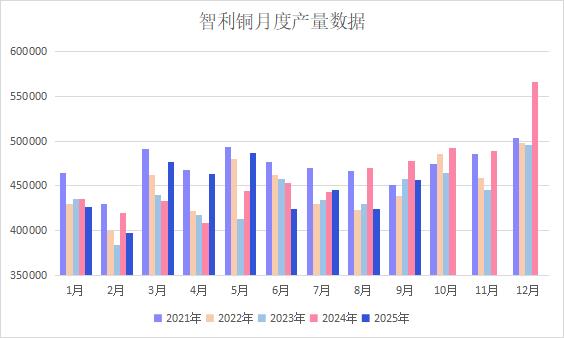
Group 1 - Chile's copper production in September was 456,663 tons, showing a month-on-month increase of 7.79% but a year-on-year decrease of 4.5% [1] - The increase in copper production in September is attributed to disruptions in mining operations that have affected output since the second half of the year [1] Group 2 - China, as the largest copper consumer globally, faces three major challenges: rising dependence on foreign upstream resources, excess capacity in the midstream processing sector, and suppressed downstream demand due to high copper prices [3] - To assist the industry in navigating these challenges, Shanghai Nonferrous Metals Network has collaborated with copper industry enterprises to compile a bilingual distribution map of the Chinese copper industry chain for 2026 [3]
印尼铜矿商Amman矿业公司离获得出口许可又进一步
Wen Hua Cai Jing· 2025-11-03 05:27
Core Viewpoint - The Indonesian copper mining company, Amman Mineral Internasional, has received approval from the Ministry of Energy to export 480,000 tons of copper concentrate for a six-month period starting from October 31 [1] Group 1: Export Approval and Operations - The approval for export is crucial for Amman Mineral to avoid exceeding the capacity limits of its concentrate storage facilities [1] - The company has not yet submitted the necessary application for the export license to the Ministry of Trade [1] - The resumption of copper concentrate exports will help ensure ongoing mining operations [1] Group 2: Regulatory Context - Indonesia has imposed a ban on the export of copper concentrate and other raw minerals since mid-2023 to encourage domestic processing [1] - Amman Mineral is allowed to export concentrates until December 2024, provided it constructs a smelter to process the concentrates into cathode copper [1] Group 3: Smelter Operations - The company’s smelter faced temporary shutdowns in July and August due to damage to the flash smelting furnace and sulfuric acid plant [1] - Repairs to the smelter are expected to be completed by the first half of 2026, and the facility is currently operating at partial capacity [1]
智利铜矿生产受干扰持续承压,全球供应趋紧
Shang Wu Bu Wang Zhan· 2025-11-01 16:20
Core Insights - Chile, the world's largest copper producer, experienced a 4.5% year-on-year decline in copper production in September due to mine operational disruptions and declining ore grades [1] Group 1: Production Challenges - The production recovery from August, following a fatal collapse at Codelco's largest mine, remains below last year's levels [1] - Several domestic mines underperformed, exacerbating the supply shortage that drove copper prices to new highs this week [1] Group 2: Specific Mine Issues - Codelco's El Teniente mine has been operating at low capacity since a deadly accident in late July that resulted in six fatalities [1] - Teck Resources' Quebrada Blanca mine is facing tailings management challenges [1] - The nearby Collahuasi mine is extracting from low-grade ore zones, with production losses exceeding expectations [1] Group 3: Global Production Impact - The world's largest copper mine, Escondida, saw a slight increase in production, which only partially offset the reductions from other mines [1]
铜荒预警,未来20年铜需求超6000年总和,中国手握两张牌能破局吗
Sou Hu Cai Jing· 2025-10-31 07:07
Core Insights - A historic surge in global copper demand is anticipated, with mining giant BHP warning of a potential shortfall of up to 10 million tons in supply over the next decade, nearly half of the expected global copper production in 2024 [4] - By 2040, China's copper demand alone could approach 20 million tons, indicating a significant increase in consumption that may match or exceed the total copper mined since the Bronze Age [4] Demand Drivers - The rise of electric vehicles (EVs) is a major contributor to the increased copper demand, with a Tesla Model 3 consuming 83 kg of copper, over four times that of traditional gasoline vehicles [8] - The construction of AI data centers is also driving copper demand, with estimates suggesting that a 1 GW data center requires approximately 65,800 tons of copper, and Nvidia's GB200 server contains 1.36 tons of copper [10] - The green energy sector, including wind and solar power, is consuming copper at unprecedented rates, with onshore wind turbines using about 4 tons and offshore turbines requiring 12 to 16 tons of copper [11] Supply Challenges - The average grade of copper ore is declining, with projections indicating it will fall below 0.45% by 2025, leading to increased extraction costs [14] - New copper mine development is becoming increasingly difficult, often requiring 16 to 20 years from exploration to production [15] - Recent incidents, such as the landslide at Indonesia's Grasberg mine, have resulted in immediate supply reductions, highlighting the instability in global copper production [15] China's Strategic Position - China is the world's largest refined copper producer, with a projected output of 15 million tons in 2024, representing nearly half of global production [17] - The country has a significant consumer market, with the household appliance sector expected to demand 4.2 million tons of copper in 2024, reflecting an 8% year-on-year increase [18] Resource Dependency and Strategic Initiatives - Despite its strengths, China faces challenges due to its heavy reliance on imported copper, with a dependency rate nearing 90% for copper concentrate [19] - The Chinese government has initiated a development plan to enhance copper resource exploration, increase recycling rates, and diversify import sources to mitigate risks [20][22] Technological Innovations - Innovations in technology are crucial for addressing the challenges of low-grade ore extraction and improving recycling efficiency, with advancements such as optical sorting and high-efficiency recovery methods being developed [23][24][25] Market Implications - Rising copper prices pose a challenge to the green transition, with forecasts suggesting prices may stabilize above $10,000 per ton by 2026, impacting the cost structures of electric vehicles and renewable energy projects [26] - Emerging markets are expected to continue increasing their copper consumption, necessitating the establishment of new large-scale copper mines to meet future demand [26] Conclusion - The future of copper resources is critical for the green economy, with China positioned as a key player, yet it must navigate the complexities of resource development, technological advancement, and cost management to maintain its competitive edge [27][28]

铜:扰动因素增加,价格震荡
Guo Tai Jun An Qi Huo· 2025-10-31 06:09
1. Report Industry Investment Rating - There is no information about the report industry investment rating in the provided content. 2. Report's Core View - The report presents the latest data on copper fundamentals, including prices, trading volumes, inventories, and spreads, and also provides macro and industry news to help understand the current situation of the copper market. The copper trend intensity is rated as neutral [1][3]. 3. Summary by Related Catalogs 3.1 Copper Fundamental Data - **Prices**: The closing price of the Shanghai Copper main contract was 87,960, with a daily decline of 0.85%, and the night - session closing price was 87,270, with a decline of 0.78%. The LME Copper 3M electronic disk closed at 10,930, down 1.44% [1]. - **Trading Volume and Open Interest**: The trading volume of the Shanghai Copper Index was 428,404, an increase of 81,170 from the previous day, and the open interest was 620,126, an increase of 2,982. The trading volume of the LME Copper 3M electronic disk was 35,174, an increase of 6,044, and the open interest was 333,000, an increase of 5,160 [1]. - **Inventories**: The Shanghai Copper inventory was 37,437, an increase of 1,692, and the LME Copper inventory was 134,950, a decrease of 400. The LME Copper注销仓单 ratio was 10.54%, a decrease of 0.30% [1]. - **Spreads**: The LME Copper cash - to - 3M spread was - 19.66, a decrease of 0.12 from the previous day. The Shanghai Copper spot - to - near - month futures spread was - 55, an increase of 5 [1]. 3.2 Macro and Industry News - **Macro News**: Chinese President Xi Jinping met with US President Donald Trump in Busan, and the China - US economic and trade teams reached consensus on three aspects. The European Central Bank maintained the deposit rate at 2% [1]. - **Industry News**: Indonesia may allow Amman Mineral International to export copper concentrates. US President Donald Trump overturned a pollution - prevention regulation on copper smelters. Anglo American's Q3 copper production was 184,000 tons, up from 181,000 tons in the same period last year, but the cumulative production in the first three quarters decreased by 9% to 526,000 tons. Glencore's copper production in the first three quarters decreased by 17% due to lower ore grades. Chile's ENAMI obtained an environmental permit for a new $1.7 - billion copper smelter that will process up to 850,000 tons of copper concentrates and produce up to 240,000 tons of cathode copper annually [1][3]. 3.3 Trend Intensity - The copper trend intensity is 0, indicating a neutral outlook, with the range of trend intensity being integers in the [- 2,2] interval [3].
伦铜价格窄幅震荡 10月30日LME铜库存减少400吨
Jin Tou Wang· 2025-10-31 03:05
Group 1 - LME copper futures prices experienced narrow fluctuations, opening at $10,929.5 per ton and currently trading at $10,947.0 per ton, reflecting a 0.27% increase [1] - The highest price during the trading session reached $10,970 per ton, while the lowest dipped to $10,927 per ton [1] Group 2 - On October 30, LME copper futures opened at $11,123.0, peaked at $11,125.5, and closed at $10,924.0, marking a decrease of 2.09% [2] - Indonesian copper miner AMMAN MINERAL reported a copper concentrate production of 310,143 tons and cathode copper production of 41,052 tons with sales of 39,805 tons for the first nine months [2] - As of October 30, the LME registered warehouse receipts totaled 120,725 tons, with canceled receipts at 14,225 tons, a reduction of 450 tons, and total copper inventory at 134,950 tons, down by 400 tons [2]
智利上半年铜矿开采成本下降,逆转趋势
Wen Hua Cai Jing· 2025-10-31 02:03
Group 1 - The core point of the article is that Chile's large copper mines have experienced a decrease in direct production costs in the first half of the year, reversing a trend of rising costs in recent years [1] - Cochilco reported that the decrease in costs is attributed to lower processing and refining costs, alongside significant increases in gold and silver prices, which rose by 39% and 26% respectively during the same period [1] - The cash cost of copper in Chile, the world's largest copper producer, has dropped to $1.767 per pound, compared to $1.912 per pound in the first half of 2024 [1] Group 2 - Cochilco conducted a survey of 21 copper mining companies, which account for approximately 94% of the country's mining output [2]
天风证券:铜矿供应增量再度不及预期 关注不断拓版图的矿企
智通财经网· 2025-10-31 00:40
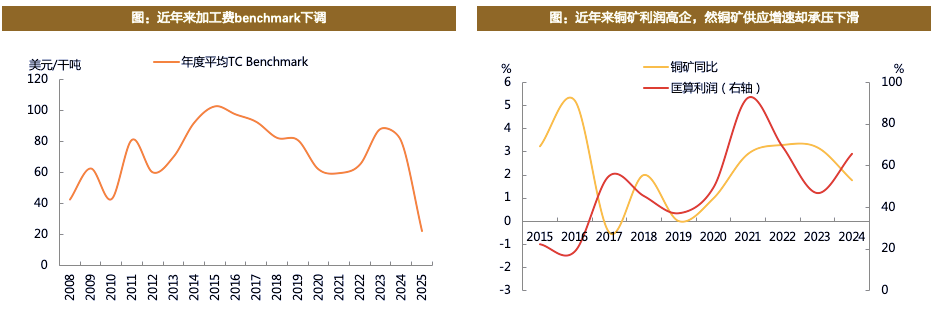
Core Viewpoint - The report from Tianfeng Securities indicates that global copper mine supply growth is expected to decline further in 2025, with a projected reduction of 23,000 tons, representing a year-over-year decrease of 0.12% [1][2]. Group 1: Supply Dynamics - The anticipated global copper mine production for 2025 is expected to decrease by 23,000 tons, with a year-over-year decline of 0.12% [2]. - Factors contributing to the supply reduction include incidents at Kamoa-Kakula, El Teniente, and Grasberg mines, while expansions at Oyu Tolgoi, MMG, and others are expected to offset some losses [2]. - Despite high copper prices maintaining mine profits around 60%, the supply growth is projected to decline, indicating a disconnect between profitability and production capacity [2][11]. Group 2: Macro Economic Influences - The global macroeconomic environment, characterized by high inflation and interest rates, is increasing project financing costs, which in turn diminishes mining companies' willingness to invest in capital expenditures [6]. - Resource nationalism is on the rise, with new mining laws in countries like Mexico and Panama affecting foreign investment sentiment [6][8]. Group 3: Industry Trends - The copper mining industry is currently in a defensive capital expenditure phase, with CAPEX growth lagging behind historical levels, particularly since 2015 [3][6]. - The trend of declining copper ore grades is limiting the willingness to expand supply, as high-grade resources are becoming increasingly scarce [6]. - The industry is experiencing rising production costs due to increases in transportation, energy, and labor costs, which are contributing to a higher cash cost for copper mining [8][11]. Group 4: Global Resource Distribution - Global copper reserves are relatively healthy, with a total of 980 million tons projected for 2024, providing a static recoverable life of approximately 42.6 years [15]. - Major copper reserves are concentrated in countries like Chile, Peru, Australia, and the Democratic Republic of the Congo, while China's copper reserves are only 4% of the global total, indicating a disparity between reserves and production [15][17]. - Chinese mining companies are expanding their footprint in resource-rich regions such as Africa and South America through mergers, acquisitions, and joint ventures to bolster their reserves [17][18].