
汽车零配件

Search documents
并购重组跟踪半月报-20250710
Bank of China Securities· 2025-07-10 12:43
Group 1 - The overall activity level of the A-share merger and acquisition market in China has weakened, characterized by "high frequency, diverse subjects, and broad fields" [1][2] - A total of 68 disclosed merger and acquisition events were recorded during the period, with a total transaction amount of 1610.13 billion RMB, showing a decrease in both the number of significant merger and acquisition events and transaction amounts compared to the previous period [1][2] - The real estate management and development, machinery, electronic equipment, instruments and components, media, electrical equipment, automotive parts, software, pharmaceuticals, and capital markets sectors are highlighted as active areas for mergers and acquisitions [1][2] Group 2 - Private enterprises and local state-owned enterprises are actively engaging in horizontal integration and strategic cooperation, indicating diverse motivations for mergers and acquisitions [1][2] - Despite the decline in the number and amount of mergers and acquisitions, there is an upward trend in structural reorganization driven by optimized regulatory policies [1][2] - The report anticipates that the merger and acquisition market will further release integration and value reconstruction potential supported by economic recovery, policy encouragement, and capital market reforms [1][2] Group 3 - 28 listed companies announced or planned restructuring during the period, with an average stock price fluctuation of 5.03% over two weeks [2][5] - 29 companies achieved significant progress after announcing restructuring plans, with an average stock price fluctuation of 5.90% [2][5] - The number of major restructuring events decreased by 17.07% compared to the previous period, and research enthusiasm declined by 26.32% [2][5] Group 4 - The report includes detailed information on specific companies involved in restructuring, including their stock codes, names, industries, and restructuring purposes [3][4][7] - Notable companies such as Wanxiang Qianchao and Guoke Microelectronics are engaged in strategic cooperation and horizontal integration through capital increases and acquisitions [3][4][7] - The report also highlights the market capitalization and price-to-earnings ratios of companies involved in restructuring, indicating their financial performance and market response [5][10]
沪深300汽车零配件指数报5840.02点,前十大权重包含华域汽车等
Jin Rong Jie· 2025-07-08 07:24
Group 1 - The Shanghai Composite Index opened high and the CSI 300 Automotive Parts Index reported 5840.02 points [1] - The CSI 300 Automotive Parts Index has decreased by 1.55% in the past month, increased by 3.91% in the past three months, and has declined by 7.92% year-to-date [1] - The CSI 300 Index categorizes its 300 sample stocks into 11 primary industries, 35 secondary industries, over 90 tertiary industries, and more than 200 quaternary industries [1] Group 2 - The CSI 300 Automotive Parts Index has a market share distribution of 88.41% from the Shanghai Stock Exchange and 11.59% from the Shenzhen Stock Exchange [1] - Within the CSI 300 Automotive Parts Index, the industry composition includes 58.02% for automotive interior and exterior parts, 15.87% for automotive system components, 14.52% for tires, and 11.59% for automotive electronics [1] - The index sample is adjusted biannually, with adjustments occurring on the next trading day after the second Friday of June and December [2]

沈阳前5月出口额同比增长15.9
Liao Ning Ri Bao· 2025-07-06 01:15
Core Insights - Shenyang's foreign trade demonstrates strong resilience amid complex external trade conditions, with a notable export growth of 15.9% year-on-year from January to May, reaching 24.29 billion yuan, setting a historical record for the same period [1] - The total import and export value of Shenyang in the first five months reached 49.85 billion yuan, showing a decrease due to import decline, but the strong export growth has narrowed the overall decline by 3.1 percentage points compared to the previous four months, indicating a positive stabilization signal [1] - The export of electrical equipment surged by 62.6% to 2.33 billion yuan, becoming a key driver of export growth, while auto parts exports increased by 3.4% to 1.89 billion yuan [1] Industry Performance - Private enterprises have shown significant vitality, with import and export values reaching 16.36 billion yuan, a year-on-year increase of 50.2%, while state-owned enterprises saw a 22.9% growth to 5.87 billion yuan [1] - The number of foreign trade enterprises with import and export performance reached 2,491, an increase of 7.5% year-on-year, with private enterprises accounting for 2,072, reflecting an 8.5% growth and becoming the most active force in foreign trade [1] Market Expansion - Shenyang has made progress in diversifying its market, with imports and exports to ASEAN reaching 4.57 billion yuan, a growth of 22.6%, becoming an important new growth point while maintaining stability in trade with South Korea and Japan [2] - New growth points have emerged, with cross-border e-commerce exports under the "low-value simplified customs clearance" model increasing by 52.9% to 1.54 billion yuan, and basic organic chemicals growing by 22.4% to 1.13 billion yuan [2] - The growth in labor-intensive products also increased by 22.3% to 1.04 billion yuan, adding new momentum to the export structure [2] Future Outlook - The strong export performance is attributed to the innovation and competitiveness of key industries like electrical equipment, as well as the robust development of private enterprises and the rapid growth of new business models like cross-border e-commerce [2] - Future strategies will focus on continuously stimulating market vitality, consolidating advantageous industries, and exploring diversified markets to ensure stable and sustainable foreign trade growth in Shenyang [2]
沪深300汽车零配件指数报5908.85点,前十大权重包含德赛西威等
Jin Rong Jie· 2025-06-26 07:39
Group 1 - The Shanghai Composite Index opened lower and the CSI 300 Automotive Parts Index reported 5908.85 points [1] - The CSI 300 Automotive Parts Index has decreased by 4.17% in the past month, 6.66% in the past three months, and 6.83% year-to-date [1] - The CSI 300 Index categorizes its 300 sample stocks into 11 primary industries, 35 secondary industries, over 90 tertiary industries, and more than 200 quaternary industries [1] Group 2 - The CSI 300 Index samples are adjusted biannually, with adjustments occurring on the next trading day after the second Friday of June and December [2] - Weight factors are generally fixed until the next scheduled adjustment, but can change with temporary adjustments due to special events affecting sample companies [2] - Companies that are delisted or undergo mergers, acquisitions, or splits will be processed according to the calculation and maintenance guidelines [2]
瑞银:科达利,买入
瑞银· 2025-06-18 00:54
Investment Rating - The report assigns a "Buy" rating for the company with a 12-month target price of Rmb175.00, while the stock price as of June 12, 2025, was Rmb111.13 [4][20]. Core Insights - The company, Keda Li, is focusing on the humanoid robotics sector by collaborating with a humanoid robot industry chain company to establish a joint venture for dexterous hands, which is expected to inject new growth momentum into the company [2][3]. - The company's current product layout in humanoid robotics includes harmonic reducers, joint components, and dexterous hands, indicating a strategic move towards innovation in this emerging field [3]. Financial Summary - The projected revenue growth from Rmb8.65 billion in 2022 to Rmb27.12 billion by 2029, reflecting a compound annual growth rate (CAGR) of approximately 17.5% [6]. - The expected net profit is projected to increase from Rmb901 million in 2022 to Rmb3.47 billion by 2029, indicating strong profitability growth [6]. - The earnings per share (EPS) is forecasted to rise from Rmb3.84 in 2022 to Rmb12.79 by 2029, showcasing significant growth potential [6]. Valuation Metrics - The company is expected to have a price-to-earnings (P/E) ratio of 16.4x in 2025, decreasing to 8.7x by 2029, suggesting an attractive valuation as earnings grow [6]. - The projected return on invested capital (ROIC) is expected to improve from 18.9% in 2025 to 24.6% by 2029, indicating efficient capital utilization [6]. Market Outlook - The forecasted stock price increase of 57.5% and a dividend yield of 2.2% contribute to an overall expected return of 59.7%, significantly above the market return assumption of 6.7% [9].
奔走于中国—中亚合作的“双向车道”(侨界关注)
Ren Min Ri Bao Hai Wai Ban· 2025-06-12 22:48
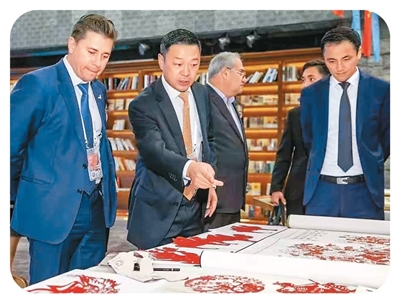
Core Insights - The relationship between China and Central Asian countries has seen significant growth and vitality, with increased trade and cultural exchanges being highlighted as key developments [8]. Group 1: China-Kazakhstan Relations - The introduction of a visa exemption agreement in 2023 has led to the establishment of multiple direct flight routes between China and Kazakhstan, facilitating easier business travel [10]. - Chinese products are increasingly popular in Kazakhstan, with local consumers showing a preference for Chinese goods, leading to a rise in cross-border shopping activities [10]. - The upcoming second China-Central Asia Summit is expected to further enhance practical cooperation between China and Kazakhstan [10]. Group 2: China-Tajikistan Relations - There has been a notable increase in Chinese enterprises investing in Tajikistan, particularly in international trade and construction sectors [12]. - A shift from "sitting merchants" to "traveling merchants" is observed, with Chinese companies now conducting market research and adapting their offerings to local needs [12]. - Cultural exchanges, such as the establishment of a Chinese library in Tajikistan, are seen as vital for enhancing mutual understanding and cooperation [13]. Group 3: China-Uzbekistan Relations - The "Two Zones and One Park" industrial technology zone project is underway, aimed at attracting Chinese investments in green energy and high-end manufacturing [14]. - The growing presence of Chinese nationals in Uzbekistan reflects the strengthening ties between the two countries, with local governments eager to collaborate with Chinese businesses [15]. - Plans for establishing vocational training schools and promoting traditional Chinese medicine in Uzbekistan indicate a commitment to long-term bilateral cooperation [16].

雷迪克拟收购誊展精密51%股权 五年研发费1.34亿筑技术护城河
Chang Jiang Shang Bao· 2025-06-11 23:47
Group 1 - Company Radik plans to acquire 51% stake in Chengzhan Precision Technology for a total consideration of 104 million yuan, enhancing its position in the robotics sector [1][2] - The acquisition includes a transfer of 25.7557% equity for 34.77 million yuan and an additional capital increase of 69.55 million yuan, with Chengzhan Precision's valuation at 137 million yuan, reflecting a 247.03% increase in value [2] - Chengzhan Precision specializes in screw processing and high-precision positioning, holding key patents for components used in humanoid robots [2] Group 2 - Radik's revenue grew from 496 million yuan in 2017 to 740 million yuan in 2024, marking a 49.19% increase, while net profit rose from 74.96 million yuan to 120 million yuan, a 60.08% increase [3] - In Q1 2025, Radik reported revenue of 186 million yuan, a year-on-year increase of 23.55%, and net profit of 34.94 million yuan, up 6.22% [3] - The company has invested over 134 million yuan in R&D from 2020 to 2024, with a total of 131 patents authorized by the end of 2024 [6] Group 3 - Radik is actively expanding into international markets, with plans to establish a wholly-owned subsidiary in Singapore and invest in a production base in Morocco [4] - The establishment of Zhejiang Leiming Robot Co., Ltd. marks a significant step for Radik into the robotics industry, focusing on smart and industrial robots [6] - The company’s total assets reached 1.868 billion yuan by the end of Q1 2025, reflecting a 6.07% increase from the previous year [6]
沪深300汽车零配件指数报5998.49点,前十大权重包含星宇股份等
Jin Rong Jie· 2025-05-29 07:23
Group 1 - The Shanghai Composite Index opened high and the CSI 300 Automotive Parts Index reported 5998.49 points [1] - The CSI 300 Automotive Parts Index increased by 3.11% in the last month, decreased by 7.08% in the last three months, and has declined by 5.42% year-to-date [1] - The CSI 300 Index categorizes its 300 sample stocks into 11 primary industries, 35 secondary industries, over 90 tertiary industries, and over 200 quaternary industries [1] Group 2 - The CSI 300 Automotive Parts Index has a market share of 87.70% from the Shanghai Stock Exchange and 12.30% from the Shenzhen Stock Exchange [1] - Within the CSI 300 Automotive Parts Index, the market share is composed of 59.93% from automotive interior and exterior parts, 13.92% from automotive system components, 13.85% from tires, and 12.30% from automotive electronics [1] Group 3 - The index sample is adjusted every six months, specifically on the second Friday of June and December [2] - Weight factors are adjusted in accordance with the sample adjustments, which occur at the same time [2] - Temporary adjustments to the CSI 300 Industry Index samples occur when there are changes in the CSI 300 Index samples due to special events or company status changes [2]

沪深300汽车零配件指数报5988.46点,前十大权重包含华域汽车等
Jin Rong Jie· 2025-05-28 07:38
Group 1 - The Shanghai Composite Index opened high and fluctuated, with the CSI 300 Automotive Parts Index reported at 5988.46 points [1] - The CSI 300 Automotive Parts Index has increased by 2.28% in the past month, decreased by 9.52% in the past three months, and has declined by 5.58% year-to-date [1] - The CSI 300 Index categorizes its 300 sample stocks into 11 primary industries, 35 secondary industries, over 90 tertiary industries, and more than 200 quaternary industries, providing analytical tools for investors [1] Group 2 - The CSI 300 Automotive Parts Index has a market share distribution of 87.87% from the Shanghai Stock Exchange and 12.13% from the Shenzhen Stock Exchange [1] - Within the CSI 300 Automotive Parts Index, the industry composition includes 60.02% for automotive interior and exterior parts, 13.98% for automotive system components, 13.87% for tires, and 12.13% for automotive electronics [1] Group 3 - The index sample is adjusted every six months, with adjustments implemented on the next trading day after the second Friday of June and December [2] - Weight factors are adjusted along with the sample changes, remaining fixed until the next scheduled adjustment unless a temporary adjustment is required [2] - Special events affecting sample companies may lead to changes in industry classification, and companies that are delisted or undergo mergers, acquisitions, or splits will be handled according to maintenance guidelines [2]
声通科技亮相第十一届成都汽配展,盈利稳定持续拓展业务
Cai Fu Zai Xian· 2025-05-26 03:42
Core Insights - The 11th Chengdu International Auto Parts and Aftermarket Service Exhibition opened with a theme of "Integration, Sharing, Trends," covering an exhibition area of 52,000 square meters and attracting over 770 participating companies [1] - The event aims to create a significant automotive industry gathering in Southwest China, with over 20 activities planned, including the 2025 China New Energy Vehicle International Cooperation Conference [1] Company Highlights - Sichuan Shengtong Xuanwu Information Technology Co., Ltd., a subsidiary of Shengtong Technology, showcased its innovative products at the exhibition, highlighting the new business models and achievements in the new energy and intelligent connected vehicle supply chain [1][2] - The Mianyang exhibition area covered 108 square meters, featuring over 110 technology products across six categories, including new energy vehicles, autonomous driving, and engine components [1][2] - The unmanned retail vehicle presented by Shengtong Xuanwu attracted significant attention, providing an immersive shopping experience through its "autonomous driving + intelligent service" capabilities [2] Industry Development - Mianyang's automotive industry has seen rapid growth, with 101 automotive enterprises projected for 2024 and an industry output value of 30.131 billion yuan, reflecting an 18.33% year-on-year increase [2] - The city is building a comprehensive new energy vehicle industry chain, integrating complete vehicles, three electric systems, core components, and lightweight materials [2][3] - The exhibition serves as a platform to strengthen Mianyang's automotive industry, promoting high-end, intelligent, and green development [3] Financial Performance - For the six months ending June 30, 2024, Shengtong Technology reported revenues exceeding 370 million yuan, with a gross profit of over 160 million yuan and an adjusted net profit exceeding 40 million yuan, resulting in gross and adjusted net profit margins of 43.7% and 11.6%, respectively [3] - Following its successful IPO, Shengtong Technology's stock price rose from an issuance price of 152.1 HKD per share to over 222.0 HKD per share by August 21, indicating strong market interest and valuation growth [4] - The company anticipates that the elimination of certain financial liabilities related to redeemable equity will positively impact its net profit post-IPO, aligning it with adjusted net profit figures [4]