运动服饰

Search documents
安踏体育(02020):事件点评:拟收购PUMA股权,持续深化多品牌全球化
Guolian Minsheng Securities· 2026-01-27 15:35
Investment Rating - The report maintains a "Buy" rating for Anta Sports (2020.HK) [2][8] Core Views - Anta Sports plans to acquire a 29.06% stake in PUMA for approximately €1.51 billion (about 12.28 billion RMB), representing a 62% premium over PUMA's previous closing price [8] - The acquisition aligns with Anta's strategy of "single focus, multi-brand, globalization," enhancing its brand matrix and global competitiveness [8] - PUMA's established brand presence and market positioning in various sports categories complement Anta's existing brands, potentially accelerating growth and resource synergy [8] - The acquisition is expected to be completed by the end of 2026, pending regulatory approvals, and will not affect Anta's annual dividend policy due to its strong cash position [8] Financial Forecasts - Revenue projections for Anta Sports are as follows: - 2024: 70.826 billion RMB - 2025: 78.479 billion RMB (growth rate of 10.8%) - 2026: 86.250 billion RMB (growth rate of 9.9%) - 2027: 94.396 billion RMB (growth rate of 9.4%) [2][9] - Net profit forecasts are: - 2024: 15.596 billion RMB - 2025: 13.139 billion RMB (decline of 15.8%) - 2026: 14.140 billion RMB (growth of 7.6%) - 2027: 15.846 billion RMB (growth of 12.1%) [2][9] - Earnings per share (EPS) estimates are: - 2024: 5.58 RMB - 2025: 4.70 RMB - 2026: 5.06 RMB - 2027: 5.67 RMB [2][9] - Price-to-earnings (P/E) ratios are projected at: - 2024: 13x - 2025: 15x - 2026: 14x - 2027: 12x [2][9] Market Positioning - PUMA is expected to rank third globally in sports brands with a 2.5% market share by 2024, following Nike and Adidas [8] - The acquisition is anticipated to enhance Anta's global strategy, leveraging PUMA's strengths in Europe, Latin America, and emerging markets [8]

安踏收购PUMA:一次非典型全球化落子
Hua Er Jie Jian Wen· 2026-01-27 14:12
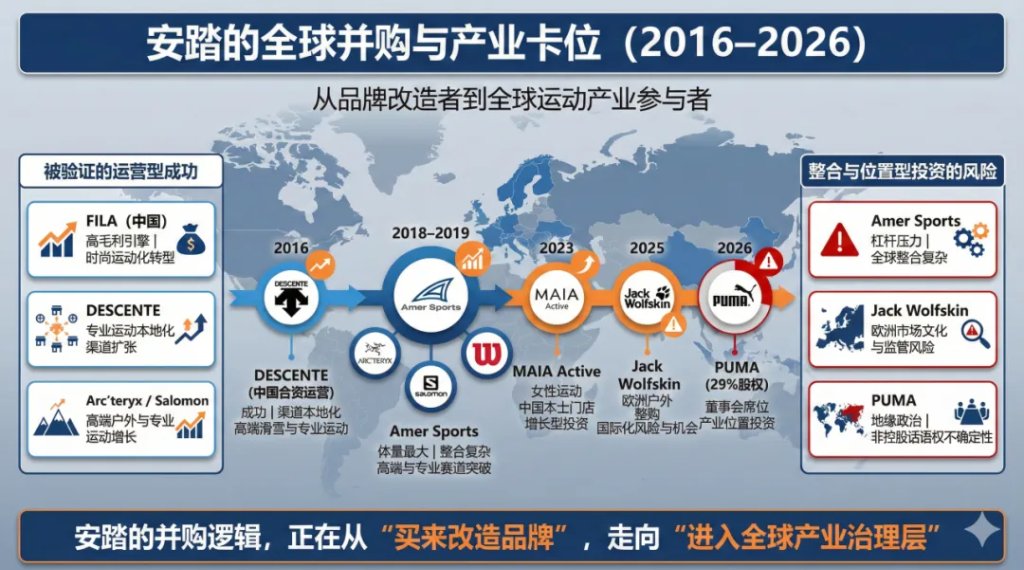
传闻落地,安踏正式出手,将PUMA近三成股权收入囊中。 安踏目前没有对PUMA发起全面要约收购的计划,充分尊重PUMA的管理文化,以及其作为德国上市公司的独立治理架构。 这与亚玛芬、狼爪并购时代形成了鲜明的反差,使安踏并购模式从以往"买来改造品牌"的整合,转向以资本为纽带、进入全球产业治理层的战略 协作。 丁世忠表示:"未来,双方将在高度共识的领域开展协作、实现优势互补,同时严格保持各自业务运营的独立性、纪律性与战略清晰,共同支持品 牌的复兴之路。" 此次安踏收购资金全部来源于集团内部现金储备,且特别强调不影响2025年的派息政策。 此次对PUMA的出手,究竟是安踏为"抄底优质资产"打出的一张安全牌,还是其全球化野心的又一次全新冲击? 非典型并购 1月27日,安踏宣布收购运动品牌彪马(PUMA SE)29.06%的股权,现金对价15亿欧元。 交易完成后,安踏将正式成为PUMA最大单一股东。 然而,与过往深度整合模式的关键不同在于,安踏此次采取了战略性财务投资的立场,并未进一步寻求运营控制权,仅计划寻求向监事会委派代 表。 安踏集团董事局主席丁世忠表示:安踏看重PUMA品牌蕴含的长期价值与潜力,并认为其近期股价 ...

豪掷123亿“娶”彪马,丁世忠的全球化野心能否靠“钞能力”实现?
Xin Lang Cai Jing· 2026-01-27 12:24
实际上,安踏创始人丁世忠一直有着做"世界的安踏"的野心。为此,安踏找到了一条通过并购国内外知 名品牌,再进行运营"翻新"的扩张路径。过去数年间,公司已经操刀了FILA、迪桑特、KOLON、始祖 鸟、狼爪等多个并购案例,让这些"过气"品牌再度翻红,并将始祖鸟母公司亚玛芬体育送上美股。此次 收购彪马,安踏能否在其身上复刻FILA、始祖鸟的成功之路呢? 炒股就看金麒麟分析师研报,权威,专业,及时,全面,助您挖掘潜力主题机会! 来源:环球老虎财经app 1月27日,安踏公告拟斥资123亿元,将昔日的运动品牌三巨头之一彪马,收入麾下。要知道,有着"并 购王"之称的安踏,此前已经收购了FILA、始祖鸟等众多"过气"品牌,并通过运营让这些品牌再度"翻 红",而接连并购国际知名运动品牌的背后也藏着丁世忠的"全球化"野心。 "并购王"安踏继续买买买。 1月27日,安踏体育公告称,公司计划以每股35欧元,合计约15.06亿欧元(约合人民币123亿元)收购 彪马(PUMA)所属公司PUMA SE 29.06%的股权,成为其最大股东。 据悉,彪马是全球知名运动品牌,已成立超78年,曾几乎比肩耐克、阿迪达斯,但近年来,彪马遭遇增 长瓶 ...

123亿收编彪马!安踏要与耐克阿迪正面交战?
Xin Lang Cai Jing· 2026-01-27 11:41
炒股就看金麒麟分析师研报,权威,专业,及时,全面,助您挖掘潜力主题机会! 来源:野马财经 拿下彪马,如何驭马是关键。 即将进入农历马年,安踏体育(2020.HK)"牵"马进厩! 1月27日,安踏体育宣布,与彪马大股东Artémis订立购股协议,拟收购彪马公司(PUMA SE)29.06% 股权,对价为每股普通股35欧元,合共15.06亿欧元(不含税)(约合人民币122.78亿元)。收购彪马利 于安踏体育继续鏖战全球市场,其强调,成为彪马最大股东后,集团有望进一步提升在全球体育用品市 场的地位及品牌知名度,从而增强整体国际竞争力。 中国企业资本联盟副理事长、中国区首席经济学家柏文喜认为,彪马定位专业运动与潮流市场的结合, 恰好填补安踏体育现有布局的空白。安踏体育主品牌主打大众专业运动,斐乐定位高端时尚,始祖鸟专 注专业户外,而彪马在足球、跑步、赛车等领域的深厚积淀,以及其在年轻消费群体中的潮流影响力, 将与现有品牌形成互补。 盘古智库高级研究员江瀚认为,收购彪马显著强化安踏体育"多品牌+全球化"布局,彪马作为全球第三 大运动品牌,在欧美及新兴市场拥有成熟渠道与年轻化品牌形象,可弥补安踏在国际高端市场的短板。 安 ...

27000点!MINIMAX-WP涨近27%
Zhong Guo Ji Jin Bao· 2026-01-27 10:32
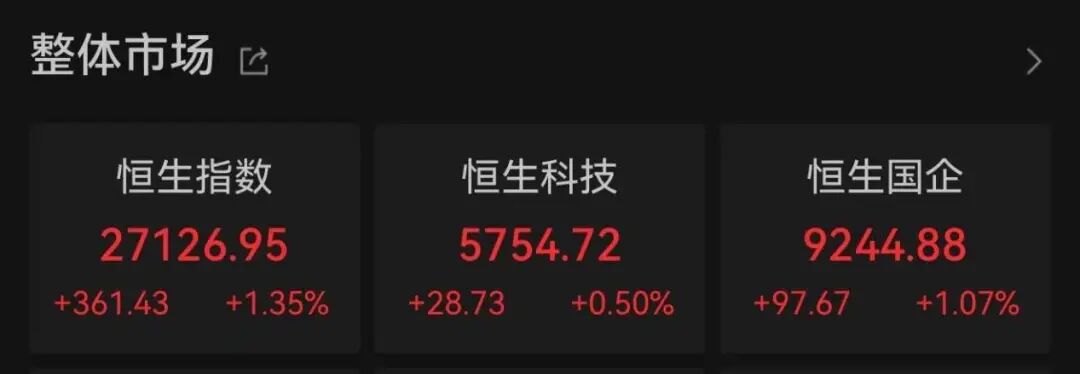
Group 1: Market Overview - The Hong Kong stock market showed signs of recovery, with the Hang Seng Index rising back above 27,000 points, closing at 27,126.95, up 1.35% [2] - The Hang Seng Technology Index increased by 0.50% to 5,754.72, while the Hang Seng China Enterprises Index rose by 1.07% to 9,244.88 [2] - The banking and insurance sectors were particularly active, contributing to the overall market strength, while large tech stocks exhibited mixed performance [2] Group 2: AI Application Stocks - MINIMAX-WP led the AI application sector, surging by 26.48% to a closing price of 488.20, with a trading volume of 1.613 billion [4][5] - The launch of MiniMax's AI-native workbench, Agent 2.0, is a key driver, featuring components like Desktop App for task execution and Expert Agents for business scenario understanding [4] Group 3: Semiconductor Sector - The semiconductor sector experienced gains, with notable increases in stocks such as Naxin Micro (up 5.61%), Shanghai Fudan (up 5.12%), and others [6][7] - Price adjustments in wafer foundry and packaging services are anticipated, with MediaTek indicating a strategic price adjustment to reflect rising manufacturing costs [6] Group 4: Insurance Sector - The insurance sector showed strong performance, with China Life rising nearly 6%, and other companies like New China Life and China Pacific Insurance also reporting gains [8][9] - A report from Huachuang Securities suggests that the insurance sector is expected to see performance improvements by 2025, driven by better investment conditions and a recovery in liabilities [8] Group 5: Corporate Acquisitions - Anta Sports announced the acquisition of a 29.06% stake in Puma for €1.5 billion (approximately 12.278 billion RMB), with shares rising by 2.03% [10] - Zijin Mining's stock rose by 2.89% following the announcement of a deal to acquire Allied Gold Corporation for approximately 5.5 billion CAD (around 28 billion RMB), expanding its gold mining operations in Africa [12][13]
刚刚,安踏29% 入股彪马 买的不是品牌
Sou Hu Cai Jing· 2026-01-27 08:17
15 亿欧元、29% 股权、不控股,这不是一次并购冲动,而是一场对全球经营权的下注。 作者 | 思岭 15 亿欧元、29% 股权、不控股,这不是一次并购冲动,而是一场对全球经营权的下注。安踏用少数股权,换取进入全球品牌治理与运营系统的入 口:产品节奏、渠道效率、库存纪律、品牌重启。它真正测试的不是彪马值不值钱,而是安踏式运营,能否在欧美成立。 2026 年 1 月 27 日,安踏体育宣布,以约 15 亿欧元现金,收购彪马(PUMA)母公司 PUMA SE 约 29.06% 股权,成为第一大股东,但不控股。 这不是一次传统意义上的并购。这是一次对"全球经营权"的下注。 29% 是一个极不浪漫、却极其理性的比例。 它有三层含义: · 足够大:可以进入董事会,进入核心治理半径; 1、全球经营权的入场券 当下全球运动行业的问题,从来不是"有没有品牌",而是品牌还能不能被重新做成增长机器。而增长机器真正的零件,不在 Logo 上,而在治理系 统里: 29% 的股权,让安踏进入这个系统内部,却不把自己锁进一场长期、沉重、充满政治摩擦的整合战。它更像买了一张后台通行证,不急着上台, 但终于能看清剧本。 2、一个可验证的"全 ...

A股重要信息回顾:严格落实春节假期免收7座及以下小型客车通行费政策,安踏体育拟以约122.78亿元人民币收购彪马公司29.06%股权成为其最大股东
Jin Rong Jie· 2026-01-27 07:56
Company News - Anta Sports plans to acquire a 29.06% stake in Puma for approximately 12.278 billion RMB, becoming its largest shareholder, with the transaction expected to complete by the end of 2026 pending regulatory approval, and the stock price rose over 3% [1] - Haike New Source signed a long-term cooperation agreement with BYD Lithium Battery Co., Ltd. on January 23, 2026, for a duration of three years, where Haike will supply at least 100,000 tons of four solvents annually to BYD's Hubei project via pipeline [1] - Joyson Safety Systems received the "Value Co-Creation Award" at the Changan Ford 2026 Supply Chain Partner Conference, with its products supporting both domestic and export models of Changan Ford [1] - Lihexing's investment in Cybertron Semiconductor is actively pursuing business cooperation with leading DRAM companies such as Samsung and SK Hynix, involving DRAM-related testing services and technical reserves [1] - Lianqi Technology has recently completed the development and system verification of a high-performance active electrical cable solution based on PCIe 6.x/CXL 3.x standards, supporting PCIe 6.0 x16 channel high-speed data transmission, suitable for AI servers and data center needs [1] - Lingbo Technology has released an open-source high-precision spatial perception model, LingBot-Depth, based on original data from the Orbbec Gemini 330 series dual-camera 3D chip, aimed at enhancing environmental depth perception and 3D spatial understanding for robots and autonomous vehicles [1] - ChipSource Microelectronics established a wholly-owned subsidiary, Wuhan Huachuang ChipSource Microelectronics Equipment Co., Ltd. in Wuhan [1]
XTEP INTERNATIONAL(1368.HK)4Q25:SAUCONY REMAINED AS KEY DRIVER DESPITE WEAK MASS MARKET
Ge Long Hui· 2026-01-27 06:03
Core Insights - Xtep's core brand retail sell-through remained flattish YoY, while Saucony experienced over 30% YoY growth, indicating a polarization between mass and premium markets [1][2] - Xtep is expected to achieve moderate growth in 2026, supported by Saucony's performance, despite overall market pressures [1][3] Performance Analysis - Xtep's core brand faced deceleration in a weaker consumer market, while Saucony's growth was bolstered by improved e-commerce operations [2] - Retail sales for Saucony in physical stores remained strong, reflecting effective expansion strategies in premium districts [3] Future Guidance - Management anticipates a more conservative 2026 guidance due to weaker peer performance and ongoing consumption pressures [4] - The 2026-2027 EPS forecast has been lowered by 3% to account for anticipated challenges [5] Valuation Metrics - Target price for Xtep has been reduced to HK$6.50, based on a revised P/E multiple of 10.5x for 2026E [6] - Despite the lowered target multiple, Xtep's valuation remains attractive with an 8x 2026E P/E and a 6% dividend yield, contingent on stable core brand performance and growth from Saucony [6]
马年营销大战,lululemon凭什么敢不热闹
Jing Ji Guan Cha Wang· 2026-01-27 05:00
Core Insights - The article discusses the marketing strategies of various sports brands during the Chinese New Year (CNY), highlighting how they engage with local consumers through culturally relevant themes and products [1][5][6] - Lululemon's approach stands out as it focuses on the essence of spring rather than traditional CNY symbols, aiming for a deeper emotional connection with consumers [5][7] Group 1: CNY Marketing Strategies - Multiple sports brands are launching CNY-themed products, with some tying their designs to the zodiac animal, while others focus on spiritual expressions or traditional Chinese art [1][6] - Brands are moving away from superficial symbol usage and are exploring deeper cultural meanings to resonate with consumers [6][9] Group 2: Lululemon's Unique Positioning - Lululemon's marketing campaign is characterized by a more subdued and introspective approach, emphasizing the theme of spring and renewal rather than overtly festive elements [2][5] - The brand's short film captures the essence of spring, portraying the beauty of repetition and change, which resonates with consumers seeking deeper meaning [3][4][5] Group 3: Consumer Engagement and Brand Growth - Lululemon's strategy includes a focus on long-term consumer relationships rather than short-term sales spikes, as evidenced by their consistent thematic campaigns over the years [6][10] - The brand's localized approach has led to significant revenue growth in China, with a reported 41% increase in revenue for the 2024 fiscal year and a 46% increase in the third quarter of 2025 [10][11] Group 4: Cultural Understanding and Community Interaction - Lululemon emphasizes understanding and respecting local culture, which is reflected in their product designs and marketing narratives [9][11] - The brand engages with consumers through various community events and initiatives, fostering a sense of belonging and emotional connection [10][11]

安踏新年第一单:120亿买了彪马
投资界· 2026-01-27 03:51
Core Viewpoint - Anta Group has successfully acquired a 29.06% stake in Puma SE for €1.5 billion (approximately 12 billion RMB), marking a significant milestone in its globalization strategy and the first cross-border acquisition by a Chinese company in 2026 [2][5]. Group 1: Strategic Considerations - Anta values Puma's long-term brand potential and believes that Puma's recent stock price does not reflect its inherent value [5]. - The acquisition will enhance Anta's existing brand matrix by complementing its offerings in various sports categories and strengthening its presence in North America and Europe [5][7]. - Puma will benefit from Anta's global market expertise, resources, and strong direct-to-consumer (DTC) capabilities [5]. Group 2: Historical Context - The history of Puma dates back to 1948 when it was founded by Rudolf Dassler, following a split from Adidas, leading to decades of competition [6]. - Puma entered the Chinese market in 1999 and has since established a strong presence, culminating in Anta's recent acquisition [7]. Group 3: Anta's Acquisition Strategy - Anta has a track record of successful acquisitions, including FILA, Amer Sports, and others, demonstrating its ability to revitalize struggling brands [9][10]. - The company has consistently focused on acquiring brands with strong value and potential for strategic transformation, often targeting those in financial distress [14][17]. - Anta's acquisition strategy emphasizes operational management and brand integration, allowing for effective brand revitalization and market positioning [15][16]. Group 4: Industry Impact - Anta's approach has set a precedent for Chinese companies in global markets, transitioning from "capital outflow" to "brand and management outflow" [7][19]. - The company's success has inspired other Chinese brands to adopt multi-brand strategies and DTC models, contributing to the overall growth of the Chinese sports goods market [17][18]. - Anta's evolution from a domestic player to a global leader illustrates the rise of Chinese commercial influence on the world stage [19].