音乐

Search documents
互联网最差的生意,可能是AI最好的生意
创业邦· 2025-11-25 05:08
Core Viewpoint - The article discusses the emergence of the "manga drama" sector as a significant application of AI in content production, highlighting its rapid growth and cost efficiency, which could lead to a transformation in the content industry [6][19]. Group 1: Market Dynamics - The manga drama market is experiencing explosive growth, with daily revenues exceeding 30 million and an expected annual market size of 20 billion [6]. - The production cost for manga dramas has been reduced to 1,000-2,500 yuan per minute, with production cycles shortened to 10-13 days, allowing small teams to manage adaptations of major IPs [6][18]. - The traditional content industry is facing a "supply-side revolution," as AI fundamentally alters the production function, moving from a model focused on high costs and long cycles to one that emphasizes efficiency and speed [7][10]. Group 2: Content Production Evolution - The shift from PGC (Professionally Generated Content) to UGC (User Generated Content) and now to AIGC (AI Generated Content) indicates a trend towards decentralization in content creation, with AIGC offering higher efficiency and lower costs [10][11]. - AI serves as a powerful tool for automating repetitive tasks in content production, significantly enhancing productivity across various media formats, including text, audio, and video [13][20]. - The manga drama sector exemplifies AI's potential to reduce production costs and time, with traditional animation costs dropping from over 500,000 yuan to between 100,000 and 300,000 yuan [17][18]. Group 3: Content Distribution and Engagement - AI's role in content distribution is becoming increasingly vital, with the ability to create precise user profiles and enhance recommendation algorithms, leading to improved engagement and retention rates [30][32]. - The use of AI in analyzing user behavior allows for targeted content delivery, which has shown to increase click-through rates and user retention significantly [30][31]. - AI's capability to adapt content to various consumption scenarios enhances user experience and engagement, as seen in the gaming and music industries [34][35]. Group 4: Future Implications - The article posits that AI will continue to reshape the content industry, particularly in video production, gaming, and film, leading to a "small cost, big production" model [38][39]. - Companies that fail to adapt to AI-driven changes in content production and distribution may find themselves at a competitive disadvantage, as traditional methods become obsolete [40][41]. - The overarching theme is that AI is not merely a trend but a fundamental shift in how content is created and consumed, returning to the core of commercial value [41].


网易-S(9999.HK):游戏长线运营能力突出 递延收入高增为后续业绩释放奠定基础
Ge Long Hui· 2025-11-24 11:59
Core Viewpoint - The company reported strong financial performance in Q3 2025, with revenue and net profit showing significant year-over-year growth, indicating resilience and growth potential across its business segments [1][2][3][4]. Financial Performance - In Q3 2025, the company achieved revenue of 28.359 billion yuan, representing a year-over-year increase of 8.2% and a quarter-over-quarter increase of 1.7% [1]. - The net profit attributable to shareholders was 8.616 billion yuan, reflecting a year-over-year growth of 31.8% and a quarter-over-quarter increase of 0.2% [1]. - Non-GAAP net profit was 9.502 billion yuan, with a year-over-year increase of 26.7% but a slight quarter-over-quarter decrease of 0.3% [1]. - Gross margin improved to 64.1%, up 2.0 percentage points year-over-year, while the sales expense ratio increased to 15.7%, up 8.3 percentage points year-over-year [1]. Gaming Business - The gaming and value-added services segment generated revenue of 22.3 billion yuan in Q3 2025, marking an 11.8% year-over-year increase and a 2.3% quarter-over-quarter increase [2]. - The company demonstrated strong operational capabilities with classic IPs performing well, including record-high concurrent players for "Dream of Dreams" [2]. - New game launches, such as "Fate: Stars" and upcoming titles like "The Sea of Forgotten," are expected to enhance global reach and player engagement [2]. NetEase Youdao - NetEase Youdao reported revenue of 1.6 billion yuan in Q3 2025, showing a year-over-year growth of 3.6% and a quarter-over-quarter growth of 14.9% [3]. - The AI-native strategy is yielding positive results, with collaborations enhancing resource integration and market demand targeting [3]. NetEase Cloud Music - NetEase Cloud Music achieved revenue of 2 billion yuan in Q3 2025, a slight year-over-year decline of 1.8% but stable quarter-over-quarter [4]. - The introduction of AI tuning features and award-winning recommendation models has improved user experience significantly [4]. Innovation and Other Businesses - Revenue from innovation and other businesses was 1.4 billion yuan, down 18.9% year-over-year and 15.3% quarter-over-quarter [4]. - The company is focusing on brand rejuvenation and leveraging AI technology to enhance content quality and community engagement [4]. Profit Forecast and Investment Rating - The company forecasts revenues of 114.8 billion yuan, 126.5 billion yuan, and 136.2 billion yuan for 2025-2027, with adjusted net profits of 39.1 billion yuan, 44.1 billion yuan, and 49.1 billion yuan respectively [4]. - The target price for 2026 is set at 265 HKD, maintaining a "Buy" rating based on the profitability and competitive landscape of different business segments [4].

开源证券:维持网易-S(09999)“买入”评级 看好出海及新游驱动成长
智通财经网· 2025-11-24 09:16
Core Viewpoint - The report from Open Source Securities maintains a "Buy" rating for NetEase-S (09999), highlighting robust third-quarter performance with both revenue and net profit showing year-on-year growth, particularly a significant net profit increase of 31.8% driven by core games and AI technology applications [1] Group 1: Performance Overview - In Q3 2025, the company achieved revenue of 28.4 billion yuan, representing an 8.2% year-on-year increase and a 1.7% quarter-on-quarter increase, with net profit reaching 8.6 billion yuan, up 31.8% year-on-year and 0.2% quarter-on-quarter [1] - The gross margin for Q3 was 64.1%, an increase of 1.2 percentage points year-on-year, while the net margin was 31.0%, up 5.4 percentage points year-on-year, indicating improved profitability driven by fair value changes in stock investments and lower foreign exchange losses [1] - The company forecasts net profits for 2025-2027 to be 35.7 billion, 38.3 billion, and 42.9 billion yuan respectively, with current price-to-earnings ratios of 16.6, 15.5, and 13.8 times [1] Group 2: Gaming and New Releases - Revenue from games and related value-added services in Q3 reached 23.3 billion yuan, reflecting an 11.8% year-on-year increase and a 2.3% quarter-on-quarter increase, driven by titles like "Dream of the Red Chamber" and new games [2] - The gross margin for this segment was 69.3%, up 0.5 percentage points year-on-year, with "Dream of the Red Chamber" achieving record high concurrent users [2] - The company is expanding its overseas product offerings, with "Destiny: Stars" topping iOS download charts in multiple regions and new titles like "Yanyun Sixteen Sounds" performing well internationally [2] Group 3: AI and Music Business - Cloud Music reported a revenue of 1.96 billion yuan in Q3, with a gross margin increase of 2.6 percentage points to 35.4%, driven by the launch of the "AI Tuning Master" [3] - Youdao's revenue reached 1.63 billion yuan in Q3, primarily due to over 40% growth in online marketing services, with a user retention rate exceeding 75% [3] - AI-driven subscription service revenue reached approximately 100 million yuan, marking a year-on-year increase of over 40%, indicating strong growth potential in music and education sectors [3]
网易-S(09999):——(9999.HK)2025Q3财报点评:网易-S(09999):游戏长线运营能力突出,递延收入高增为后续业绩释放奠定基础
Guohai Securities· 2025-11-23 07:02
Investment Rating - The report maintains an "Accumulate" rating for the company [1][9] Core Insights - The company demonstrates strong long-term operational capabilities in the gaming sector, with a significant increase in deferred revenue laying a solid foundation for future performance releases [2][6] - The Q3 2025 financial results show revenue of 28.359 billion yuan, a year-on-year increase of 8.2% and a quarter-on-quarter increase of 1.7%. The net profit attributable to shareholders is 8.616 billion yuan, reflecting a year-on-year increase of 31.8% and a quarter-on-quarter increase of 0.2% [5][6] Financial Performance Summary - **Revenue and Profitability**: In Q3 2025, the company achieved revenue of 28.359 billion yuan (YoY +8.2%, QoQ +1.7%) and a net profit of 8.616 billion yuan (YoY +31.8%, QoQ +0.2%). The non-GAAP net profit was 9.502 billion yuan (YoY +26.7%, QoQ -0.3%) [5][6] - **Gross Margin**: The gross margin improved to 64.1% (YoY +2.0 percentage points, QoQ -1.0 percentage points) [6] - **Expense Ratios**: The sales expense ratio was 15.7% (YoY +8.3 percentage points, QoQ +22.5 percentage points), R&D expense ratio was 16.0% (YoY -5.1 percentage points, QoQ +2.5 percentage points), and management expense ratio was 4.1% (YoY -2.2 percentage points, QoQ +8.4 percentage points) [6] Business Segment Performance - **Gaming Business**: The gaming and value-added services generated revenue of 22.3 billion yuan (YoY +11.8%, QoQ +2.3%). The gaming sector shows strong resilience and growth momentum, with classic IPs performing well [6] - **Youdao**: In Q3 2025, Youdao achieved revenue of 1.6 billion yuan, a year-on-year increase of 3.6% and a quarter-on-quarter increase of 14.9% [6] - **NetEase Cloud Music**: Revenue for Q3 2025 was 2 billion yuan (YoY -1.8%, QoQ flat). The introduction of AI features has enhanced user experience significantly [6] - **Innovative and Other Businesses**: Revenue decreased to 1.4 billion yuan (YoY -18.9%, QoQ -15.3%). The company is focusing on brand rejuvenation and leveraging AI technology [6] Earnings Forecast and Valuation - The company is projected to achieve revenues of 114.8 billion yuan, 126.5 billion yuan, and 136.2 billion yuan for 2025, 2026, and 2027 respectively. Adjusted net profits are expected to be 39.1 billion yuan, 44.1 billion yuan, and 49.1 billion yuan for the same years [8][9] - The target price for 2026 is set at 265 HKD, maintaining the "Accumulate" rating [6][9]
网易Q3营收净利双升 丁磊称“将专注于已有的成功产品”
Zhong Guo Jing Ying Bao· 2025-11-22 03:17
Core Insights - NetEase reported Q3 2025 net revenue of 28.4 billion yuan, an 8.2% year-on-year increase, with net profit attributable to shareholders rising to 8.6 billion yuan from 6.5 billion yuan in the same period last year [2] - The company’s gaming and related value-added services generated net income of 23.3 billion yuan, up 11.8% year-on-year, while NetEase Youdao's net income was 1.6 billion yuan, a 3.6% increase [2] - Total operating expenses for Q3 were 10.2 billion yuan, up from 9 billion yuan in the previous quarter and 9.3 billion yuan year-on-year, primarily due to increased marketing expenses related to online games [2] Business Segmentation - Gaming and related services: 23.3 billion yuan, +11.8% YoY [2] - NetEase Youdao: 1.6 billion yuan, +3.6% YoY [2] - NetEase Cloud Music: 2 billion yuan, -1.8% YoY [2] - Innovation and other businesses: 1.4 billion yuan, -18.9% YoY [2] Operational Insights - Total operating expenses increased to 10.2 billion yuan, with sales and marketing expenses at 4.5 billion yuan and R&D expenses at 4.5 billion yuan, maintaining a research intensity of 16% [2] - CEO Ding Lei emphasized a focus on existing successful products and a cautious approach to new projects, ensuring competitive content before market launch [3] - The company is undergoing a normal organizational optimization process, with personnel changes aimed at enhancing team focus and efficiency [3] AI Strategy - NetEase is investing significantly in AI technology for game development and operations, with a focus on enhancing content innovation and operational efficiency [4] - The company has seen a nearly 150% year-on-year increase in operating profit for Youdao, with record high revenues in online marketing services and AI subscription sales [4]
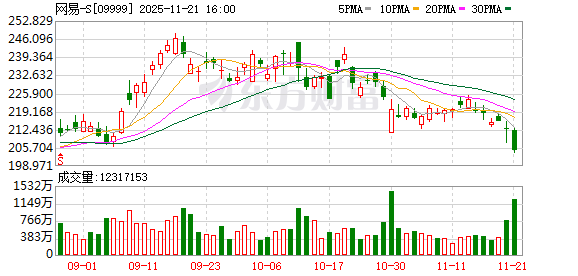
网易Q3营收284亿元,管理层透露游戏新品类开发计划
Guo Ji Jin Rong Bao· 2025-11-21 12:46
Core Insights - NetEase reported its Q3 financial results for the period ending September 30, 2025, showing a net revenue of 28.4 billion yuan, an increase of 8.2% year-over-year, and a net profit attributable to shareholders of 8.6 billion yuan, up 31.8% year-over-year [1] Group 1: Financial Performance - The company's gross profit for Q3 was 18.2 billion yuan, reflecting a year-over-year growth of 10.3% [1] - As of September 30, 2025, NetEase's net cash balance was 153.2 billion yuan, an increase from 131.5 billion yuan as of December 31, 2024 [1] - Non-GAAP net profit attributable to shareholders was 9.5 billion yuan, representing a year-over-year increase of 26.7% [1] Group 2: Business Segments - The gaming segment remains the core of NetEase's business, accounting for 82.04% of total revenue, with net revenue from games and related services reaching 23.3 billion yuan, a year-over-year increase of 11.8% [1] - Online games contributed 97.6% of the gaming revenue, driven by titles such as "Fantasy Westward Journey" and new releases like "Yanyun Sixteen Sounds" [1][2] - NetEase Youdao's net revenue was 1.628 billion yuan, a year-over-year increase of 3.6%, with online marketing services becoming the largest revenue source for the first time [4] Group 3: Game Development and Strategy - The company is focusing on high-quality game development, avoiding blind expansion into new products, and is committed to a more strategic approach in the coming years [2] - NetEase has closed at least seven overseas studios since 2024, including Jackalyptic Games and Bad Brain Game Studios, as part of a restructuring effort [2] - The game "Yanyun Sixteen Sounds" has shown strong performance overseas, reaching over 500,000 players within 40 minutes of launch and ranking in the top charts on Steam [3] Group 4: Other Business Segments - NetEase Cloud Music reported a year-over-year revenue decline of 1.8% to 2 billion yuan, while the "Innovation and Other" segment saw a more significant drop of 18.9%, with revenues of 1.4 billion yuan [4] - Youdao's online marketing services revenue grew by 51.1% to 740 million yuan, while learning services and smart hardware revenues declined significantly [4]
“神曲印钞机”轰鸣:从一首赚200万到一首赔2万
投中网· 2025-11-21 08:22
Core Insights - The article discusses the transformation of the music industry in China, highlighting the rapid growth of companies like Hai Kui Music and Kua Jing Music, which have significantly increased their revenue and employee count in a short period. Hai Kui Music achieved an annual output value of 600 million yuan and expanded from 29 to 500 employees within five years [4][5]. - Tencent Music Entertainment (TME) plays a crucial role in this transformation, forming alliances with numerous music companies and achieving a revenue growth of 20.6% to 8.46 billion yuan in Q3 2025, with a net profit increase of 27% [5][6]. - The rise of short videos has reshaped the music landscape, leading to a market where online music platforms capture more market share, while traditional record companies face existential threats [6][8]. Group 1: Industry Dynamics - The music industry is experiencing a shift from content creation to traffic generation, with platforms and artists focusing on producing catchy, viral songs to capture audience attention [16][17]. - The proliferation of music content has led to a saturation of the market, with platforms like QQ Music losing users to competitors that leverage short video and recommendation algorithms [18][20]. - The average revenue per thousand plays on domestic platforms is around 1 yuan, significantly lower than the 20-50 yuan seen on international platforms, indicating a challenging financial environment for artists [34]. Group 2: Challenges for Artists - Independent musicians face increasing pressure as the cost of music production remains high while revenue from streaming diminishes, leading to a situation where many artists are "losing money" on their creations [24][26]. - The industry is caught in a cycle of homogenization and low quality, with a significant increase in the number of demos submitted, making it harder for unique voices to stand out [27][28]. - The emergence of AI in music production poses a new challenge, as it can generate popular songs at a lower cost, further complicating the landscape for human artists [28]. Group 3: Future Outlook - Despite the challenges, there is a belief that the music industry will eventually find a balance between high-quality content and mass appeal, as companies like TME and NetEase Music invest in supporting original artists [42][46]. - The article suggests that the current environment may lead to a bifurcation in the music scene, with one side focusing on algorithm-driven hits and the other on traditional, high-quality music production [32][44]. - Optimism remains among some artists who continue to pursue their passion for music, believing that the market will eventually reward quality over quantity [46][48].


“神曲印钞机”轰鸣:从一首赚200万到一首赔2万
创业邦· 2025-11-20 10:31
Core Insights - The article discusses the rapid growth and transformation of the music industry in China, highlighting the success of companies like Hai Kui Music and TME (Tencent Music Entertainment) as they adapt to the rise of short video platforms and market demands [5][6][7]. Group 1: Company Growth and Performance - Hai Kui Music has grown from 29 employees to 500 in five years, generating an annual output value of 600 million [5]. - TME's revenue increased by 20.6% to 8.46 billion yuan in Q3 2025, with a net profit surge of 27%, marking eight consecutive quarters of double-digit growth [6]. - Chengdu's Kuaijing Music has seen a 47.7% year-on-year revenue growth in the first eight months of the year, making it one of the fastest-growing music industry regions in China [5]. Group 2: Industry Transformation - The music industry is undergoing a significant transformation due to the rise of short videos, leading to a market reshuffle where online music platforms are capturing more market share [7][9]. - Independent musicians and industry professionals are experiencing both opportunities and challenges in this changing landscape, with the emergence of "earworm" songs that generate substantial revenue for music companies [9][10]. Group 3: Challenges Faced by Musicians - Many independent musicians are struggling financially, with some reporting that their earnings from streaming are insufficient to cover production costs, leading to a situation where they are "losing money to make music" [25][34]. - The average revenue per thousand streams on domestic platforms is around 1 yuan, significantly lower than the 20-50 yuan seen on international platforms, creating a challenging environment for music creators [34]. Group 4: Market Dynamics and Consumer Behavior - The influx of new music content has not translated into listener engagement, with a significant portion of new releases going unheard, as older songs still dominate streaming platforms [29][32]. - The article notes a dichotomy in the music industry, where low-quality, mass-produced songs are prevalent, while high-quality music struggles to find an audience [32][44]. Group 5: Future Outlook - Despite the challenges, there is optimism among some industry players about the future of Chinese music, with ongoing efforts to improve the industry structure and support for quality content creation [45][47].

传媒月月谈:10月板块回调,关注估值修复
2025-11-20 02:16
Summary of Key Points from Conference Call Records Industry Overview - **Content Industry Policy Environment Improvement**: The introduction of the "21 Regulations" by the broadcasting authority encourages content innovation, with 2026 expected to be a critical observation period for content innovation and mechanism optimization, providing positive signals for industry development [1][2] - **AI Technology Empowering Content Production**: AI technology is anticipated to enhance efficiency and gradually penetrate content generation, leading to high levels of automation. This will revolutionize the gaming, advertising, and film sectors, fostering new user engagement methods and business models [1][2] - **Cultural Export Driving New Growth**: The export of high-quality Chinese content, particularly in gaming, online literature, and short dramas, is expected to create new growth opportunities and enhance China's cultural influence globally [1][2] - **IP Economic Value Enhancement**: The domestic IP industry chain is maturing, with leading content companies transitioning to IP operation ecosystems, improving commercialization potential and performance volatility. The rapid development of IP consumer products and derivatives is noted [1][2] Gaming Market Performance - **October Gaming Market Revenue Recovery**: In October, the overall revenue of domestic gaming apps increased by 1% year-on-year and 5% month-on-month. The new version of "Honkai: Star Rail" topped the iOS bestseller list in mainland China, with expectations for increased entertainment demand during the year-end and Spring Festival [1][3] - **Top Performing Games**: The top five games in October included "Honor of Kings," "Delta Force," "DNF Endless Winter," and "Peace Elite." New games launched between August and October that entered the top 100 include "Yise" by Xindong Company, "Bunbun Kingdom" by Century Huatuo, and "Dungeon Castle 4" by Taojing Interactive [3] Changes in Gaming Channels - **Significant Channel Changes**: Google Play opened third-party download and payment channels in the US on October 29, allowing external store downloads and third-party payments. Apple launched a mini-program partner plan on November 14, which may temporarily impact iOS gaming revenue but is expected to improve payment conversion rates and reduce user churn in the long term [4][5] Social Community and Advertising Sector - **Double Eleven Event Insights**: The Double Eleven shopping festival this year lasted over 30 days, with various e-commerce platforms simplifying promotional rules. Kuaishou invested 3 billion yuan in red envelopes and product subsidies, leading to significant growth in GMV for major brands [6] - **Advertising Trends**: Advertisers are increasingly focused on efficiency and ROI, maintaining a cautiously optimistic outlook, although some sectors still present upward opportunities [6] Digital Media Sector Updates - **October Viewing Trends**: Long-form drama effective views increased month-on-month but decreased year-on-year by approximately 4%. Major platforms' monthly active users were reported as follows: iQIYI (330 million), Tencent Video (360 million), Mango TV (250 million), and Youku (180 million) [7][8] Film Industry Insights - **Recent Box Office Performance**: October's box office was subdued, with total revenue down 28% to 2.6 billion yuan. The National Day holiday's impact and the withdrawal of some Japanese films due to geopolitical tensions affected performance. The 2025 annual box office is projected to maintain a neutral expectation of 49 billion yuan [14] - **Upcoming Film Releases**: Anticipated films include "Demon Slayer," "Mad World 3," "Avatar 3," and various domestic productions, with a focus on the timing of release schedules to align with market demand during the holiday season [14][15] Company-Specific Performance - **iQIYI's Q3 Performance**: iQIYI reported a net loss of 148 million yuan in Q3, with expectations for revenue growth in Q4 driven by the popularity of the IP series "Tang Dynasty Mysteries." The company anticipates a total revenue increase year-on-year and quarter-on-quarter [11] - **Tencent Music's Q3 Results**: Tencent Music reported a net profit of 2.41 billion yuan in Q3, a year-on-year increase of 32.6%. The company is focusing on live performances and IP agency business as key investment areas, which may lead to fluctuations in gross margin [12]
GenAI难破优质内容创作的“不可能三角”|破晓访谈
腾讯研究院· 2025-11-19 08:33
Core Viewpoint - Generative AI (GenAI) is igniting a profound paradigm shift in content production, breaking down barriers to high-quality dynamic content generation and pushing complex creative work into the realm of machines. This technological advancement brings both strategic anxiety and opportunity to the cultural industry, prompting a comprehensive rethinking of existing value chains, business models, and content ecosystems [2]. Group 1: Application of GenAI - In fields like online literature and music, GenAI is widely applied throughout the entire production process, with platforms embedding easily accessible AI generation tools, leading to generalized and socialized creative capabilities. The industry widely believes that content creation should adhere to "human-machine collaboration" while enhancing production efficiency through "engineering" [7]. - GenAI's fundamental difference from previous technologies lies in its potential to replace certain human capabilities, evolving into a "new species" that competes directly with humans. AI-generated content will "eliminate mediocrity," forcing human creators to strive for higher quality, shifting the industry from "quantity competition" to "quality competition" [7]. - The emergence of "super individuals" or "micro-teams" will become the new norm, with "human-machine collaboration" as the core competitive advantage. Future content producers must be adept at harnessing AI, acting as "directors" or "architects" in the creative process [7]. Group 2: Impact on Cultural Industry - GenAI will disrupt the existing interests within the cultural industry, with copyright confirmation and revenue distribution becoming core challenges and significant opportunities for reshaping the industry. The potential for "super individuals" to bypass intermediaries and connect directly with consumers may lead to new business models [8]. - Consumer acceptance of AI-generated content hinges on content quality. GenAI is driving a shift in consumer motivation from superficial "emotional stimulation" to deeper "emotional and value recognition," creating a new blue ocean of content composed of numerous small yet exquisite IPs [8]. - The traditional "talent growth path" in the content industry may face disruption due to GenAI, which excels in "diversity" but poses challenges in "controllability." There is a need to be cautious about AI eroding the significance of creation and the soil for talent growth [9]. Group 3: Insights from Industry Experts - Industry experts emphasize that while GenAI is making strides in various cultural content forms, the actual implementation of "cost reduction and efficiency enhancement" in content production remains to be fully realized. The current capabilities of GenAI are still limited, and human creators will continue to play a crucial role in high-quality outputs [10]. - The music industry is witnessing a significant shift, with many companies adopting AI for music creation and production processes. However, while AI can generate music, it still relies heavily on user input and creativity to achieve desired results [11]. - The concept of "content engineering" is gaining traction, where the creative process is standardized and can be automated to a degree, allowing for rapid production of content while still requiring human creativity for high-quality outcomes [12]. Group 4: Future of Content Production - The future landscape of content production may see a shift towards direct engagement between creators and platforms, with the potential for individual creators to establish their own brands and sell their works directly to consumers [24]. - The emergence of new roles in the music industry, such as those who can effectively collaborate with AI tools, will be crucial. The industry may see a rise in "bedroom musicians" who can independently create and monetize their music using AI [20]. - The acceptance of AI-generated content by consumers will depend on the perceived quality of the output. As AI-generated works improve, consumers may become indifferent to whether content is created by humans or machines, leading to a potential oversaturation of average-quality content [27][28]. Group 5: Concerns and Challenges - There are concerns that the rise of AI in content creation may lead to a lack of growth opportunities for emerging creators, as reliance on AI could hinder the traditional learning and development processes necessary for becoming skilled authors [31]. - The music industry may face significant challenges as AI-generated music becomes more prevalent, potentially displacing many current musicians and altering the landscape of music creation [32]. - The relationship between human creativity and machine-generated content presents a "impossible triangle" scenario, where achieving low labor costs, low machine costs, and high-quality output simultaneously may not be feasible [33].