
资产管理

Search documents
Correction: Amundi announces new 2025-2028 strategic plan to drive continued value creation and invest in long-term leadership
Globenewswire· 2025-11-18 12:10
Core Viewpoint - Amundi has announced its new strategic plan for 2025-2028, titled "Invest for the Future," which aims to enhance value creation, diversify client segments, and expand geographical reach while focusing on innovation and operational efficiency [2][6][11]. Strategic Priorities - The plan outlines six strategic priorities aimed at generating over €300 billion in net inflows by 2028, including a focus on retirement solutions and digital distribution [7][10]. - Amundi aims to generate more than €100 billion in net inflows from retirement solutions by capitalizing on the shift to defined-contribution plans and individualised solutions [7]. - The company plans to grow its digital client base by 50% by 2028, enhancing the investment propositions for digital players and traditional banks [7]. Financial Targets - Amundi targets earnings per share of more than €7 by 2028 under a constant market and forex scenario [9][10]. - The company aims to achieve an industry-leading cost-income ratio below 56% during the plan period [9][10]. - A commitment to a payout ratio of at least 65% for shareholders is established for the period 2025-2028 [11]. Geographical Expansion - The strategic plan includes capturing over €150 billion in net inflows from Asia by 2028, leveraging a strong regional presence and partnerships [10]. - Continued growth is expected in core European markets, with a focus on Northern Europe, including the UK, Germany, Benelux, and the Nordics [10]. Innovation and Technology - Amundi plans to drive innovation by investing in active, passive, and private assets, including launching 100 new ETFs by 2028 [10]. - The company aims to double its technology revenues by 2028, focusing on wealth management tech opportunities and enhancing its AI capabilities [10]. Operational Efficiency - The plan emphasizes optimizing the operating model to enhance efficiency, including the use of AI to support process optimization and resource reallocation to growth areas [10]. - Amundi intends to invest €800 million in organic growth initiatives across priority areas during the plan horizon [10].

帅丰电器拟出资5300万元参与认购投资基金份额 拓展多元投资渠道
Zhi Tong Cai Jing· 2025-11-18 11:56
Core Viewpoint - The company, Shuaifeng Electric (605336.SH), is seizing investment opportunities in emerging industries by diversifying its investment channels through a partnership with several entities to invest in a venture capital fund [1] Group 1 - The company plans to invest a total of RMB 53 million as a limited partner in the Xiamen Chip Force Lan No. 2 Venture Capital Fund Partnership (Limited Partnership) [1] - The investment is made in collaboration with Advantage Jin Kong (Shanghai) Asset Management Co., Fujian Bingzhong Investment Co., Jiushitongyuan (Shanghai) Digital Technology Co., Hangzhou Huifang Private Fund Management Co., and several individuals [1]

澳大利亚主权财富基金增持黄金,预警全球经济“新型冲击”风险
第一财经· 2025-11-18 10:18
Core Viewpoint - The Future Fund of Australia highlights increasing risks of "more frequent and intense new shocks" to the global economy, prompting a shift in asset allocation towards gold, actively managed stocks, and hedge funds [3][5]. Group 1: Investment Strategies - The Future Fund has raised its allocation to gold and other commodities to provide asymmetric protection against supply-driven inflation and stagflation [5]. - The fund's strategy includes reducing nominal government bond exposure, increasing inflation-linked bonds, and expanding investments in real assets like infrastructure [5]. - The report emphasizes that physical assets, particularly commodities, can offer strong hedging effects during high unexpected inflation periods [5]. Group 2: Global Gold Demand Trends - Global gold demand increased by 1% year-on-year in the first ten months of this year, reaching 3,717 tons, with a 41% rise in value to $384 billion [3]. - Central banks have shown a strong inclination to increase gold reserves, with 47% planning to buy more gold as a strategic tool against geopolitical and financial risks [7]. - In the first three quarters of this year, global central bank gold purchases reached 220 tons, a 28% increase from the previous quarter [7]. Group 3: Future Price Projections - Goldman Sachs projects that gold prices could rise to $4,900 per ounce by the end of 2026, with current spot prices around $4,011 per ounce [3][8]. - Other financial institutions, including Bank of America and Morgan Stanley, have also raised their gold price forecasts for 2026, indicating a bullish outlook for the precious metal [8].


高盛资管:美股“七巨头”或加剧分化 新兴市场明年有望跑赢大盘
Zhong Zheng Wang· 2025-11-18 10:11
中证报中证网讯(记者 葛瑶)11月18日,高盛资产管理发布2026年投资展望报告认为,在人工智能投 资持续推进的背景下,美国科技巨头仍将保持增长动能,但"七巨头"内部业绩分化或将加剧。此外,新 兴市场股票有望凭借估值优势和盈利跑赢整体市场。 在美股方面,高盛资管认为"七巨头"凭借强大的核心业务和战略再投资继续扩大市场份额,这些公司强 劲的盈利能力有望为进一步的增长奠定基础。超大规模企业的人工智能资本支出应在2026年持续。然 而,强者更强的趋势并非完全一致,这些大型企业迄今为止表现出的业绩同质性可能出现变化,差异扩 大。 高盛资产管理投资组合经理格雷格·图尔托(Greg Tuorto)表示:"小盘股有望实现增长,尤其在国防、 科技、消费以及日益增长的医疗保健领域。然而,较高的波动性和流动性风险需要更优秀的主动管理能 力,以识别高潜力的变革型龙头,并且应对主题过热带来的风险。" 2026年,高盛资管认为新兴市场有跑赢整体市场的可能。其称,2025年,美元走弱、油价下跌、通胀缓 解以及美联储鸽派立场等多重宏观条件支持新兴市场。新兴市场股票目前的远期市盈率较美国股票折价 约40%,低于长期平均水平。鉴于新兴市场强劲 ...
澳大利亚主权财富基金增持黄金,预警全球经济“新型冲击”风险
Di Yi Cai Jing· 2025-11-18 09:31
Core Insights - The global investment landscape is undergoing a fundamental shift, with traditional rules becoming less effective and uncertainty increasing significantly [1][4] - The Future Fund of Australia has raised its allocations to gold, actively managed stocks, and hedge funds in response to these changes [1][4] - Central banks are increasingly diversifying their reserves and increasing gold holdings as a strategic tool to hedge against geopolitical and financial risks [6] Group 1: Investment Strategies - The Future Fund aims for long-term returns exceeding 4% to 5% above the consumer price index (CPI) while managing risk at an acceptable level [4] - The fund's strategy includes reducing nominal government bond exposure, increasing inflation-linked bonds, and expanding allocations to commodities like gold to provide asymmetric protection against supply-driven inflation [4][5] - The report emphasizes that physical assets, particularly commodities, can provide strong hedging effects during periods of unexpected high inflation [5] Group 2: Gold Demand and Price Projections - Global gold demand increased by 1% year-on-year in the first ten months of the year, reaching 3,717 tons, with a value increase of 41% to $384 billion [1] - Goldman Sachs projects that gold prices could rise to $4,900 per ounce by the end of 2026, with current spot prices around $4,011 per ounce [2] - Central banks are expected to continue significant gold purchases, with a projected average monthly purchase of 80 tons from Q4 2025 to 2026 [6] Group 3: ETF Trends - Global physically-backed gold ETFs have seen net inflows for five consecutive months, with October's inflow reaching $8.2 billion, indicating strong annual performance [7] - As of the end of October, total assets under management (AUM) for global gold ETFs increased by 6% to $503 billion, with holdings rising to 3,893 tons [7] - Major financial institutions have raised their gold price forecasts, with Bank of America projecting a target price of $5,000 per ounce by 2026 [7]

资管巨头发声 看多亚洲尤其是中国
Zhong Guo Ji Jin Bao· 2025-11-18 09:27
Core Insights - Allianz Investment emphasizes that the Asian market, particularly the Chinese stock market, is a key diversification choice for investors who are currently overexposed to U.S. equities [1][5]. Group 1: U.S. Monetary Policy and Fixed Income - Allianz's Chief Investment Officer for Fixed Income, Zeng Zheng, predicts further interest rate cuts by the Federal Reserve, with a terminal rate of around 3.5% by mid-2026 [1][3]. - Zeng highlights that fixed income remains a core tool for capital preservation amid macroeconomic volatility and policy divergence, urging investors to focus on maintaining portfolio resilience through prudent duration management [3][4]. - The investment return drivers are shifting, with 2025 returns driven by credit spread narrowing, while 2026 is expected to be primarily driven by spreads [3]. Group 2: Asian Market Opportunities - Zeng notes that many investors are heavily weighted in U.S. stocks, particularly in large tech sectors, and there is a trend of capital returning to Asia from global markets [6]. - The current low allocation of global investors to Asian stocks presents a significant opportunity, especially as Asian stocks have a low correlation with U.S. equities, making them a critical diversification choice [6]. Group 3: Key Investment Themes in Asia - Four major themes driving investment opportunities in Asian stocks include: 1. Innovation in technology manufacturing, particularly in semiconductors, AI, and biotechnology, especially in China and South Korea [7]. 2. Corporate reforms in China, South Korea, Japan, and Singapore aimed at enhancing shareholder value through buybacks and improved governance [7]. 3. Supply chain diversification benefiting markets like India as companies reduce geopolitical and operational concentration [7]. 4. Emerging consumer trends driven by growing domestic consumption and digital infrastructure, particularly in China and India [7]. Group 4: China's Economic Strategy - Allianz's Senior Economist for Asia, Tang Jicheng, identifies two key focuses of China's economic strategy: continued investment in advanced manufacturing and efforts to boost domestic consumption [9]. - The "14th Five-Year Plan" outlines five strategic areas for attention, including modern industrial systems, technological breakthroughs, a unified domestic market, human-centered urbanization, and international cooperation [10]. Group 5: Asset Allocation and Gold - Allianz's Head of Multi-Asset Growth, Hartwig Kos, indicates that risk assets remain attractive, with a shift towards more diversified global allocations beyond U.S. equities [13]. - Gold is reaffirmed as a strategic asset, increasingly driven by geopolitical uncertainty and de-dollarization, making it a vital component of a low-correlation, robust multi-asset investment portfolio [13]. Group 6: Sustainable Investment Trends - Allianz's Head of Sustainable and Impact Investing, Matt Christensen, notes that sustainable investment regulation is entering a new phase, with a shift from mere disclosure to clearer product classifications in the EU [15]. - Impact investing is maturing, with growing recognition of achieving market-level returns, particularly in private markets, supported by clearer outcome and reporting standards [16].
资管巨头发声,看多亚洲尤其是中国
Zhong Guo Ji Jin Bao· 2025-11-18 09:12
Core Viewpoint - Allianz Investment emphasizes that Asian markets, particularly the Chinese stock market, are key diversification choices for investors who are currently overexposed to US equities [1][4]. Group 1: US Federal Reserve and Interest Rates - Allianz's Chief Investment Officer for Fixed Income, Zeng Zheng, predicts further interest rate cuts by the US Federal Reserve, with a terminal rate of around 3.5% by mid-2026 [2]. - Zeng notes that the likelihood of the Fed choosing to cut rates is greater than maintaining the current rates, although the exact timing remains uncertain [2]. - Fixed income is highlighted as a core tool for capital preservation amid macroeconomic volatility, with a shift in return drivers expected from credit spreads to interest rate spreads by 2026 [2][3]. Group 2: Investment Opportunities in Asia - Zeng Yonghui, Chief Investment Officer for Asia Pacific equities, points out that many investors are overly concentrated in US stocks, particularly in large tech sectors, and are now reallocating to Asian assets [4]. - The current low allocation of global investors to Asian stocks presents a significant opportunity, especially as Asian stocks have a low correlation with US stocks [4]. - Four key themes driving investment opportunities in Asian stocks include innovation in technology, corporate reforms in major Asian economies, supply chain diversification, and emerging consumer trends [5]. Group 3: China's Economic Strategy - Allianz's Senior Economist, Tang Jicheng, identifies two main focuses of China's economic strategy: continued investment in advanced manufacturing and boosting domestic consumption [7]. - The "14th Five-Year Plan" outlines five strategic areas for attention, including modern industrial systems, technological breakthroughs, a unified domestic market, human-centered urbanization, and international cooperation [8]. Group 4: Multi-Asset Investment Strategies - Allianz's Head of Growth Multi-Asset, Hartwig Kos, notes that risk assets remain attractive, with a shift towards more diversified global allocations beyond US equities [10]. - The traditional "60/40" stock-bond portfolio remains viable, but flexibility and inclusion of non-core risk exposures like emerging market bonds and gold are essential for resilience [10]. - Gold is reaffirmed as a strategic asset, increasingly driven by geopolitical uncertainties and de-dollarization, making it a crucial component of a diversified investment portfolio [10]. Group 5: Sustainable Investment Trends - Allianz's Head of Sustainable and Impact Investing, Matt Christensen, indicates that sustainable investment regulation is entering a new phase, with a shift from mere disclosure to clearer product classifications in the EU [11]. - Impact investing is maturing, with growing recognition of achieving market-level returns, particularly in private markets, supported by clearer standards for outcomes and reporting [12].
资管巨头发声,看多亚洲尤其是中国
中国基金报· 2025-11-18 09:02
Core Viewpoint - Allianz Investment emphasizes that the Asian market, particularly the Chinese stock market, is a key diversification choice for investors who are currently overexposed to the US stock market [10][11]. Group 1: Market Outlook - Allianz Investment's Chief Investment Officer for Fixed Income, Zeng Zheng, predicts that the Federal Reserve will further cut interest rates, with the terminal rate expected to be around 3.5% by mid-2026 [5][7]. - Zeng notes that recent US policy signals suggest a potential stabilization in inflation data, although employment data may weaken [6][7]. - The investment return drivers are shifting, with 2025 returns driven by credit spread narrowing, while 2026 returns are likely to be primarily driven by spreads [8]. Group 2: Investment Opportunities in Asia - Zeng highlights that many investors are overly concentrated in US stocks, particularly in large tech sectors, and there is a trend of Asian investors reallocating funds back to Asian assets [11]. - Four key themes driving investment opportunities in Asian stocks include: 1. Innovation in technology manufacturing, especially in semiconductors, AI, and biotechnology [12]. 2. Corporate reforms in China, Korea, Japan, and Singapore aimed at enhancing shareholder value [12]. 3. Supply chain diversification benefiting markets like India due to reduced geopolitical concentration [12]. 4. Emerging consumer trends driven by domestic consumption and digital infrastructure, particularly in China and India [12]. Group 3: China's Economic Strategy - Allianz Investment's Senior Economist, Tang Jicheng, identifies two main focuses of China's economic strategy: continued investment in advanced manufacturing and boosting domestic consumption [14]. - The "14th Five-Year Plan" suggests five strategic areas to watch: 1. Building a modern industrial system with a focus on advanced manufacturing and green transformation [15]. 2. Achieving substantial technological breakthroughs to enhance innovation capabilities [15]. 3. Establishing a strong domestic market to promote free flow of production factors [15]. 4. Promoting human-centered urbanization for balanced regional development [15]. 5. Strengthening international cooperation to enhance bilateral investments [15]. Group 4: Asset Allocation and Gold - Allianz Investment's Head of Multi-Asset Growth, Hartwig Kos, notes that risk assets remain attractive, with a shift towards more diversified global allocations beyond the US stock market [19]. - Gold has reestablished its status as a strategic asset, increasingly driven by geopolitical uncertainties and de-dollarization, making it a crucial component of a diversified investment portfolio [20]. - Hartwig Kos anticipates that the trend of investing in gold will continue until 2026, supported by retail investment flows and geopolitical tensions [20]. Group 5: Sustainable Investment Trends - Allianz Investment's Head of Sustainable and Impact Investing, Matt Christensen, indicates that sustainable investment regulation is entering a new phase, with a shift from mere disclosure to clearer product classifications in the EU [21]. - Impact investing is maturing, with growing recognition of achieving market-level returns, particularly in private markets [21]. - Allianz has developed proprietary tools to integrate ESG and impact risk analysis into portfolio construction, enabling scenario testing and risk mitigation strategies across asset classes [22].

币圈深陷熊市之际,“山寨币”ETF上市潮来了,Solana ETF已上市,接下来是DOGE币
Hua Er Jie Jian Wen· 2025-11-18 07:32
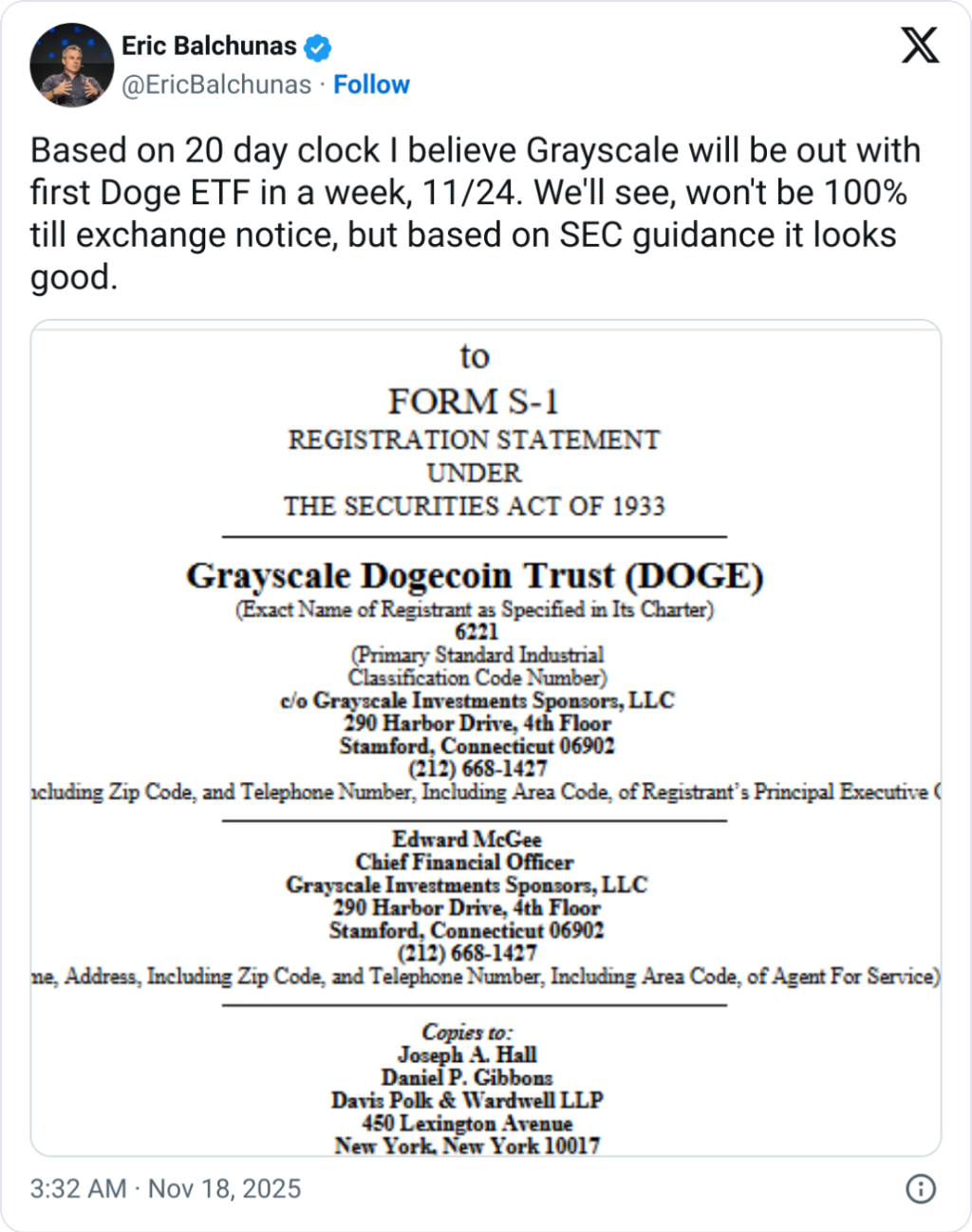
Group 1 - The landscape of cryptocurrency exchange-traded funds (ETFs) is rapidly expanding, with new products focused on altcoins like Solana and Dogecoin entering the market, providing investors with more diversified exposure to digital assets [1] - VanEck launched its Solana ETF (VSOL), becoming the third ETF in the U.S. market to offer staking rewards for Solana, following Bitwise and Grayscale, which have collectively attracted over $380 million since their launch [1][2] - The upcoming Dogecoin ETF from Grayscale is expected to launch as early as November 24, potentially becoming the first ETF in the U.S. to directly hold Dogecoin [1][3] Group 2 - The competition among Solana-related ETFs is intensifying, with VanEck adopting an aggressive pricing strategy by waiving its 0.3% management fee until February 17 or until the fund reaches $1 billion in assets [2] - Fidelity's Solana ETF (FSOL) is set to launch with a fee of 0.25%, directly competing with existing funds [2] - Grayscale plans to convert its existing Grayscale Dogecoin Trust (DOGE) into a spot ETF, which is currently in a 20-day grace period for regulatory approval [3][5] Group 3 - The surge in altcoin ETFs is primarily driven by changes in the regulatory environment, as the SEC relaxed listing standards in September, allowing for faster approval processes [5] - Prior to this, there were different structures of related products, such as the DOGE ETF launched by REX Shares and Osprey Funds, which is registered under the Investment Company Act of 1940 and does not directly hold the cryptocurrency [6][7]
国金资管王斯杰:坚守长期价值 以哑铃型配置力争穿越市场周期
Zheng Quan Ri Bao· 2025-11-18 05:26
Core Viewpoint - The core investment philosophy emphasizes long-termism, focusing on sustainable value rather than short-term gains [2][5][6] Investment Philosophy - The investment strategy is centered around long-term value investment, avoiding the temptation of chasing popular trends [2] - The manager advocates for a "barbell strategy" that balances high-growth stocks with assets that have measurable intrinsic value, adjusting weights based on market conditions [2][3] Market Focus - The AI and robotics sectors are highlighted as key areas of investment interest, with AI expected to drive the next wave of technological change despite short-term uncertainties in application and commercialization [3][4] - Investment opportunities in AI are identified in two main paths: companies providing essential equipment for the AI industry and those with strong application capabilities [3] Robotics Sector - The robotics industry is still in its early stages of industrialization, with uncertainties in technology choices and cost control, necessitating ongoing research to identify investment opportunities [4] Product Selection - Emphasis is placed on selecting fund managers with a strong alignment of values and investment frameworks, advocating for diversified, low-correlation asset combinations to mitigate risks [5] - The investment approach involves a cautious mindset, focusing on undervalued assets during downturns and realizing gains when valuations are high [5] Future Outlook - The market is anticipated to be in a phase of structural optimization and diversification of opportunities by 2026, with a focus on structural shifts and rebalancing as key investment themes [5]