互联网服务

Search documents
百度20250820
2025-08-20 14:49
Summary of Baidu's Earnings Call Company Overview - **Company**: Baidu - **Quarter**: Q2 2025 - **Total Revenue**: 227 billion RMB, a decrease of 4% year-over-year [2][17] Key Financial Highlights - **Non-Online Marketing Revenue**: 100 billion RMB, an increase of 34% year-over-year, driven by AI cloud business [2][3] - **AI Cloud Revenue**: 65 billion RMB, a growth of 27% year-over-year [2][12] - **Operating Costs**: 184 billion RMB, an increase of 12% year-over-year [17] - **Net Income**: 73 billion RMB, with diluted earnings per share of 20.35 RMB [18][17] - **Free Cash Flow**: Negative 4.7 billion RMB, primarily due to increased investments in AI [19] AI Business Developments - **AI Transformation**: 64% of mobile search result pages utilized AI-generated content by July 2025, with over 90% of monthly active users experiencing AI transformation [2][10] - **AIGC Video Generation**: Millions of AIGC videos generated daily, with rapid growth in video distribution within Baidu applications [2][10] - **Digital Human Technology**: Significant advancements in realism and capabilities, generating tens of millions in GMV through live commerce [4][5][16] Apollo Autonomous Driving Progress - **Service Volume**: Over 2.2 million fully autonomous rides provided in Q2 2025, a 148% increase year-over-year [7][14] - **Global Expansion**: Partnerships with Uber and Lift to accelerate market penetration, covering 16 cities with over 200 million kilometers driven [7][14] AI Cloud Business Achievements - **Core Competitive Advantage**: Unique four-layer AI architecture driving healthy growth in AI cloud business [6][12] - **Subscription Revenue**: Over half of AI cloud revenue derived from subscription services, showing stable growth [22] Strategic Partnerships - **Collaborations**: Strategic partnerships established with leading lifestyle platforms and top gaming companies, enhancing AI cloud recognition [13] Search Functionality Enhancements - **Task Completion**: Expansion of search capabilities from providing answers to completing tasks, facilitating end-to-end service connections [11][23] Cost Optimization and Profitability Outlook - **Cost Management**: Focus on improving internal efficiency and resource coordination to protect profit margins amid advertising revenue challenges [26][27] - **Future Profitability**: Gradual improvement in profit margins expected as core advertising business stabilizes and non-advertising revenue increases [27] Market Position and Competitive Landscape - **AI Model Market**: Rapid iteration of AI models, with a focus on application-oriented innovation to meet diverse market needs [20][21] - **Sustainable AI Cloud Demand**: Growing demand for AI-driven cloud solutions across various industries, with a focus on cost-effective, high-performance solutions [25] Conclusion - Baidu's Q2 2025 performance reflects a strategic pivot towards AI and cloud services, with significant growth in non-online marketing revenue and advancements in autonomous driving technology. The company is focused on optimizing costs and enhancing profitability while navigating a competitive landscape in AI and cloud services.

联掌门户上涨2.5%,报3.28美元/股,总市值4.99亿美元
Jin Rong Jie· 2025-08-20 13:52
Core Insights - LZMH's stock price increased by 2.5% to $3.28 per share, with a total market capitalization of $499 million as of August 20 [1] - The company reported total revenue of 823 million RMB for the year ending December 31, 2024, representing a year-on-year growth of 44.64% [1] - Net profit attributable to shareholders reached 5.542 million RMB, showing a significant increase of 189.26% year-on-year [1] Company Overview - LZMH is a Cayman Islands-registered holding company primarily operating through its domestic subsidiary, LZMH Network Technology Co., Ltd [1] - The company focuses on community family life services, utilizing IoT access screens to create a community service platform [1] - LZMH aims to establish an interactive community environment centered around smart hardware screens, leveraging data collection and information dissemination [1] Business Model - The company positions its screen count as a competitive advantage, with community traffic as a key resource and service providers as the workforce [1] - LZMH's revenue model is based on an advertising platform, completing the first community life ecosystem layout in China [1]
股票行情快报:今天国际(300532)8月20日主力资金净卖出144.81万元
Sou Hu Cai Jing· 2025-08-20 12:25
Core Viewpoint - The stock of Today International (300532) has shown a decline in both share price and financial performance, with significant outflows from institutional and retail investors, indicating potential concerns about the company's future performance [1][2]. Financial Performance - As of the mid-2025 report, Today International reported a main revenue of 1.412 billion yuan, a year-on-year decrease of 14.36% [2] - The net profit attributable to shareholders was 188 million yuan, down 22.53% year-on-year [2] - The net profit after deducting non-recurring items was 158 million yuan, a decline of 31.25% year-on-year [2] - The company's second-quarter performance showed a main revenue of 707 million yuan, down 19.69% year-on-year, and a net profit of 118 million yuan, down 18.35% year-on-year [2] Market Position - Today International's total market capitalization is 6.034 billion yuan, ranking 84th out of 145 in the internet services industry [2] - The company has a price-to-earnings ratio of 16.06, significantly lower than the industry average of 383.71, ranking 2nd in the industry [2] - The return on equity (ROE) stands at 10.53%, placing the company 1st in the industry [2] Investor Sentiment - On August 20, 2025, the stock closed at 13.31 yuan, down 0.45%, with a turnover rate of 3.9% and a trading volume of 168,000 hands [1] - The net outflow of main funds was 1.4481 million yuan, accounting for 0.65% of the total trading volume, while retail investors saw a net inflow of 6.5182 million yuan, representing 2.92% of the total trading volume [1]


易点天下:与APPLovin的合作,强化了公司全球流量整合能力
Zheng Quan Ri Bao Zhi Sheng· 2025-08-20 10:39
Group 1 - The core viewpoint of the article highlights that the collaboration between the company and APPLovin enhances the company's global traffic integration capabilities and expands the e-commerce customer growth market [1] - The company asserts that there is no competition or impact from this partnership, indicating a smooth and orderly progression of their collaboration [1]

小米汽车,差点就盈利了
21世纪经济报道· 2025-08-20 10:37
Core Viewpoint - Xiaomi Group's Q2 2025 financial report shows significant growth in revenue and adjusted net profit, driven by its automotive business, IoT, and internet services, despite challenges in its smartphone segment [4][6]. Financial Performance - Xiaomi reported Q2 revenue of 116 billion yuan, a year-on-year increase of 30.5%, and an adjusted net profit of 10.8 billion yuan, up 75.4% [4]. - The automotive business generated 20.6 billion yuan in revenue from the delivery of 81,300 vehicles, with a gross margin of 26.4% [6][9]. - The operating loss in the automotive sector decreased from 500 million yuan in Q1 to 300 million yuan in Q2, marking a 40% improvement [9][12]. Business Segments Smartphone Business - Smartphone revenue was 45.5 billion yuan, accounting for 39.3% of total revenue, but showed a decline of 2.1% year-on-year and 10.1% quarter-on-quarter [14]. - The average selling price (ASP) of smartphones fell to 1,073 yuan, down 11.3% from the previous quarter [15]. - Despite challenges, Xiaomi maintained a 14.7% market share globally, ranking third, and regained the top position in Southeast Asia with an 18.9% market share [16]. IoT and Internet Services - IoT revenue reached 38.7 billion yuan, a 44.7% increase year-on-year, with a gross margin of 22.5% [17]. - Internet services generated 9.1 billion yuan, growing 10.1% year-on-year, with a high gross margin of 75.4% [20]. - The IoT segment is becoming a significant profit source, surpassing the smartphone business in gross margin contribution [20]. Cost Management - Xiaomi's overall expense ratio decreased to 13.9%, down 2.2 percentage points year-on-year, indicating effective cost control despite entering the automotive sector [22]. - R&D expenses were 7.8 billion yuan, with a slight decrease in the R&D expense ratio due to revenue growth outpacing absolute spending [24]. - The company leveraged shared R&D resources across its product lines, enhancing efficiency [24]. Automotive Business Outlook - Xiaomi's automotive business is close to profitability, with a theoretical net loss of approximately 6,000 yuan per vehicle, indicating that minor adjustments could lead to profitability [11][12]. - The company aims to deliver 350,000 vehicles by the end of the year, with production capacity increasing [12]. - The automotive sector's rapid growth and decreasing losses suggest a potential for achieving quarterly profitability by late 2025 or early 2026 [12].

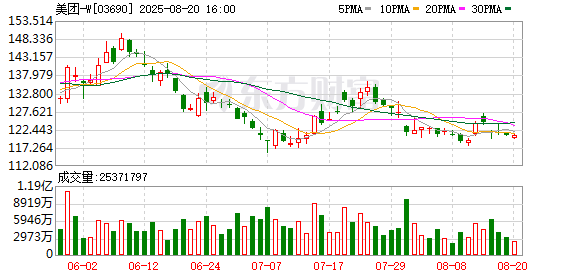
摩根大通在美团-W的持股比例于8月15日从5.96%升至6.04%
Mei Ri Jing Ji Xin Wen· 2025-08-20 09:21
(文章来源:每日经济新闻) 每经AI快讯,8月20日,香港交易所信息显示,摩根大通在美团-W的持股比例于8月15日从5.96%升至 6.04%,平均股价为121.3056港元。 ...

百度集团第二季度营收327亿元人民币,预估327.4亿元人民币
Hua Er Jie Jian Wen· 2025-08-20 09:05
Core Insights - Baidu Group reported an adjusted operating profit of 4.4 billion RMB for the second quarter, exceeding the forecast of 3.97 billion RMB [1] Financial Performance - The adjusted operating profit of 4.4 billion RMB indicates a strong performance compared to market expectations [1] - The forecasted profit of 3.97 billion RMB was surpassed, showcasing the company's ability to outperform analyst predictions [1]
资金抢筹海外上市的中国资产ETF,KWEB、MCHI、FXI吸金
Ge Long Hui· 2025-08-20 08:57
Group 1 - Global hedge funds are buying Chinese stocks at the fastest pace since the end of June, according to Goldman Sachs Prime Brokerage data [1] - The stock purchases are primarily driven by long positions, with short covering as a secondary factor, at a ratio of approximately 9:1 [2] - China has seen the highest net buying in Prime business since August [2] Group 2 - There has been significant capital inflow into overseas-listed Chinese asset ETFs, including KWEB, MCHI, and FXI over the past month [3] - KWEB is an ETF focused on Chinese internet companies, while MCHI tracks the MSCI China Index, investing in A-shares and Hong Kong stocks across various sectors [4][5] - FXI is an ETF that tracks the FTSE China 50 Index, covering the largest and most liquid 50 stocks listed in Hong Kong [6] Group 3 - As of August 15, the top ten holdings in FXI include major companies such as Tencent, Alibaba, and Xiaomi [7] - Global actively managed public funds had a 6.4% allocation to Chinese stocks as of the end of July, which is below the historical average of 13% over the past decade [7] - Despite increased interest from overseas investors, the current allocation level remains conservative, indicating a potential for market upward momentum [7] Group 4 - Recent domestic policies in China are seen as favorable for stock market performance, attracting more long-term foreign capital [7] - Analysts highlight that the valuation of major Chinese assets is relatively low compared to historical levels, making A-share blue chips more attractive than high P/E ratios of large U.S. tech companies [7] - The outlook for Chinese securities is positive due to potential foreign capital inflows and stabilizing international geopolitical risks [7]
小米汽车,差点就盈利了
投中网· 2025-08-20 07:20
Core Viewpoint - Xiaomi Group's Q2 2025 financial report shows significant growth in revenue and adjusted net profit, driven by its automotive business and other segments, despite challenges in its smartphone division [6][8]. Financial Performance - Q2 revenue reached 116 billion yuan, a year-on-year increase of 30.5%, while adjusted net profit was 10.8 billion yuan, up 75.4% [6]. - The automotive business delivered 81,300 vehicles, generating 20.6 billion yuan in revenue with a gross margin of 26.4% [9][15]. Automotive Business Insights - The automotive division's operating loss decreased from 500 million yuan in Q1 to 300 million yuan in Q2, marking a 40% improvement [9][12]. - The gross margin for the automotive business improved from 23.2% in Q1 to 26.4% in Q2, indicating effective cost management and scale effects [13][14]. - Xiaomi's automotive business is close to profitability, needing to reduce costs or increase margins by approximately 6,000 yuan per vehicle to break even [16][20]. Smartphone Business Challenges - Smartphone revenue was 45.5 billion yuan, accounting for 39.3% of total revenue, but showed a decline of 2.1% year-on-year and 10.1% quarter-on-quarter [19]. - The average selling price (ASP) of smartphones fell to 1,073 yuan, down 11.3% quarter-on-quarter, reflecting increased competition and a shift to lower-priced models [21]. IoT and Internet Services Growth - IoT and lifestyle product revenue reached 38.7 billion yuan, a 44.7% increase year-on-year, with a gross margin of 22.5% [22]. - Internet services revenue was 9.1 billion yuan, growing 10.1% year-on-year, with a high gross margin of 75.4% [23][24]. Cost Management and Efficiency - Xiaomi's overall expense ratio decreased to 13.9%, down 2.2 percentage points year-on-year, showcasing effective cost control despite entering the automotive sector [28]. - The company achieved cost efficiency through scale effects and shared R&D investments across its product lines [29][30]. Future Outlook - With a backlog of over 200,000 orders for the YU7 model, Xiaomi is well-positioned to meet its annual target of 350,000 vehicle deliveries [17]. - The automotive business is expected to achieve quarterly profitability by late 2025 or early 2026, potentially ahead of competitors like Xpeng and NIO [17].

摩根斯坦利&瑞银:小米二季报解读,汽车业务高毛利率弥补手机疲软,下半年关键看北京第二工厂产能爬坡48/64
美股IPO· 2025-08-20 04:29
Core Viewpoint - The electric vehicle (EV) business has become the biggest highlight for Xiaomi in the latest quarter, with both Morgan Stanley and UBS emphasizing that EV deliveries will be a key driver for the stock price in the second half of the year [1][5][11]. Financial Performance - Xiaomi's Q2 2025 adjusted net profit reached 10.831 billion RMB, a year-on-year increase of 75.4%, marking the highest quarterly profit in history [3]. - Total revenue for Q2 reached 115.956 billion RMB, a year-on-year growth of 30% and a quarter-on-quarter growth of 4%, exceeding Morgan Stanley's expectations by 3% [15]. - The company's overall gross margin improved to 22.5%, up 1.8 percentage points year-on-year, but down 0.3 percentage points quarter-on-quarter [8]. Business Segment Analysis - The EV business showed a gross margin of 26.4%, significantly up by 3.3 percentage points quarter-on-quarter, indicating strong profit potential [8]. - AIoT business gross margin was 22.5%, up 2.8 percentage points year-on-year but down 2.7 percentage points quarter-on-quarter [9]. - The smartphone business faced challenges with a gross margin of 11.5%, down 0.7 percentage points year-on-year and 0.9 percentage points quarter-on-quarter, reflecting intense market competition [10]. Electric Vehicle Business Insights - UBS maintains a delivery forecast of 720,000 units for 2026, assuming full capacity operation of the second-phase factory [14]. - The average selling price of EVs increased by 6.4% quarter-on-quarter to 254,000 RMB, driven by high-end models SU7 Ultra and YU7 [11]. - The strong order intake for the YU7 model is expected to drive EV delivery volumes, which will be a key catalyst for stock price growth in the second half of the year [13]. Market Outlook - Morgan Stanley maintains an "Overweight" rating with a target price of 62 HKD, indicating an 18% upside potential from the current stock price [1][5]. - The company's diversified business strategy is proving effective, with the rapid development of the EV business opening new growth avenues [17].