
光通信

Search documents
002281午后直线涨停!CPO概念爆发
证券时报· 2026-03-10 08:26
Market Overview - The Asia-Pacific stock markets mostly rose, with the South Korean Composite Index up over 5% and the Nikkei 225 Index rising nearly 3% [2] - The A-share market also saw a strong upward trend, with the ChiNext Index and the Sci-Tech Innovation Board Index both increasing over 3% [3] - The total trading volume in the A-share market was approximately 2.42 trillion yuan, a decrease of about 250 billion yuan from the previous day [3] CPO Concept Surge - The CPO concept experienced a significant surge, with stocks like Yuanjie Technology rising nearly 14% to reach a historical high, and Tianfu Communication increasing over 10% [3][6] - Other notable performers included Guangxun Technology and Dongshan Precision, both hitting the daily limit and achieving new highs [6] - The demand for optical communication infrastructure is expected to enter a new growth cycle, driven by the increasing need for AI computing power [8] Semiconductor Sector Performance - The semiconductor sector showed strong performance, with stocks like Changguang Huaxin hitting a 20% limit up and achieving a historical high [10] - Other companies such as Youxun Co. and Huahai Chengke also saw significant increases, with gains exceeding 14% [10] - The semiconductor industry is experiencing a recovery, with demand driven by TWS headphones, wearable devices, and AI servers [12] Oil Sector Decline - The oil sector faced a substantial decline, with companies like Keli Co. and Qianeng Hengxin dropping over 10% [14] - China Petroleum fell over 7%, reflecting broader market concerns regarding geopolitical tensions affecting oil supply [14][16] - The recent geopolitical risks, particularly in the Strait of Hormuz, have led to increased volatility in oil prices, with potential for further escalation if conflicts persist [17]







异动盘点0310 | 存储概念股走高,迅策涨势延续;部分光通信股逆市拉升,Xenon制药飙升49.64%
贝塔投资智库· 2026-03-10 04:07
Group 1: Storage Sector - Storage concept stocks rose, with 澜起科技 (06809) up 6.93% and 兆易创新 (03986) up 2.62%. Leveraged ETFs linked to South Korean chip leaders also surged, with two times long positions on 海力士 (07709) up 14.86% and two times long on 三星电子 (07747) up 10.7%. This was driven by a strong rebound in the Korean market on March 10, where both SK Hynix and Samsung Electronics saw their stock prices rise over 10% [1] - The global AI investment boom is driving a surge in storage demand, exacerbating the supply-demand imbalance in the NAND market [1] Group 2: Airport and Aviation Sector - 首都机场 (00694) saw a sharp decline of over 10%, with its total market value dropping below 10 billion HKD, down 9.33% as of the report. This was due to an announcement from the Shanghai Stock Exchange regarding adjustments to the Hong Kong Stock Connect, which removed Beijing Capital International Airport from the list effective March 9 [1] - After several days of decline, Hong Kong bank stocks rebounded, with 渣打集团 (02888) up 4.38% and 汇丰控股 (00005) up 3.23%. This rebound coincided with signs of de-escalation in the US-Iran conflict [3] Group 3: Pharmaceutical Sector - 复宏汉霖 (02696) rose over 5.5% after the Chinese National Medical Products Administration approved its Class 1 new drug HLX316 for clinical trials aimed at treating advanced/metastatic solid tumors [1] - 科济药业-B (02171) increased by over 10.6%, reporting annual revenue of 126 million RMB, a year-on-year increase of 218.7%, with a narrowed loss of 97.86 million RMB, down 87.7% year-on-year [4] Group 4: Technology Sector - 兆威机电 (02692) saw a rise of over 9% on its second day of trading, reaching a high of 84.55 HKD, following its inclusion in the Hong Kong Stock Connect list [2] - 迅策 (03317) continued its upward trend, with a peak increase of over 29%, reaching a historical high of 150 HKD, driven by the rapid popularity of the OpenClaw AI software [2] - 腾讯 (00700) rose nearly 6% after the launch of its AI product WorkBuddy, which is seen as Tencent's version of the popular OpenClaw software [4] Group 5: Communication Sector - 光通信 concept stocks strengthened, with 长飞光纤光缆 (06869) up 12.1%, 汇聚科技 (01729) up 8.21%, and 剑桥科技 (06166) up 7.93%. This was influenced by Applied Optoelectronics Inc. receiving its first mass production order for 1.6T data center optical transceivers worth over 200 million USD from a major long-term customer [2]

【大涨解读】光模块、CPO:龙头获首批1.6T订单,英伟达GTC大会也召开在即,行业大规模商用路线图有望落地
Xuan Gu Bao· 2026-03-10 02:50
Core Viewpoint - The CPO sector experienced a collective rebound on March 10, with several companies seeing significant stock price increases, indicating a positive market sentiment towards optical communication technologies and related investments [1]. Group 1: Market Performance - Companies such as Huylv Ecological, Ruiskanda, and Tiantong Co. reached their daily price limits, while Dekeli and Juguang Technology saw increases of over 10% [1]. - Other companies like Tianfu Communication, Yuanjie Technology, and Hengtong Optic-Electric also experienced substantial gains, reflecting a broader positive trend in the optical communication market [1]. Group 2: Key Events - On March 9, AOI announced it received its first mass production order for 1.6T optical transceivers, valued at over $200 million, marking a significant step towards large-scale commercialization of high-speed optical interconnect products [2]. - AOI's founder and CEO, Thompson Lin, highlighted a clear market trend towards higher-speed optical modules, with a target of exceeding 500,000 units per month for 800G and 1.6T products by the end of 2026, and an expected annual revenue of over $1 billion for that year [3]. Group 3: Strategic Investments - NVIDIA's investment of $4 billion in Coherent and Lumentum aims to secure priority access to advanced laser components and optical network products, focusing on developing optical interconnect technologies for AI data centers [4]. - The upcoming GTC 2026 conference is anticipated to showcase the transition of CPO technology from research to large-scale commercialization, with NVIDIA's CPO switch products expected to drive demand for core components [4]. Group 4: Technological Advancements - MicroLED CPO technology is projected to significantly reduce power consumption, with potential applications in the next phase of optical interconnect technology evolution [4]. - Data from TrendForce indicates that demand for transmission rates of 800Gbps and 1.6Tbps is expected to accelerate starting in 2025, with MicroLED CPO architecture potentially reducing power consumption from approximately 30W to about 1.6W, representing a nearly 20-fold decrease [4][5].

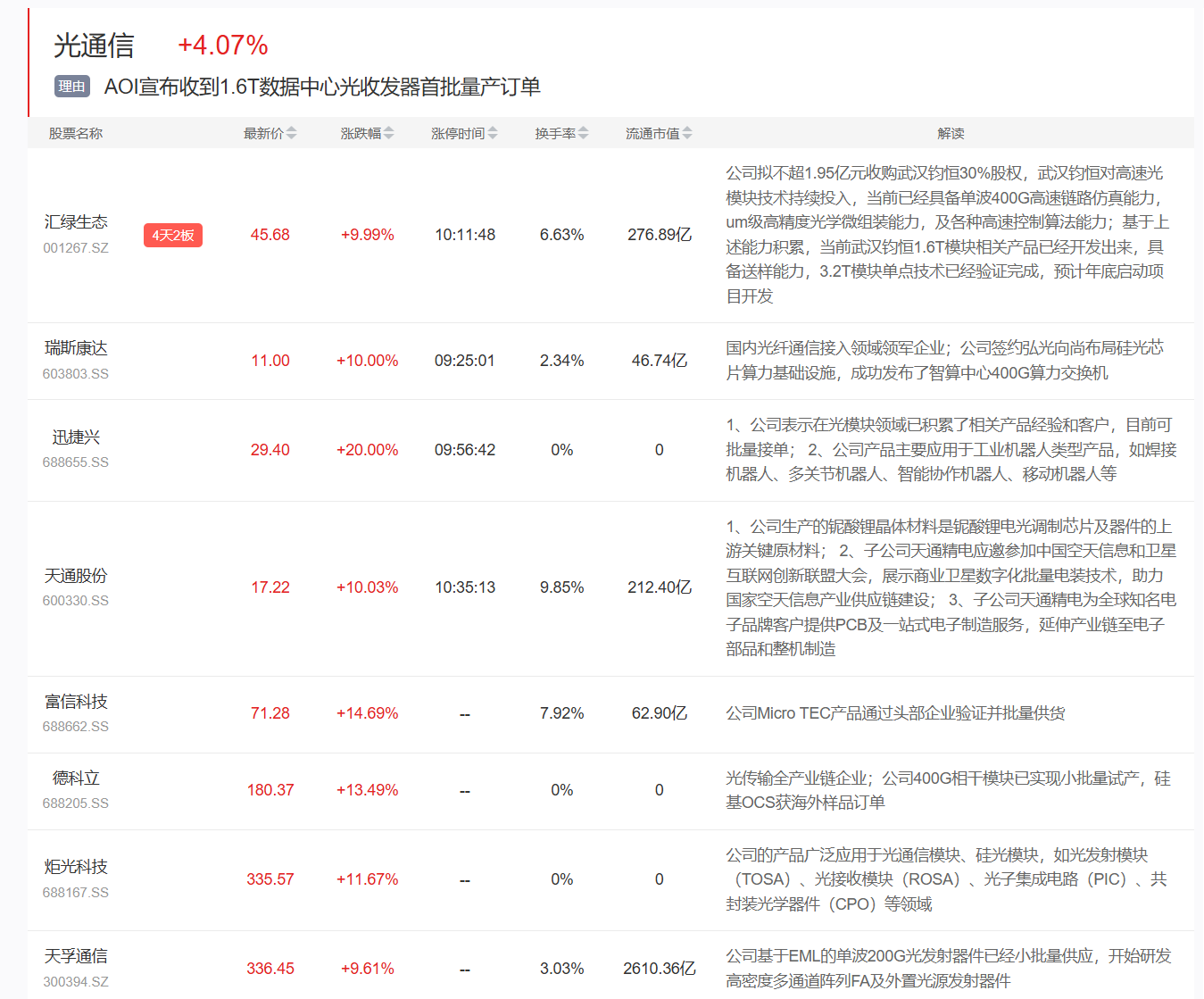
1.6T光模块首批量产订单落地,英伟达GTC前夕产业链迎关键催化
Xuan Gu Bao· 2026-03-09 23:14
Group 1 - Applied Optoelectronics (AOI) announced the receipt of its first mass production order for 1.6T data center optical transceivers from a long-term major hyperscale customer, amounting to over $200 million, marking the official entry of the new generation of high-speed optical interconnect products into large-scale commercial use, which led to a 7% increase in its stock price [1] - Lumentum, another leader in the optical industry, saw its stock rise by 10% concurrently with AOI's announcement [1] - Guolian Minsheng Securities indicated that 2026 is viewed as the year of mass production for 1.6T optical modules, and the recent order validates this assessment [1] Group 2 - Nvidia announced a multi-year strategic partnership with Lumentum involving a $2 billion investment and multi-billion dollar procurement commitments, focusing on developing optical interconnect technology and packaging integration solutions for AI data centers [1] - Nvidia's CEO Jensen Huang stated that this collaboration will advance the development of the world's most advanced silicon photonics technology, aiming to "build the next generation of gigawatt-level AI factories" [1] - The upcoming Nvidia GTC conference, scheduled for March 16-19 in San Jose, is highly anticipated for the release of the next-generation AI chip roadmap and network architecture plans [1] Group 3 - According to Guotai Junan Securities, the current Scale-Up networks predominantly use copper cabling, which limits transmission distances to within a single cabinet, while optical interconnects can cover distances of several dozen to hundreds of meters, indicating a significant advantage [2] - The trend of optical interconnects replacing copper cabling is deemed irreversible as AI clusters expand to hundreds or even thousands of cards, with expectations for NPO to be applied in bulk by 2027 and CPO to be widely used in the Rubin Ultra platform by the end of 2027 [2] - The OFC 2026 event is expected to define the trends in the optical communication industry for 2026-2027, focusing on the mass production evolution of 1.6T and 3.2T, verification of CPO and NPO mass production progress, and the adaptability of optical circuit switching (OCS) in AI clusters [2] Group 4 - Zhongji Xuchuang is identified as a domestic leader in optical modules, actively advancing the research and customer validation of 1.6T products while maintaining a strong product line in 400G and 800G mass shipments [2] - Taicheng Light's main products include MPO and other multi-core connectors, suitable for high-density multi-fiber connections, primarily used for optical interconnects within large data centers [3]
通信行业跟踪报告:海内外头部厂商加码布局光学技术领域,继续关注光通信等核心环节
Wanlian Securities· 2026-03-09 13:09
Investment Rating - The industry is rated as "Outperforming the Market," indicating an expected relative increase of over 10% in the industry index compared to the broader market within the next six months [19]. Core Insights - Recent investments by Nvidia in optical technology companies Lumentum and Coherent, amounting to $2 billion each, reflect a strategic move to enhance its ecosystem and emphasize the importance of optical communication products [2][8]. - Huawei's launch of next-generation all-optical network products at the MWC 2026 highlights the anticipated upgrade in demand for optical network solutions, driven by AI applications and increased bandwidth requirements [2][17]. - ZTE's introduction of a modular liquid cooling CDU at MWC 2026 demonstrates a significant focus on cooling solutions for high-density computing environments, addressing the challenges posed by traditional cooling methods [2][3][17]. Industry Dynamics - **Optical Communication**: Nvidia's strategic agreements with Lumentum and Coherent include substantial procurement commitments and capacity rights, aimed at advancing optical technology for AI infrastructure [2][13]. - **Optical Networks**: Huawei's innovations in all-optical networks are set to meet the growing demands for bandwidth and reliability, with the ITU-T's ION-2030 framework outlining the future capabilities and standards [2][17]. - **Liquid Cooling**: ZTE's modular liquid cooling solution supports flexible scaling from 400kW to 2MW, addressing the cooling needs of high-performance computing and enhancing operational efficiency [2][3][17]. Industry Valuation - As of March 6, 2026, the PE-TTM for the communication industry stands at 27.97, which is above the historical average of 22.00 for the years 2023-2025, indicating a higher valuation compared to historical levels [15].

纯推演:中东冲突若缓和,依次利好抄底哪些行业题材?
格隆汇APP· 2026-03-09 10:17
Core Viewpoint - The article suggests that if the Middle East conflict eases, investors should first target "geopolitically mispriced sectors" and then pursue "AI opportunities," indicating a sequential approach to investment recovery [6]. Group 1: Current Situation of the Middle East Conflict - The current situation shows signs of potential easing, with both sides leaving room for retreat, which is crucial for de-escalation [8]. - The new Iranian leader appears strong but is likely consolidating power rather than escalating conflict, while Trump's recent statements indicate a desire for a dignified exit from military actions [9]. - The Strait of Hormuz remains partially open, allowing for 25% of global oil transport, suggesting that neither side is willing to completely sever ties [10]. Group 2: Market Reactions to Conflict Easing - The easing of conflict is expected to lead to a decrease in oil prices, which previously rose by 25% due to supply fears, thus normalizing expectations in the energy sector [17]. - Reduced oil prices will alleviate inflationary pressures, increasing the likelihood of interest rate cuts by the Federal Reserve, leading to a more accommodative global financial environment [19]. - As risk aversion decreases, capital is expected to flow back into equities and commodities that were previously sold off [20]. Group 3: Investment Strategy for Bottom Fishing - The core investment strategy involves two paths: first targeting "geopolitically mispriced assets," followed by pursuing "long-term growth in AI sectors" [22]. - The rationale is that mispriced sectors will rebound quickly, while AI sectors will see slower but substantial growth as capital returns [23]. Group 4: Target Sectors for Investment - The first path focuses on sectors related to geopolitical safety, specifically gold and precious metals, and alternatives to fossil fuels such as renewable energy and nuclear power [26]. - Gold is expected to rebound quickly due to its status as a safe haven, while industrial metals like copper and aluminum will benefit from global economic recovery [26]. - The second path emphasizes AI-related sectors, particularly in light of upcoming events like the GTC conference and the release of new AI models, which are expected to drive demand for computing power [28][30]. Group 5: Investment Prioritization - The recommended order for bottom fishing includes: 1. Gold: Quick rebound and long-term stability [36] 2. Precious metals and rare earths: Mid-term holding as geopolitical safety becomes more important [36] 3. Renewable energy and nuclear power: Long-term growth driven by energy security trends [36] 4. Optical communication (AI computing chain): Mid-term core opportunity due to increasing demand [36] 5. AIDC cloud computing: Long-term positioning as demand from major cloud providers increases [36].

68岁教授带队,海信拆出百亿独角兽冲刺IPO
创业邦· 2026-03-09 07:33
Core Viewpoint - The article highlights the impressive financial performance of Nazhen Technology, a spinoff from Hisense Group, driven by the surging demand for high-speed optical modules in the AI computing era, with projected revenue growth of 64.3% to 8.355 billion yuan and a staggering net profit increase of 875% to 873 million yuan by 2025 [2][3][24]. Company Overview - Nazhen Technology specializes in optical communication and connection products, positioning itself as a critical player in the AI computing infrastructure [3][5]. - The company is led by Dr. Huang Weiping, a top scientist with a strong academic background, who has been instrumental in its development since its founding in 2002 [10][12]. Financial Performance - The financial data indicates a significant revenue increase from 4.239 billion yuan in 2023 to 8.355 billion yuan in 2025, with a notable dip in net profit in 2024 due to industry destocking, followed by a remarkable rebound in 2025 [24][26]. - The core business of data communication optical modules is projected to contribute 54.69 billion yuan in revenue by 2025, accounting for 65.5% of total revenue [26]. Market Position and Competition - Nazhen Technology ranks fifth globally in the professional optical module market with a 2.9% market share and third in the Chinese market with a 7.2% share [15]. - The global optical module market is expected to grow from 126.7 billion yuan in 2024 to 295.4 billion yuan by 2029, with a compound annual growth rate of 18.5% [32]. Strategic Importance of IPO - The upcoming IPO is seen as a pivotal step in Hisense Group's transformation from a traditional home appliance manufacturer to a technology platform, expanding its reach into semiconductor and AI infrastructure [5][30]. - If successful, Nazhen Technology will become the sixth listed company under the Hisense umbrella, further solidifying its market presence [4][30]. Challenges and Risks - The company faces challenges in its optical chip business, which has shown declining sales and profitability, raising concerns about its ability to maintain a competitive edge [26][37]. - High customer concentration, with the top five customers accounting for 68.9% of revenue, poses risks to revenue stability [29]. Future Outlook - The company aims to enhance its product offerings and expand its market presence through continued investment in R&D and capacity building, particularly in high-end laser chip production [29][30].

国投证券(香港)晨报-20260309
国投证券(香港)· 2026-03-09 07:03
Core Insights - The report highlights the impact of escalating tensions in the Middle East on global markets, particularly emphasizing the inflationary pressures from soaring oil prices and the resulting risk of stagflation [2][4][5] - The Hong Kong stock market showed a weak rebound, with the Hang Seng Index rising by 1.72%, driven by improved sentiment from external markets, but the overall trend remains cautious due to global risk aversion [2][3] Industry Analysis - The "JD ecosystem" saw a collective rise, with JD Group and JD Logistics reporting better-than-expected earnings, which boosted market confidence in their core retail business [3] - The pharmaceutical sector experienced a broad increase, particularly in innovative drugs and biopharmaceuticals, supported by government policies emphasizing the industry as a "new pillar" of the economy [3] - The oil price surged significantly due to geopolitical tensions, with WTI crude oil futures rising over 12% in a single day and more than 35% over the week, marking one of the largest weekly increases since 1983 [4] - The report notes that the market is reassessing the macroeconomic outlook amid concerns of slowing growth and high energy prices, with a focus on the upcoming FOMC meeting for potential interest rate guidance [5] Company-Specific Developments - MiniMax reported impressive earnings for 2025, with total revenue reaching $79 million, a 159% year-on-year increase, driven by strong demand for AI-native products [8] - The report indicates that MiniMax's average daily token consumption surged sixfold compared to December 2025, reflecting the rapid growth in demand for its AI models [8] - The launch of the GLM-5 model by Zhiyuan has positioned it as a leading open-source model, enhancing its programming capabilities and achieving compatibility with domestic computing power [9] - Alibaba's Qwen3.5 model was released with significant improvements, capturing a substantial market share in the Chinese AI cloud market, with a goal to dominate 80% of the incremental market [10]
CIEN20260308
2026-03-10 10:17
Summary of Conference Call Notes Industry Overview - The telecommunications industry has experienced significant growth over the past three years, with the communication sector being the top performer in the market for 2023, 2024, and 2025. [1] - Optical communication technology, particularly in North America, has been a key driver of this growth. [1] Key Companies Discussed - **Ciena**: A leader in long-distance optical interconnects, providing products primarily to telecom operators and large cloud service providers. [6] - **Momentum and Coherent**: Companies involved in optical chip production, receiving significant investments from Nvidia to enhance their product performance. [2] - **Fabrinet**: A customer of Tianfu Communication, with a market cap of approximately $1 billion to $2 billion. [3] - **Siana**: A leading company in DCI (Data Center Interconnect) optical transmission, with a projected valuation of around 30 times earnings by 2027. [4][5] Financial Performance and Projections - Ciena's revenue for Q1 2026 was reported at $1.427 billion, exceeding guidance, with expectations for Q2 2026 revenue between $1.45 billion and $1.55 billion. [15][16] - The company anticipates full-year revenue of $5.9 billion to $6.3 billion for 2026, which may be conservative based on market trends. [16] - Ciena's growth is driven by increasing demand from AI and cloud service providers, with a projected revenue growth of 19% in 2025. [22] Market Dynamics - The demand for DCI is expected to triple in China by 2025, outpacing growth in optical modules. [25] - North America has a higher demand for DCI due to its numerous small-scale data centers, compared to China's larger, centralized data centers. [24] - The rise of AI is reshaping network architectures, leading to increased capital expenditures from cloud service providers. [17][18] Technological Advancements - Ciena's technology focuses on coherent optical communication, which offers better signal stability and longer transmission distances compared to traditional methods. [8] - The company is expanding its product offerings to include short-distance interconnects, enhancing its technology portfolio. [12] - Innovations in optical technology are expected to drive further growth in data center interconnects and overall network efficiency. [35] Investment Opportunities - The conference highlighted potential investment opportunities in A-share companies involved in DCI and optical technologies, such as DeKeLi and Guangxun Technology. [25][40] - The overall sentiment in the telecommunications sector remains optimistic, with expectations for continued growth driven by AI and cloud computing demands. [40] Conclusion - The telecommunications and optical communication sectors are poised for significant growth, with key players like Ciena leading the charge. Investors are encouraged to monitor developments in this space for potential opportunities. [40]
FN20260308
2026-03-09 05:18
Summary of Fabrinet's Conference Call Company Overview - **Fabrinet** is a leading global precision optical manufacturing service provider, with approximately 80% of its revenue derived from optical communication. It serves major clients such as Nvidia's Mellanox and Tianfu Communication [2][5]. Core Business Insights - **Optical Communication**: The company is transitioning its data communication business towards 800G/1.6T, significantly reducing the share of 100G products. The telecom segment is driven by DCI (400G/800G ZR) growth, with Q2 FY2026 revenue expected to reach approximately $500 million, setting a record [2][9]. - **HPC Business**: Fabrinet has entered the HPC supply chain, primarily supplying PCBA, with an annual revenue target exceeding $150 million. Currently, two fully automated production lines are operational, with a third line in certification, expected to contribute 5%-10% to future revenue [2][14]. - **Capacity Expansion**: The company is expanding its capacity with Building 10 in Thailand, which spans 2 million square feet and can support $2.5 billion in revenue, meeting demand for the next five years. Fabrinet holds $1 billion in cash and has no debt [2][16]. Financial Performance - **Revenue Structure**: The revenue breakdown shows optical communication as the core segment (approximately 80%), followed by automotive electronics (10%-15%) and industrial lasers (5%). The new HPC segment is expected to provide significant incremental revenue [2][8]. - **Client Concentration**: Key clients include Nvidia (27.6% revenue share by 2025) and Cisco (18%). The company has a strong client base in optical communication, with significant contributions from DCI and telecom sectors [2][9]. Industry Trends and Future Outlook - **Optical Communication Demand**: The demand for optical communication has remained robust over the past three years, driven by GPU demand and bandwidth rate increases. The industry is expected to evolve towards higher rates (1.6T, 3.2T), creating opportunities for new technologies and materials [3]. - **DCI Growth**: DCI has been separated from traditional telecom to highlight its growth, primarily driven by data center needs. The company anticipates that DCI will be a major source of incremental revenue [11]. Additional Insights - **Automotive Electronics**: The automotive electronics segment, while smaller, is stable and growing, with revenues around $200 million in 2022, currently between $300 million and $400 million. Key clients include Valeo and Velodyne Lidar [12]. - **Industrial Laser Business**: This segment accounts for about 5% of revenue, with a scale of approximately $100 million to $150 million. It has a stable customer base and high technical barriers, making it a significant long-term focus [13]. - **Global Production Layout**: Fabrinet's production facilities are located in Thailand, China, Israel, and the USA, with Thailand being the main site for optical communication manufacturing. The company has plans for further expansion with additional buildings reserved for future capacity [16]. Conclusion Fabrinet is well-positioned in the optical communication and HPC markets, with a strong financial foundation and a clear strategy for growth through capacity expansion and diversification into new business areas. The company is expected to benefit from ongoing trends in AI and data center connectivity, particularly through its DCI offerings.