
纺织业

Search documents
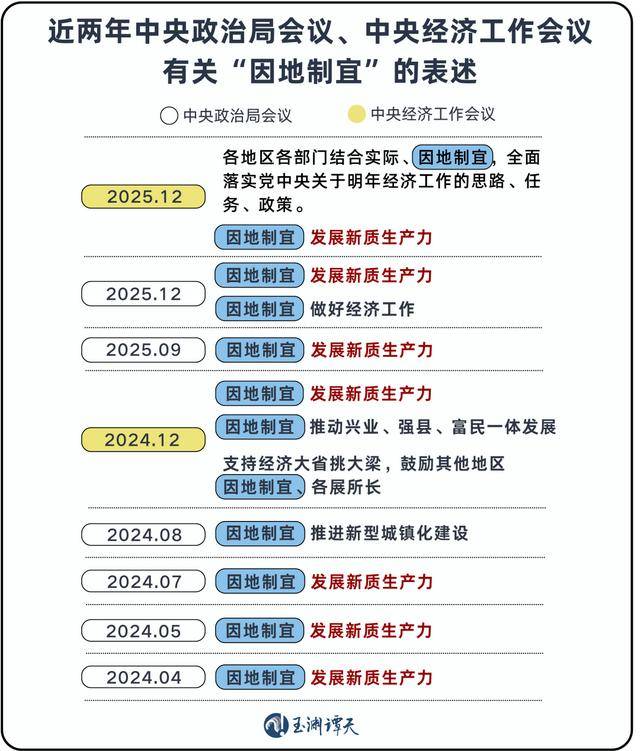
玉渊谭天:再解因地制宜
Sou Hu Cai Jing· 2026-01-28 02:16
Group 1 - The core viewpoint of the articles emphasizes the importance of "localized approaches" in driving China's economic growth, particularly in the context of achieving a GDP exceeding 140 trillion yuan by 2025 [1][10] - Various regions in China, such as Beijing and Shandong, have reported significant economic milestones, indicating a robust overall economic performance despite global challenges [1][9] - The concept of "new quality productivity" is highlighted as a key driver for economic transformation, with digitalization being a major trend influencing this shift [4][5] Group 2 - The penetration rates of the digital economy across different sectors in China are noted, with agriculture at 10.78%, industry at 25.03%, and services at 45.63%, indicating substantial room for growth [4][5] - The necessity for regions to adopt tailored strategies rather than simply focusing on popular industries is emphasized, as effective digital transformation requires deep expertise in specific fields [5][7] - The article discusses the critical components for successful digital transformation, including digital infrastructure, talent, and data governance systems [7][9] Group 3 - The "Fifteen Five" plan suggests a strategic focus on enhancing functional zones, which include urbanization areas, agricultural production zones, and ecological function areas, to optimize regional development [10][13] - The classification of performance evaluation metrics based on regional characteristics, as seen in Hainan's approach, illustrates a shift towards more nuanced governance that aligns with local resources and capabilities [14][16] - The articles conclude that a clear direction and defined boundaries will enable regions to explore growth paths that are suitable for their unique contexts, ultimately contributing to a more resilient and quality-driven economic growth [16][17]

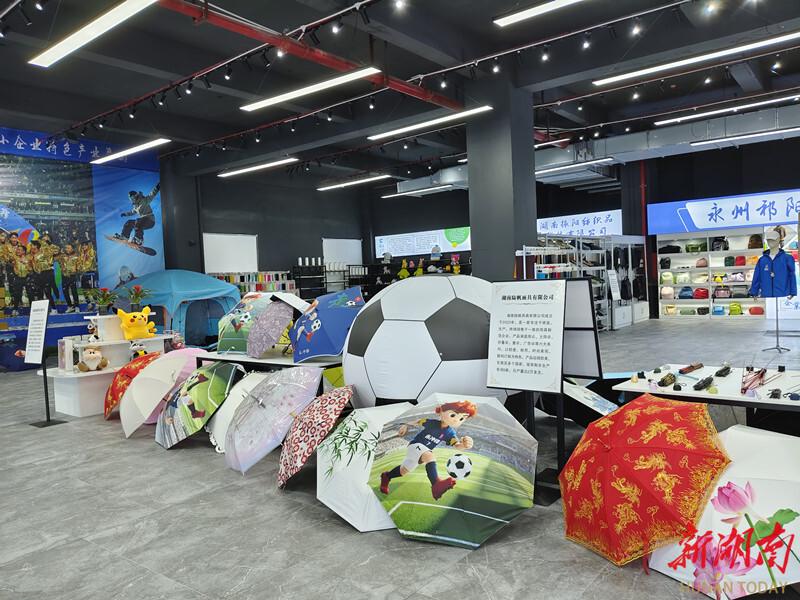
「向新而行·湖南经济新动能」永州:新兴纺织小镇的现代产业经纬
Xin Lang Cai Jing· 2026-01-27 23:08
Core Insights - The article highlights the development of the Baishui Textile Town in Qiyang, which has successfully established a complete textile industry chain and attracted significant investment, leading to substantial economic growth and job creation [1][16]. Group 1: Industry Development - Baishui Textile Town has introduced 38 large-scale textile enterprises and established 15 provincial and above technology innovation platforms, producing 1 billion meters of umbrella fabric, 300 million meters of tent fabric, 300 million meters of luggage fabric, and 500 million meters of high-end elastic fabric annually [1]. - The town achieved a total output value of 9.744 billion yuan and tax revenue of 986.475 million yuan in 2025, representing growth rates of 18.15% and 19.78% respectively [10]. Group 2: Business Growth - Qiyang Dongjun Textile Co., Ltd. has expanded from a small operation with 30 employees to a full-chain enterprise with over 1,700 employees and a factory area of 331 acres [5]. - The company has improved its production efficiency significantly, with one worker now managing 60 weaving machines compared to 22-24 previously, and has saved nearly 3 million yuan in electricity costs annually due to equipment upgrades [10]. Group 3: Technological Innovation - The integration of information technology into production has led to advancements such as zero wastewater discharge and improved product quality, with companies adopting automated processes that enhance efficiency and reduce labor costs [6][17]. - Qiyang Dongjun Textile Co., Ltd. has transitioned from manual color matching to computer-assisted processes, resulting in faster production times and reduced errors [10]. Group 4: Community Impact - The textile industry has created over 15,000 jobs in the region, with local residents increasingly filling management and technical roles, reflecting a shift from reliance on external labor [11][12]. - The establishment of processing points in villages has provided flexible employment opportunities for over 8,000 villagers, with average monthly incomes exceeding 4,000 yuan [15].
企业家+科学家+投资家,协同创新做好“加法”
Xin Lang Cai Jing· 2026-01-27 23:07
Core Viewpoint - The "entrepreneur + scientist + investor" collaborative innovation model is highlighted as a key focus in the provincial government work report, aiming to enhance the integration of industry, academia, and research for economic growth and high-quality development [1] Group 1: Collaborative Innovation Model - The provincial government report inspires new ideas for implementing the "entrepreneur + scientist + investor" model over the next five years, emphasizing the need for a close connection between production, learning, research, and application [1] - The establishment of a specialized integrated circuit industry fund is proposed to address common challenges faced by technology enterprises, such as high investment costs and long cycles [2] - A market-oriented risk-sharing system is suggested to alleviate investment concerns, with government-led initiatives to establish or increase funding for industry guidance and technology transformation [2] Group 2: Role of Enterprises - Enterprises are seen as crucial in identifying industry pain points and market trends, effectively integrating technological and capital advantages to avoid mismatches between research and industry [3] - Data indicates that by 2025, the province aims for a 6.5% growth in industrial added value, with a significant increase in specialized and innovative enterprises, showcasing the upward trend in traditional industry advantages [3] Group 3: Policy Support and Ecosystem Optimization - There is a call for policy support to form cross-industry innovation alliances centered around leading enterprises, which can drive broader industrial development [4] - Incentives for small and medium-sized enterprises (SMEs) to engage in technological innovation are recommended, focusing on encouraging minor innovations to enhance their participation in collaborative ecosystems [5] - The establishment of a full-chain innovation model in the new energy sector is highlighted, addressing critical technological challenges and enhancing the overall innovation ecosystem [6]
欧盟与印度达成“终极贸易协定” 欧股上涨
证券时报· 2026-01-27 15:10
Core Points - The article discusses the landmark trade agreement signed between the EU and India, which is expected to create a free trade area covering 2 billion people and significantly boost economic development for both parties [1] Group 1: Agreement Highlights - The agreement includes substantial tariff reductions and breakthroughs in market access, with nearly 97% of EU export products receiving tariff reductions or exemptions from India, potentially saving European companies up to €4 billion annually in tariff costs [3] - Key tariff reductions include a decrease in India's automotive tariffs from 110% to 10%, wine tariffs from 150% to 20%, and the complete elimination of tariffs on processed foods like pasta and chocolate [3] - In return, Indian industries such as textiles, jewelry, and leather will gain broader market access in the EU, with European companies receiving privileged access in sectors like financial services and maritime logistics [3] Group 2: Trade and Economic Impact - The EU-India bilateral trade in goods reached €120 billion in 2024, a nearly 90% increase over the past decade, with service trade adding an additional €60 billion [5] - The agreement is expected to double EU exports to India and provide critical support for India's infrastructure upgrades and job creation, with the EU being a significant source of technology and investment [5] Group 3: Strategic Cooperation - The trade agreement represents a strategic partnership between the EU and India, showcasing an alternative to a fragmented global landscape, with plans for additional agreements to facilitate the movement of seasonal workers, students, and skilled professionals, as well as enhance security and defense cooperation [8] - The collaboration aligns with the EU's goal to reduce dependence on the US and India's aim to diversify its military imports away from Russia, thus enhancing both parties' autonomy [8] Group 4: Next Steps - The core negotiations of the agreement have been completed, and it will now enter the internal approval process for both parties, with expectations for it to be implemented in the near term [9]

恒天海龙:中国恒天集团有限公司拟减持3%股份
Guo Ji Jin Rong Bao· 2026-01-27 11:12
恒天海龙公告,公司持股5%以上股东中国恒天集团有限公司计划在公告披露之日起十五个交易日后的 三个月内,通过集中竞价和大宗交易方式减持公司股份合计不超过2591.9.万股,占公司总股本比例 3.00%。减持原因是为了进一步聚焦主业,回收资金用于纺机主业发展。减持股份来源为2012年恒天海 龙破产重整司法划转获得的股份。减持价格将根据市场价格及交易方式确定,存在实施不确定性。中国 恒天集团有限公司不是公司控股股东或实际控制人,本次减持不会影响公司治理结构和持续经营。 ...

2025年贵州纺织特色产业提质发展
Yang Guang Wang· 2026-01-27 03:15
Core Insights - The article highlights the rapid growth and development of the textile industry in Guizhou, particularly through the establishment of the Bijie Hongsheng Textile Technology Co., which has achieved significant production and revenue milestones within a short period [1][2]. Group 1: Company Developments - Bijie Hongsheng Textile Technology Co. has over 600 intelligent textile machines operating, producing 200,000 meters of quality fabric daily [1]. - The company achieved a production value of 120 million yuan within just four months of its official launch in July 2025 [1]. - The first phase of production includes 36 varieties of advertising fabric, which are sold in domestic markets such as Henan and Shandong, as well as international markets including Vietnam, Singapore, and Malaysia [1]. Group 2: Industry Growth - Guizhou's textile and garment industry saw a value-added growth of 27.1% and 5.9% respectively compared to the previous year [2]. - The province is focusing on new industrialization and enhancing its competitive industries, with a particular emphasis on attracting leading enterprises to fill gaps in high-end fabric production [2]. - The Bijie textile industry is part of a broader initiative to create a modern textile and garment industrial cluster, with over 120 textile enterprises established in the region [1][2]. Group 3: Future Directions - There is a need to address challenges in the dyeing process and improve logistics costs, as well as to fill talent and technology gaps within the industry [3]. - Recommendations include leveraging leading enterprises to drive the entire industrial chain's development and enhancing the training of specialized talent in the textile and garment sector [3]. - The goal is to create a modern textile and garment industry cluster in Southwest China that is influential and sustainable, focusing on intelligent, green, and integrated development [3].
2025年工业企业利润:黑色金属增3倍,煤炭开采降41.8%
Sou Hu Cai Jing· 2026-01-27 02:18
Core Insights - The National Bureau of Statistics reported a significant increase in profits for large-scale industrial enterprises in 2025, with notable growth in various sectors [1] Group 1: Profit Growth by Industry - The profit of the black metal smelting and rolling processing industry increased by 300% compared to the previous year [1] - The non-ferrous metal smelting and rolling processing industry saw a profit growth of 22.6% [1] - The computer, communication, and other electronic equipment manufacturing industry experienced a profit increase of 19.5% [1] - The electricity and heat production and supply industry reported a profit growth of 13.9% [1] - The specialized equipment manufacturing industry grew by 5.7% [1] - The electrical machinery and equipment manufacturing industry increased by 4.9% [1] - The general equipment manufacturing industry saw a profit growth of 4.2% [1] - The agricultural and sideline food processing industry reported a profit increase of 3.2% [1] - The automobile manufacturing industry experienced a modest profit growth of 0.6% [1] Group 2: Declines in Specific Industries - The petroleum, coal, and other fuel processing industries reported a reduction in losses compared to the previous year [1] - The non-metallic mineral products industry declined by 1.7% [1] - The chemical raw materials and chemical products manufacturing industry saw a decrease of 7.3% [1] - The textile industry experienced a decline of 12.0% [1] - The oil and gas extraction industry reported a significant decline of 18.7% [1] - The coal mining and washing industry faced a substantial decrease of 41.8% [1]
2025年煤炭开采和洗选业实现盈利3520亿元
Guo Jia Tong Ji Ju· 2026-01-27 02:05
Group 1 - In 2025, the total profit of industrial enterprises above designated size in the country reached 739.82 billion yuan, an increase of 0.6% compared to the previous year [1] - The profit situation in major industries includes: - Black metal smelting and rolling industry profits increased by 3.0 times - Non-ferrous metal smelting and rolling industry increased by 22.6% - Computer, communication, and other electronic equipment manufacturing increased by 19.5% - Electricity and heat production and supply increased by 13.9% - Special equipment manufacturing increased by 5.7% - Electrical machinery and equipment manufacturing increased by 4.9% - General equipment manufacturing increased by 4.2% - Agricultural and sideline food processing increased by 3.2% - Automobile manufacturing increased by 0.6% - The petroleum, coal, and other fuel processing industry reduced losses compared to the previous year - Non-metallic mineral products industry decreased by 1.7% - Chemical raw materials and chemical products manufacturing decreased by 7.3% - Textile industry decreased by 12.0% - Oil and gas extraction industry decreased by 18.7% - Coal mining and washing industry decreased by 41.8% [1] Group 2 - In 2025, the coal mining and washing industry achieved a total profit of 352.0 billion yuan, a year-on-year decrease of 41.8% [2]
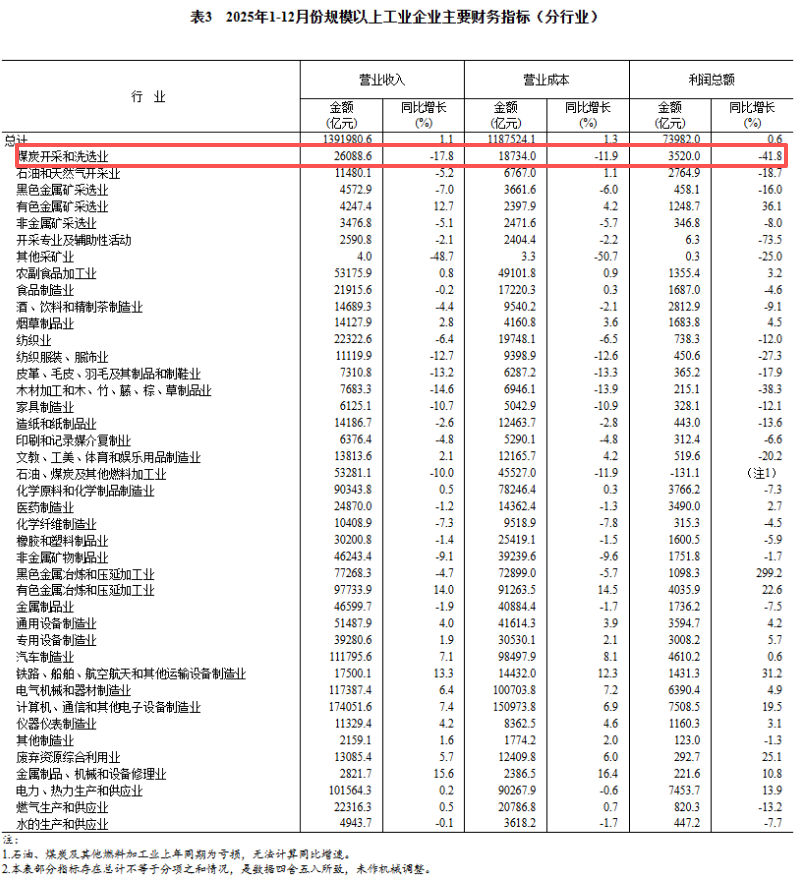
国家统计局:2025年煤炭开采和洗选业实现盈利3520亿元
Guo Jia Tong Ji Ju· 2026-01-27 01:39
Group 1 - In 2025, the total profit of industrial enterprises above designated size in the country reached 73,982.0 billion yuan, an increase of 0.6% compared to the previous year [1] - The profit situation in major industries includes: - Black metal smelting and rolling industry profits increased by 3.0 times - Non-ferrous metal smelting and rolling industry increased by 22.6% - Computer, communication, and other electronic equipment manufacturing increased by 19.5% - Electricity and heat production and supply increased by 13.9% - Special equipment manufacturing increased by 5.7% - Electrical machinery and equipment manufacturing increased by 4.9% - General equipment manufacturing increased by 4.2% - Agricultural and sideline food processing increased by 3.2% - Automobile manufacturing increased by 0.6% - The petroleum, coal, and other fuel processing industry reduced losses compared to the previous year - Non-metallic mineral products industry decreased by 1.7% - Chemical raw materials and chemical products manufacturing decreased by 7.3% - Textile industry decreased by 12.0% - Oil and gas extraction industry decreased by 18.7% - Coal mining and washing industry decreased by 41.8% [1][2]
内外棉价格如何展望
2026-01-26 15:54
Summary of Conference Call on Cotton Market Outlook Industry Overview - The conference call primarily discusses the cotton industry, focusing on the Chinese cotton market and its dynamics with the U.S. market, including tariffs and production levels [1][3][6]. Key Points and Arguments Tariff Impact - China's tariff level remains high at approximately 20%, creating uncertainty in demand [1][3]. - In 2025, China's share of the U.S. apparel market decreased by about 5 percentage points, from 20% to 15.5%, indicating significant effects from tariffs [1][3]. Supply Chain Dynamics - Xinjiang's cotton production is a critical supply factor, with current public inspection volumes reaching 7.06 million tons and continuing to increase [1][3]. - Despite an expected record high production of 7.4 million tons in 2026, the lack of increased import quotas and stockpiling in 2025 has led to tight market supply and low ending inventories, supporting domestic cotton prices [1][7][8]. Downstream Business Conditions - Downstream enterprises, particularly cotton spinning companies, are facing poor operating conditions, contrasting sharply with rising upstream raw material prices [4][13]. - Weak terminal consumption is exerting pressure on both domestic demand and exports [4][6]. Global Cotton Market Trends - The global cotton market is experiencing a historical high in holding volumes, indicating that recent price increases are largely driven by capital involvement rather than just fundamental or policy support [23]. - Major cotton-producing countries like China, the U.S., and Brazil may reduce planting areas, leading to a decrease in global supply [12][15][17]. Future Demand and Consumption - Domestic cotton consumption in China is projected to be around 8.5 million tons in 2026, with an increase to 8.68 million tons in 2027, marking one of the highest levels in the past decade [27]. - However, the growth in consumption is heavily reliant on export increases rather than domestic demand, which remains low [27]. Price Dynamics - The external cotton market, particularly SE7 cotton prices, has been weak due to overall global supply being loose and increased competition from Brazilian cotton [11][12]. - The price gap between domestic and international cotton is currently around 3,000 yuan, the highest in recent years, which may lead to a substitution effect against domestic cotton consumption [22][32]. Macroeconomic and Policy Environment - The macroeconomic environment is expected to be more favorable compared to 2025, with a trend towards loosening that could positively impact commodity prices [24]. - Future policies regarding planting areas and target price subsidies will be crucial in determining the domestic market's supply-demand relationship [24][26]. Uncertainties in Production - Cotton production uncertainties stem from planting areas and weather conditions, which can significantly impact final yields [18]. Conclusion - The cotton market is navigating through a complex landscape of high tariffs, changing supply dynamics, and uncertain demand. The focus on domestic consumption growth and the impact of global economic conditions will be critical for future market stability and pricing strategies [1][6][20][24].