
房地产

Search documents
甘肃2025年经济运行“成绩单”出炉:GDP突破1.36万亿元,增长5.8%,增速领跑彰显强劲韧性
Zhong Guo Fa Zhan Wang· 2026-01-21 07:24
Core Viewpoint - Gansu Province has achieved significant economic growth in 2025, with key indicators surpassing expectations, reflecting a stable and improving economic environment. Economic Performance - The GDP of Gansu Province reached 1,369.75 billion yuan in 2025, growing by 5.8% year-on-year, consistently outperforming the national average for 16 consecutive quarters since 2022 [2] - The primary industry added value was 177.3 billion yuan (5.5% growth), the secondary industry 455.82 billion yuan (6.7% growth), and the tertiary industry 736.63 billion yuan (5.3% growth), indicating collaborative growth across all sectors [2] Industrial Growth - Industrial production remains a key driver of economic growth, with a 9.5% increase in the added value of industrial enterprises above designated size [3] - The mining industry grew by 5.4%, manufacturing by 9.3%, and the electricity, heat, gas, and water production and supply industry by 17.6%, showcasing enhanced power supply capabilities [3] - Key industries such as non-ferrous metal smelting and rolling processing, and electricity and heat production saw added value growth of 19.5% and 18.5%, respectively [3] Foreign Trade - Gansu's total import and export value reached 71.17 billion yuan, a 16.2% increase year-on-year, with exports surging by 44.5% to 18.38 billion yuan, indicating improved international competitiveness [4] - Imports totaled 52.79 billion yuan, growing by 8.7%, with trade with Belt and Road countries accounting for 70.5% of total trade [4] Agricultural Production - Grain production reached a historical high of 13.0925 million tons, a 1.01% increase from the previous year, with autumn grain production growing by 1.97% [5] - Livestock production also increased, with pork, beef, mutton, and poultry meat output reaching 1.803 million tons, a 6.3% growth [5] Consumer Market and Investment - The service sector showed strong recovery, with new service industries like information technology and leasing services growing by 19.2% and 15.6%, respectively [6] - Retail sales of consumer goods increased by 2.5%, driven by policies promoting consumption upgrades, with significant growth in categories such as communication equipment and new energy vehicles [6] - Fixed asset investment saw a slight decline overall, but excluding real estate, it grew by 2.7%, with manufacturing investment up by 4.5% and infrastructure investment up by 14.5% [6]
万科A涨超5%,万科企业涨超3%
Mei Ri Jing Ji Xin Wen· 2026-01-21 06:30
(文章来源:每日经济新闻) 每经AI快讯,1月21日,万科A涨超5%,万科企业涨超3%。 ...

超500亿元,“跑了”
Zhong Guo Ji Jin Bao· 2026-01-21 06:10
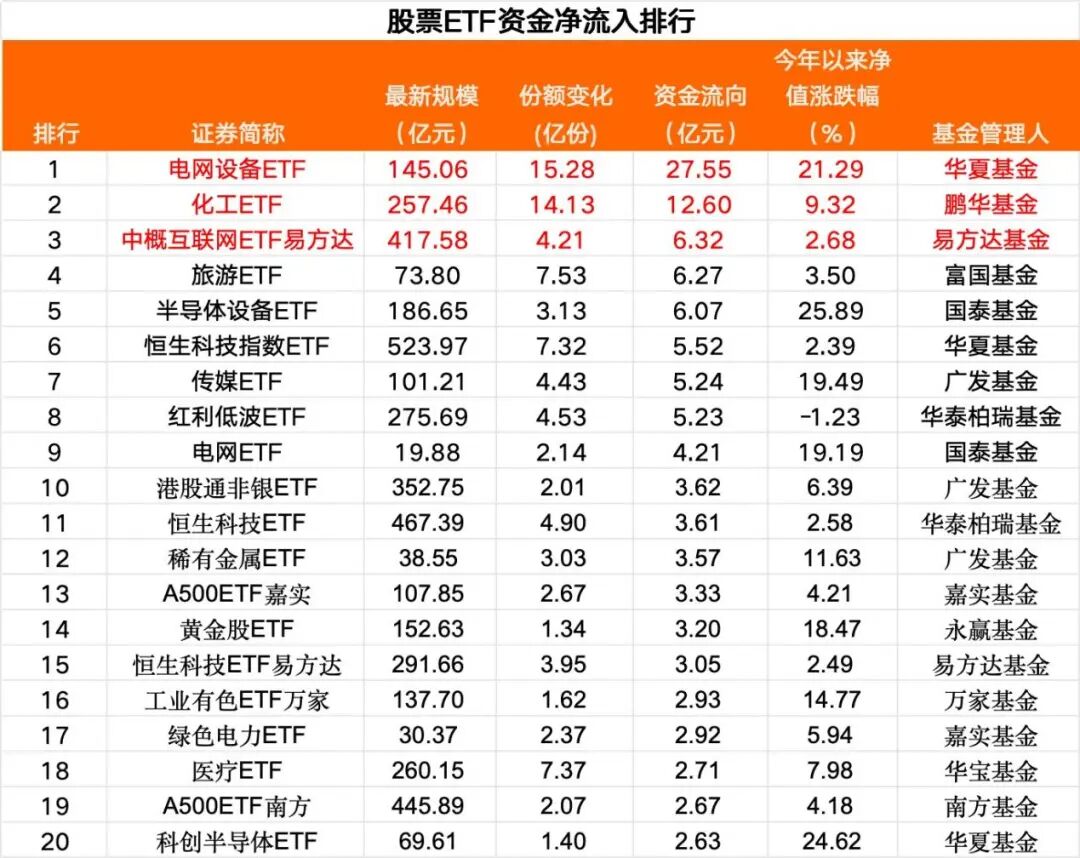
Group 1 - On January 20, the A-share market experienced a decline, with all three major indices falling, and over 500 billion yuan in net outflows from stock ETFs [1][2] - In the past four trading days, the total net outflow from stock ETFs exceeded 240 billion yuan, with over 920 billion yuan in net outflows in the first two days of the week [2] - The total scale of stock ETFs in the market reached 4.75 trillion yuan as of January 20, 2026, with a trading volume of 3.13 trillion yuan on that day [3] Group 2 - The building materials and real estate sectors led the gains among stock ETFs, with the top three performing ETFs all from the building materials sector, each rising over 3.3% [4] - The worst-performing ETFs included those related to satellites, aviation, and communication equipment, with many experiencing declines exceeding 3% [4] - On January 20, the net outflow from stock ETFs was approximately 505 billion yuan, with 51 ETFs seeing inflows of over 100 million yuan [5] Group 3 - The top five inflow sectors included new energy (net inflow of 2.91 billion yuan), gold (2.75 billion yuan), and petrochemical (1.87 billion yuan) [5] - The leading ETFs by net inflow included the Electric Grid Equipment ETF with a net inflow of 2.755 billion yuan, followed by the KI ETF and the China Concept Internet ETF [6] - The top outflow ETFs included the CSI 300 ETF from Huatai-PineBridge, which saw a net outflow of 10.984 billion yuan, and the CSI 500 ETF with a net outflow of 9.143 billion yuan [7] Group 4 - Major public fund companies continue to see inflows into their ETFs, with E Fund's China Concept Internet ETF attracting 640 million yuan and the Gold ETF attracting 360 million yuan on January 20 [8] - The market is expected to remain stable due to supportive monetary policy and positive macroeconomic data, with a potential spring rally anticipated [8] - Short-term market fluctuations may occur due to regulatory measures aimed at preventing excessive volatility, but a spring rally is expected to resume around the Chinese New Year [9]

FICC日报:指数震荡调整-20260121
Hua Tai Qi Huo· 2026-01-21 05:21
Report Summary 1. Report Industry Investment Rating There is no information provided regarding the report's industry investment rating. 2. Core Viewpoints - Overseas factors such as Trump's remarks and concerns about Japan's fiscal deterioration have led to a decline in major global indexes. Domestically, market enthusiasm has cooled under policy guidance, with a decrease in trading volume and index levels. Currently, investors can focus on the entry opportunities for IC [1][3]. 3. Summary by Directory Macro - economic Charts - The report presents charts showing the relationships between the US dollar index, US Treasury yields, RMB exchange rate, and A - share trends, as well as the relationship between US Treasury yields and A - share styles [6][8][10]. Spot Market Tracking Charts - A - share indexes showed mixed performance. The Shanghai Composite Index closed at 4113.65 points, down 0.01%; the ChiNext Index fell 1.79%. Industries such as petroleum and petrochemicals, building materials, real estate, and transportation led the gains, while communications, national defense and military industry, and computer industries led the losses. The trading volume of the Shanghai and Shenzhen stock markets was 2.8 trillion yuan. Overseas, the three major US stock indexes all closed down, with the Nasdaq falling 2.39% to 22954.32 points [1]. - The daily performance table of major domestic stock indexes shows the closing prices and daily changes on January 20, 2026, and January 19, 2026 [13]. Stock Index Futures Tracking Charts - In the futures market, the current - month contracts of IH and IC were at a premium. The trading volume and open interest of stock index futures increased simultaneously [2]. - The table of stock index futures trading volume and open interest shows the current values and changes of IF, IH, IC, and IM contracts [15]. - The table of stock index futures basis shows the current values and changes of the basis of IF, IH, IC, and IM contracts for the current - month, next - month, current - quarter, and next - quarter contracts [38]. - The table of stock index futures inter - period spreads shows the current values and changes of inter - period spreads for different contract combinations of IF, IH, IC, and IM [43][44].
超2900只个股上涨
第一财经· 2026-01-21 03:56
Market Overview - The A-share market showed mixed performance with the Shanghai Composite Index up by 0.16% to 4120.10 points, while the Shenzhen Component Index rose by 0.76% to 14263.20 points, and the ChiNext Index increased by 0.85% to 3306.00 points [4][5] - The STAR 50 Index experienced a significant rise of nearly 3%, reaching 1526.83 points [3][4] Sector Performance - The computing hardware industry chain strengthened, with GPU and server sectors leading the gains. Stocks related to lithium mining, semiconductors, AI smartphones, rare earths, and humanoid robots were also active [5] - Conversely, sectors such as coal, retail, liquor, banking, and electricity showed weakness [5] Trading Volume - The total trading volume in the Shanghai and Shenzhen markets reached 1.63 trillion yuan, a decrease of 216.9 billion yuan compared to the previous trading day. Over 2900 stocks rose in the market [6] Notable Stocks - The small metals sector continued to perform well, with companies like Zhongtung High-tech and Zhangyuan Tungsten hitting new highs. Other companies such as Xianglu Tungsten and Baowu Magnesium also saw gains [6] - In the computing hardware sector, stocks like Robot Technology surged over 10%, reaching a historical high, with other companies like Lian Te Technology and Sega Technology following suit [6] AI Server Market Insights - According to TrendForce's latest AI Server research report, North American cloud service providers are expected to increase their investment in AI infrastructure, leading to a projected annual growth of over 28% in global AI server shipments by 2026 [6]

地缘政治风波与川普交易
2026-01-21 02:57
Summary of Key Points from Conference Call Records Industry Overview - **Geopolitical Trends**: The trend of de-dollarization is strengthening globally, with precious metals, especially gold, becoming a focal point in capital markets. The U.S. economy faces structural issues such as high deficits, high leverage, and inflation, which may impact global financial stability [1][2] - **China's Economic Outlook**: China's macroeconomic environment is expected to stabilize by 2025, with a projected GDP growth of 4.5% in Q4. However, internal demand remains weak, and the investment sector is declining, particularly in the real estate industry, where second-hand home prices are rapidly falling [1][5] Core Insights and Arguments - **2026 Economic Changes**: Anticipated changes in 2026 include adjustments in baseline statistics affecting GDP, CPI, and PPI readings, a potential improvement in endogenous demand despite its current weakness, and a focus on quality and structure of economic growth rather than just speed [6][9] - **Industrial Inventory Cycle**: Since October 2023, the inventory cycle of Chinese industrial enterprises has been flat. A downward trend is expected in 2026 due to supply-demand adjustments, with a potential recovery in 2027 driven by the "14th Five-Year Plan" [7] Important but Overlooked Content - **Policy Shifts**: The Chinese government is shifting its focus from high-speed growth to improving the quality and structure of economic growth, which may lead to a reduction in growth targets [9] - **Bond Market Dynamics**: The bond market is showing signs of stability, with significant compression in yield spreads. Large banks are buying long-term bonds, while smaller banks are focusing on medium-term national development bonds, indicating a healthy market demand [11][12] - **Market Volatility and Financing**: Recent adjustments in financing margin ratios to 100% reflect regulatory measures similar to those in 2015, suggesting that future leverage in the market may be limited [18][19] - **Investment Recommendations**: Current investment strategies should focus on technology and cyclical sectors, with a shift from precious metals to industrial and new energy metals. There is also a recommendation to explore themes related to internet assets, AI applications, and other innovative sectors [20] This summary encapsulates the key points from the conference call records, highlighting the current state and future outlook of the relevant industries and economic conditions.
银泰证券鑫新闻:研究所日报
Yintai Securities· 2026-01-21 02:50
Fiscal Policy and Investment - The overall fiscal expenditure for 2026 will "only increase" and focus on key areas to "strengthen" support, with a special bond issuance of 500 billion yuan for private investment[2] - A 500 billion yuan guarantee plan for private investment aims to guide banks in providing loans to small and micro enterprises[2] - The implementation of interest subsidies for loans in 14 key industrial chains is expected to support social investment activities and consumption[2] Market Performance - On January 20, the Shanghai Composite Index fell by 0.01%, while the Shenzhen Component Index dropped by 0.97%, with total trading volume at 27,776.57 billion yuan, an increase of 693.09 billion yuan from the previous trading day[3] - Major global stock indices experienced declines, with the NASDAQ, S&P 500, and Dow Jones down by 2.39%, 2.06%, and 1.76% respectively[3] - The 10-year government bond yield in China decreased by 1.66 basis points to 1.8260%[3] Currency and Commodity Trends - The US dollar index closed at 98.5413, down by 0.51%, while the offshore RMB appreciated by 10 basis points to 6.9559[4] - Gold prices rose above $4,762 per ounce, and silver prices peaked at $95 per ounce amid increased global risk aversion[2] Sector Performance - The oil and petrochemical, construction materials, and real estate sectors led gains with increases of 1.74%, 1.71%, and 1.55% respectively[3] - The telecommunications, defense, and computer sectors saw declines of 3.23%, 2.87%, and 1.94% respectively[3]
黄金,爆发!A股多个板块,异动
Zheng Quan Shi Bao Wang· 2026-01-21 02:42
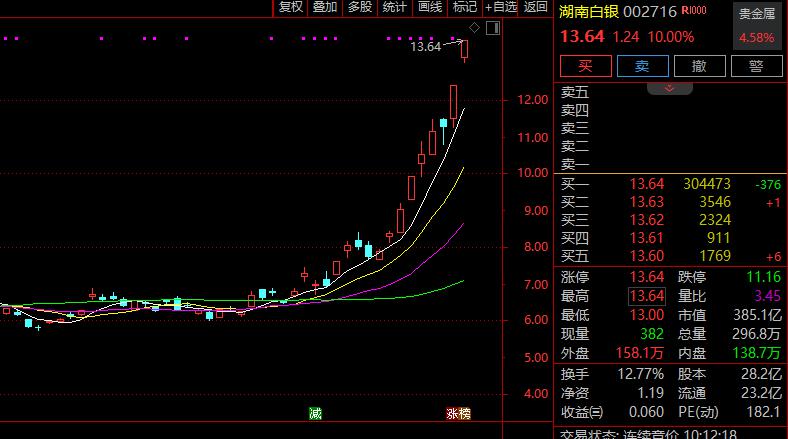
Market Overview - The A-share market opened lower on January 21, but all three major indices turned positive by the time of reporting [1] - In the Hong Kong market, the Hang Seng Index slightly declined while the Hang Seng Tech Index saw a minor increase [2] Sector Performance - The polyurethane, gold, and non-ferrous metal sectors led the gains, while AI marketing, internet, communication equipment, and Zhizhu AI sectors experienced declines [2] - The precious metals sector opened strong, with companies like Hunan Silver and Shandong Gold showing significant gains [3] Gold Market Insights - Gold stocks in the Hong Kong market opened higher, with Zhaojin Mining and Shandong Gold seeing notable increases [5] - Spot gold prices surged, breaking the $4,800 per ounce mark and reaching a new historical high of $4,828.59 per ounce, up 1.38% [5] - The National Bank of Poland announced plans to purchase 150 tons of gold, valued at approximately $23 billion at current market prices, exceeding the total gold reserves of larger economies like Brazil and Mexico [5] Real Estate Sector - The real estate sector continued its strong performance, with companies like Chengdu Investment Holdings and Vanke A experiencing upward momentum [6] - A joint announcement from the Ministry of Finance and other departments extended the personal income tax preferential policy for housing purchases until the end of 2027, allowing taxpayers to enjoy tax refunds when purchasing new homes within one year of selling their own [8] Robotics and AI Sector - The humanoid robot concept saw a rise, with companies like Fangzheng Electric and Yifan Transmission hitting their daily limits [8] - Industry reports indicate that large-scale production of humanoid robots is imminent, with significant technological breakthroughs expected by 2025 and commercialization anticipated by 2026 [8] Lithium Mining Sector - The lithium mining sector experienced a rebound, with companies like Shengxin Lithium Energy hitting their daily limit [9] - The main contract for lithium carbonate on the Shanghai Futures Exchange rose over 5%, surpassing 164,000 yuan per ton [9] PCB Sector Developments - The PCB sector saw fluctuations, with companies like Aoshikang and Guanghe Technology reaching their daily limits [9] - Due to tight supply and soaring prices of raw materials, Japanese semiconductor material manufacturer Resonac announced a price increase of over 30% for copper foil substrates and adhesive films starting March 1 [9]
未知机构:东财策略每日复盘20260120一市场概况1月20日A股震-20260121
未知机构· 2026-01-21 02:20
【东财策略】每日复盘20260120 一、市场概况 1月20日A股震荡下行,三大指数集体收跌。 截至收盘,沪指跌0.01%收报4113点,深证成指跌0.97%,创业板指跌1.79%;两市成交额2.78万亿,较昨日小幅放 量。 全天上涨2233家,下跌3102家。 二、行业表现 【东财策略】每日复盘20260120 一、市场概况 1月20日A股震荡下行,三大指数集体收跌。 截至收盘,沪指跌0.01%收报4113点,深证成指跌0.97%,创业板指跌1.79%;两市成交额2.78万亿,较昨日小幅放 量。 全天上涨2233家,下跌3102家。 二、行业表现 分行业看,申万一级行业中,涨幅前五位是石油石化(+1.74%)、建筑材料(+ 截至目前,LPR已连续8个月保持不变。 3)盈方微于今日复牌并披露重大资产重组进展,拟收购上海肖克利及富士德中国100%股权以强化半导体分销业 务。 四、后市展望和思考 融资端约束叠加题材澄清、业绩扰动,行情更可能从"高弹性主线"转向"可验证线索"主导的轮动:一是涨价与供给 收敛的资源、化工链,二是地产链的低位修复与政策预期交易,三是年报预告驱动的业绩线索。 分行业看,申万一级行业中,涨 ...
银泰证券鑫新闻:研究所日报-20260121
Yintai Securities· 2026-01-21 01:59
Fiscal Policy and Investment - The overall fiscal expenditure for 2026 will "only increase" with a focus on key areas, including a special guarantee plan of 500 billion yuan for private investment to guide banks in providing 500 billion yuan in loans for small and micro enterprises[2] - A loan interest subsidy policy will be implemented for small and micro enterprises, covering 14 key industrial chains and related sectors, which is expected to support social investment activities and consumption[2] Market Performance - On January 20, the Shanghai Composite Index fell by 0.01%, while the Shenzhen Component Index decreased by 0.97%, with a total trading volume of 27,776.57 billion yuan, an increase of 693.09 billion yuan from the previous trading day[3] - The three major U.S. stock indices saw declines of 2.39% for the Nasdaq, 2.06% for the S&P 500, and 1.76% for the Dow Jones, reflecting a general downturn in global markets[3] Bond and Currency Markets - The yield on the 10-year Chinese government bond was 1.8260%, with a change of -1.66 basis points, while the average rates for interbank R001 and R007 were 1.4212% and 1.5429%, respectively[3] - The U.S. dollar index closed at 98.5413, down by 0.51%, and the offshore RMB appreciated by 10 basis points to 6.9559[4] Sector Performance - The leading sectors included oil and petrochemicals, construction materials, and real estate, with gains of 1.74%, 1.71%, and 1.55%, respectively[3] - Conversely, sectors such as telecommunications, defense, and computers experienced declines of 3.23%, 2.87%, and 1.94%[3]