
装备制造业

Search documents
规上工业增加值同比增长8.7%!2025年1-4月青岛经济运行情况发布
Sou Hu Cai Jing· 2025-05-27 04:23
Economic Overview - The overall economic operation of Qingdao is stable, continuing a positive development trend in 2023 [1] Industrial Production - The industrial added value above designated size increased by 8.7% year-on-year in the first four months, with 22 out of 35 major industries showing growth, resulting in a growth rate of 62.9% [1] - Key industries such as railway, shipbuilding, aerospace, and automotive manufacturing saw significant increases in added value, contributing a total of 5.8 percentage points to the industrial growth rate [1] - The equipment manufacturing sector's added value grew by 14.2%, boosting the overall industrial growth rate by 7.3 percentage points, which is higher than the overall industrial added value growth rate of 5.5% [1] Service Sector - The revenue of service enterprises above designated size grew by 7.0% year-on-year in the first quarter, with leasing and business services increasing by 18.8% and scientific research and technical services by 3.8% [2] - Passenger transport volumes for rail, road, and air increased by 2.8%, 9.1%, and 2.5% respectively, while postal business volume grew by 10.4% [2] Fixed Asset Investment - Fixed asset investment increased by 1.0% year-on-year in the first four months, with the secondary industry seeing a significant growth of 27.8% [3] - Private investment rose by 8.3%, accounting for 63.7% of total investment, contributing 5.0 percentage points to the overall fixed asset investment growth [3] Online Consumption - Retail sales through public networks increased by 8.5% year-on-year, making up 37.7% of total retail sales [4] - The sales of cultural and office supplies and communication equipment surged by 48.7% and 23.8% respectively, driven by the policy encouraging the replacement of consumer goods [4] Trade and Exports - The total value of foreign trade imports and exports reached 291.1 billion yuan, a year-on-year increase of 3.7%, accounting for 25.8% of the province's total [5] - Exports grew by 8% to 175.64 billion yuan, while imports decreased by 2.2% to 115.46 billion yuan [5] - Private enterprises contributed significantly to trade, with a total of 204.84 billion yuan in imports and exports, marking a 6.4% increase [5] Financial and Employment Situation - The general public budget revenue was 49.49 billion yuan, while expenditure was 50.17 billion yuan, with education and cultural tourism spending increasing by 7.2% and 19.2% respectively [6] - Urban employment increased by 114,700, a growth of 5.0% year-on-year, with a notable rise in employment among migrant workers [7] - The consumer price index (CPI) showed a slight year-on-year decrease of 0.1%, with various categories experiencing different price changes [7]
1—4月 大连市规上工业增加值同比增长11.9%
Zheng Quan Shi Bao Wang· 2025-05-27 04:13
Economic Performance - In the first four months, Dalian's industrial production accelerated, with the industrial added value of large-scale enterprises increasing by 11.9% year-on-year, up 1.0 percentage points from January to March [1] - High-tech manufacturing added value grew by 21.1%, maintaining double-digit growth for 24 consecutive months [1] - The added value of state-owned enterprises increased by 18.9%, while private enterprises grew by 7.4% [1] Investment Trends - Fixed asset investment in Dalian rose by 3.4% year-on-year, with manufacturing investment increasing by 5.3% and infrastructure investment surging by 29.2% [2] - High-tech industry investment saw a significant rise of 23.4%, with high-tech manufacturing investment skyrocketing by 225.7% [3] - The number of industrial technology transformation projects reached 220, up 12.2% year-on-year, with completed investment increasing by 107.5% [3] Consumer Market - Retail sales in Dalian reached 31.14 billion yuan, marking an 18.5% year-on-year increase [3] - Significant growth was observed in categories such as building materials (2670.9%), furniture (779.1%), and home appliances (495.5%) [3] - Online retail sales through public networks surged by 215.0% year-on-year [3] Service Sector Performance - The total turnover of road, waterway, and air transport increased by 1.8%, -3.9%, and 6.4% respectively [2] - The postal business volume grew by 20.5%, while telecommunications business volume rose by 11.6% [2] - Revenue from various service sectors, including culture, sports, and entertainment, saw significant increases, with a 15.0% rise [2] Price Trends - Consumer prices in Dalian decreased by 0.4% year-on-year, with consumer goods prices down by 0.9% [4] - The price of food and tobacco fell by 1.8%, while clothing prices increased by 0.7% [4] - The total electricity consumption reached 16.67 billion kWh, up 2.1% year-on-year [4]
4月工业企业利润增速加快,“两新”政策效应持续显现
Di Yi Cai Jing· 2025-05-27 03:52
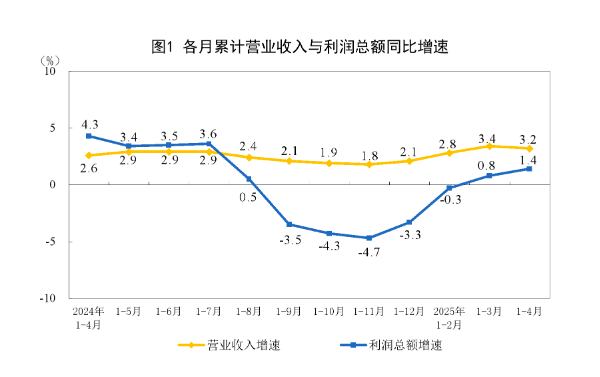
Core Viewpoint - The article emphasizes the importance of expanding domestic demand, implementing industrial development support policies, and promoting the integration of technological and industrial innovation to ensure the sustained and healthy development of the industrial sector [1][7]. Industrial Profit Growth - From January to April, profits of industrial enterprises above designated size increased by 1.4%, accelerating by 0.6 percentage points compared to the first quarter [1]. - In April, profits grew by 3.0% year-on-year, an acceleration of 0.4 percentage points from March [1]. - The equipment manufacturing and high-tech manufacturing sectors showed significant profit growth, with equipment manufacturing profits rising by 11.2% and high-tech manufacturing profits increasing by 9.0% during the same period [4]. Sector Performance - Among 41 major industrial categories, 23 reported year-on-year profit growth, indicating a growth rate of nearly 60% [4]. - The equipment manufacturing sector contributed significantly, driving a 3.6 percentage point increase in total industrial profits [4]. - High-end manufacturing sectors such as biopharmaceuticals and aircraft manufacturing saw profits increase by 24.3% and 27.0%, respectively [4]. Policy Impact - The "Two New" policies have shown continued effectiveness, with specialized and general equipment sectors experiencing profit growth of 13.2% and 11.7%, respectively [5][6]. - The consumer goods sector benefited from policies promoting the replacement of old products, with profits in related industries growing by 17.2% to 15.1% [6]. Future Outlook - The industrial sector is expected to maintain high growth, supported by macroeconomic policies and the ongoing transformation and upgrading of industries [7]. - The Ministry of Industry and Information Technology is focusing on enhancing the industrial ecosystem and avoiding homogeneous competition, while promoting innovation and collaboration among enterprises [8]. - Local governments are actively implementing measures to stabilize industrial performance and support small and medium-sized enterprises [9].

税费优惠激活中国经济蓬勃“向新力”
Zhong Guo Jing Ji Wang· 2025-05-26 23:55
Group 1 - The core viewpoint emphasizes that the acceleration of technological innovation will significantly contribute to high-quality development, fostering a virtuous cycle among technology, industry, and finance, and integrating various chains such as funding, innovation, and talent [1][4] - A series of tax and fee reduction policies have effectively supported the cultivation of new productive forces and the high-quality development of the manufacturing industry, with tax reductions and refunds amounting to 424.1 billion yuan in the first quarter of this year [1][2] - The precision of tax reductions reflects the "quality improvement and efficiency enhancement" role of fiscal policy, focusing on R&D investment, venture capital, and key industrial chains, thereby strengthening the innovation capabilities of enterprises [1][3] Group 2 - The comprehensive effects of structural tax reductions and other measures have led to a positive growth trend in innovation momentum, with high-tech industry sales revenue increasing by 13.9% year-on-year in the first four months of this year, significantly outpacing the overall national growth rate [2] - Manufacturing has also shown steady growth, with sales revenue increasing by 4.7% year-on-year in the same period, particularly in advanced manufacturing sectors such as computer and intelligent equipment manufacturing, which saw sales revenue growth of 23.8% and 15.7% respectively [2] - The government has introduced a series of tax incentives covering all aspects of enterprise innovation activities, promoting the high-end, intelligent, and green transformation of the manufacturing sector, thereby enhancing the economy's new driving force [3]
消费新趋势藏着哪些机会?专访工银国际首席经济学家程实
21世纪经济报道· 2025-05-26 09:37
Economic Performance - In April, the industrial added value above designated size increased by 6.1% year-on-year, and retail sales of consumer goods reached 371.74 billion yuan, growing by 5.1% year-on-year [1][4] - Fixed asset investment (excluding rural households) for January to April was 1,470.24 billion yuan, with a year-on-year growth of 4.0% [1] Consumer Trends - The "new pragmatic" consumption trend emphasizes the dual demand for "quality-price ratio" and "supporting services," encouraging companies to integrate products and services deeply [1][11] - The shift in consumption patterns from "external display" to "internal entertainment" highlights the importance of service consumption in driving economic growth [1][9] Real Estate Market - The real estate market is currently in a bottoming phase, with short-term policies focusing on stabilizing demand while maintaining supply and basic needs in the long term [1][6] - Policies such as lowering mortgage rates and optimizing city-specific support measures are suggested to boost market confidence [1][5] Manufacturing Sector - The equipment manufacturing and high-tech manufacturing sectors achieved high growth rates of 9.8% and 10% respectively, indicating ongoing industrial structure optimization [1][4] - Encouragement for companies to expand into high value-added and high-quality end products is emphasized [1][5] Foreign Trade - In April, exports increased by 9.3% year-on-year, with a notable shift of enterprises towards domestic sales, indicating a diversification of market strategies [1][14] - Future foreign trade focus should include enhancing resilience in supply chains and exploring new markets through regional cooperation like RCEP and the Belt and Road Initiative [1][16]

山东:1—4月规模以上工业增加值同比增长8.1%
news flash· 2025-05-26 07:50
Core Insights - Shandong Province's industrial output value above designated size increased by 8.1% year-on-year from January to April 2025, indicating robust industrial growth [1] - Out of 41 industries, 35 achieved positive growth, resulting in a growth coverage of 85.4% [1] - The equipment manufacturing sector's output value grew by 13.9%, surpassing the overall industrial growth rate by 5.8 percentage points, contributing an additional 3.4 percentage points to the province's industrial growth [1]
专访工银国际首席经济学家程实:房地产政策重心应向“稳需求”倾斜,企业可顺应“新务实主义”消费趋势|大咖谈经济
2 1 Shi Ji Jing Ji Bao Dao· 2025-05-26 06:54
Economic Performance - In April, the industrial added value above designated size increased by 6.1% year-on-year and 0.22% month-on-month, while the total retail sales of consumer goods reached 37,174 billion yuan, growing by 5.1% year-on-year [1] - Fixed asset investment (excluding rural households) from January to April totaled 147,024 billion yuan, with a year-on-year growth of 4.0% [1] Structural Challenges - Despite the positive growth in industrial and consumer sectors, structural challenges remain, including the need for further improvement in residents' income and the ongoing bottoming out of the real estate market [2] - The external environment poses risks such as geopolitical conflicts and trade frictions, but there is potential for China to diversify its export markets and enhance its high-tech product offerings [2] Manufacturing Growth - The equipment manufacturing industry and high-tech manufacturing industry achieved high growth rates of 9.8% and 10% respectively, indicating ongoing industrial structure optimization [2][3] - Government support through fiscal measures and subsidies is suggested to bolster emerging technology products and enhance market efficiency [2] Real Estate Market - The real estate market is currently in a bottoming phase, and policies should focus on stabilizing demand while ensuring risk control [4] - Short-term measures may include lowering mortgage rates and optimizing city-specific support policies to meet housing demand [4][5] Consumer Spending - The introduction of differentiated subsidies is recommended to stimulate consumption, particularly in lower-tier cities and rural areas [6] - The shift in consumption patterns from "external display" to "internal entertainment" highlights the importance of service consumption in driving economic growth [7][8] Foreign Trade - In April, exports increased by 9.3%, with a notable shift towards emerging markets, which helps mitigate risks from traditional markets [11] - Future focus areas for foreign trade include enhancing the resilience of supply chains, deepening regional cooperation, and improving the competitiveness of products in international markets [12]
4月经济数据点评:关税不确定性尚存,扩内需政策加快落地
CDBS· 2025-05-26 02:20
Economic Performance - In April, industrial added value increased by 6.1% year-on-year, exceeding the expected growth of 5.2% but down from the previous month's growth of 7.7%[10] - From January to April, fixed asset investment grew by 4.0% year-on-year, below the expected 4.3% and the previous value of 4.2%[10] - Social retail sales in April rose by 5.1% year-on-year, lower than the expected 5.5% and the previous month's growth of 5.9%[10] Sector Analysis - The production sector showed a slowdown but maintained rapid growth, with service industry growth steady and equipment manufacturing and high-tech manufacturing performing well[7] - Despite increasing tariff impacts, export growth of 8.1% in April exceeded expectations of 0.8%, partially mitigating tariff disruptions[11] Consumer Trends - Consumption showed signs of slowing down, but structural highlights were evident, with both social retail sales and service retail sales showing recovery trends[12] - Significant growth in specific consumer goods was noted, with home appliances and communication equipment sales increasing by 38.8% and 19.9% respectively[12] Investment Insights - Fixed asset investment growth was below expectations across all three major components, indicating a need for policy support[13] - Infrastructure investment growth was recorded at 10.9% year-on-year, while real estate investment declined by 10.3%[14] Future Outlook - The report suggests that while short-term tariff impacts may ease, long-term uncertainties remain, with ongoing supply exceeding demand posing risks to economic stability[8] - Recent policies aimed at boosting domestic demand are expected to enhance consumption and stabilize market confidence, with close monitoring of policy implementation and US-China tariff negotiations recommended[8]
一大批“两重”项目开工投产,“两新”加力扩围
Zhong Guo Chan Ye Jing Ji Xin Xi Wang· 2025-05-25 22:39
Group 1 - The core viewpoint emphasizes the effective implementation of "Two Heavy" projects and the expansion of "Two New" policies, which are crucial for enhancing economic development and stability [1][2][3] - "Two Heavy" projects focus on strategic areas such as technological self-reliance, urban-rural integration, and ecological security, with significant funding allocated for infrastructure and agricultural development [2][3] - The National Development and Reform Commission (NDRC) aims to complete the project list for "Two Heavy" construction by the end of June, ensuring high standards in implementation and efficiency [3] Group 2 - "Two New" initiatives involve large-scale equipment upgrades and consumer product replacements, which have become vital for boosting consumption and investment [4][5] - Retail sales in key categories such as home appliances and furniture have shown substantial growth, contributing to an increase in overall social retail sales [4] - Investment in equipment and tools has risen significantly, with a notable contribution from sectors closely related to "Two New" policies, indicating a positive trend in manufacturing and technological upgrades [4][5] Group 3 - The economic outlook remains stable, with domestic demand expanding and external markets diversifying, as evidenced by a 4.7% year-on-year increase in social retail sales [6][7] - High-tech manufacturing and equipment sectors are experiencing rapid growth, with significant increases in production output for servers and industrial robots [6] - The NDRC plans to accelerate fund allocation and improve the efficiency of fund usage to support the ongoing implementation of "Two New" policies [5][6]
税收增速转正折射经济持续恢复
Jing Ji Ri Bao· 2025-05-25 22:08
Economic Performance and Tax Revenue - China's economy is showing a positive trend, providing strong support for tax revenue growth [1][3] - In April, national tax revenue increased by 1.9%, marking the first month of positive growth after a period of decline [1][3] - The growth in tax revenue aligns with improved economic indicators such as industrial added value and retail sales [1] Industry-Specific Tax Revenue - Certain industries, particularly equipment manufacturing, are maintaining strong tax revenue performance, reflecting their robust development [2] - In April, the added value of the equipment manufacturing industry grew by 9.8%, contributing 55.9% to the growth of large-scale industry [2] - Tax policies supporting technological innovation and manufacturing have resulted in significant tax reductions and refunds, totaling 424.1 billion yuan in the first quarter [2] Macroeconomic Policy and Fiscal Measures - The central government is implementing more proactive macroeconomic policies to sustain economic recovery and tax revenue growth [3][4] - Fiscal spending in the first four months of the year has been the fastest since 2020, aimed at boosting economic activity and ensuring livelihood support [3] - Continued emphasis on expanding domestic demand and supporting new productive forces is crucial for maintaining economic stability [3] Fiscal and Tax System Reforms - To promote fiscal revenue growth, reforms in the fiscal and tax system are necessary, particularly to enhance local financial autonomy [4] - There is a focus on improving the efficiency of fund usage and policy effectiveness through better fiscal management practices [4] - The interaction between economic performance and tax revenue is emphasized, with a positive cycle expected as proactive policies are implemented [4]