非银金融

Search documents
南向资金年内净流入超万亿港元 大金融及科技股受追捧
Zheng Quan Shi Bao· 2025-09-03 18:15
Group 1 - The Hong Kong stock market has attracted significant attention from global investors, with net inflows from mainland China reaching a record high of 10057.3 billion HKD as of September 3 [1] - Southbound funds have seen a continuous net inflow for 27 months, with six months in 2023 exceeding 1000 billion HKD, indicating a strong market performance [2] - The Hang Seng Index and Hang Seng Tech Index have both risen over 25% year-to-date, ranking among the top global indices [2] Group 2 - Major sectors attracting southbound fund inflows include finance and technology, with the banking sector seeing a market value increase of nearly 3000 billion HKD since the end of last year [3][4] - The pharmaceutical and biotechnology sectors have also benefited, with holdings increasing by over 4000 billion HKD due to breakthroughs in innovative drug development [3] Group 3 - Four industries have recorded net inflows exceeding 1000 billion HKD this year, with banking leading at over 2100 billion HKD, followed by retail and pharmaceutical sectors [4] - Traditional industries such as steel and agriculture have experienced net outflows, indicating a shift in investment focus [4] Group 4 - Nearly 60% of Hong Kong Stock Connect stocks have seen an increase in holdings this year, with significant increases in bank stocks [5] - A total of 61 stocks have been continuously accumulated by southbound funds for five months, primarily in sectors like social services and pharmaceuticals [5] Group 5 - Notable individual stocks include Yiyang Medical, which has seen its holding ratio increase by over 35 percentage points, and Delin Holdings, which has increased by over 20 percentage points [6] - The average increase in stock prices for the top 20 heavily accumulated stocks exceeds 35% year-to-date, with some stocks like Dekang Agriculture and InnoCare rising over 200% [6]


两融余额再创历史新高,这些热门股获杠杆资金青睐
第一财经· 2025-09-03 12:59
Core Viewpoint - The A-share market is experiencing high activity levels, with the margin trading balance reaching a historical high of 2.297 trillion yuan as of September 1, surpassing the previous peak in 2015 [2][6][8]. Margin Trading Balance - As of September 1, the margin trading balance reached 2.297 trillion yuan, an increase of 356.42 billion yuan from the previous trading day, marking the second-largest increase this year [4][6]. - The margin trading balance has been on an upward trend since surpassing 2 trillion yuan on August 5, with significant increases noted on August 18 and August 26 [5][6]. - The current margin trading balance is 239.56 billion yuan higher than the peak in 2015, although the proportion of margin funds to A-share circulating market value is lower than in 2015 [6][8]. Investor Participation - The number of investors participating in the margin trading market has increased, reaching 591,355 as of September 1, up from 581,874 the previous day [9]. - The maintenance guarantee ratio, a key indicator of the safety of leveraged funds, remains high at 289.89% [9]. Industry and Stock Preferences - Recent trends show that leveraged funds are favoring sectors such as electronics, non-bank financials, computers, power equipment, and pharmaceuticals, with margin balances in these sectors exceeding 100 billion yuan [11][12]. - The electronics sector received the highest net margin buy-in of 83.64 billion yuan from August 5 to September 1, followed by telecommunications and computers [12][16]. - Notable stocks with high margin balances include Dongfang Caifu, China Ping An, and Kweichow Moutai, with Dongfang Caifu leading at approximately 275 billion yuan [13][14]. Recent Stock Performance - Stocks like Cambrian (688256.SH) and Shenghong Technology (300476.SZ) have seen significant net buy-ins, with Cambrian receiving 6.67 billion yuan and experiencing a 110.20% increase in stock price during the same period [16][17]. - The trend indicates a shift towards technology stocks, contrasting with the previous year's preference for traditional industries [17].




【3日资金路线图】电力设备板块净流入超70亿元居首 龙虎榜机构抢筹多股
Zheng Quan Shi Bao· 2025-09-03 12:41
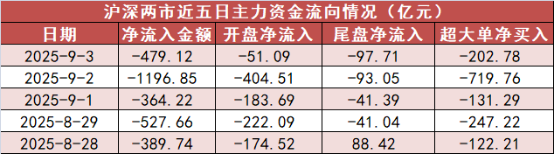
Market Overview - The A-share market experienced an overall decline on September 3, with the Shanghai Composite Index closing at 3813.56 points, down 1.16%, the Shenzhen Component Index at 12472 points, down 0.65%, and the ChiNext Index at 2899.37 points, up 0.95% [1] - The total trading volume in the A-share market was 23961.02 billion yuan, a decrease of 5166.64 billion yuan compared to the previous trading day [1] Capital Flow - The main capital in the A-share market saw a net outflow of 479.12 billion yuan, with an opening net outflow of 51.09 billion yuan and a closing net outflow of 97.71 billion yuan [2] - The CSI 300 index had a net outflow of 57.65 billion yuan, while the ChiNext saw a net outflow of 203.51 billion yuan and the STAR Market had a net outflow of 28.31 billion yuan [4] Sector Performance - In the primary industry sectors, only two sectors saw net capital inflows, with the power equipment sector leading at 70.39 billion yuan [6] - The computer sector experienced the largest net outflow at 172.12 billion yuan, followed by non-bank financials at 158.23 billion yuan and defense industry at 125.99 billion yuan [7] Individual Stock Activity - Rock Mountain Technology had the highest net inflow of main capital at 30.18 billion yuan [8] - Institutions showed interest in several stocks, with notable net purchases in Chenxin Pharmaceutical and significant net sales in Julun Intelligent [10] Institutional Focus - Recent institutional ratings and target prices indicate potential upside for several stocks, including Jinwei Industrial with a target price of 28.40 yuan, representing a 26.05% upside from the latest closing price [13]





【3日资金路线图】电力设备板块净流入超70亿元居首 龙虎榜机构抢筹多股
证券时报· 2025-09-03 11:49
Market Overview - The A-share market experienced an overall decline on September 3, with the Shanghai Composite Index closing at 3813.56 points, down 1.16%, and the Shenzhen Component Index at 12472 points, down 0.65%. The ChiNext Index rose by 0.95% to 2899.37 points. The total market turnover was 23961.02 billion yuan, a decrease of 5166.64 billion yuan compared to the previous trading day [2]. Capital Flow - The main capital outflow from the A-share market was 479.12 billion yuan, with an opening net outflow of 51.09 billion yuan and a closing net outflow of 97.71 billion yuan [3][4]. - The CSI 300 index saw a net outflow of 57.65 billion yuan, while the ChiNext experienced a net outflow of 203.51 billion yuan and the STAR Market had a net outflow of 28.31 billion yuan [5]. Sector Performance - In the primary industry sectors, only two sectors saw net capital inflows, with the power equipment sector leading at 70.39 billion yuan, despite a decline of 0.74% [7][8]. - The top five sectors with the largest capital outflows included: - Computer: -172.12 billion yuan - Non-bank financials: -158.23 billion yuan - Defense: -125.99 billion yuan - Machinery: -123.67 billion yuan - Automotive: -117.41 billion yuan [8]. Stock Highlights - The stock with the highest net capital inflow was Yanshan Technology, with 30.18 billion yuan [9]. - Institutions showed interest in several stocks, with notable net purchases in: - Chenxin Pharmaceutical: 115.76 million yuan - Xiaocheng Technology: 110.91 million yuan - Ailuo Energy: 72.55 million yuan [12]. Institutional Focus - Recent institutional ratings and target prices for selected stocks include: - Jinhe Industrial: Strong Buy, target price 28.40 yuan, current price 22.53 yuan, upside potential 26.05% - Hanzhong Precision: Buy, target price 40.55 yuan, current price 26.62 yuan, upside potential 52.33% [14].

数据复盘丨通信、电力设备等行业走强 80股获主力资金净流入超1亿元
Zheng Quan Shi Bao Wang· 2025-09-03 10:34
Market Overview - The Shanghai Composite Index closed at 3813.56 points, down 1.16%, with a trading volume of 10123 billion yuan [1] - The Shenzhen Component Index closed at 12472.00 points, down 0.65%, with a trading volume of 13517.9 billion yuan [1] - The ChiNext Index closed at 2899.37 points, up 0.95%, with a trading volume of 6575.71 billion yuan [1] - The STAR Market 50 Index closed at 1306.48 points, down 1.64%, with a trading volume of 682 million yuan [1] - Total trading volume for both markets was 23640.9 billion yuan, a decrease of 5109.24 billion yuan from the previous trading day [1] Sector Performance - Communication and power equipment sectors showed strength, while defense, securities, insurance, and computer sectors experienced significant declines [3][4] - Among 31 primary sectors, 8 sectors saw net inflows of funds, with the power equipment sector leading at a net inflow of 2.63 billion yuan [5] - The defense industry had the highest net outflow of funds, totaling 7.43 billion yuan [5] Individual Stock Movements - A total of 777 stocks rose, while 4334 stocks fell, with 39 stocks hitting the daily limit up and 23 stocks hitting the limit down [3] - Tianpu Co. achieved a remarkable 9 consecutive limit-up days, leading the market in this regard [3] - 80 stocks received net inflows exceeding 1 billion yuan, with Yanshan Technology receiving the highest at 3.018 billion yuan [7] - 184 stocks experienced net outflows exceeding 1 billion yuan, with Dongfang Wealth seeing the largest outflow at 3.474 billion yuan [9] Institutional Activity - Institutions had a net buying of approximately 50.26 million yuan, with the highest net purchase in Chenxin Pharmaceutical at about 116 million yuan [10]
两市主力资金净流出714.26亿元 非银金融行业净流出居首
Zheng Quan Shi Bao Wang· 2025-09-03 09:50
Market Overview - On September 3, the Shanghai Composite Index fell by 1.16%, the Shenzhen Component Index decreased by 0.65%, while the ChiNext Index rose by 0.95%. The CSI 300 Index declined by 0.68% [1] - Among the tradable A-shares, 823 stocks increased, accounting for 15.19%, while 4,560 stocks decreased [1] Capital Flow - The main capital experienced a net outflow of 71.426 billion yuan throughout the day, marking the eighth consecutive trading day of net outflows [1] - The ChiNext saw a net outflow of 17.129 billion yuan, the Sci-Tech Innovation Board had a net outflow of 6.808 billion yuan, and the CSI 300 constituents experienced a net outflow of 17.301 billion yuan [1] Industry Performance - Among the 28 industries, only three saw net inflows: - The Electric Equipment industry rose by 1.44% with a net inflow of 2.958 billion yuan - The Textile and Apparel industry fell by 1.17% but had a net inflow of 0.022 billion yuan - The Comprehensive industry increased by 1.64% with a net inflow of 0.003 billion yuan [1][3] - The industries with the largest net outflows included: - Non-bank Financials, which fell by 3.05% with a net outflow of 12.210 billion yuan - Defense and Military Industry, which dropped by 5.83% with a net outflow of 10.131 billion yuan [2][3] Individual Stock Performance - A total of 1,560 stocks experienced net inflows, with 534 stocks having inflows exceeding 10 million yuan. Notably, 85 stocks had inflows over 100 million yuan [3] - The stock with the highest net inflow was Yanshan Technology, which rose by 9.07% with a net inflow of 3.230 billion yuan. Other notable inflows included Unisplendour and CATL, with net inflows of 1.873 billion yuan and 1.663 billion yuan, respectively [3]
主力资金动向 29.58亿元潜入电力设备业
Zheng Quan Shi Bao Wang· 2025-09-03 09:38
今日各行业主力资金流向一览 | 行业名 | 成交量(亿 | 成交量较昨日增减 | 换手率 | 涨跌幅 | 今日主力资金净流入(亿 | | --- | --- | --- | --- | --- | --- | | 称 | 股) | (%) | (%) | (%) | 元) | | 电力设 | 95.37 | -9.20 | 3.81 | 1.44 | 29.58 | | 备 | | | | | | | 纺织服 饰 | 23.86 | 1.69 | 3.41 | -1.17 | 2.22 | | 综合 | 6.34 | -18.46 | 3.75 | 1.64 | 0.03 | | 传媒 | 54.48 | -14.57 | 3.72 | -0.15 | -0.79 | | 环保 | 22.15 | -23.83 | 2.46 | -1.66 | -1.48 | | 社会服 务 | 21.60 | -6.55 | 4.78 | -1.28 | -2.01 | | 美容护 理 | 2.54 | -14.92 | 2.57 | -2.24 | -2.73 | | 轻工制 | 27.56 | -4.46 | 3.29 ...
非银金融行业9月3日资金流向日报
Zheng Quan Shi Bao Wang· 2025-09-03 09:15
沪指9月3日下跌1.16%,申万所属行业中,今日上涨的有3个,涨幅居前的行业为综合、通信、电力设 备,涨幅分别为1.64%、1.61%、1.44%。跌幅居前的行业为国防军工、非银金融,跌幅分别为5.83%、 3.05%。非银金融行业位居今日跌幅榜第二。 资金面上看,两市主力资金全天净流出714.26亿元,主力资金净流入的行业仅有3个,电力设备行业净 流入资金29.58亿元;纺织服饰行业净流入资金2.22亿元;综合行业净流入资金310.66万元。 | 代码 | 简称 | 今日涨跌幅(%) | 今日换手率(%) | 主力资金流量(万元) | | --- | --- | --- | --- | --- | | 300059 | 东方财富 | -4.38 | 5.98 | -341410.13 | | 601099 | 太平洋 | -8.03 | 15.72 | -133661.33 | | 600030 | 中信证券 | -3.22 | 1.55 | -65318.66 | | 601696 | 中银证券 | -6.19 | 4.90 | -43103.33 | | 601318 | 中国平安 | -1.50 | ...


310.66万元资金今日流入综合股
Zheng Quan Shi Bao Wang· 2025-09-03 09:12
Market Overview - The Shanghai Composite Index fell by 1.16% on September 3, with only three sectors showing gains: comprehensive, communication, and electric equipment, which rose by 1.64%, 1.61%, and 1.44% respectively [1] - The defense and military industry and non-bank financial sectors experienced the largest declines, with drops of 5.83% and 3.05% respectively [1] Capital Flow Analysis - The net outflow of capital from the two markets reached 71.426 billion yuan, with only three sectors seeing net inflows: electric equipment (2.958 billion yuan), textile and apparel (222 million yuan), and comprehensive (3.1066 million yuan) [1] - The non-bank financial sector had the highest net outflow, totaling 12.210 billion yuan, followed by the defense and military sector with a net outflow of 10.131 billion yuan [1] Comprehensive Sector Performance - The comprehensive sector saw a rise of 1.64% with a net inflow of 3.1066 million yuan, despite only one of its 16 constituent stocks rising [2] - The stock with the highest net inflow in the comprehensive sector was Dongyangguang, which attracted 105 million yuan, followed by Teli A and Hongmian Co., with inflows of 8.7395 million yuan and 5.0492 million yuan respectively [2] - The stocks with the largest net outflows included Yuegui Co., Zhangzhou Development, and Zongyi Co., with outflows of 65.8146 million yuan, 15.135 million yuan, and 13.3925 million yuan respectively [2]


新发规模再创新高!基金公司,紧急限制!
证券时报· 2025-09-03 09:11
Core Viewpoint - The issuance of actively managed equity funds is experiencing a rebound, driven by the recovery of the A-share market and improved fund performance, with significant fundraising activities observed recently [1][2]. Fund Issuance and Performance - As of September 2, 26 actively managed equity funds have confirmed their issuance periods, with the招商均衡优选混合基金 exceeding its fundraising cap of 50 billion yuan on its first day of issuance [2][4]. - The招商均衡优选混合基金 aims for excess returns through a balanced approach across market, industry, style, and individual stocks, managed by 吴潇, who has over 8 years of experience [2][3]. - The overall issuance scale of actively managed equity funds this year has reached 785.28 billion yuan, with 29 funds exceeding 10 billion yuan in issuance [5]. Market Conditions and Future Outlook - The A-share market has shown positive performance, with the Shanghai Composite Index rising by 12% and the ChiNext Index increasing by 33.4% since the second half of the year [5][6]. - The macroeconomic environment is favorable for equity markets, with expectations of U.S. Federal Reserve rate cuts and a stable U.S.-China relationship contributing to a positive outlook [6][7]. - Investment opportunities are identified in sectors such as AI technology, retail, non-bank financials, and innovative pharmaceuticals, with a focus on technology sectors like semiconductors and computing [7].