
信托

Search documents
以并购重塑制造强市!东莞资本市场高质量发展大会举行
Zheng Quan Shi Bao Wang· 2025-07-31 03:09
7月30日下午,并购新浪潮·东莞智造跃升新引擎——东莞资本市场2025年高质量发展大会举行,来 自"政产学研金"各界的代表济济一堂,共同探寻并购重组何以成为企业裂变成长、制造业高端跃升的重 要路径。同时,大会也围绕并购方法论、实操要点、协同生态等关键议题展开深入探讨,为东莞上市公 司提供决策参考与战略借鉴。 本次活动由东莞市委金融办指导,东莞市上市公司协会、东莞市投资控股集团有限公司(下称"投控集 团")主办,东莞证券、东莞银行、东莞信托、东莞科创集团、智数公司、华联期货协办,南方报业传 媒集团东莞分社承办。 在当前资本市场不断改革深化、并购重组持续活跃的背景下,并购不仅是企业扩张、迭代、开拓的关键 路径,更是驱动"东莞智造"向全球价值链高端跃升的核心引擎。东莞,这座底蕴深厚的制造业名城,坐 拥境内外上市企业84家、上市后备企业347家、专精特新企业超3000家,正加速迈向国际科创制造强 市。本次活动以"并购"为核心议题,不仅全面回顾了2024年资本市场发展成果,也通过园区推介、战略 签约、主题演讲、圆桌论坛等多个重磅环节,凝聚各方并购智慧,全面助力"东莞智造"向高端化、智能 化、国际化迈进。 "政产学研金" ...

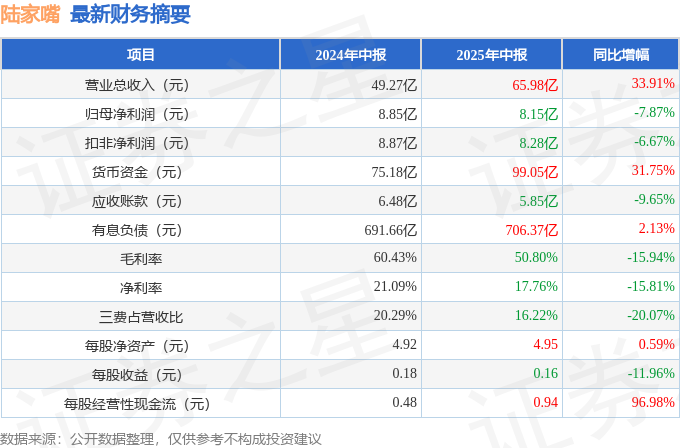
陆家嘴2025年中报简析:增收不增利
Zheng Quan Zhi Xing· 2025-07-30 22:39
Core Insights - Lujiazui reported a revenue increase but a decline in net profit for the first half of 2025, indicating a challenging financial environment [1][2] Financial Performance - Total revenue reached 6.598 billion yuan, a year-on-year increase of 33.91% [1] - Net profit attributable to shareholders was 815 million yuan, down 7.87% year-on-year [1] - Gross margin decreased to 50.8%, down 15.94% year-on-year [1] - Net margin fell to 17.76%, down 15.81% year-on-year [1] - Operating cash flow per share increased significantly by 96.98% to 0.94 yuan [1] Key Financial Metrics - The company’s total assets included cash and cash equivalents of 9.905 billion yuan, a 31.75% increase [2] - Accounts receivable decreased by 9.65% to 585 million yuan [1] - Interest-bearing liabilities rose by 2.13% to 70.637 billion yuan [1] - The ratio of selling, general, and administrative expenses to revenue decreased by 20.07% to 16.22% [1] Business Operations - The increase in revenue was attributed to higher sales in real estate, property services, hotel services, and financial business [3] - The cost of sales increased by 66.51%, primarily due to differences in project cost recognition [3] - The company’s return on invested capital (ROIC) was reported at 2.64%, indicating weak capital returns historically [4] Cash Flow and Debt Analysis - The company’s cash flow situation is healthy, with cash assets representing 8.7% of total assets [5] - The debt situation shows an interest-bearing asset liability ratio of 41.57% [5] - Inventory levels are high, with inventory to revenue ratio at 416.91% [5] Market Expectations - Analysts expect the company’s performance for 2025 to reach 1.585 billion yuan, with an average earnings per share of 0.31 yuan [5]


建元信托: 2025年第一次临时股东大会决议公告
Zheng Quan Zhi Xing· 2025-07-30 16:37
证券代码:600816 证券简称:建元信托 公告编号:临 2025-021 建元信托股份有限公司 本公司董事会及全体董事保证本公告内容不存在任何虚假记载、误导性陈述或者重大 遗漏,并对其内容的真实性、准确性和完整性承担法律责任。 重要内容提示: ? 本次会议是否有否决议案:无 一、 会议召开和出席情况 (一) 股东大会召开的时间:2025 年 7 月 30 日 (二) 股东大会召开的地点:上海市杨浦区佳木斯路 777 号中谷小南国花园酒 店三楼红宝石 CD 厅 (三) 出席会议的普通股股东和恢复表决权的优先股股东及其持有股份情况: 份总数的比例(%) (四) 表决方式是否符合《公司法》及《公司章程》的规定,大会主持情况等。 本次股东大会由公司董事会召集,公司第九届董事会董事长秦怿先生主持。 本次股东大会表决方式采用现场投票和网络投票相结合的方式进行表决。会议的 建元信托股份有限公司公告 (一) 非累积投票议案 审议结果:通过 表决情况: | 股东类 | 同意 | | | 反对 | | | 弃权 | | | --- | --- | --- | --- | --- | --- | --- | --- | --- ...

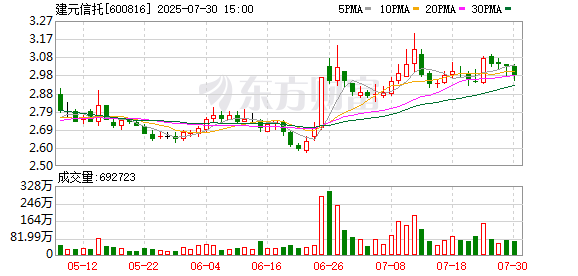
建元信托(600816)7月30日主力资金净流出1958.53万元
Sou Hu Cai Jing· 2025-07-30 13:34
金融界消息 截至2025年7月30日收盘,建元信托(600816)报收于2.98元,下跌1.65%,换手率1.27%, 成交量69.27万手,成交金额2.07亿元。 通过天眼查大数据分析,建元信托股份有限公司共对外投资了60家企业,参与招投标项目15次,知识产 权方面有商标信息37条,此外企业还拥有行政许可11个。 资金流向方面,今日主力资金净流出1958.53万元,占比成交额9.45%。其中,超大单净流出2323.27万 元、占成交额11.21%,大单净流入364.74万元、占成交额1.76%,中单净流出流入640.88万元、占成交 额3.09%,小单净流入1317.65万元、占成交额6.36%。 来源:金融界 建元信托最新一期业绩显示,截至2025一季报,公司营业总收入6795.44万元、同比增长55.74%,归属 净利润2634.17万元,同比增长27.56%,扣非净利润4381.84万元,同比增长14.36%,流动比率1.195、速 动比率1.195、资产负债率36.12%。 天眼查商业履历信息显示,建元信托股份有限公司,成立于1995年,位于上海市,是一家以从事其他金 融业为主的企业。企业注册资本9 ...
建元信托:2025年第一次临时股东大会决议公告
Zheng Quan Ri Bao· 2025-07-30 12:40
(文章来源:证券日报) 证券日报网讯 7月30日晚间,建元信托发布公告称,公司2025年第一次临时股东大会于2025年7月30日 召开,审议通过了《关于修订并撤销监事会的议案》等议案。 ...
以并购重塑制造强市!东莞资本市场2025年高质量发展大会举行
Quan Jing Wang· 2025-07-30 12:23
活动现场,世界金融论坛副主席、金砖智库学术委员会主席、全国社保基金理事会原副理事长王忠民, 中国上市公司协会 党委委员、副会长孙念瑞,广东证监局党委委员、副局长戴文慧,东莞市委常委、 常务副市长曾坚朋,市委金融办常务副主任钟正良,市市场监管局二级调研员梁少华,市税务局二级高 级主办石小辉,投控集团、东莞证券董事长陈照星,东莞市上市公司协会会长林海川等出席活动。 曾坚朋在致辞中表示,近年来,资本市场初步形成了以"科技创新+先进制造"为鲜明特色的东莞板块, 孕育了基础雄厚、活力充沛的企业生态,对并购重组有着强烈的内生需求。近年来,东莞出台《东莞市 便利企业融资赋能高质量发展若干措施》,多维度发力强化金融供给与财政协同,同时大力支持市上市 公司协会发挥桥梁作用,支持企业通过并购做大做优做强。曾坚朋表示,热切期盼全球上市公司龙头企 业、证券交易所、金融机构、专业服务商等各方齐发力,为东莞加快建设国际科创制造强市、为中国资 本市场高质量发展贡献力量。 7月30日下午,并购新浪潮·东莞智造跃升新引擎——东莞资本市场2025年高质量发展大会举行,来 自"政产学研金"各界的代表济济一堂,共同探寻并购重组何以成为企业裂变成长、 ...
拟任华润信托董事长的胡昊,当选国信证券非独立董事
Nan Fang Du Shi Bao· 2025-07-30 11:49
Group 1 - GuoXin Securities announced personnel changes, including the appointment of Hu Hao as a non-independent director and the removal of Zhang Rui from her independent director position [2][6] - Hu Hao has recently been nominated as the chairman of China Resources Trust, which is the second-largest shareholder of GuoXin Securities, holding 22.23% of its shares [6] - Hu Hao has extensive experience in the banking sector, having held various positions at Bank of Communications before joining China Resources Trust [6] Group 2 - Yi Longxin has been appointed as an independent director, replacing Zhang Rui, who was removed due to consecutive absences from board meetings [7][8] - Yi Longxin is currently a professor and head of the Accounting Department at Shenzhen University and has served as an independent director for other companies [7] - Zhang Rui was removed from her position after failing to attend two consecutive board meetings without delegating another independent director to attend on her behalf [8]

资产支持票据产品报告(2025年上半年):资产支持票据发行规模同比快速增长,发行成本有所降低,个人消费金融、小微贷款两类资产表现活跃
Zhong Cheng Xin Guo Ji· 2025-07-30 07:25
Report Industry Investment Rating - No relevant information provided Core Viewpoints of the Report - In H1 2025, the issuance scale of asset - backed notes increased rapidly year - on - year, and the issuance cost decreased. Personal consumer finance and micro - loans were active among the underlying assets. Secondary market transactions also showed growth [3]. Summary by Related Catalogs Issuance Situation - In H1 2025, 280 asset - backed note products were issued, with a total issuance scale of 258.275 billion yuan, a year - on - year increase of 74 in quantity and 48.44% in scale. April had the highest issuance volume and scale [3][4]. - The top five issuing institutions in terms of issuance scale were SDIC Taikang Trust Co., Ltd., Beijing Jingdong Century Trading Co., Ltd., China National Foreign Trade Trust Co., Ltd., Huaxin International Trust Co., Ltd., and Huaneng Guicheng Trust Co., Ltd. The top five and top ten issuing institutions accounted for 42.97% and 62.85% of the total issuance scale respectively [6]. - In terms of underlying asset categories, debt - based ABNs dominated, with a scale of 231.007 billion yuan, a year - on - year increase of 52.45% and a scale share of 89.44%. The average issuance scale of other - type assets was the highest at 175.1 million yuan per unit [9]. - The underlying asset sub - types included personal consumer finance, micro - loans, accounts receivable, specific non - financial claims, and supply chains. Personal consumer finance had the largest scale share at 44.48% [11]. - The highest single - product issuance scale was 6.043 billion yuan, and the lowest was 90 million yuan. Products with a single - issuance scale in the (5, 10] billion yuan range had the largest number of issuances and the highest scale share [15]. - The shortest product term was 0.17 years, and the longest was 23.41 years. Products with a term in the (0, 1] year range had the largest number of issuances and the highest scale share [18]. - By rating level, AAAsf - rated notes accounted for 90.64% of the issuance scale [19]. - For one - year AAAsf - rated notes, the interest rate center was around 1.97%, and the median decreased by 34BP year - on - year [21]. - In H1 2025, 88 ABCP products were issued, with a total scale of 89.119 billion yuan, accounting for 34.51% of the ABN issuance scale [23]. Issuance Spread - Compared with the same - term treasury bonds, the issuance spread of 1 - year asset - backed notes narrowed, while that of 3 - year notes widened slightly. Compared with the same - term AAA - rated corporate bonds, the issuance spreads of both 1 - year and 3 - year asset - backed notes narrowed [27][29][32]. - For personal consumer finance, micro - loans, and accounts receivable, the issuance spreads showed different trends. The issuance costs of these three types of products decreased significantly compared with the previous year [32][34][36]. Secondary Market Transaction - In H1 2025, the total trading volume of asset - backed notes in the secondary market was 258.04 billion yuan, and the number of transactions was 2,840, with year - on - year increases of 23.34% and 21.89% respectively [39]. - The products with active secondary - market transactions were mainly personal consumer finance, class REITs, accounts receivable, micro - loans, and partnership shares [40]. Industry Dynamic Review - On March 14, 2025, the National Association of Financial Market Institutional Investors (NAFMII) issued the Action Plan for Further Supporting the High - quality Development of Private Enterprises in the Inter - bank Bond Market, which was conducive to optimizing the bond financing environment for private enterprises [42]. - On May 7, 2025, NAFMII issued the Notice on Launching Science and Technology Innovation Bonds and Building a "Science and Technology Board" in the Bond Market. On May 26, the first science and technology innovation asset - backed security was successfully issued, which was helpful for the bond market to serve the science and technology innovation field [43].
审慎“挑伙伴” 信托公司加码消费金融
Zhong Guo Zheng Quan Bao· 2025-07-29 23:11
Core Viewpoint - Trust companies are increasingly participating in the consumer finance market, leveraging policies aimed at boosting consumption, while facing challenges such as stricter compliance and heightened competition [1][5]. Group 1: Consumer Finance Business Expansion - The "放心借" product allows borrowers to apply for personal loans from lenders like Yunnan Trust, with loan amounts and terms determined by the lender's assessment [2]. - Trust companies have cumulatively lent over 1 trillion yuan in the consumer finance sector, with significant contributions from companies like Huaxin Trust and Guomin Trust [3]. - The shift towards consumer finance is seen as a response to government policies aimed at stimulating consumption, with multiple departments issuing guidelines to support this initiative [5]. Group 2: Collaboration and Risk Management - Trust companies are becoming more selective in choosing partners for consumer finance, focusing on the asset scale and profitability of lending institutions [4]. - The integration of technology and data analytics is emphasized as a means to enhance risk management and operational efficiency in consumer finance [6][8]. - There is a growing concern regarding consumer complaints and the need for improved customer service in the face of rising competition and product homogeneity [7]. Group 3: Regulatory Environment and Future Outlook - The tightening of regulations is prompting trust companies to adapt their business models, moving from non-standard to standardized financial products [2][6]. - Trust companies are expected to strengthen their compliance and risk control measures while exploring innovative product offerings to meet diverse customer needs [8].
审慎“挑伙伴”信托公司加码消费金融
Zhong Guo Zheng Quan Bao· 2025-07-29 21:07
Core Insights - Trust companies are increasingly participating in the consumer finance market, integrating it with inclusive finance as a key direction for business transformation [1][3] - The tightening of risk control and compliance regulations poses challenges for trust companies in the consumer finance sector, leading to more cautious selection of partner institutions [1][6] Group 1: Consumer Finance Business Expansion - The "放心借" product allows borrowers to apply for personal loans from lenders like Yunnan Trust, with loan amounts and interest rates determined by the lender's assessment [2] - Trust companies have cumulatively lent over 1 trillion yuan in the consumer finance sector, with significant contributions from companies like Huaxin Trust and Guomin Trust [3] - The shift towards consumer finance is seen as a response to government policies aimed at boosting consumption, with multiple initiatives launched to support this sector [4] Group 2: Operational Strategies and Challenges - Trust companies are adopting a more selective approach in choosing lending partners, focusing on asset scale and profitability [3][4] - The industry faces high complaint volumes and compliance pressures, with significant consumer complaints reported by companies like Guomin Trust and Tianjin Trust [6] - The competition in consumer finance is intensifying, with challenges such as product homogeneity and high customer acquisition costs for smaller institutions [6] Group 3: Technological Integration and Future Outlook - Trust companies are expected to enhance their risk control systems and leverage technology to meet diverse customer needs [7] - The integration of artificial intelligence and other technologies is anticipated to drive innovation in trust products and services [7] - Strengthening cooperative ecosystems and customer management is seen as crucial for trust companies to effectively navigate the evolving consumer finance landscape [6][7]