脑机接口

Search documents
A股异动丨脑机接口概念股走强,国内脑机接口产品首次进入审批“绿色通道”
Ge Long Hui A P P· 2025-11-12 02:17
Core Viewpoint - The A-share market is experiencing a surge in brain-computer interface concept stocks, driven by the approval of a domestically developed implantable wireless brain-computer interface system entering the special review process by the National Medical Products Administration of China, marking a significant step in the commercialization of this technology in China [1] Group 1: Stock Performance - Aipeng Medical saw a nearly 12% increase in stock price, with a total market value of 40.03 billion and a year-to-date increase of 80.63% [2] - Century Huatong and Innovative Medical both rose over 7%, with market values of 141.1 billion and 10.5 billion respectively, and year-to-date increases of 269.65% and 198.87% [2] - Botao Biological increased by over 5%, with a market value of 6.62 billion and a year-to-date increase of 95.06% [2] - Xiangyu Medical rose over 4%, with a market value of 8.33 billion and a year-to-date increase of 78.19% [2] - Other notable stocks include Sanbo Brain Science, Saily Medical, Dineike, Taihe Technology, and Chengyi Tong, all showing increases of over 3% [1][2] Group 2: Industry Development - The implantable wireless brain-computer interface system developed by Shanghai Ladder Medical Technology Co., Ltd. is the first invasive brain-computer interface product to enter the "green channel" for innovative medical devices in China, indicating a key advancement from clinical validation to market access in this cutting-edge technology field [1]




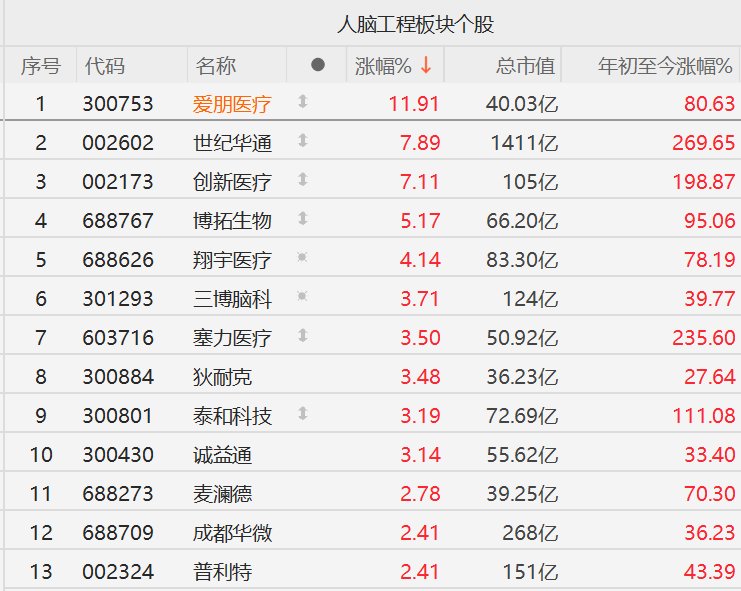
脑机接口概念股盘初拉升,爱朋医疗涨超9%
Mei Ri Jing Ji Xin Wen· 2025-11-12 02:00
(文章来源:每日经济新闻) 每经AI快讯,11月12日,A股脑机接口概念股盘初拉升,爱朋医疗涨超9%,创新医疗、倍益康、翔宇 医疗、世纪华通跟涨。 ...
特斯拉准备扩建得州超级工厂,拟年产1000万台Optimus人形机器人;国内脑机接口产品首次进入审批“绿色通道”——《投资早参》
Mei Ri Jing Ji Xin Wen· 2025-11-12 00:41
Market News - The three major US stock indices closed mixed, with the Dow Jones up 1.18%, S&P 500 up 0.21%, and Nasdaq down 0.25% [1] - International gold prices continued to rise, with spot gold up 0.34% at $4129.75 per ounce, and COMEX gold futures up 0.36% at $4136.7 per ounce [1] - International oil prices increased, with WTI crude oil up 1.33% at $60.93 per barrel, and Brent crude oil up 1.56% at $65.06 per barrel [1] - European stock indices all closed higher, with Germany's DAX up 0.53%, France's CAC40 up 1.25%, and the UK's FTSE 100 up 1.15% [1] Industry Insights - Tesla is preparing to expand its Texas Gigafactory to build a dedicated facility for mass production of its humanoid robot, Optimus, aiming for an annual production capacity of 10 million units by 2027 [2] - The humanoid robot industry is expected to see significant growth starting in 2025, driven by advancements in component performance and cost reduction [2] - Key beneficiaries in the humanoid robot sector include core supply chains and application scenarios, with concept stocks such as Hanyu Group, Haoshi Electromechanical, and Hanwei Technology [2] - Anhui Province is advancing in quantum technology, with plans to implement nearly 300 application scenarios by the end of this year and 1,000 by 2027 [3] - Recent breakthroughs in quantum computing have been achieved, particularly in atomic quantum computing, which could enhance the stability and speed of operations [3] - The MEMS optical switch market is projected to grow at a compound annual growth rate of 25% from 2024 to 2025, with concept stocks including Keda Technology, Saiwei Electronics, and Puyuan Precision [4] - Shanghai Ladder Medical Technology's implantable wireless brain-machine interface system has entered the special review process for innovative medical devices, marking a significant step in the commercialization of this technology [3][6] - The global brain-machine interface medical application market is expected to reach $40 billion by 2030 and $145 billion by 2040, indicating substantial growth potential [5][6] - Key concept stocks in the brain-machine interface sector include Zhongke Information, Guanhao Biological, and Aipeng Medical [6]


国内首个脑机接口进入审批绿通,商业化应用落地有望加速(附概念股)
Zhi Tong Cai Jing· 2025-11-11 23:49
Core Insights - The brain-computer interface (BCI) sector in China is experiencing significant advancements, with the first invasive BCI product entering the special review process by the National Medical Products Administration, marking a critical step towards market approval [1] - The Chinese government is actively promoting the BCI industry through various policies and standards, including the release of the first technical standard for BCI medical devices [1][2] - Clinical practices for BCIs in China are accelerating, with several hospitals initiating clinical applications and trials, positioning China as the second country globally to enter the clinical trial phase for invasive BCIs [3] Industry Developments - The BCI industry is expected to achieve key technological breakthroughs by 2027, establishing an advanced technical, industrial, and standard system, with a goal of nurturing globally influential companies by 2030 [2] - The BCI market is projected to grow significantly, with estimates indicating a market size of approximately $2.62 billion in 2024, reaching $2.94 billion by 2025, and potentially growing to $12.4 billion by 2034 [4] Clinical and Commercial Progress - Major hospitals in China are launching BCI clinical applications, with initiatives such as the first BCI outpatient clinic in Central China and the establishment of specialized clinical wards for BCI technology [3] - The development of BCI technology is seen as a beacon of hope for over 3 billion people suffering from neurological disorders globally [3] Investment Opportunities - Companies like MicroPort NeuroScience and Heartway Medical are actively involved in BCI projects, with MicroPort achieving a significant market share in neuro-interventional medical devices in China [5] - Nanjing Panda Electronics is also engaged in BCI technology development, focusing on multimodal human-computer interaction systems [5]
国内首个脑机接口进入审批绿通 商业化应用落地有望加速(附概念股)
Zhi Tong Cai Jing· 2025-11-11 23:22
脑机接口领域又迎利好。11月11日,上海阶梯医疗科技自主研发的"植入式无线脑机接口系统"正式进入 国家药监局创新医疗(002173)器械特别审查程序。这是我国首个获此资格的侵入式脑机接口产品,标 志着该技术从临床验证迈向市场准入的关键阶段。该系统旨在治疗严重神经系统疾病,此次纳入"绿色 通道"将加速其上市进程,推动我国脑机接口产业化发展。 今年以来,脑机接口领域政策端持续升温。 此前,9月15日,国家药品监督管理局正式发布YY/T1987—2025《采用脑机接口技术的医疗器械术语》 医疗器械行业标准。这是我国脑机接口医疗器械行业的首个技术标准,为脑机接口医疗器械研发、生产 和监管提供了权威、统一的通用语言和关键依据,是脑机接口从技术创新到应用落地的标志性事件。 与此同时,中国脑机接口的临床实践明显加速。 中国科学院脑科学与智能技术卓越创新中心联合复旦大学附属华山医院与相关企业,开展了侵入式脑机 接口的前瞻性临床试验。这标志我国在侵入式脑机接口技术上成为继美国之后,全球第二个进入临床试 验阶段的国家。 多家三甲医院也接连宣布脑机接口临床应用。其中,华中科技大学同济医学院附属同济医院启用华中地 区首个脑机接口门诊 ...
港股概念追踪 | 国内首个脑机接口进入审批绿通 商业化应用落地有望加速(附概念股)
智通财经网· 2025-11-11 23:21
Core Insights - The brain-computer interface (BCI) sector in China is experiencing significant advancements, with the first invasive wireless BCI system entering the special review process by the National Medical Products Administration, marking a critical step towards market approval [1] - The Chinese government is actively promoting the BCI industry through various policies and standards, including the release of the first technical standard for BCI medical devices, which provides a unified framework for development and regulation [1][2] - By 2027, breakthroughs in key BCI technologies are expected to establish an advanced technical, industrial, and standard system, with the goal of nurturing globally influential companies by 2030 [2] Industry Developments - Clinical practices for invasive BCIs in China are accelerating, with the country becoming the second globally to enter clinical trial phases after the United States [3] - Major hospitals are launching BCI clinical applications, indicating a shift from research-driven to clinically-driven development in the BCI field [3] - The global BCI market is projected to grow from approximately $2.62 billion in 2024 to $2.94 billion in 2025, with expectations to reach $12.4 billion by 2034 [4] Investment Opportunities - Companies like MicroPort NeuroScience and Heartway Medical are actively involved in BCI projects, with MicroPort achieving a significant market share in neuro-interventional medical devices in China [5] - Heartway Medical is set to begin formal clinical trials for its invasive BCI project by the end of 2026, following successful animal testing [5] - Nanjing Panda Electronics is developing a multimodal human-computer interaction system based on BCI technology, indicating ongoing innovation in the sector [5]
人形机器人、脑机接口、6G将如何改变生产和生活?
Bei Jing Ri Bao Ke Hu Duan· 2025-11-11 23:21
Core Insights - The article discusses the rapid advancements in various future industries in China, particularly focusing on humanoid robots, brain-computer interfaces, and 6G technology, highlighting their potential to drive economic growth and improve quality of life [2][5][6]. Group 1: Humanoid Robots - The humanoid robot "Mei Luo" is capable of autonomous decision-making and performing quality inspections in manufacturing settings, showcasing the integration of embodied intelligence in industrial applications [3]. - The humanoid robot market in China is projected to reach 870 billion yuan by 2030, indicating significant growth potential in this sector [3]. - Midea Group is leveraging its manufacturing capabilities to transition humanoid robots from experimental phases to practical applications, creating a closed-loop system with factory operations [3][4]. Group 2: Brain-Computer Interfaces - Brain-computer interface technology is moving from research to clinical applications, with a market size expected to exceed 3.8 billion yuan by 2025, reflecting its growing importance in healthcare [6]. - The technology offers innovative solutions for conditions like Alzheimer's disease, providing new hope for intervention and treatment [6]. - Companies in the brain-computer interface sector are expected to achieve breakthroughs in core technologies, enhancing their commercial applications in rehabilitation and treatment of neurological disorders [6]. Group 3: 6G Technology - The transition from 5G to 6G is marked by the introduction of 5G-A technology, which enhances communication reliability and supports various industrial applications, including autonomous driving and smart manufacturing [7][8]. - The 6G market in China is anticipated to surpass 1.2 trillion yuan by 2030, indicating a substantial opportunity for growth and innovation in telecommunications [8]. - 6G technology is expected to significantly improve performance in multiple areas, including real-time data processing for autonomous vehicles and enhanced industrial internet capabilities [8].
A股晚间热点 | 央行重磅报告!涉及货币政策、房地产等
智通财经网· 2025-11-11 14:39
重要程度:★★★★★ 11月11日,中国人民银行发布2025年第三季度中国货币政策执行报告,总结前三季度货币政策执行情况, 分析当前经济金融形势,明确下一阶段政策取向。以下为相关要点: 实施好适度宽松的货币政策,强化货币政策的执行和传导。 研究制定"十五五"时期金融科技发展规划,稳妥有序推进金融领域人工智能大模型应用。 着力推动保障性住房再贷款等金融政策措施落地见效,完善房地产金融基础性制度。 1、央行发布重磅报告!涉及货币政策、房地产 重点提及人工智能 保持流动性充裕,使社会融资规模、货币供应量增长同经济增长、价格总水平预期目标相匹配。 防范汇率超调风险,保持人民币汇率在合理均衡水平上基本稳定。 2、什么信号?软银以415亿元的价格清仓英伟达 重要程度:★★★★ 据媒体报道,软银集团11月11日发布业绩报告显示,其持有的3210万股英伟达股票(含资产管理子公司持 股)已于2025年10月以58.3亿美元(约合人民币415亿元)价格售出。此次出售未反映在软银第二季度财报中, 该公司也未披露出售原因。 点评:是战略撤退吗?是AI泡沫真要破裂了吗?应该都不是。因为软银还和OpenAI签署了修订协议,承诺将 追加投 ...

中国信通院左铠瑞:壮大未来产业——全球态势、中国优势与培育路径
Sou Hu Cai Jing· 2025-11-11 12:11
Core Insights - The discussion focuses on the importance of developing future industries to create a high-tech industrial system comparable in scale over the next decade, emphasizing the need for strategic planning and innovation [2][3]. Group 1: Potential Key Areas and Global Development Trends - Future industries are characterized by innovation, strategy, long-term focus, externality, and high uncertainty, serving as a crucial path for economic growth and national competitive advantage [3]. - Global technological innovation is experiencing unprecedented activity, marked by new technologies (AI, 5G/6G, cloud computing), new infrastructure (intelligent and green upgrades), and new data elements becoming strategic resources [3][4]. - Key areas of focus for future industries include next-generation communication (6G, satellite internet), advanced computing (semiconductors, quantum computing), future intelligence (AI, brain-machine interfaces), and advanced manufacturing [5]. Group 2: China's Advantages and Challenges - China possesses several advantages in the six potential areas: proactive policy guidance, rich application scenarios due to a large domestic market, and abundant data resources [10]. - Specific advantages include leading technology innovation in 6G, strong AI capabilities, and a solid manufacturing base for humanoid robots [11]. - Challenges include a need for improved original innovation capabilities, key technology shortcomings (e.g., chips, operating systems), and a lack of high-quality datasets for AI and robotics [13][14]. Group 3: Pathways for Developing Future Industries - Strengthening top-level design and systematic layout is essential, including establishing mechanisms for global technology forecasting and enhancing policy coordination [15]. - Enhancing original innovation capabilities and addressing key technology gaps through collaborative efforts in high-end chips and core algorithms is crucial [16][17]. - Accelerating breakthroughs in key areas such as AI, 6G, and humanoid robots while fostering international cooperation to leverage global resources and markets is necessary for innovation [17].

引爆新赛道!脑机接口未来已来?
格隆汇APP· 2025-11-10 11:29
Core Insights - The article emphasizes that brain-computer interfaces (BCIs) are a revolutionary component of new productive forces, breaking physical barriers between the brain and the external world, enabling direct control of devices through thought [2] - The BCI industry is gaining momentum due to dual breakthroughs in hardware and software technologies, as well as supportive national policies, positioning it as a key driver for transformation in various sectors such as medical rehabilitation and consumer electronics [2][19] Global Competition - Major countries are recognizing the strategic value of BCIs, leading to significant investments and initiatives aimed at securing a competitive edge in brain science [4] - The United States is a leading player in this race, having launched the BRAIN Initiative in 2013 with an initial investment of over $100 million and a planned total investment of $4.5 billion over 12 years [5][6] - Other countries, including those in the EU, Japan, and South Korea, are also making substantial investments in BCI research, with collaborative efforts and national programs to advance the field [6][7] Technological Breakthroughs - The successful commercialization of BCIs relies on advancements in both hardware and software [9] - Hardware developments focus on flexible, miniaturized, and high-density electrodes, which enhance signal capture and reduce damage to brain tissue [12][15] - Software algorithms are evolving from unidirectional commands to bidirectional interactions, allowing for real-time feedback and expanding the application scope of BCIs [16][18] Domestic Landscape - The BCI industry in China is witnessing a surge in enterprise involvement, with companies leveraging their technological strengths to drive commercialization [18] - Notable companies like Chengyi Tong and Xiangyu Medical are establishing comprehensive research and development frameworks, focusing on rehabilitation and full-chain autonomous development [18] - The market is currently in the early stages of commercialization, with investment themes centered around clinical advancements and product rollout timelines [18][19]