
电子

Search documents
2025中国企业ESG“金责奖”年度可持续发展奖揭晓
Xin Lang Cai Jing· 2026-01-15 07:37
Core Viewpoint - The 2025 China Enterprise ESG "Golden Responsibility Award" aims to recognize companies that have made significant contributions to ESG (Environmental, Social, and Governance) practices, promoting sustainable development in China [1][4]. Group 1: ESG Services and Initiatives - Sina Finance ESG Rating Center offers 14 ESG services, including information, reports, training, and consulting, to help listed companies promote ESG concepts and enhance their sustainable development performance [1][4]. - In 2025, many quality enterprises in China are actively practicing their responsibilities in environmental, social, and governance areas, while domestic financial institutions are steadily advancing in ESG responsible investment [1][4]. Group 2: Award Selection and Winners - The 2025 China Enterprise ESG "Golden Responsibility Award" attracted over 5,000 participating companies since its launch in November, with winners selected based on comprehensive ESG performance, professional scoring, and online voting results [1][5]. - The winners of the 2025 China Enterprise ESG "Golden Responsibility Award" for the Annual Sustainable Development Award include China General Nuclear Power, Sungrow Power Supply, Kweichow Moutai, CATL, Zijin Mining, Hikvision, Yili, Baosteel, Chint Electric, and China Mobile [2][5]. Group 3: ESG Rating Center Overview - The Sina Finance ESG Rating Center is the first Chinese ESG professional information and rating aggregation platform, dedicated to promoting sustainable development and responsible investment [3][6]. - The center aims to establish ESG evaluation standards suitable for China's characteristics and enhance corporate ratings, while also launching multiple ESG innovation indices for investors [3][6].






粤开市场日报-20260115-20260115
Yuekai Securities· 2026-01-15 07:36
Market Overview - The A-share market showed mixed performance today, with the Shanghai Composite Index down by 0.33% closing at 4112.60 points, while the Shenzhen Component Index increased by 0.41% to 14306.73 points. The ChiNext Index fell by 0.46% to 1493.95 points, and the Growth Enterprise Market Index rose by 0.56% to 3367.92 points. Overall, 2226 stocks rose while 3121 stocks fell, with a total trading volume of 29055 billion yuan, a decrease of 10359 billion yuan compared to the previous trading day [1][12]. Industry Performance - Among the Shenwan first-level industries, the leading sectors included electronics, basic chemicals, non-ferrous metals, building materials, and electric equipment, with respective gains of 1.67%, 1.40%, 1.37%, 0.56%, and 0.54%. Conversely, the sectors that experienced declines included comprehensive, national defense and military industry, media, computer, and commercial retail, with losses of 3.35%, 2.80%, 2.70%, 2.40%, and 1.65% respectively [1][12]. Concept Sectors - The top-performing concept sectors today were advanced packaging, cobalt mining, photolithography machines, semiconductor materials, semiconductor silicon wafers, HBM, the SMIC industrial chain, semiconductor equipment, wafer industry, copper-clad laminates, power batteries, lithium battery electrolytes, selected rare metals, memory, and small metals [2][11].
千问App宣布全面接入阿里生态业务,通信ETF华夏(515050)盘中一度翻红
Mei Ri Jing Ji Xin Wen· 2026-01-15 06:35
Group 1 - The A-share market experienced an upward trend on January 15, with the technology sector showing reduced declines. The communication ETF Huaxia (515050) rebounded by 1% from its maximum drop, with top-performing stocks including Junqiao Electronics, Yuanjie Technology, and Luxshare Precision [1] - Qianwen App announced a comprehensive integration with Alibaba's ecosystem, enabling AI shopping functionalities such as food delivery, purchasing, and flight booking. This upgrade will introduce over 400 AI service functions, positioning Qianwen App as the first global AI assistant capable of handling complex real-life tasks [1] - Huasheng Securities highlighted a critical transformation period in the industry as full-modal AI accelerates penetration into customer service, content creation, and smart terminal interactions. The focus is on achieving natural and reliable interactions, precise responses, and stable cross-scenario performance [1] Group 2 - The communication ETF Huaxia (515050) tracks the CSI 5G Communication Theme Index, focusing on the supply chains of companies like Nvidia, Apple, and Huawei. Its top five holdings include Zhongji Xuchuang, Xinyi Sheng, Luxshare Precision, Industrial Fulian, and Zhaoyi Innovation [2] - The AI ETF Huaxia (159381) tracks the ChiNext AI Index, with a significant focus on AI companies in the ChiNext market. The optical module CPO accounts for over 54% of its weight, covering domestic software and AI application firms, with top three holdings being Zhongji Xuchuang (15.64%), Xinyi Sheng (15.57%), and Tianfu Communication (6.85%) [2] - The cloud computing ETF Huaxia (516630) tracks the cloud computing index, which has a high AI computing power content, covering popular computing concepts such as optical modules, computing leasing, data centers, AI servers, and liquid cooling [2]
20cm速递|科创综指ETF国泰(589630)小幅回调,市场迎“科技+周期的两翼齐飞”,回调或可布局
Mei Ri Jing Ji Xin Wen· 2026-01-15 06:29
Group 1 - The current market should focus on the dual growth of "technology + cycles," with AI hardware, such as optical communication, showing a rising trend similar to the previous peak during 5G base station construction, driven by rapid structural demand for AI computing power expansion [1] - The core factor for the sustained strength of AI hardware is the marginal change in profit growth (ΔG), which currently does not show a significant turning point, suggesting that it is likely to continue following the broader valuation bull market [1] - The main players in the AI industry may shift, as AI applications are transitioning from "computing infrastructure" to "scenario realization," with a resurgence expected under the resonance of policy, demand, ecology, and capital [1] Group 2 - New themes emerging from the 14th Five-Year Plan, such as commercial aerospace and brain-computer interfaces, have the potential to become new mainlines in the market [1] - In the cyclical sector, industries benefiting from PPI improvement are expected to perform well, supported by price increase signals and anti-involution policies [1] - The Guotai Science and Technology Innovation Index ETF (589630) tracks the Science and Technology Innovation Index (000680), which saw a daily fluctuation of 20%, covering 97% of the listed companies on the Science and Technology Innovation Board, with over 560 constituent stocks in hard technology fields like electronics and biomedicine [1]
去年我国外贸进出口总值创历史新高
Qi Huo Ri Bao Wang· 2026-01-15 05:37
Core Viewpoint - In 2025, China's foreign trade is projected to reach 45.47 trillion yuan, marking a 3.8% increase, with exports at 26.99 trillion yuan (up 6.1%) and imports at 18.48 trillion yuan (up 0.5%), maintaining its position as the world's largest goods trading nation [1][2] Trade Performance - China's total import and export value in 2025 is expected to exceed 45 trillion yuan, setting a historical record and achieving growth for the ninth consecutive year [1] - In December 2025, the monthly import and export value reached 4.26 trillion yuan, a year-on-year increase of 4.9%, setting a new monthly record [1] - The growth in exports is attributed to the effective implementation of stable foreign trade policies, the continuous release of import potential from a large market, and a complete industrial system adapting to overseas demand [1] Export and Import Details - Despite external challenges, exports in 2025 are expected to grow by 6.1%, driven by a 13.2% increase in high-tech product exports, contributing 2.4 percentage points to overall export growth [2] - The trade of intermediate goods has also significantly supported export growth, providing strong backing for global industrial cooperation [2] - Imports are projected to reach a historical high of 18.48 trillion yuan, maintaining China's position as the world's second-largest import market for 17 consecutive years [2] Economic Factors Influencing Trade - The positive export performance in 2025 is attributed to several factors, including a gradual recovery in the global electronics industry, improved market liquidity due to changes in monetary policy in major economies, and proactive strategies by domestic companies to secure orders amid uncertainties in U.S. tariff policies [3] - The import of copper, aluminum, and other minerals is expected to rise, while the demand for lithium, nickel, and cobalt is driven by the export of new energy products [3] U.S.-China Trade Relations - In 2025, trade between China and the U.S. is projected to reach 4.01 trillion yuan, accounting for 8.8% of China's total trade, with China being the third-largest export destination and import source for the U.S. [3] - The essence of U.S.-China economic cooperation is mutual benefit, and maintaining stable and sustainable trade relations is beneficial for both countries and the world [4] Future Trade Outlook - The global trade growth momentum remains insufficient, and China's foreign trade faces a complex external environment, with multiple international organizations lowering global trade growth forecasts [4] - However, China's institutional, market, industrial, and talent advantages are becoming more pronounced, enhancing its resilience to risks and stabilizing the foundation of foreign trade [4]
FICC日报:政策调整融资保证金比例,指数冲高回落-20260115
Hua Tai Qi Huo· 2026-01-15 05:11
Report Industry Investment Rating - Not provided in the content Core Viewpoints of the Report - Policy adjustment of the margin ratio for margin trading may lead to a "factory" - shaped trend in the stock index, with short - term growth slowing down. If the cooling process is not smooth, the Shanghai Composite 50 and CSI 300 indices may face relatively greater pressure [3] Summary by Related Catalogs Market Analysis Policy and Macroeconomic Data - The Shanghai, Shenzhen, and Beijing Stock Exchanges adjusted the minimum margin ratio for margin trading from 80% to 100% for new margin trading contracts, while existing contracts and their extensions remain unchanged [1] - In November last year, the US PPI and core PPI both rose 3% year - on - year, higher than the market expectation of 2.7%. Energy cost increases were the main driver of the PPI increase [1] - In December last year, the annualized total of existing home sales in the US was 4.35 million, the highest since February 2023. The median home price rose only 0.4% year - on - year to $405,400, the slowest growth in two and a half years [1] Spot Market - A - share indices showed a pattern of rising and then falling. The Shanghai Composite Index fell 0.31% to close at 4126.09 points, while the ChiNext Index rose 0.82%. The computer, communication, media, and electronics sectors led the gains, while the banking, real estate, and non - bank financial sectors led the losses. The trading volume of the Shanghai and Shenzhen stock markets was close to 4 trillion yuan, a new high [2] - The three major US stock indices closed down across the board, with the Nasdaq falling 1% to 23471.75 points [2] Futures Market - The basis of stock index futures declined. The trading volume and open interest of stock index futures increased simultaneously [2] Strategy - Policy cooling usually has a certain effect, but considering the long - term slow - bull market, historical experience can only be a limited reference. The stock index may show a "factory" - shaped trend, with short - term growth slowing down. If the cooling process is not smooth, large funds may suppress the market through their positions, and the Shanghai Composite 50 and CSI 300 indices may face relatively greater pressure [3] Chart Summaries Macroeconomic Charts - Include charts showing the relationship between the US dollar index and A - share trends, US Treasury yields and A - share trends, RMB exchange rates and A - share trends, and US Treasury yields and A - share style trends [6][9][10] Spot Market Tracking Charts - Table 1 shows the daily performance of major domestic stock indices on January 14, 2026, including the Shanghai Composite Index, Shenzhen Component Index, ChiNext Index, CSI 300 Index, Shanghai Composite 50 Index, CSI 500 Index, and CSI 1000 Index, with their respective closing prices, previous - day closing prices, and daily percentage changes [12] - Charts show the trading volume of the Shanghai and Shenzhen stock markets and the margin balance [6][13] Stock Index Futures Tracking Charts - Table 2 shows the trading volume and open interest of IF, IH, IC, and IM stock index futures, including the current values and changes [14] - Charts show the open interest, latest open - interest ratios, and net positions of foreign investors for IH, IF, IC, and IM contracts [6][15][17] - Table 3 shows the basis of stock index futures for different contracts (current month, next month, current quarter, and next quarter) and their changes [36] - Table 4 shows the inter - contract spreads of stock index futures and their changes [39] - Charts show the basis and inter - contract spreads of IF, IH, IC, and IM contracts [6][37][38]
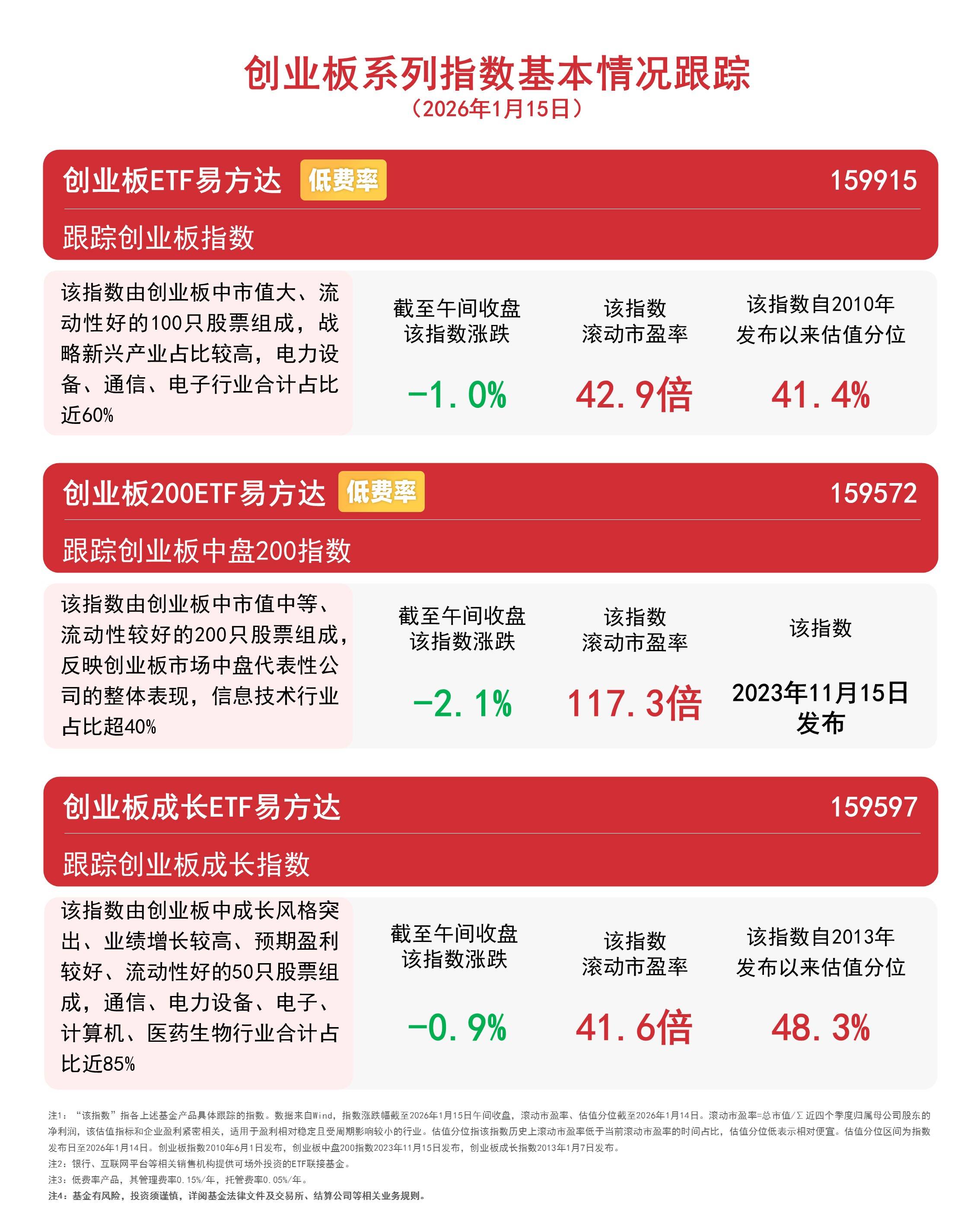
创业板指数半日跌逾1%,关注创业板ETF易方达(159915)等产品布局机会
Sou Hu Cai Jing· 2026-01-15 05:03
Group 1 - The ChiNext Growth Index fell by 0.9%, the ChiNext Index decreased by 1.0%, and the ChiNext Mid-cap 200 Index dropped by 2.1% as of the midday close [1] - CITIC Securities indicated that the current market shows a divergence in industry performance, with sectors that have sufficient expectations remaining flat while thematic concepts are active, and previously lagging sectors are experiencing a rebound [1] - Overall, there is continued optimism for the cross-year market, focusing on future industrial hotspots, AI, semiconductors, and the resource price increase chain [1] Group 2 - The ChiNext Growth ETF by E Fund tracks the ChiNext Growth Index, which consists of 50 stocks characterized by growth style, high earnings growth, good profit expectations, and strong liquidity [4] - The information technology sector accounts for over 40% of the ChiNext market, with the combined share of telecommunications, power equipment, electronics, computers, and biomedicine industries nearing 85% [4] - The ChiNext Index was launched on June 1, 2010, and the ChiNext Mid-cap 200 Index will be launched on November 15, 2023 [4]


2025年外贸数据点评:掘金2026出口链
Changjiang Securities· 2026-01-15 04:46
Export Performance - December 2025 exports increased by 6.6% year-on-year, exceeding the 3% consensus forecast from Reuters[9] - Monthly exports reached $35.778 billion, with a trade surplus of $11.414 billion[7] - The growth in exports was driven by strong performance in automobiles and high-tech products, with respective year-on-year growth rates of 16.6% and 12.1%[9] Trade Dynamics - Exports to Hong Kong showed significant improvement, contributing an additional 0.97 percentage points to overall export growth[9] - The automotive sector's robust performance was influenced by the EU's proposed minimum import price policy, leading to a "rush to import" effect[9] Import Trends - December imports rose by 5.7% year-on-year, surpassing the 0.9% forecast from Reuters[9] - Key imports included integrated circuits and high-tech products, with respective growth rates of 13.5% and 8.7%[9] Future Outlook - Export growth in 2026 is expected to be supported by the manufacturing cycle, Belt and Road investments, and price advantages of export goods[3] - Structural opportunities are identified in sectors such as AI and infrastructure, driven by ongoing global manufacturing recovery and investment trends[3] Risk Factors - Uncertainties surrounding U.S. tariff policies may impact China's export outlook, with potential legal challenges to tariff implementations[48]
2025年业绩高增长股提前看 36股净利润增幅翻倍
Zheng Quan Shi Bao Wang· 2026-01-15 03:54
Group 1 - A total of 216 companies have announced their annual performance forecasts for 2025, with 85 companies expecting profit increases, accounting for 39.35% [1] - Among the companies with positive forecasts, 43.52% are expected to report profit increases or earnings, while 86 companies anticipate losses and 17 expect declines [1] - The companies with the highest expected profit growth include Huisheng Biological with a median profit increase of 1355.24%, followed by Zhongtai Co. and Baiwei Storage with expected increases of 677.22% and 473.71% respectively [1] Group 2 - The average increase in stock prices for companies expecting profit growth has been 13.24% this year, outperforming the Shanghai Composite Index [2] - The stock with the highest increase this year is Jinhaitong, which has risen by 42.45%, followed by Nanxing Co. and Bai'ao Saitou with increases of 35.70% and 32.91% respectively [2] - The list of companies expecting significant profit increases includes various sectors, with notable mentions in agriculture, public utilities, and electronics [2][3] Group 3 - The expected profit growth companies are primarily concentrated in the electronics, pharmaceutical, and machinery sectors, with 7, 4, and 4 companies respectively [1] - The main board, ChiNext, and STAR Market have 24, 9, and 3 companies respectively among those expecting profit growth [1]



——12月进出口数据解读:2026年出口会继续强吗?
Huafu Securities· 2026-01-15 03:29
Export Performance - In December, China's export year-on-year growth rate recorded 6.6%, an increase of 0.7 percentage points from the previous month, with a two-year average growth rate rising[3] - The main drivers of export growth were the electronics industry and high-tech products, with significant increases in exports to neighboring regions, while other regions saw declines[3] - Automotive exports continued to grow significantly, benefiting from a low base, while electronic exports also strengthened due to a decrease in the base[4] Import Trends - December's import year-on-year growth rate was 5.7%, up 3.8 percentage points from the previous month, with the growth rate exceeding the average of the past five years[5] - The increase in imports was primarily driven by higher energy imports and a significant rise in electronic product imports, particularly from the EU and Latin America[5] - Notably, imports from the EU surged by 17.9%, a rise of 16.2 percentage points, while imports from the US fell by 28.6%[5] Future Outlook - Exports are expected to maintain resilience in 2026, with a slight decrease in the growth rate center, influenced by a low base in January and February[4] - The "reciprocal tariff" policy is anticipated to lead to a significant decline in exports to the US starting April 2025, but the decline is expected to narrow after April 2026[4] - Recent agreements between China and the EU regarding electric vehicle exports are expected to boost automotive exports to Europe[4] Risks - Potential risks include slower-than-expected domestic economic recovery, weaker demand from developing countries, and unexpected declines in demand from Europe and the US[7] - Changes in import and export policies, particularly regarding tariffs, pose additional uncertainties for future trade performance[7]