券商

Search documents
近3000只个股上涨
第一财经· 2025-10-23 07:35
Core Viewpoint - The A-share market showed a slight upward trend with all three major indices closing in the green, indicating a potential recovery phase in the market [3][4]. Market Performance - The Shanghai Composite Index rose by 0.22% to close at 3922.41 points, while the Shenzhen Component Index also increased by 0.22% to 13025.45 points, and the ChiNext Index saw a smaller gain of 0.09% to 3062.16 points [4]. - The total trading volume in the Shanghai and Shenzhen markets was 1.64 trillion yuan, a decrease of 239 billion yuan compared to the previous trading day, with nearly 3000 stocks rising across the market [5]. Sector Performance - Sectors such as ice and snow tourism, coal, and short drama saw significant gains, while newly listed stocks and brokerage firms strengthened in the afternoon. Quantum technology concepts surged towards the end of the trading session [4]. - Conversely, sectors like deep earth technology, cultivated diamonds, and CPO concepts experienced collective pullbacks [4]. Capital Flow - Main capital inflows were observed in coal, energy metals, and media sectors, while semiconductor, communication, and specialized equipment sectors faced net outflows [6]. - Specific stocks that attracted net inflows included China Nuclear Engineering (6.66 billion yuan), Demingli (6.31 billion yuan), and Shenghong Technology (6.11 billion yuan) [7]. - On the other hand, stocks such as ZTE Corporation, Industrial Fulian, and New Yisheng faced net outflows of 9.47 billion yuan, 7.27 billion yuan, and 6.41 billion yuan respectively [8]. Institutional Insights - Guodu Securities suggested that the Shanghai Composite Index is expected to fluctuate within the 3700 to 3900 range, indicating a "high-low cut" trend, and recommended a defensive strategy focusing on finance, coal, new consumption, and dividend sectors [10]. - Dongguan Securities highlighted that the third-quarter reports will validate the advantages of new economic momentum, with market focus shifting towards economic indicators that may become central again [10].


财信证券晨会纪要-20251023
Caixin Securities· 2025-10-22 23:31
Key Insights - The report highlights a mixed performance in the stock market, with the Shanghai Composite Index closing at 3913.76, down 0.07% [1] - The report indicates a significant growth in Shanghai's GDP, which surpassed 4 trillion yuan for the first time, achieving a year-on-year growth of 5.5% [18] - The aviation industry showed robust growth, with a 10.3% increase in total transportation turnover in the first three quarters [21] Market Strategy - The market is experiencing a period of low trading volume and slight adjustments across major indices, reflecting cautious investor sentiment ahead of key macroeconomic events [7][10] - The report suggests focusing on sectors likely to benefit from the "14th Five-Year Plan," such as deep earth economy, state-owned enterprise reforms, and clean energy [10] Industry Dynamics - 17 listed brokerages announced interim dividend distributions totaling 7.949 billion yuan, with significant disparities in dividend amounts among firms [26] - UBTECH Robotics secured a 126 million yuan order for its Walker humanoid robot, bringing its total orders for the year to over 630 million yuan [28] - The launch of the upgraded G2 interactive industrial robot by Zhiyuan Robotics has already garnered several billion yuan in orders before its market release [30] - The CR450 high-speed train prototype achieved a record speed of 453 km/h during testing, indicating advancements in China's rail technology [33] Company Tracking - China Jushi reported a 19.53% increase in revenue to 13.904 billion yuan and a 67.51% rise in net profit to 2.568 billion yuan for the first three quarters [40] - Shengnong Development's net profit increased by 202.82% year-on-year, reaching 1.159 billion yuan, driven by significant investment income [42] - Wens Foodstuff Group experienced an 18% decline in net profit for the first three quarters, totaling 5.256 billion yuan [44] - Baiya Co. reported a 2.5% increase in net profit to 245 million yuan for the first three quarters, despite a decline in the third quarter [46] - Feiwo Technology achieved a remarkable 163.26% increase in net profit, reaching 46 million yuan for the first three quarters [48]
A股集体下跌!场内近3000股飘绿
Qi Huo Ri Bao Wang· 2025-10-22 12:34
Group 1 - A-shares experienced a collective decline on October 22, with the Shanghai Composite Index slightly down by 0.07% to 3913.76 points, the Shenzhen Component down by 0.62% to 12996.61 points, and the ChiNext Index down by 0.79% to 3059.32 points [1] - The total trading volume in the Shanghai, Shenzhen, and Beijing markets was 1690.5 billion yuan, a decrease of over 200 billion yuan compared to the previous day [1] - Nearly 3000 stocks were in the red, with sectors such as coal, non-ferrous metals, brokerage, and semiconductors declining, while the oil sector saw strong gains, with companies like Keli Co., Ltd. rising over 10% [1] Group 2 - Goldman Sachs released a report suggesting that despite potential pullbacks in Chinese stocks, investors should shift their mindset from "selling on highs" to "buying on lows," predicting a 30% increase in the MSCI China Index by the end of 2027 [2] - Dongguan Securities noted that the index is at a high point, with increased capital divergence, warning of potential short-term fluctuations due to profit-taking, but also highlighted that economic recovery in Q4 is expected to be supported by policies [2] - The report emphasized that the expectation of interest rate cuts by the Federal Reserve could attract foreign capital inflows, enhancing the allocation value of A-shares and potentially driving domestic funds into the stock market [2]


恒生科技跌幅居前,券商紧随其后;内房地、内银行逆势上涨
Ge Long Hui· 2025-10-22 12:08
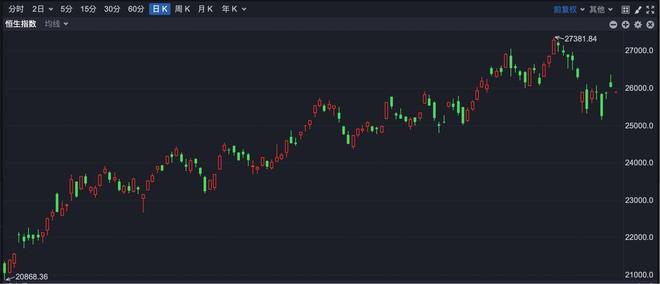
券商股回撤,不可能个股普跌,其中国泰君安大跌2.23%,中金公司、中国银河、广发证券、第一上海、 东方证券、中信证券等超10只个股跌幅均在1%上方。 内银行逆势上涨,其中甘肃银行大涨4%,重庆银行、农业银行、浙商银行、中信银行等股涨幅均在1%上 方;渤海银行、泸州银行、青岛银行、招商银行等股逆势小跌。 内容只是个人观点,仅供参考,不作为投资依据!欢迎关注交流,互相学习、共同探讨! 低开低走后全天弱势,截至收盘恒生指数下跌0.94%。恒生科技跌幅居前,券商紧随其后;内房地、内银 行逆势上涨。 恒生科技再度回落,其中网银大跌4.41%,比亚迪电子下跌4.28%,金山软件下跌3.84%,京东健康下跌 3.74%,联想集团、ASMPT、快手、阿里健康、哔哩哔哩等超10只个股跌幅在2%上方。 内房地有不错表现,其中辰兴发展20CM涨停,景瑞控股上涨8.33%,雅居乐集团上涨6.33%,合景泰富、 众安集团、北京北辰、金轮天地等多股涨幅均在2%上方;恒达集团逆势下跌6.15%。 ...
银行存款利率“跳水”,A股市场如何接招?
3 6 Ke· 2025-10-22 08:39
Core Viewpoint - A wave of deposit rate cuts among small and medium-sized banks has emerged in October, driven by competitive pressures from larger banks and the need to balance customer retention with cost control [1][2]. Summary by Sections Deposit Rate Cuts - Several small and medium-sized banks, including Suzhou Bank and Shanghai Huari Bank, have announced reductions in deposit rates, with some banks cutting rates by as much as 80 basis points [1]. - The three-year fixed deposit rate at Huari Bank was reduced from 2.3% to 2.15% [1]. Economic Logic Behind Rate Cuts - The reduction in deposit rates is part of macroeconomic adjustments aimed at stimulating consumption and investment amid economic challenges such as insufficient domestic demand and cautious corporate investment [2]. - Lower deposit rates encourage residents to spend or invest their money, thereby boosting market activity and economic growth [2]. Market Supply and Demand Dynamics - High household savings rates have led to an excess of deposits in banks, while loan demand has not kept pace, particularly in a slowing economy [3]. - To maintain balance and reduce the burden of high deposit interest payments, banks are compelled to lower deposit rates [3]. Banking Sector Pressures - The narrowing net interest margin, which fell from 1.52% at the end of last year to 1.42% by the second quarter of this year, is pressuring banks to cut deposit rates to maintain profitability [4]. - Increased competition from fintech and various investment products is also prompting banks to adjust their deposit rates [4]. Impact on A-Share Market - The reduction in deposit rates is expected to have a significant ripple effect on the A-share market, altering capital flows and investment behaviors [5][6]. - Historical data shows that after previous rate cuts, there was a notable increase in A-share market activity, with a surge in new accounts and investments [7]. Sector-Specific Impacts - The consumer sector is likely to benefit from lower financing costs, which can enhance corporate performance and stimulate consumer spending [8]. - Growth sectors such as technology and renewable energy may also see opportunities for expansion due to reduced borrowing costs [8]. - Financial stocks, particularly brokerage firms, may experience increased revenues from heightened market activity, while banks may face mixed outcomes due to compressed net interest margins [9]. Overall Market Trends - Historically, A-share market valuations tend to rise during periods of declining interest rates, as lower financing costs improve profit expectations [10]. - However, uncertainties in the global economy and domestic recovery may lead to market volatility despite rate cuts [10]. Investor Strategies - Investors are advised to adjust their strategies in response to the changing environment, focusing on low-valuation, high-dividend stocks for stable returns [12]. - Growth sectors should be monitored for potential investment opportunities, particularly in innovative companies with strong market positions [12]. - Diversification across asset classes is recommended to mitigate risks associated with market fluctuations [13].
深地经济、培育钻石大涨!特斯拉Optimus机器人何时量产?
Mei Ri Jing Ji Xin Wen· 2025-10-22 08:36
Market Overview - The Shanghai Composite Index experienced slight fluctuations, closing down 0.07% at 3913.76 points, with a trading volume of 1.6679 trillion yuan, a decrease of 206 billion yuan compared to the previous day [1]. Robotics Industry Developments - The humanoid robot sector is seeing positive developments, with Tesla posting numerous job openings for Optimus robot manufacturing engineers, indicating potential mass production of the third-generation robot [1]. - Domestic companies are also making progress, with Yushu Technology submitting its first phase of IPO guidance report, and Leju Robotics completing nearly 1.5 billion yuan in Pre-IPO financing aimed at core technology development and supply chain layout [1]. Investment Competition - The 76th session of the simulated stock trading competition hosted by Daily Economic News App commenced, allowing participants to use a simulated capital of 500,000 yuan. The competition runs from October 20 to October 31, with registration open until October 31 [1][3]. - Cash rewards for the competition include 688 yuan for the first place, 188 yuan for the second to fourth places, and 88 yuan for the fifth to tenth places, with additional rewards for monthly leaderboard positions [3]. Market Sentiment - Some participants believe the Shanghai Composite Index is in a normal upward trend and is currently in a consolidation phase. A breakout above 3950 points could open new upward potential [3]. - Anticipation is building for reduced market uncertainties following the APEC meeting at the end of October [3]. Sector Opportunities - Participants are optimistic about sectors such as humanoid robots, brokerage firms, commercial aerospace, and optical switches [5]. - Recent months have seen participants successfully capitalize on opportunities in the silver sector, with notable mentions of Shengda Resources and Hunan Silver, which performed strongly following recommendations from the "Fire Line Quick Review" service [5]. Additional Resources for Participants - Participants in the competition will receive free access to the "Fire Line Quick Review" for six trading days upon registration, with top performers receiving extended access [7]. - The "Fire Line Quick Review" provides insights into market trends, investment logic, and company analyses [7].

资讯日报:港股市场情绪回暖延续前日反弹-20251022
Guoxin Securities Hongkong· 2025-10-22 06:07
Market Overview - The Hong Kong stock market sentiment continues to improve, maintaining an upward trend from the previous day's rebound, with a net inflow of HKD 1.171 billion from southbound funds[9] - Major technology stocks saw a collective narrowing of gains in the afternoon, with Alibaba up 2% while Meituan turned negative and Xiaomi fell 1.44%[9] - The Hang Seng Index closed at 26,027.55, reflecting a weekly increase of 3.09% and a year-to-date increase of 29.87%[3] U.S. Market Performance - On October 21, the Dow Jones Industrial Average rose by 0.47%, reaching a new historical high, while the S&P 500 remained flat and the Nasdaq fell by 0.16%[9] - Notable performances included General Motors, which surged nearly 15%, marking its best single-day performance in five years, and Raytheon Technologies, which rose nearly 8%[9] - Beyond Meat experienced a dramatic increase of over 146%, with a cumulative rise of approximately 600% over three trading days[9] Sector Highlights - Semiconductor stocks, insurance stocks, and heavy machinery stocks maintained a generally upward trend despite narrowing gains in the afternoon[9] - Financial stocks, particularly Chinese securities firms and domestic insurance stocks, showed significant activity, with China Life rising over 6% and CICC up over 3%[9] - Gold and silver prices experienced a significant pullback, leading to declines in related stocks, with China Silver Group dropping over 6%[9] Key Index Performance - The Shanghai Composite Index closed at 3,916.33, up 1.36% for the day and 14.94% year-to-date[3] - The Hang Seng Tech Index closed at 6,007.94, reflecting a year-to-date increase of 33.49%[3] - The Nikkei 225 index rose by 0.27%, reaching a new closing historical high[9]
午评:沪指跌0.44%,煤炭、有色等板块走低,人造肉概念逆市活跃
Zheng Quan Shi Bao Wang· 2025-10-22 04:31
Core Viewpoint - The market is experiencing a downward trend with the Shanghai Composite Index falling by 0.44% and various sectors such as coal and non-ferrous metals declining, while the artificial meat concept remains active [1] Market Performance - As of the midday close, the Shanghai Composite Index is at 3899.05 points, down 0.44%, the Shenzhen Component is down 0.81%, and the ChiNext Index is down 0.89%. In contrast, the North China 50 Index has risen by 1.19% [1] - The total trading volume across the Shanghai, Shenzhen, and North exchanges reached 1.1142 trillion yuan [1] Sector Analysis - Sectors such as coal, non-ferrous metals, semiconductors, and brokerage firms are experiencing declines, while engineering machinery, real estate, oil, and pharmaceuticals are seeing gains. The artificial meat, industrial mother machines, and biological vaccine concepts are particularly active [1] Economic Outlook - Dongguan Securities indicates that the index has reached a high point, leading to increased capital divergence and potential short-term fluctuations due to profit-taking. However, as tariff disturbances are gradually resolved, the economy is expected to continue recovering in the fourth quarter supported by policy measures [1] - The expectation of interest rate cuts by the Federal Reserve may attract foreign capital inflows, while the decline in domestic risk-free interest rates enhances the investment value of A-shares, potentially driving more domestic capital into the stock market [1] Investment Strategy - The market may face short-term fluctuations, but the medium-term upward trend is expected to continue. It is advised to maintain flexible positions, avoid blind chasing of highs, and actively adjust holdings based on economic conditions and valuation [1]
停火将至?金价巨震!调整只是“黄金坑”?上海金ETF(159830)近10日“吸金”近1.6亿元,花旗、世界黄金协会齐撑金价
Sou Hu Cai Jing· 2025-10-22 02:49
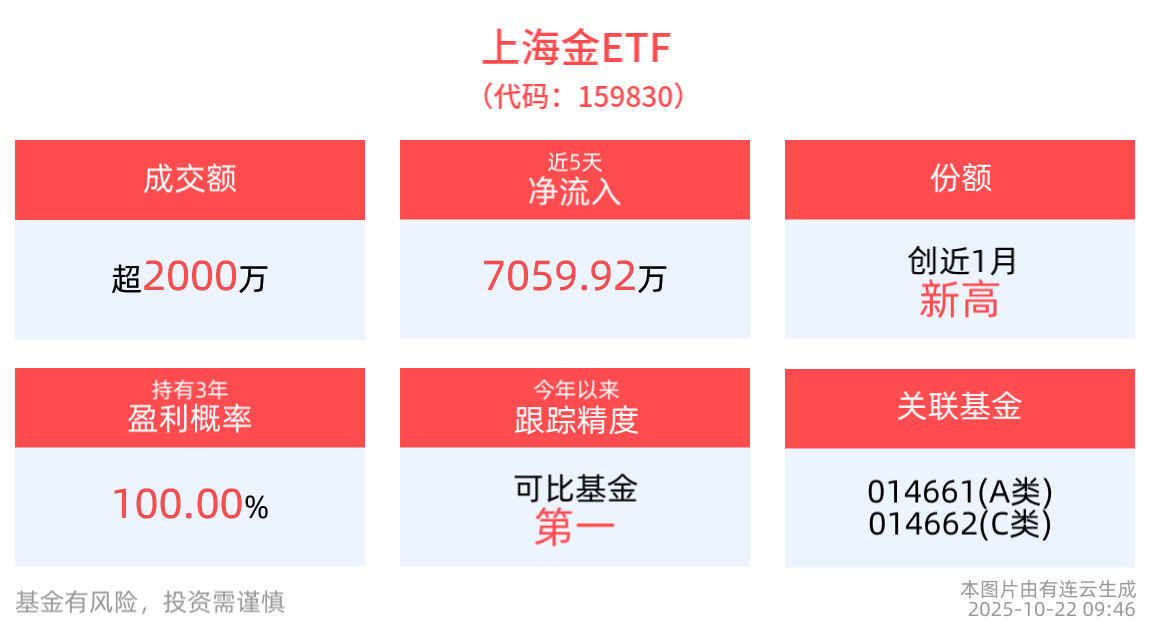
Group 1 - Shanghai Gold ETF (159830) experienced a significant pullback, dropping over 5% with a transaction volume of 27.94 million yuan as of October 22, 2025 [3] - The latest share count for Shanghai Gold ETF reached 166 million, marking a one-month high as of October 21 [3] - The net inflow of funds into Shanghai Gold ETF was 11.84 million yuan, with a total of nearly 160 million yuan attracted over the last 10 trading days [3] Group 2 - The Shanghai Gold ETF closely tracks Shanghai Gold (SHAU.SGE) and has a management fee of 0.25% and a custody fee of 0.05%, both lower than the average for similar products [3] - The ETF supports T+0 trading, enhancing liquidity for investors [3] Group 3 - European leaders issued a joint statement on October 21 supporting negotiations for a ceasefire in the Russia-Ukraine conflict, emphasizing opposition to the use of force to change international borders [3] Group 4 - On October 22, spot gold prices experienced significant volatility, initially dropping nearly 3% to $4,003 per ounce before rebounding above $4,100 [4] - The fluctuations were attributed to technical adjustments and reduced safe-haven demand due to expectations of a ceasefire in geopolitical conflicts, while global central bank gold purchases and expectations of Federal Reserve easing supported the rebound [4] - Citibank forecasts that the end of the U.S. government shutdown and the announcement of a U.S.-China agreement may lead gold to enter a consolidation phase over the next 2-3 weeks [4] - The World Gold Council suggests that only a major liquidity crisis could disrupt both gold and stock markets, but currently, there are no signs of significant breakdowns in the credit and banking systems, indicating gold's resilience [4]
港股速报|港股低开 黄金股集体大跌 泡泡玛特高开超7%
Mei Ri Jing Ji Xin Wen· 2025-10-22 02:32
今日(10月22日)早盘,港股市场小幅低开。 截至发稿,恒生指数报25897点,下跌129.93点,跌幅0.50%。 个股方面,潼关黄金(00340.HK)跌超8%,中国黄金国际(02099.HK)、老铺黄金(06181.HK)、灵 宝黄金(03330.HK)跌超6%,招金矿业(01818.HK)、紫金矿业(02899.HK)、山东黄金 (01787.HK)、紫金黄金国际(02259.HK)跌超5%。 焦点公司方面,泡泡玛特(09992.HK)昨日大跌8%,并在盘后公布三季度业绩,今日早间,泡泡玛特 股价高开超7%。 打开百度APP畅享高清图片 恒生科技指数报5958点,下跌49.31点,跌幅0.82%。 焦点板块方面,受国际金价跳水影响,今日黄金股板块集体大跌。 消息面,国际金银大跌,现货黄金跌5.18%,报4130.41美元/盎司,盘中一度创自2013年4月以来的最大 单日跌幅。现货白银跌7.16%,报48.705美元/盎司,盘中一度创下自2021年以来的最大跌幅。COMEX 黄金期货当月连续合约结算价下跌250.30美元,跌幅5.74%,报4109.1美元/盎司。 据媒体报道,分析人士指出,资金获利回调 ...