商用车

Search documents
2025商用车销量榜:福田超64万辆登顶,重汽/东风超40万拼前二,谁领涨?| 头条
第一商用车网· 2026-01-17 13:36
Core Viewpoint - The commercial vehicle market in China has shown consistent growth since June 2025, with total sales expected to exceed 4 million units for the year, reaching approximately 4.2965 million units, marking a year-on-year increase of 11% [1][17][25]. Sales Performance - In December 2025, the commercial vehicle market sold 425,000 units, reflecting an 8% month-on-month increase and a 15% year-on-year increase, although the growth rate compared to the previous month decreased by 9 percentage points [3][10]. - The December 2025 sales figure is the highest for that month in the past five years, surpassing December 2024 by approximately 56,400 units and exceeding the lowest figure from December 2022 by over 130,000 units [5]. Market Share and Rankings - The top ten companies in December 2025 accounted for 72.5% of the market share, with the top five companies holding over 46.7% [14]. - Foton led the monthly sales with 57,700 units, maintaining its position as the annual sales champion for 2025 [9][19]. - The rankings of companies in the top ten saw changes, with Dongfeng and Changan moving up in the rankings, while some companies experienced declines [15]. Yearly Performance of Leading Companies - Foton's total sales for 2025 exceeded 600,000 units, while other leading companies like Heavy Truck and Dongfeng also surpassed 400,000 units, with sales figures of 428,200 and 403,100 units respectively [19]. - The overall market share for the top ten companies reached 75.3%, with Foton and Heavy Truck having market shares of 15.0% and 10.0% respectively [22]. Industry Trends - The commercial vehicle market has shown a competitive landscape with significant shifts in rankings and market shares among leading companies, indicating a dynamic and evolving industry [23]. - The year 2025 concluded with a strong performance, setting the stage for potential developments in 2026 [25][26].



戴姆勒卡车2025年销量同比下降8%
Xin Lang Cai Jing· 2026-01-16 13:38
Core Viewpoint - Daimler Trucks announced a total sales forecast of 422,510 trucks and buses for 2025, representing an 8% decrease from last year's sales of 460,409 units [1] Group 1: Sales Performance - Total sales for trucks and buses in 2025 are projected to be 422,510 units, down 8% from 460,409 units in the previous year [1] - The North American truck segment experienced a significant decline, with sales dropping 26% to 141,814 units [1]
长源东谷:公司2025年在柴油商用车领域的市场占有率正在统计过程中
Zheng Quan Ri Bao Zhi Sheng· 2026-01-16 11:47
(编辑 丛可心) 证券日报网讯 1月16日,长源东谷在互动平台回答投资者提问时表示,公司2025年在柴油商用车领域的 市场占有率正在统计过程中,请稍后关注公司定期报告。广西玉柴系公司重要客户与合作伙伴,其相关 数据建议直接向对方咨询。 ...

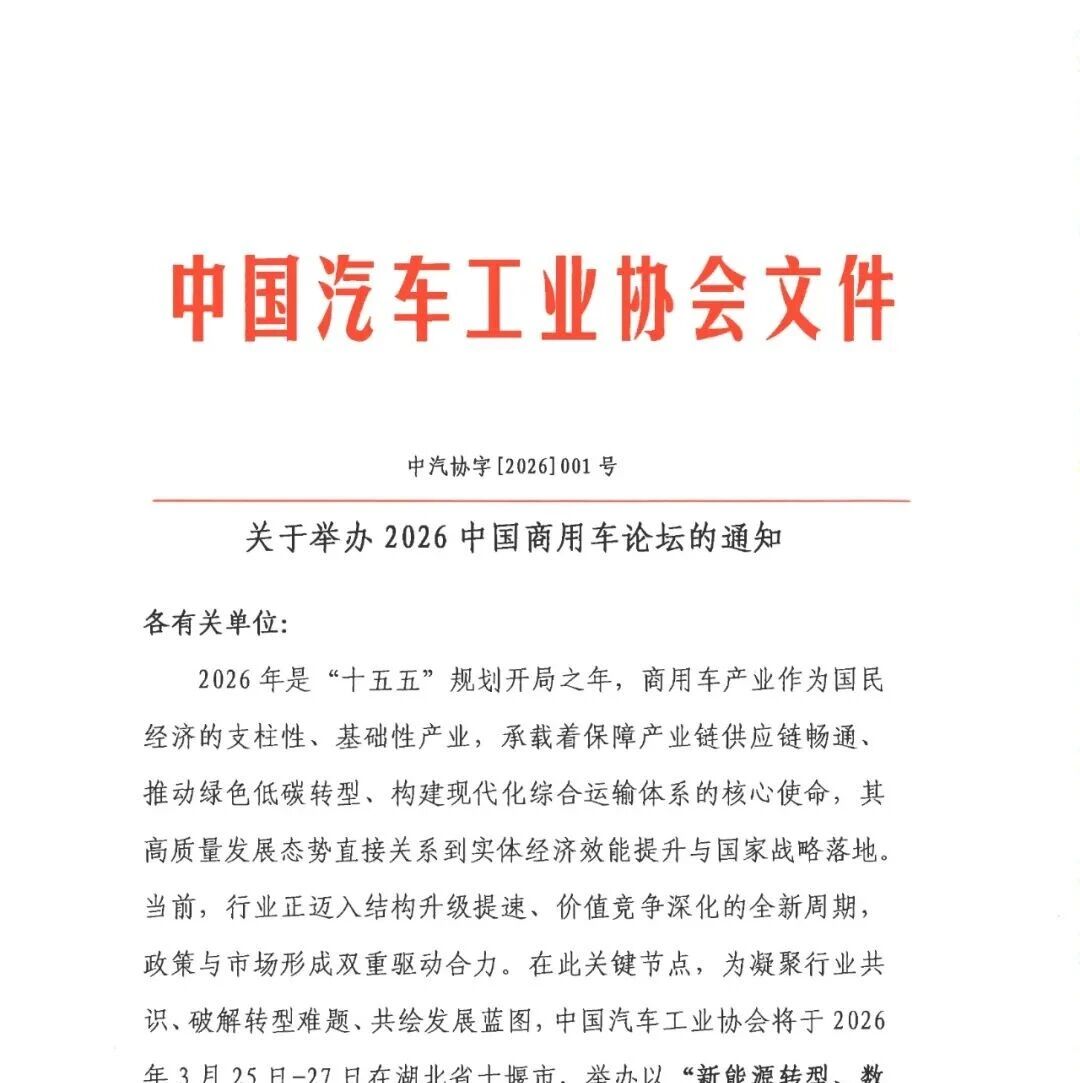
【会议通知】中国汽车工业协会发布《关于举办2026中国商用车论坛的通知 》
中汽协会数据· 2026-01-16 09:12
中国商用车论 CHINA COMMERCIAL VEHICLES FO 中国汽车工业协会文件 诚邀国内外行业同仁、产业链伙伴、专家学者、中汽协会 会员单位以及关心商用车行业发展的各界朋友参加盛会。我们 期待与大家一道,以开放眼光、合作姿态共同推动我国商用车 产业高质量发展! 现就论坛有关事项说明如下: 中汽协字[2026] 001 号 关于举办 2026中国商用车论坛的通知 各有关单位: 2026年是"十五五"规划开局之年,商用车产业作为国民 经济的支柱性、基础性产业,承载着保障产业链供应链畅通、 推动绿色低碳转型、构建现代化综合运输体系的核心使命,其 高质量发展态势直接关系到实体经济效能提升与国家战略落地。 当前,行业正迈入结构升级提速、价值竞争深化的全新周期, 政策与市场形成双重驱动合力。在此关键节点,为凝聚行业共 识、破解转型难题、共绘发展蓝图,中国汽车工业协会将于 2026 年 3月25日-27日在湖北省十堰市,举办以"新能源转型、数 智化赋能:新形势下商用车发展的新要求与新路径"为主题的 2026 中国商用车论坛。 中国商用车论坛是中国汽车工业协会倾心打造的我国商用 汽车行业的顶级盛会。2026中国 ...
【商用车】2025年12月轻型商用车市场预测研究报告
乘联分会· 2026-01-16 08:50
Industry Insights - The Ministry of Industry and Information Technology and five other departments have issued a plan to promote green low-carbon consumption in sectors such as new energy vehicles and green building materials [2] - The plan includes enhancing the efficiency standards for consumer products and promoting the certification of green building materials [2] - There is a push for the development of national standards for smart home interconnectivity and support for enterprises to create comprehensive smart and green solutions [2] Product Analysis - The core technology of new energy large vans includes platform design, allowing for flexible cargo dimensions through various combinations of wheelbase, vehicle height, and cargo layout [7] - New energy large vans show stronger adaptability in scenarios such as express delivery, supermarket distribution, and cold chain transportation [9] - User experience is expected to be upgraded with the introduction of these new energy large vans [11] Market Strategy Recommendations - Companies are advised to enhance innovation in research and development and focus on application scenarios to drive growth [13] - There is a recommendation for commercial model innovation, shifting from merely selling vehicles to providing services and ecosystems that address the entire vehicle purchase journey [21] Sales Forecast - The light commercial vehicle market is expected to maintain stability amid structural adjustments, with sales projected to reach approximately 2.9 million units in 2026, reflecting a slight increase of 1.9% [28]
5000台底换电重卡将落地!
第一商用车网· 2026-01-16 06:51
1月13日,时代骐骥与平安租赁正式签署战略合作协议,双方将充分发挥各自在重卡底盘换 电解决方案与金融租赁服务领域的优势,共同开拓新能源换电重卡市场,计划在2026年共 同推动5000台底换 电 重卡落地。 宁德时代换电业务总经理、时代骐骥CEO杨峻,平安租赁商用车事业部、汽车经营租赁 (新车)事业部总经理王雨青出席仪式并见证签约,时代骐骥电池租赁业务中心总经理郭琦 与平安租赁商用车事业部大中区总经理金科分别代表双方签约。 根据协议,双方将重点围绕骐骥底换重卡场景的电池经营性租赁及换电站补能业务开展合 作,通过资源共享与信息协作,为客户提供多元化的产品与服务。2026年,双方计划共同 推动5000台底盘换电重卡落地。同时,双方还将在换电车型推广、动力电池梯次利用、运 力网络搭建及金融产品创新等领域深化协同,全力构建覆盖车辆、电池与补能设施的全生态 产业链。 此次战略合作的达成,是双方响应国家"双碳"目标、推动交通物流绿色转型的重要实践, 通过"技术方案+金融服务"的深度融合,将有效降低用户初始购车成本和使用门槛,加速电 动重卡的普及,助力物流降本增效。 ● 董事长换人!东风子公司发生多项重要变更 | 头条 ● ...

全面新能源化|三年全系产品高效落地!福田卡文引领商用车新能源变革之路
Xin Lang Cai Jing· 2026-01-15 14:14
Core Viewpoint - The official launch of the first mass-produced liquid hydrogen heavy truck, BEACON, marks a milestone in the development history of Foton Cavin, showcasing the successful implementation of the "three-year full series layout" strategy and filling a significant gap in the industry [1][7]. Group 1: Technological Breakthrough - BEACON leads the way with three power versions: pure electric, gas hydrogen, and liquid hydrogen, achieving a revolutionary innovation in liquid hydrogen application [1][8]. - The liquid hydrogen model features 62 innovations in materials, structures, and processes, resulting in a 30% weight reduction, a total capacity of 100 kg, and a range of over 1000 kilometers with a hydrogen consumption of only 7.6 kg per 100 kilometers [1][8]. - The BEACON is equipped with a self-developed 300 kW fuel cell, achieving a B10 lifespan of 1.6 million kilometers and an operational efficiency of over 58%, which is 9 percentage points higher than the industry average [2][9]. Group 2: Efficient Development - Foton Cavin has rapidly completed a full product matrix, launching various models including the electric VAN, small truck, light truck, and heavy truck within three years, demonstrating unprecedented speed in the commercial vehicle industry [3][10]. - The brand's mission is to make every kilometer better, with a vision to become a leading international enterprise in new energy technology, achieving its ambitious goals ahead of schedule [10][11]. - The company has developed a comprehensive service ecosystem, including a nationwide service network and an app that integrates various lifecycle services for commercial vehicles, enhancing customer experience [4][11]. Group 3: Global Expansion - Foton Cavin has established a global development strategy, leveraging Foton's mature overseas system and supply chain to actively expand into international markets [12][13]. - The brand has successfully entered multiple European markets and plans to launch in 50 countries and regions within the next three years, aiming for a sales target of 50,000 vehicles [12][13]. - Foton Cavin's products meet international standards, having obtained various EU certifications, laying a solid foundation for overseas expansion [6][12].
一年省6万?北汽重卡发布“i追梦”,重新定义“新油车”
第一商用车网· 2026-01-15 11:30
Core Viewpoint - The commercial vehicle industry is at a crossroads of energy transition and technological iteration, with a focus on hybrid solutions that meet real operational needs rather than a binary choice between traditional fuel and electric vehicles [1][3]. Group 1: Industry Transformation - The heavy truck industry is undergoing three profound changes, including intensified domestic competition and the rise of Chinese brands in overseas markets, with exports increasing from 100,000 units to over 300,000 units in four years, projected to account for nearly 30% of total sales by 2025 [5]. - The combined market share of new energy and gas heavy trucks is expected to reach 56% by 2025, while traditional fuel vehicles face shrinking market share [5]. - A price war in the heavy truck market has led to price declines exceeding 20%, with some products falling below component cost, accelerating industry reshuffling [5]. Group 2: User-Centric Innovation - North Benz Heavy Truck has launched the "New Oil Truck Three-Year Evolution Action," focusing on user collaboration to develop the iDream hybrid tractor, addressing five major user pain points: product mismatch, high acquisition costs, minimal fuel savings, frequent failures, and excessive weight [7][9]. - The iDream aims for "oil-electric parity, oil-electric equivalence, and a 15% reduction in fuel consumption," emphasizing a systematic reconstruction of both hardware and software [9][11]. Group 3: Technical Features - The iDream hybrid tractor features proprietary components, including a Cummins DHE H700 engine with a thermal efficiency of 50%, a P2 architecture electric drive system with a transmission efficiency of 99.7%, and a 30 kWh battery with a lifespan of 7,000 cycles [9][11]. - Intelligent technologies such as the Smart ED30 eco-driving system and Smart TMS temperature control system enhance operational efficiency and user experience, addressing real-world operational challenges [11][13]. Group 4: Economic Benefits - Real-world testing shows that the iDream hybrid truck can achieve fuel consumption as low as 28 liters per 100 kilometers on flat highways, a 10% reduction compared to traditional fuel trucks, and 33 liters in mountainous areas, a 20% reduction [13]. - The potential annual savings for drivers can exceed 60,000 yuan, factoring in fuel, urea, battery, brake wear, and air conditioning costs, demonstrating the commercial value of hybrid trucks [13][14]. Group 5: Industry Value Logic - The launch of the iDream hybrid tractor represents a redefinition of industry value logic, emphasizing that the evolution of heavy trucks is not merely about technology and parameters but about redefining operational scenarios [14].

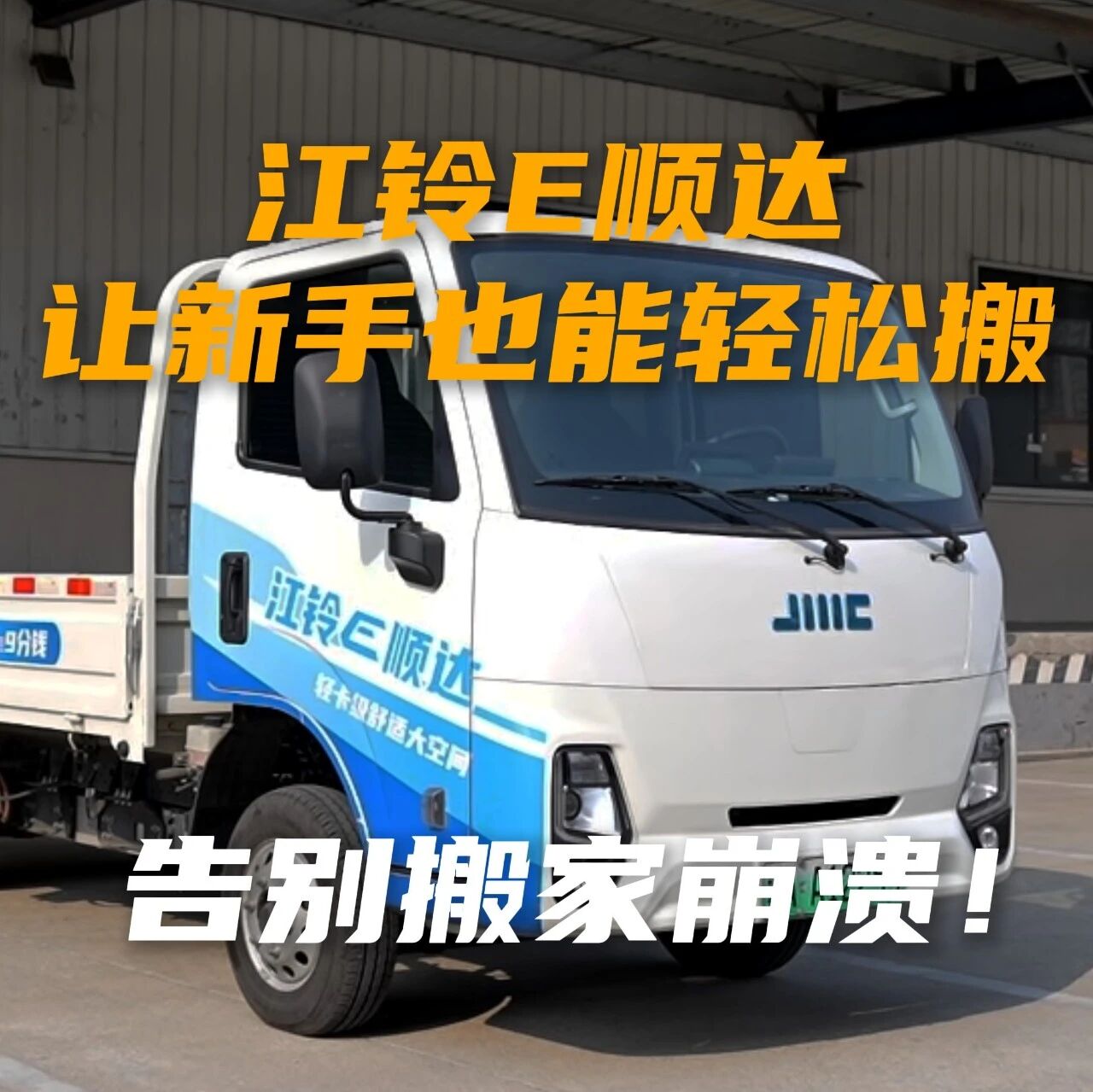
告别搬家崩溃!江铃E顺达让新手也能轻松搬
第一商用车网· 2026-01-15 11:30
Group 1 - The core viewpoint highlights the competitive landscape in the heavy-duty truck market, with Shaanxi Auto and Jiefang vying for the top position, both surpassing 10,000 units in sales, while a dark horse enters the top eight [4] - The traction vehicle segment saw a 25% increase in December, with cumulative sales projected to reach nearly 600,000 units by 2025 [4] - Heavy-duty truck sales are expected to stabilize at 1.145 million units in 2025, with major players like Heavy Truck exceeding 300,000 units and Jiefang over 200,000 units [4] Group 2 - A significant tender for 990 million yuan has been announced for new energy sanitation vehicles, indicating a growing investment in sustainable transport solutions [4] - The company has been actively delivering new energy trucks, with a notable pattern of 100 units being delivered repeatedly, showcasing strong demand in this segment [5]
三大新品将重磅亮相,陕汽商用车2026如何精耕细分市场?
第一商用车网· 2026-01-15 11:30
承志传薪当致远,凝心聚力贵同行。陕汽商用车2026合作伙伴大会将于2026年1月20日在 陕西宝鸡隆重启幕。本次大会以"产品引领、精耕细分、共创未来"为主题,将邀请全国合 作伙伴、行业嘉宾及各界媒体,围绕战略方向、新品矩阵、行业趋势与合作共赢展开深度对 话,共同擘画商用车产业在新时代下的可持续发展蓝图。 实力登场!硬核新品重磅亮相 在商用车行业迈向绿色化、智能化的关键阶段,产品实力是应对一切挑战的根基。陕汽商用 车坚持以用户真实运营场景为出发点,持续推动技术迭代与产品进化。本次大会,陕汽商用 车将正式揭晓智云新能源、德龍轻卡、德御重卡三大主力品系下的三款战略新品。 这些新品并非简单迭代,而是针对快递速运、干线物流、城市配送等核心细分市场的深度回 应。它们集成了行业前沿的技术成果,力求在"更经济、更可靠、更安全、更舒适、更智 能"五个维度实现实质性突破,为用户提供兼具卓越运营效率与出色可靠性的运输解决方 案,切实兑现"为用户造好车,为客户创财富"的品牌承诺。 为切实回应不同合作伙伴的发展需求,大会设置重卡、轻卡&新能源、专用车、服务配件、 供应商五大分会场,聚焦2026年市场趋势研判、合作模式创新、业务政策宣贯 ...