
绿色低碳消费

Search documents
2026年以旧换新已惠及3053万人次,三天新增销售额逾65亿元,智能绿色产品成换新主流
Sou Hu Cai Jing· 2026-02-24 07:49
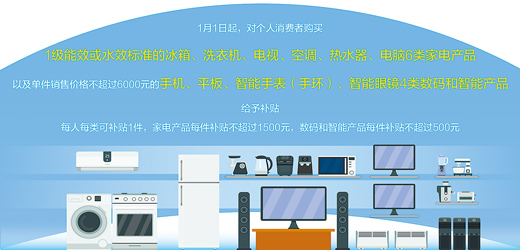
Group 1 - The core viewpoint of the articles highlights the effectiveness of the 2026 consumer goods trade-in policy, which has significantly boosted consumer participation and sales figures [1][2] - As of February 22, 2026, the trade-in policy has benefited 30.53 million people, generating sales of 204.54 billion yuan, showing a notable increase from previous data [1] - The policy's impact is evident in the sales of smart and green products, with smart glasses sales increasing by 47.3% and water-saving bathroom fixtures by 23.2% during the Spring Festival [1] Group 2 - The coverage of the trade-in policy has expanded to include digital and smart products such as smartphones, tablets, and smart wearables, with subsidies of up to 500 yuan for eligible items [2] - Data from the Spring Festival period indicates a sustained release of consumer spending potential, with a reported 8.6% increase in daily sales for major retail and catering enterprises compared to the previous year [2] - The trade-in policy is expected to continue driving demand for smart and green products, reflecting a shift in consumer preferences towards quality and technology [2]
从一个家电卖场看国补新账(财经深一度)
Ren Min Ri Bao· 2026-02-02 13:31
Core Viewpoint - The new national subsidy policy for 2026 aims to stimulate consumer spending by focusing on energy-efficient and smart products, with a more targeted approach to financial resources [3][15]. Group 1: Policy Changes - The 2026 subsidy policy narrows its focus from 12 categories in 2025 to 6 key categories: televisions, refrigerators, water heaters, computers, washing machines, and air conditioners [3]. - The subsidy standard has been reduced from 20% to 15%, and the maximum subsidy per household appliance has decreased from 2000 yuan to 1500 yuan, emphasizing the efficient use of fiscal funds [3][15]. - New products like smart glasses have been included in the subsidy list, reflecting the government's responsiveness to emerging consumer demands [3]. Group 2: Implementation and Market Response - The Chongqing Municipal Commerce Committee quickly implemented the subsidy policy, with a well-prepared execution plan ready within hours of the official announcement [6]. - The initial response from consumers was strong, with a significant increase in foot traffic at stores like JD MALL, doubling the number of visitors [8]. - However, there were issues with the redemption rate of subsidy coupons, leading to a policy adjustment to allow for daily coupon claims instead of weekly [9][10]. Group 3: Financial Support and Consumer Behavior - Financial institutions have been proactive in addressing the cash flow pressures faced by retailers, introducing products like "National Subsidy Loans" to support businesses [12]. - The average transaction value at stores has increased by over 40% compared to 2024, indicating that consumers are opting for higher-quality products rather than just cheaper options [15]. - The new policy is seen as a driver for consumption upgrades, with a notable increase in sales of energy-efficient and smart products, reflecting a shift in consumer preferences towards quality [14][15]. Group 4: Future Outlook - The 2026 subsidy policy is expected to foster a more advanced, intelligent, and green domestic market, aligning with national goals for sustainable consumption [16].

2025年北京全市居民服务性消费支出占居民人均消费支出的比重接近6成
Bei Jing Shang Bao· 2026-01-28 03:12
Core Insights - Beijing is accelerating the development of an international consumption center city, with a notable focus on service consumption [1] Group 1: Consumption Trends - Total market consumption in Beijing increased by 1.6% year-on-year, showing a 1.1 percentage point improvement compared to the first three quarters [1] - Service consumption in Beijing grew by 5% year-on-year, with nearly 60% of residents' per capita consumption expenditure allocated to service-related spending [1] - Retail sales of social consumer goods decreased by 2.9% year-on-year, but the decline narrowed by 2.2 percentage points compared to the previous three quarters [1] Group 2: Sector Performance - Information service consumption, driven by digital technologies such as internet live streaming and gaming, experienced double-digit growth [1] - The cultural and entertainment sectors, including film and performance markets, achieved double-digit growth in box office revenues [1] - The tourism and travel sector remained active, with revenues from travel agencies and related services increasing by over 10% [1] Group 3: Product Categories - Retail sales of gold, silver, and jewelry increased by 39.5%, cosmetics by 12.6%, and grain and oil products by 5.7% year-on-year [1] - The penetration rate of new energy vehicles is rising, with retail sales of these products increasing by 13.2% year-on-year, supported by policies promoting consumption and the popularity of certain new models [1]
【商用车】2025年12月轻型商用车市场预测研究报告
乘联分会· 2026-01-16 08:50
Industry Insights - The Ministry of Industry and Information Technology and five other departments have issued a plan to promote green low-carbon consumption in sectors such as new energy vehicles and green building materials [2] - The plan includes enhancing the efficiency standards for consumer products and promoting the certification of green building materials [2] - There is a push for the development of national standards for smart home interconnectivity and support for enterprises to create comprehensive smart and green solutions [2] Product Analysis - The core technology of new energy large vans includes platform design, allowing for flexible cargo dimensions through various combinations of wheelbase, vehicle height, and cargo layout [7] - New energy large vans show stronger adaptability in scenarios such as express delivery, supermarket distribution, and cold chain transportation [9] - User experience is expected to be upgraded with the introduction of these new energy large vans [11] Market Strategy Recommendations - Companies are advised to enhance innovation in research and development and focus on application scenarios to drive growth [13] - There is a recommendation for commercial model innovation, shifting from merely selling vehicles to providing services and ecosystems that address the entire vehicle purchase journey [21] Sales Forecast - The light commercial vehicle market is expected to maintain stability amid structural adjustments, with sales projected to reach approximately 2.9 million units in 2026, reflecting a slight increase of 1.9% [28]

服务性消费成未来趋势?
清华金融评论· 2025-12-16 05:58
Core Viewpoint - The consumer market in Beijing showed improvement in the first eleven months of the year, with total consumption increasing by 1.4% year-on-year, reflecting a slight recovery in the market [3]. Group 1: Service Consumption - Service consumption in Beijing grew steadily, with a year-on-year increase of 4.8% from January to November. The integration of digital technology into consumer services has led to double-digit growth in information services, driven by internet live streaming, gaming, and lifestyle services [4]. - The tourism sector remained active, with significant increases in air and rail passenger volumes, and revenues from travel agencies and related services grew by over 10% [4]. - The cultural and entertainment services sector saw a richer supply, with box office revenues from movies and performances achieving double-digit growth [4]. Group 2: Retail Sales - The total retail sales of consumer goods in Beijing reached 12,492.9 billion yuan, representing a year-on-year decline of 3.1%, but the decline was narrowed by 0.1 percentage points compared to the previous month [5]. - Among major retail categories, sales of gold and silver jewelry and cosmetics grew by 40.5% and 12.3%, respectively. Sales of home appliances and audio-visual equipment increased by 1.3% due to the old-for-new consumption policy [5]. - Basic living goods such as grain and oil saw retail sales increase by 6.9%, while daily necessities grew by 1.2%. However, sales of communication equipment and cultural office supplies declined by 17.4% and 0.8%, respectively [5]. - The automotive market faced challenges, with sales of traditional fuel vehicles declining by 14.8% and petroleum products down by 16.9%. In contrast, sales of new energy vehicles increased by 8.3%, supported by the old-for-new policy and local consumption vouchers [5]. Group 3: Market Outlook - Overall, the Beijing consumer market maintained growth, and the trend of upgrading consumption structure remains unchanged. Future actions will focus on implementing measures to boost consumption, stabilize employment, and expand the supply of quality goods and services to stimulate new consumption vitality [6].

【联合发布】新能源商用车周报(2025年11月第4周)
乘联分会· 2025-12-01 08:39
Core Insights - The article discusses the growth and developments in the new energy commercial vehicle sector, highlighting significant sales increases and new product launches in the market [5][17][29]. Policy and Regulations - The Ministry of Industry and Information Technology (MIIT) is promoting the establishment of national emerging industry development demonstration bases, aiming to create around 100 park-type and 1,000 enterprise-type bases by 2035, focusing on new technologies and industries such as new energy and intelligent connected vehicles [10][11][14]. Market Insights - In the first ten months of 2025, sales of Changan's new energy VANs increased by 72.9%, with the medium VAN segment accounting for over 60% of total sales [17][18]. - The large VAN market saw a remarkable growth of 344.5% for the Kai Cheng V919 model during the same period, with the model's new version launched in November [23]. - The small VAN market also experienced significant growth, with the Rui Xing EM80Ⅱ and EM60Ⅱ models increasing by 127.6% and 416.3%, respectively [27][28]. Company Monitoring - Changan Automobile is advancing its "Three Major Plans" to enhance its core competitiveness in the new energy sector, with a commitment to invest 100 billion yuan in new energy projects by 2025 [29]. - Chery Commercial Vehicle launched the Zero Meter Light Truck, targeting urban distribution needs with advanced energy efficiency features [33]. - Foton Motor introduced the Aoling Zhi Lan EL cold region version, addressing winter operational challenges for electric light trucks [38]. - GAC's Lingcheng T9 new energy heavy truck was launched, featuring a fully self-developed three-electric system [40].



多部门最新回应,关于促进家电家居等大宗消费
Sou Hu Cai Jing· 2025-11-30 12:09
Core Insights - The Chinese government has introduced a plan to enhance the adaptability of supply and demand in consumer goods, aiming to create three trillion-level consumption sectors and ten hundred-billion-level consumption hotspots by 2027, with a focus on high-quality development by 2030 [1] Group 1: Development Goals - By 2027, China aims to establish three trillion-level consumption sectors and ten hundred-billion-level consumption hotspots [1] - By 2030, the goal is to achieve a high-quality development pattern where supply and consumption interact positively, with a steady increase in consumption's contribution to economic growth [1] Group 2: Key Consumption Areas - The three trillion-level consumption sectors include elderly products, smart connected vehicles, and consumer electronics [1] - The ten hundred-billion-level consumption hotspots cover categories closely related to daily life, such as baby products, smart wearables, cosmetics, fitness equipment, outdoor products, pet food, civilian drones, trendy toys, jewelry, and national fashion apparel [1] Group 3: Current Market Trends - In the first ten months of this year, the trade-in policy for consumer goods has generated over 2.4 trillion yuan in sales, benefiting more than 360 million people [3] - Retail sales of home appliances, furniture, and communication equipment have seen approximately 20% year-on-year growth, maintaining a rapid growth rate [3] Group 4: Regulatory and Standardization Efforts - The State Administration for Market Regulation has released 22 national standards related to energy and water consumption for daily consumer goods, enhancing the supply of quality products to meet consumer demand [3] - The plan emphasizes the development of energy-efficient and environmentally friendly products suitable for rural areas, including efficient range hoods, gas stoves, water heaters, and bathroom products [3][4]

六部门发文:拓展汽车改装等汽车后市场消费
Cai Jing Wang· 2025-11-28 01:35
Core Viewpoint - The implementation plan aims to enhance the adaptability of supply and demand in consumer goods, targeting significant optimization of the supply structure by 2027, with the formation of three trillion-level consumption sectors and ten billion-level consumption hotspots [1] Group 1: Key Industries - Focus on key industries such as smart connected new energy vehicles and consumer electronics, with initiatives for typical innovative application activities [1] - Encouragement of green and low-carbon consumption in sectors like new energy vehicles [1] Group 2: Market Development - Expansion of automotive aftermarket consumption, including vehicle modifications, RV camping, and automotive events [1] - Promotion of high-quality development in the automotive rental market [1]
六部门发文:拓展汽车改装、房车露营等汽车后市场消费
Cai Jing Wang· 2025-11-27 02:08
Core Viewpoint - The implementation plan aims to enhance the adaptability of supply and demand in consumer goods, with a target to optimize the supply structure significantly by 2027, creating three trillion-level consumption sectors and ten billion-level consumption hotspots [1] Group 1: Key Industries - Focus on key industries such as smart connected new energy vehicles and consumer electronics, with initiatives for typical innovative application activities [1] - Encouragement of green and low-carbon consumption in sectors like new energy vehicles [1] Group 2: Market Development - Expansion of automotive aftermarket consumption, including vehicle modifications, RV camping, and automotive events [1] - Promotion of high-quality development in the automotive rental market [1]
今年前10月北京市场总消费额同比增长1.3%
Xin Jing Bao· 2025-11-18 05:22
Group 1 - The total consumption in Beijing from January to October increased by 1.3% year-on-year, with service consumption remaining active, particularly in information, transportation, and cultural entertainment sectors [1] - Service consumption in the city grew by 4.7% year-on-year, driven by internet live streaming, gaming, and lifestyle services, with the information sector achieving double-digit growth [1] - During the National Day and Mid-Autumn Festival holidays, total tourism spending in the city increased by 4.7%, with spending from inbound tourists rising by over 50% [1] Group 2 - The total retail sales of social consumer goods (referred to as "social retail total") reached 1,124.86 billion yuan from January to October, a year-on-year decline of 3.2%, but the decline narrowed by 1.9 percentage points compared to the first three quarters [2] - In October, retail sales grew by 12.6% due to the early launch of the "Double Eleven" promotional activities, strong sales of new products, and the effectiveness of local consumption vouchers [2] - Among 13 major retail categories, 10 performed better than in the previous three quarters, with jewelry, cosmetics, and home appliances seeing year-on-year retail sales growth of 41.2%, 10.8%, and 3.4% respectively [2] - The sales of traditional fuel vehicles declined, with automotive and petroleum products retail sales down by 16.1% and 17.4%, respectively, although the decline was less severe than before [2] - Retail sales of new energy vehicles increased by 3.8%, with the growth rate improving by 5.6 percentage points compared to the previous three quarters [2]