轻工制造

Search documents
万联晨会-20251217
Wanlian Securities· 2025-12-17 00:48
Core Insights - The A-share market experienced a collective decline on Tuesday, with the Shanghai Composite Index falling by 1.11%, the Shenzhen Component Index by 1.51%, and the ChiNext Index by 2.1%. The total trading volume in the Shanghai and Shenzhen markets was 1,723.99 billion yuan [2][7] - In the industry sectors, retail, beauty care, and social services led the gains, while telecommunications, comprehensive services, and non-ferrous metals faced the largest declines. Concept sectors such as duty-free shops, ride-hailing, and pre-made dishes saw significant increases, while superconductors, newly listed tech stocks, and silicon energy concepts experienced notable declines [2][7] Market Performance - Domestic market performance showed the Shanghai Composite Index closing at 3,824.81, down 1.11%, and the Shenzhen Component Index at 12,914.67, down 1.51%. The total trading volume was 1,723.99 billion yuan [4] - Internationally, the Dow Jones closed at 48,114.26, down 0.62%, while the S&P 500 closed at 6,800.26, down 0.24%. The Nasdaq, however, rose by 0.23% to 23,111.46 [4] Economic News - The Central Economic Work Conference emphasized that expanding domestic demand is the top priority for 2025, focusing on boosting consumption from both supply and demand sides. Measures will be taken to stabilize the real estate market by controlling new supply and activating existing stock [3][8] Retail Data Analysis - In November 2025, the total retail sales of consumer goods reached 438.98 billion yuan, with a year-on-year growth of 1.3%, marking a significant decline in growth rates compared to previous months [9][12] - The Consumer Price Index (CPI) for November was 0.7%, an increase of 0.5 percentage points from October [9] - Retail sales in urban areas grew by 1.0% year-on-year, while rural areas saw a higher growth rate of 2.8% [9][10] Investment Recommendations - The report suggests focusing on sectors such as food and beverage, social services, and retail. Specific recommendations include: - For the liquor industry, it is believed to be in a bottoming phase with low valuations and high dividends providing support [13] - In the consumer goods sector, attention is drawn to dairy products, beverages, and condiments due to favorable conditions for profit release [13] - The social services sector is highlighted for its growth potential, particularly in tourism, duty-free, and education [13] - In retail, gold and jewelry are recommended due to their appeal as safe-haven assets amid changing global trade environments [13]
上市公司捧出大蛋糕!今年分红将超2.6万亿元
Yang Zi Wan Bao Wang· 2025-12-16 08:29
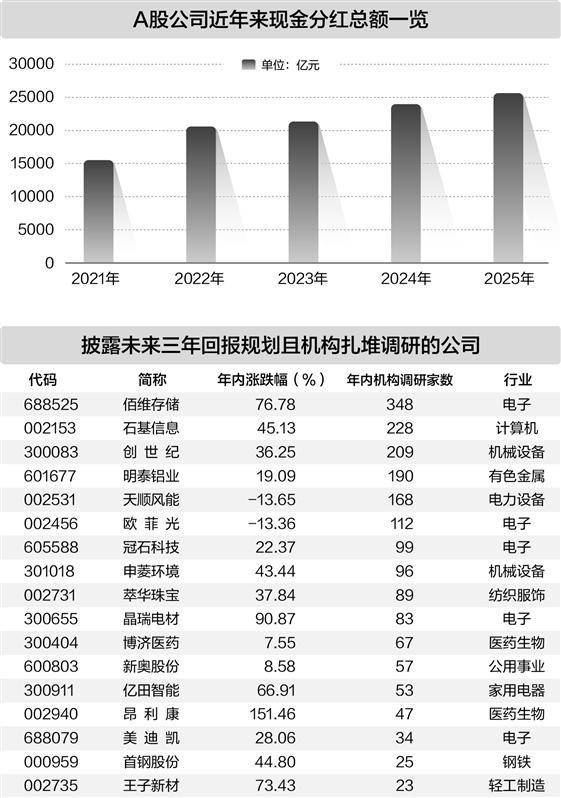
扬子晚报网12月16日讯(记者 范晓林 薄云峰 实习生 潘伊笑)据数据统计,截至12月10日,以股权登记 日计算,今年以来,3762家A股上市公司合计分红金额达2.46万亿元,超过去年全年,再创历史新高。 | 代码 | 简称 | 年内涨跌幅(%) | 年内机构调研家数 | 行业 | | --- | --- | --- | --- | --- | | 688525 | 佰维存储 | 76.78 | 348 | 电子 | | 002153 | 石基信息 | 45.13 | 228 | 计算机 | | 300083 | 创世纪 | 36.25 | 209 | 机械设备 | | 601677 | 明泰铝业 | 19.09 | 190 | 有色金属 | | 002531 | 天顺风能 | -13.65 | 168 | 电力设备 | | 002456 | 欧菲 光 | -13.36 | 112 | 电子 | | 605588 | 冠石科技 | 22.37 | da | 电子 | | 301018 | 申菱环境 | 43.44 | 96 | 机械设备 | | 002731 | 萃华珠宝 | 37.84 | 89 | 纺织服 ...

2025年11月社零数据跟踪报告:11月社零总额同比+1.3%,只有中西药品类增速环比有所上升
Wanlian Securities· 2025-12-16 07:55
Investment Rating - The industry is rated as "stronger than the market," indicating an expected relative increase of over 10% in the industry index compared to the broader market within the next six months [44]. Core Insights - In November 2025, the total retail sales of consumer goods in China reached 43,898 billion yuan, with a year-on-year growth of 1.3%, reflecting a significant decline in growth rates both year-on-year and month-on-month [10][11]. - The Consumer Price Index (CPI) for November increased by 0.7% year-on-year, up from 0.2% in October, indicating rising inflationary pressures [10]. - Retail sales growth for goods and dining both saw a month-on-month decline, with goods retailing growing by 1.0% year-on-year and dining income increasing by 3.2% year-on-year [11][12]. - Online retail sales from January to November 2025 totaled 144,582 billion yuan, marking a year-on-year increase of 9.1%, which accounted for 31.7% of total retail sales [34]. Summary by Sections Overall Performance - The total retail sales of consumer goods in November 2025 were 43,898 billion yuan, with a year-on-year growth of 1.3%, a decrease of 1.7 percentage points from the previous year and a month-on-month decline of 1.6 percentage points [10][11]. Segment Analysis - In November, among 16 categories of goods, 7 categories (including daily necessities, tobacco and alcohol, home appliances, furniture, petroleum products, automobiles, and building materials) experienced negative growth. Only the Chinese and Western medicine category saw an increase in growth rate [17][18]. - The cultural and office supplies category and communication equipment category showed strong growth, both exceeding 11% [17]. Online Retail - Cumulative online retail sales from January to November reached 144,582 billion yuan, with a year-on-year growth of 9.1%, which is an increase of 1.7 percentage points compared to the same period in 2024 [34][36]. - The physical goods online retail sales amounted to 118,193 billion yuan, with a year-on-year growth of 5.7% [34]. Investment Recommendations - The report suggests focusing on sectors such as food and beverage, social services, and retail, particularly highlighting opportunities in the liquor industry, consumer goods, and tourism sectors due to expected policy support for domestic consumption [38][39][42].
美之高创历史新高,融资客减仓
Zheng Quan Shi Bao Wang· 2025-12-16 02:53
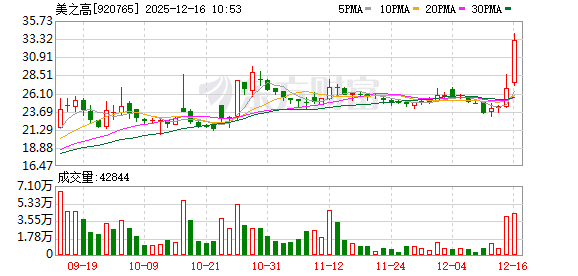
美之高股价创出历史新高,截至9:39,该股上涨24.21%,股价报33.20元,成交量216.07万股,成交金额 6612.64万元,换手率4.09%,该股最新A股总市值达28.86亿元,该股A股流通市值17.53亿元。 证券时报·数据宝统计显示,美之高所属的轻工制造行业,目前整体跌幅为0.22%,行业内,目前股价上 涨的有46只,涨幅居前的有美之高、皮阿诺、宏裕包材等,涨幅分别为24.21%、9.98%、6.03%。股价 下跌的有115只,跌幅居前的有中源家居、新宏泽、安妮股份等,跌幅分别为9.83%、8.85%、6.54%。 两融数据显示,该股最新(12月15日)两融余额为264.94万元,其中,融资余额为264.94万元,近10日 减少55.30万元,环比下降17.27%。 公司发布的三季报数据显示,前三季度公司共实现营业收入3.64亿元,同比下降7.52%,实现净利 润-438.37万元,同比下降126.88%,基本每股收益为-0.0600元。(数据宝) (文章来源:证券时报网) ...
渤海证券研究所晨会纪要(2025.12.16)-20251216
BOHAI SECURITIES· 2025-12-16 00:29
Core Insights - The report emphasizes that domestic demand will dominate and set the economic tone for the coming year, with a short-term focus on improvements in the export chain [2] Industry News - The Central Economic Work Conference was held in Beijing, highlighting the importance of domestic demand [2] - A notification on strengthening the collaboration between commerce and finance to boost consumption was officially released [2] Important Company Announcements - Jian Sheng Group announced an investment of 818 million yuan in capacity construction in Egypt [2] - Ribo Fashion plans to acquire 71% of Indile's shares for 1.42 billion yuan through a combination of issuing shares and cash payment [2] Market Review - From December 8 to December 12, the light industry manufacturing sector underperformed the CSI 300 index by 0.96 percentage points, with a decline of 1.04% compared to the CSI 300's decline of 0.08% [2] - During the same period, the textile and apparel sector lagged behind the CSI 300 index by 2.49 percentage points, with a decline of 2.57% [2] Weekly Strategy - The Central Economic Work Conference emphasized the need to build a strong domestic market as a primary task for economic work next year. Policies for replacing old products in sectors like automobiles, home appliances, and home furnishings are expected to continue [2] - The real estate market will be stabilized with city-specific measures to control inventory and encourage the purchase of existing homes for affordable housing [2] - Approximately 100 cities, including Hangzhou and Wuhan, have increased housing purchase subsidies this year, indicating a less pessimistic outlook for the real estate sector [2] Recommendations - The report maintains a "neutral" rating for the light industry manufacturing and textile apparel sectors, while suggesting to continue monitoring companies with strong overseas capacity and brand pricing power [3] - Companies such as Oppein Home (603833), Sophia (002572), Pathfinder (300005), Semir Apparel (002563), Guibao Pet (301498), and Zhongchong Co. (002891) are rated as "overweight" [3]
松霖科技涨3.99%,股价创历史新高
Zheng Quan Shi Bao Wang· 2025-12-15 01:59
证券时报·数据宝统计显示,松霖科技所属的轻工制造行业,目前整体跌幅为0.05%,行业内,目前股价 上涨的有54只,涨幅居前的有中锐股份、顺灏股份、永吉股份等,涨幅分别为10.08%、10.03%、 6.30%。股价下跌的有99只,跌幅居前的有新宏泽、*ST亚振、ST华鹏等,跌幅分别为8.89%、5.00%、 4.98%。 公司发布的三季报数据显示,前三季度公司共实现营业收入18.52亿元,同比下降15.49%,实现净利润 1.59亿元,同比下降50.53%,基本每股收益为0.3700元,加权平均净资产收益率4.87%。(数据宝) 松霖科技股价创出历史新高,截至9:32,该股上涨3.99%,股价报34.70元,成交量107.40万股,成交金 额3736.19万元,换手率0.25%,该股最新A股总市值达150.22亿元,该股A股流通市值148.36亿元。 (文章来源:证券时报网) ...


国内高频指标跟踪(2025年第49期):内需仍待提振
GUOTAI HAITONG SECURITIES· 2025-12-14 07:33
Consumption - Overall commodity consumption is weak, with automotive sales declining and high-end liquor prices continuing to fall[1] - Seasonal recovery in textile and apparel demand is insufficient compared to the same period last year[1] - Service consumption shows stable population movement, with Shanghai's amusement consumption performing well in the off-season[1] Investment - Investment remains weak, with infrastructure construction slowing down and new home transactions marginally declining[1] - The area of new homes sold in 30 cities continues to decrease, with a slight narrowing of the year-on-year decline[14] - The proportion of second-hand home transactions has increased to 65.94%[14] Production - Production is expected to improve mainly due to year-end rush work, with coal inventory at ports continuing seasonal replenishment[1] - The operating rate of asphalt has slightly decreased to 27.8%, remaining at historical lows[14] - The operating rate of carbonates has increased, but remains at a relatively low level compared to the same period last year[23] Trade - The number of ships departing from ports has shown seasonal recovery, with domestic and international freight rates continuing to diverge due to demand differences[1] - Export value has increased, with a year-on-year growth rate of 17.3%[20] Prices - Industrial product prices have declined, with the PPI dropping by 0.97%[33] - CPI growth rate has decreased by 0.02 percentage points, with significant price increases in food and healthcare services[33] Liquidity - The US dollar index has fallen by 58 basis points to 98.4, influenced by the Federal Reserve's interest rate cuts[36] - The central bank's net currency injection was 4.7 billion yuan in the week of December 13[36]
资金行为研究双周报(2025/12/01-2025/12/12):杠杆资金多头力量抬升-20251213
ZHONGTAI SECURITIES· 2025-12-13 13:12
Market Fund Flow Overview - Institutional funds have shown a net outflow from major indices, while retail funds have stabilized after a brief outflow, indicating a shift towards net inflow [3][10] - The net inflow rate difference between retail and institutional funds for the ChiNext index fell into negative territory from December 4 to 8, suggesting stronger institutional support for the index during this period [3][10] Market Capitalization and Valuation Style - Institutional funds are accelerating their outflow from high valuation indices and the CSI 300, reflecting a profit-taking tendency, while retail funds continue to flow into high valuation and large-cap styles [3][22] - The net inflow rate difference between retail and institutional funds has narrowed significantly after December 11, indicating a potential increase in institutional support for small-cap stocks [3][22] Major Industry Style - Both institutional and retail funds have consistently flowed into the consumer sector, while there is a divergence in the technology and cyclical manufacturing sectors [4][27] - Institutional outflows from the technology sector have increased again after a brief slowdown, while outflows from the cyclical sector have shown a converging trend [4][27] Primary Industry Fund Flow - In the upstream resources sector, there is a strong consensus on non-ferrous metals and basic chemicals, with institutional outflows from non-ferrous metals no longer significantly increasing [5][40] - The midstream materials and manufacturing sector has seen high trading activity in electrical equipment, while the downstream essential consumption sector has seen increased institutional investment in agriculture, forestry, animal husbandry, and fishery [5][40] Leverage Fund Situation - The margin trading balance remains high at approximately 2.51 trillion yuan, with the average collateral ratio slightly fluctuating [5][77] - The trading activity of margin financing has stabilized, with the trading volume accounting for 9.89% of total market transactions, indicating sustained market risk appetite [5][79] - The net buying amount of margin trading in the electronics sector has significantly increased, indicating a shift from bearish to bullish sentiment [5][84]
活跃股揭秘:79只股周换手率超100%
Zheng Quan Shi Bao Wang· 2025-12-12 15:45
其次是海欣食品,一周换手率为210.52%,一周股价下跌15.29%,该股本周因连续三个交易日内,跌幅 偏离值累计达20%、连续三个交易日内,涨幅偏离值累计达20%等2次登陆龙虎榜,买卖居前营业部 中,机构专用席位净卖出1026.86万元,营业部累计净买入5279.13万元。资金流向上,该股本周主力资 金净流出5.49亿元。 德艺文创本周换手率203.63%,位居榜单第三,一周股价上涨0.65%,该股本周因日换手率达30%等4次 登陆龙虎榜,买卖居前营业部中,机构专用席位净卖出9627.81万元,营业部累计净买入1782.50万元。 资金流向上,该股本周主力资金净流入1.07亿元。 (原标题:活跃股揭秘:79只股周换手率超100%) 沪指本周下跌0.34%,其中,79股成交活跃,周换手率超过100%。 证券时报•数据宝统计显示,本周共有79只个股换手率超过100%;换手率在50%~100%的有264只;换手 率在10%~50%的有2238只。分行业看,本周换手率100%以上个股中,电子行业个股最多,有11只个股 上榜;计算机、机械设备等紧随其后,分别有10只、9只个股上榜。 大鹏工业是本周换手率最高的个股,一 ...

【12日资金路线图】电子板块净流入逾150亿元居首 龙虎榜机构抢筹多股
证券时报· 2025-12-12 13:11
Market Overview - The A-share market experienced an overall increase on December 12, with the Shanghai Composite Index closing at 3889.35 points, up 0.41%, and the Shenzhen Component Index at 13258.33 points, up 0.84% [2] - Total trading volume in the A-share market reached 21191.52 billion yuan, an increase of 2337.46 billion yuan compared to the previous trading day [2] Capital Flow - The main capital outflow in the A-share market was 89.34 billion yuan, with an opening net outflow of 136.84 billion yuan and a closing net outflow of 5.49 billion yuan [3] - The CSI 300 index saw a net capital outflow of 65.19 billion yuan, while the ChiNext index had a net outflow of 42.56 billion yuan and the STAR Market saw a net outflow of 32.26 billion yuan [5] Sector Performance - The electronics sector led with a net inflow of 154.33 billion yuan, followed by the power equipment sector with 95.56 billion yuan and the communications sector with 76.08 billion yuan [7][8] - Conversely, the basic chemicals sector experienced a net outflow of 35.35 billion yuan, with retail and light industry sectors also seeing significant outflows [8] Notable Stocks - Dongshan Precision's main capital inflow was 11.14 billion yuan, making it the top stock in terms of capital inflow [9] - Institutions showed significant interest in stocks such as Guocera Materials, which had a net institutional buy of 153.14 million yuan, and Zhongneng Electric with 124.26 million yuan [11][12] Institutional Focus - Recent institutional ratings highlighted stocks like Changhong Technology with a target price of 16.00 yuan, indicating a potential upside of 21.77% from its latest closing price [13]