
低空经济

Search documents
上海低空经济“驶向”何方?
Huan Qiu Wang· 2025-08-25 04:04
Core Insights - The low-altitude economy in China is rapidly emerging as a significant sector, driven by favorable policies, technological advancements, and increasing market demand [1][3] - This industry encompasses a full-chain ecosystem, including aircraft manufacturing, infrastructure development, operational services, and application scenarios, with the potential to enhance efficiency in logistics, emergency response, and urban governance [1][3] Industry Development - Shanghai is positioned as a leading city in the low-altitude economy, benefiting from a strong industrial foundation, talent pool, and supply chain resources, particularly in aviation and electronic technology [1][3] - The city’s geographical advantages, such as being a hub in the Yangtze River Delta, facilitate cross-regional collaboration and resource sharing [1][3] Challenges - Shanghai faces significant challenges, including limited airspace availability, with less than 50% of airspace usable for low-altitude flights due to the presence of major airports and military zones [3][4] - The lack of manufacturing facilities for core enterprises and the absence of clear regulations and safety standards complicate the establishment of a commercial ecosystem [3][4] Strategic Initiatives - To address these challenges, Shanghai is implementing key measures, such as developing a testing base that simulates complex urban environments for flight safety and operational training [4][5] - The city is also establishing a municipal low-altitude flight service center to streamline airspace management and facilitate high-frequency operations [5] Future Outlook - Experts believe that with improved infrastructure, a robust standard system, and innovative application scenarios, the low-altitude economy in Shanghai and nationwide could transition from pilot projects to large-scale operations [5]


低空经济行业周报(第三十期):首条昆山至上海中心低空航线通航,江西金控等设立3.05亿低空经济 | 投研报告
Zhong Guo Neng Yuan Wang· 2025-08-25 02:42
Group 1 - The core viewpoint of the article highlights the supportive measures for the low-altitude economy in Yunnan Province, which includes free high-altitude drone testing services and financial rewards for certified products [1][2] - The first low-altitude route connecting Kunshan and Shanghai has officially opened, allowing for a 20-minute flight and supporting night operations, filling a gap in nighttime low-altitude transportation in the Yangtze River Delta [2] - A low-altitude economic industry fund of 305 million yuan has been established, focusing on investments in low-altitude aircraft manufacturing, infrastructure construction, and operational services [2] Group 2 - Huaguang Yuanhai, a company listed on the Beijing Stock Exchange, announced an investment of 10 million yuan in Hunan's low-altitude economic industry investment fund to support the development of a low-altitude economic cluster [2] - Six Points Technology, a company in which Siwei Tuxin holds shares, has developed a comprehensive low-altitude economic solution and signed strategic cooperation agreements with other enterprises [2] - The low-altitude economy is experiencing vertical implementation from macro (national planning) to micro (infrastructure bidding and application scenario development), suggesting a positive outlook for related sectors [2] Group 3 - The average increase in A-share related to the low-altitude economy from August 18 to August 22 was 2.7%, with the top five gainers being Changyuan Donggu (+15.3%), Guangyang Co. (+15.3%), and Hengtuo Kaiyuan (+14.5%) [3] - The top five decliners included Shanhe Intelligent (-12.2%) and Keli Ke (-7.2%) [3] - In the US market, EHang Intelligent saw an increase of 3.5%, while Joby Aviation and Eve Holding experienced declines of 10.1% and 12.8%, respectively [4]
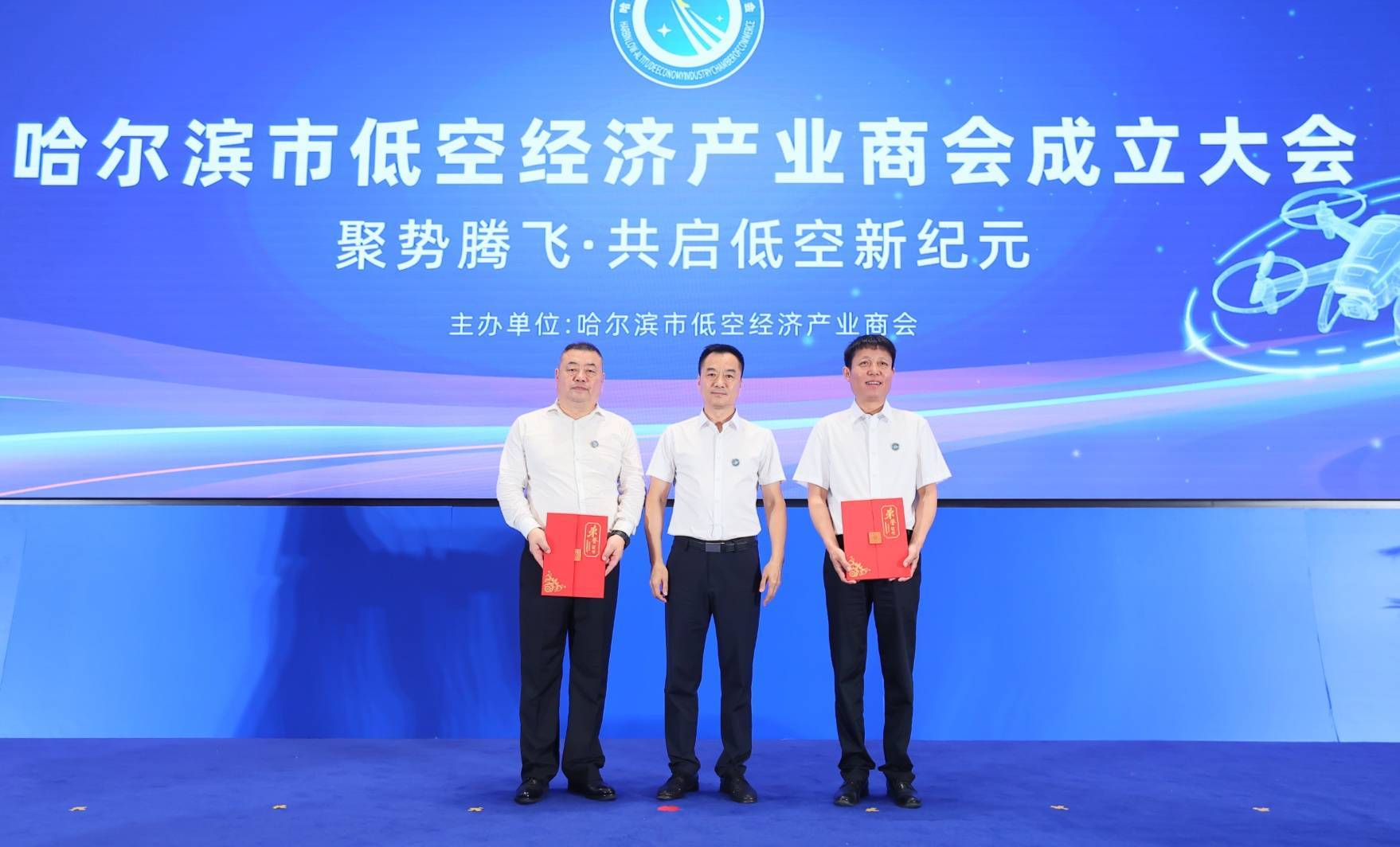
哈尔滨市低空经济产业商会成立大会在哈尔滨召开
Sou Hu Cai Jing· 2025-08-24 23:39
Core Viewpoint - The establishment of the Harbin Low Altitude Economy Industry Association marks a significant milestone in the development of low altitude economy in Harbin, indicating a new phase characterized by organization, planning, and leadership, which is crucial for building a modern transportation system and fostering new economic growth [1][2] Group 1 - The founding conference attracted over 500 participants from various sectors including enterprises, research institutions, financial organizations, government representatives, and experts, highlighting the historical importance of the event [1] - The association aims to create a high-end platform that integrates government, industry, academia, research, and application, breaking down industry barriers and fostering collaboration [2] - The low altitude economy is identified as a strategic emerging industry with a market potential in the trillion-level range, emphasizing its significance for future economic development [2] Group 2 - The first batch of member units of the association covers the entire industry chain, including manufacturing, flight control systems, power systems, sensors, operational services, airport construction, data platforms, and investment financing, indicating the formation of a collaborative and mutually beneficial low altitude economic ecosystem [6] - The deepening of low altitude airspace management reforms and the maturation of technology will enable the low altitude economy to play an irreplaceable role in various sectors such as emergency rescue, agricultural protection, tourism, urban management, and logistics, contributing to high-quality economic and social development [8]
首批21个跨区域质量强链联动项目发布
Zheng Quan Ri Bao· 2025-08-24 15:45
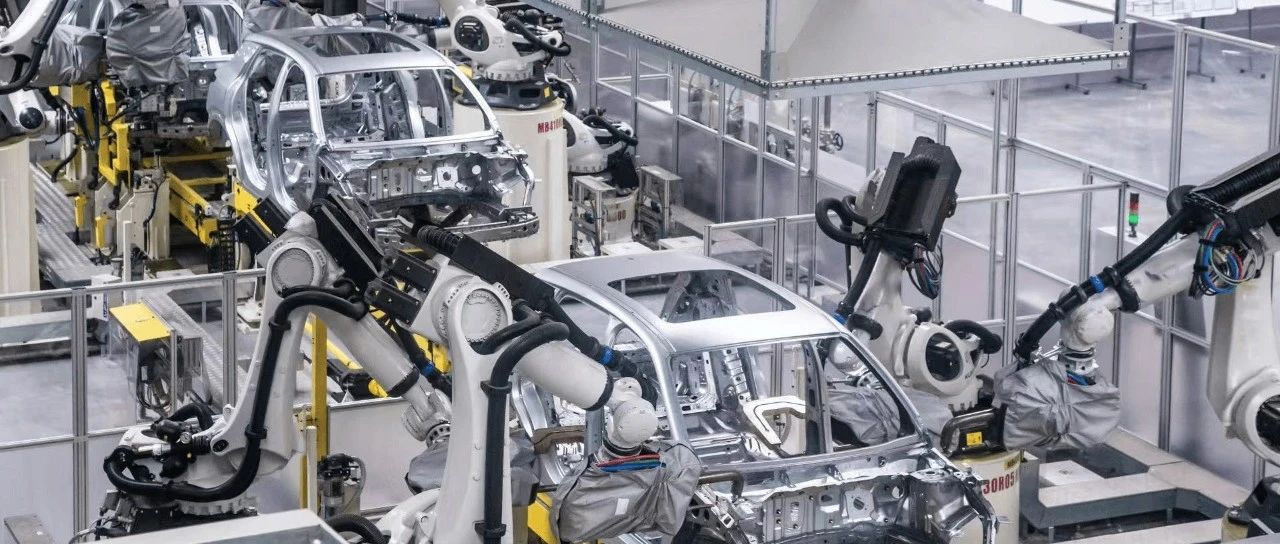
Core Viewpoint - The release of the first batch of 21 cross-regional quality strong chain projects aims to enhance quality cooperation and support across various industries, including both emerging and traditional sectors, thereby improving the resilience and safety of industrial chains [1][2][3] Group 1: Emerging and Traditional Industries - The cross-regional projects encompass both emerging industries such as robotics, brain-computer interfaces, low-altitude economy, and commercial aerospace, as well as traditional industries like textiles, engineering machinery, and coal chemical [1] - Experts believe that the implementation of these projects will help break through key technological bottlenecks in the industrial chain, facilitating the industrialization of technological achievements and expanding application scenarios [2] Group 2: Quality Improvement and Economic Development - The quality strong chain initiative is seen as essential for accelerating the development of new productive forces and is a key measure to enhance domestic circulation and meet the high-quality living needs of the population [2] - The projects aim to introduce new technologies and models to improve product and service quality in traditional industries, thereby achieving a transformation of old and new driving forces [2] Group 3: Collaboration and Coordination - It is recommended that involved regions and departments establish a regular communication mechanism to enhance coordination, integrate quality technology innovation resources, and promote policy linkage and resource sharing [3] - Companies are encouraged to strengthen collaboration with universities and research institutions to address quality bottlenecks and create more significant breakthroughs [3]
创投基金“快人一步”靠什么
Zheng Quan Ri Bao· 2025-08-24 15:41
Group 1 - The core viewpoint of the article emphasizes the crucial role of venture capital funds in supporting emerging industries, particularly in the robotics sector, by providing early-stage investments that enable companies to lead in innovation [1][2] - Venture capital funds are recognized as the "starting point" for capital markets to serve technological innovation, with policies encouraging them to invest early, small, long-term, and in hard technology [2][3] - The systematic policy guidance creates a virtuous cycle that injects stable capital into technological innovation, facilitating a collaborative development ecosystem for "technology research and development - capital empowerment - industrial upgrading" [2][4] Group 2 - Venture capital funds are characterized by a high-risk appetite, willing to "test and learn" during the nascent stages of emerging industries, which allows them to calibrate the value of different sectors and seek excess returns [3][4] - The funds employ a professional risk assessment system and scientific valuation methods, diversifying investments across multiple sectors to mitigate risks associated with individual projects [3][4] - The low cost and long-term nature of venture capital funding provide essential support for the sustainable operation of technology-driven enterprises, aligning well with their funding needs [4][5] Group 3 - The iterative process of "testing - summarizing - correcting" enables venture capital funds to act as "pathfinders," discovering and nurturing high-quality companies while accelerating the growth of emerging industries through technological innovation [5]
低空行业周报(8月第3周):低位静待催化,关注基建+无人机-20250824
Huafu Securities· 2025-08-24 13:31
Investment Rating - The industry rating is "Outperform the Market" indicating that the overall return of the industry is expected to exceed the market benchmark index by more than 5% in the next 6 to 12 months [53]. Core Insights - The low-altitude economy index increased by 3.97% during the week of August 18-22, outperforming the overall market, which saw the Shanghai Composite Index rise by 3.49% [15][27]. - The report highlights that the low-altitude sector is currently in a position of waiting for catalysts, with infrastructure development and drone applications being key focus areas for future growth [5][30]. - The establishment of a leadership group by the Civil Aviation Administration of China for general aviation and low-altitude economy is expected to bring favorable policies in the second half of the year [29][30]. Summary by Sections Market Review - The low-altitude economy index ranked 147 out of 330 sectors, indicating a relatively strong performance compared to the overall market [15][27]. - The top five gainers in the A-share and Hong Kong stock markets included Aerospace Hongtu (+16.89%) and Changyuan Donggu (+15.33%), while the biggest losers included Lais Information (-6.97%) and Xicai Testing (-5.71%) [3][18]. Industry Dynamics - The report notes significant growth in the manufacturing of intelligent unmanned aerial vehicles, with an 80.8% increase in production for July [33]. - Various local governments are actively working on practical measures such as airspace division and low-altitude flight management, which are expected to support the industry's development [35][36]. Investment Strategy - The report suggests focusing on infrastructure companies such as Suzhou Planning and Lais Information, as well as drone-related companies like Guoan Da and Henghe Precision [32][31]. - The low-altitude industry is seen as having the potential for rebound, especially with the ongoing developments in infrastructure and drone applications [30][29].
一个大学专业爆红
投资界· 2025-08-23 08:04
Core Viewpoint - The rapid expansion of China's low-altitude economy market has triggered a competition for "high-end" talent, with educational institutions responding by adding relevant programs to meet industry demands [6][8]. Summary by Sections Talent Competition - The Ministry of Education announced the addition of 239 undergraduate programs for 2025, with 120 focused on "Low Altitude Technology and Engineering," indicating a strong emphasis on low-altitude economy-related fields [6][7]. - Six universities, including Beijing University of Aeronautics and Astronautics, have been designated to lead the development of low-altitude economy disciplines, reflecting their existing strengths in aerospace and communication technologies [7][8]. Market and Policy Drivers - The low-altitude economy is becoming a favored area for academic program adjustments, driven by national policies and market demand, particularly in logistics, tourism, and emergency rescue sectors [8][9]. - By the end of 2024, the number of low-altitude economy enterprises in China is projected to reach 14,707, a year-on-year increase of 19.8%, significantly higher than the previous three-year average growth rate of 9.1% [8][9]. Regional Landscape - The competition in the low-altitude economy is not only about industry chains but also about talent, with various provinces actively establishing related programs [11][16]. - Sichuan leads with 14 low-altitude economy-related programs, followed by Jiangsu (11), Beijing (10), and Guangdong (10) [11][17]. - Major cities like Beijing and Chengdu are at the forefront, each with 10 programs, while cities like Nanjing and Guangzhou are also expanding their offerings [13][17]. Industry-Academia Collaboration - Despite a foundational talent pool, there is a significant talent shortage in the low-altitude economy, necessitating a shift towards more specialized and interdisciplinary training [19][20]. - Leading companies in the low-altitude economy are increasingly partnering with universities to enhance talent development through collaborative programs [19][20]. - The collaboration aims to align academic training with market needs, ensuring that educational institutions remain relevant and effective in producing qualified professionals [20].

成都:1-7月新能源汽车产量增长326.2%|首席资讯日报
首席商业评论· 2025-08-23 04:48
Group 1 - Chengdu's new energy vehicle production increased by 326.2% from January to July this year, with overall industrial added value growing by 8.0% and fixed asset investment rising by 4.5% [2] - The automotive manufacturing industry in Chengdu saw a growth of 22.9%, while the production of lithium-ion batteries increased by 41.4% [2] Group 2 - Elon Musk attempted to persuade Mark Zuckerberg to participate in an informal acquisition offer for OpenAI, but Zuckerberg and Meta did not sign any letter of intent [3] - OpenAI's board formally rejected Musk's acquisition offer in February [3] Group 3 - During the "14th Five-Year Plan" period, national market regulatory authorities handled 89.03 million complaints and recovered economic losses of 21.71 billion yuan for consumers [4] - Consumer complaints received by national consumer associations totaled 5.75 million, recovering 5.78 billion yuan in losses [4] Group 4 - The summer box office in 2025 surpassed 10.5 billion yuan as of August 22 [5] Group 5 - Citic Securities estimates that over 90 trillion yuan in deposits will mature in 2025, with 4.5 to 9 trillion yuan potentially seeking higher returns, likely flowing into "fixed income+" products rather than directly into equity markets [6] Group 6 - The low-altitude tourism market in Shenzhen has seen a 30% increase in flight orders compared to last year, with family bookings making up 60% of the total [7] - Educational low-altitude tourism activities for students are also experiencing significant growth, providing insights into the low-altitude economy [7] Group 7 - Since the beginning of the "14th Five-Year Plan," China has seen a net increase of 19.99 million enterprises and 33.94 million individual businesses [8] Group 8 - The African smartphone market grew by 7% year-on-year in Q2 2025, with shipments reaching 19.2 million units, driven by improved purchasing power in key markets like Egypt, Nigeria, and South Africa [9] - The market is expected to maintain a compound annual growth rate (CAGR) of 2.1% from 2025 to 2029 [9] Group 9 - Tianfeng Securities predicts that the overall electricity price level for coal-fired power plants in Guangdong will remain relatively stable in 2026, with limited downward space due to the near-bottom trading prices [10] Group 10 - The China Consumers Association reported a doubling of complaints related to concert ticket refunds in the first half of 2025, with over 90% of these complaints concerning refund requests [11] - Recommendations include establishing a tiered refund standard similar to those in the railway and aviation sectors [11] Group 11 - Google's report on its Gemini model indicates that each query consumes approximately 0.24 watt-hours of energy, equivalent to running a microwave for one second [12] Group 12 - Many cities have seen land plots being "re-planned and re-sold," increasing the proportion of residential land and boosting the enthusiasm of real estate companies for land acquisition [13][14]
市场监管总局发布首批21个跨区域质量强链联动项目
Xin Lang Cai Jing· 2025-08-22 23:29
Core Viewpoint - The State Administration for Market Regulation has officially launched the first batch of 21 cross-regional quality strong chain linkage projects to enhance the resilience and safety of industrial and supply chains [1] Group 1: Project Overview - The 21 cross-regional quality strong chain linkage projects encompass both emerging industries such as robotics, brain-computer interfaces, low-altitude economy, and commercial aerospace, as well as traditional industries like textiles, engineering machinery, and coal chemical [1] - The projects aim to promote cross-regional collaboration in industrial chain supply division, addressing quality issues through targeted cooperation [1] Group 2: Implementation and Goals - The State Administration for Market Regulation has instructed leading provinces of each project to strengthen coordination and promote a series of "small but beautiful" quality collaborations [1] - The initiative focuses on solving specific quality problems, breaking through key common quality bottlenecks, and achieving significant landmark breakthroughs in quality [1]
120所高校拟增设低空技术与工程专业 培养低空经济人才
Yang Guang Wang· 2025-08-22 16:39
Core Viewpoint - The Ministry of Education has announced the addition of the low-altitude technology and engineering major in 2025, reflecting the rapid growth of the low-altitude economy, which is expected to become a strategic emerging industry in China [1][5]. Group 1: Industry Overview - The low-altitude economy is defined as a comprehensive economic form that relies on low-altitude airspace and various manned and unmanned aircraft for diverse low-altitude flight activities [1]. - The market size of China's low-altitude economy is projected to reach 1.5 trillion yuan by 2025 and 3.5 trillion yuan by 2035, indicating a significant growth trend and strong employment demand [3]. Group 2: Educational Initiatives - A total of 120 universities are planning to add the low-altitude technology and engineering major, with six universities already offering it [1]. - Universities like Anhui University and Nanjing University of Posts and Telecommunications are focusing on training talents in low-altitude communication networks and integrating their existing strengths in electronic and communication engineering [2][4]. Group 3: Talent Demand and Industry Needs - There is a high demand for professionals who understand both technology and air traffic planning, as the low-altitude economy requires interdisciplinary knowledge [3][4]. - The expansion of the low-altitude technology and engineering major is seen as a response to the strategic direction of the country, the need for industrial upgrades, and educational reforms [5]. Group 4: Recommendations for Educational Institutions - Educational institutions are advised to tailor their talent training programs to local industry needs, focusing on specific areas such as electric aircraft technology and operational economics [4][5]. - The establishment of a closed-loop ecosystem involving technology research, talent training, and practical application is essential for the sustainable development of the low-altitude economy [5].