
天然气

Search documents
陕天然气:LNG业务盈利波动但对整体收益影响有限
Sou Hu Cai Jing· 2025-11-13 07:49
Core Viewpoint - The company acknowledges the potential decline in international LNG prices due to increasing LNG production capacity, but emphasizes that the impact on overall revenue and profit will be limited [1] Group 1: Company Response to Investor Concerns - The company recognizes that LNG business profitability is influenced by market price fluctuations and demand conditions, leading to certain volatility in earnings [1] - The company plans to focus on cost reduction and precise management to enhance profitability, despite the challenges posed by market conditions [1] - Measures include reducing costs in production and minimizing non-production expenditures to ensure a hard decline in costs and expenses [1]

专题报告:中国天然气进出口格局
Guang Fa Qi Huo· 2025-11-13 07:45
Report Industry Investment Rating No relevant content provided. Core Viewpoints of the Report - China has a large natural gas supply gap, making it a major importer with an import dependency of 40% - 44% in recent years. The import volume far exceeds the export volume, but both show an overall increasing trend. The import forms are pipeline gas and liquefied natural gas (LNG), with the LNG import volume growing faster and exceeding the pipeline gas volume since 2017 [1][6]. - The export volume of natural gas in China is much lower than the import volume, but it shows an overall increasing trend. Pipeline gas is the main form of export, and the export destinations are Hong Kong and Macau. The export of LNG started in 2018, driven by domestic supply - demand conditions and international market premiums [7]. - The import volume of China's pipeline gas has increased steadily, and the import price may be highly correlated with international oil prices. The import sources are mainly from Russia and Turkmenistan. The LNG import volume has grown rapidly, with diversified sources and long - term contracts accounting for a large proportion [2][17]. Summary by Relevant Catalogs 1. China's Basic Situation of Natural Gas Import and Export - Supply gap: In 2015, the domestic natural gas supply gap was 663 billion cubic meters, and it expanded to 1768 billion cubic meters in 2024, driving up the import demand [6]. - Import volume: From 2015 to 2024, the import volume increased from 611 billion cubic meters to 1817 billion cubic meters, with a compound growth rate of 11.5%. In 2024, the main import sources were Russia, Australia, Turkmenistan, Qatar, and Malaysia, accounting for 81% of the total import volume [6]. - Import dependency: Since 2018, the import dependency has been in the range of 40% - 44% [6]. - Export volume: From 2015 to 2024, the export volume increased from 33 billion cubic meters to 60 billion cubic meters, with a compound growth rate of 6.2%. The export is mainly pipeline gas, and the export destinations are Hong Kong and Macau. The export of LNG started in 2018, and it is expected to grow in the long - term [7]. 2. The Full Operation of Three Existing On - shore Import Channels and the Steady Growth of China's Pipeline Gas Import Volume - Import volume growth: From 2015 to 2024, the import volume increased from 2468 thousand tons to 5369 thousand tons, with a compound growth rate of 8.1% [2][11]. - Import sources: The import countries are Turkmenistan, Uzbekistan, Kazakhstan, Myanmar, and Russia. In 2024, the import amounts from Turkmenistan and Russia were 9.57 billion and 8.04 billion US dollars respectively, accounting for 83.5% of the total import amount [11]. - Import pipelines: There are three import pipelines: the Central Asian Gas Pipeline, the China - Myanmar Gas Pipeline, and the Eastern Route of the China - Russia Gas Pipeline. The Central Asian Gas Pipeline has four lines (ABC are in operation, D is under construction), the China - Myanmar Gas Pipeline enhances the energy security of south - western China, and the Eastern Route of the China - Russia Gas Pipeline improves the gas supply in the northeast and east of China and optimizes the import structure [12][13][16]. - Price: The import price of pipeline gas may be highly correlated with international oil prices, with a lag of about 6 months and a correlation coefficient of 0.93 [17]. 3. Diverse Sources and Long - term Contracts Dominating: China Becomes the World's Largest LNG Importer - Import volume growth: From 2006 to 2024, the import volume increased from 68,800 tons to 7,664,900 tons, with a compound growth rate of 29.9%. It can be divided into two stages: high - speed growth from 2006 - 2021 and a significant slowdown from 2022 - 2025 [21]. - Import sources: The sources are diverse, with more than 15 countries. The main sources are Australia, Qatar, Russia, Malaysia, the United States, and Indonesia, accounting for 89% of the total import volume in 2024. The import volume from different countries shows different trends [22]. - Import structure: Long - term contracts dominate, accounting for 87.4% of the total LNG import volume in 2024. More domestic procurement units are participating in international LNG procurement, and state - owned enterprises have signed a large number of long - term contracts after the Russia - Ukraine conflict [23].
国际能源署:全球约7.3亿人仍无法获电力供应
中国能源报· 2025-11-13 07:04
Core Insights - The International Energy Agency (IEA) released the "World Energy Outlook 2025" report, highlighting that approximately 730 million people globally still lack access to electricity and that climate risks are intensifying [1] - The report indicates that global targets for energy accessibility and climate change response have not been met, but achieving net-zero emissions by mid-century could help limit long-term temperature rise to within 1.5 degrees Celsius [1] Energy Demand Trends - The report forecasts that electricity demand will grow at a rate significantly faster than overall energy consumption, driven primarily by data centers and artificial intelligence, particularly in developed economies and China [1] - Renewable energy, especially solar photovoltaic, is expected to see the fastest growth in demand, with China maintaining its position as the largest renewable energy market globally [1] Nuclear and Fossil Fuels Outlook - A revival in nuclear energy is anticipated, with global nuclear power capacity expected to increase by at least one-third by 2035 [1] - In the short term, global oil and natural gas supplies are projected to be generally sufficient, although geopolitical risks remain a concern [1] Recommendations for Future Energy Strategy - The IEA urges countries to accelerate the diversification of energy structures and deepen international cooperation to address future uncertainties and risks [1]


中辉能化观点-20251113
Zhong Hui Qi Huo· 2025-11-13 02:30
Report Industry Investment Ratings - Crude oil: Cautiously bearish [2] - LPG: Cautiously bearish [2] - L: Bearish continuation [2] - PP: Bearish continuation [2] - PVC: Bearish continuation [2] - PX: Cautiously bullish [2] - PTA: Cautiously bullish [4] - Ethylene glycol: Cautiously bearish [4] - Methanol: Sideways at the bottom [4] - Urea: Short on rallies [4] - Natural gas: Cautiously bullish [7] - Asphalt: Cautiously bearish [7] - Glass: Bearish continuation [7] - Soda ash: Bearish rebound [7] Core Views - Crude oil: The oversupply in the off - season remains the core driver, and the upside of oil prices is under pressure. OPEC's latest monthly report predicts an oversupply in 2026, and OPEC+ plans to expand production in December and then pause in early next year. With the start of the consumption off - season and OPEC+ still in the expansion cycle, the pressure of oversupply is rising, and oil prices face significant downward pressure [2]. - LPG: Weak oil prices bring negative impacts to the cost side, and the trend of LPG is weak. Although the supply - demand fundamentals have improved, the cost - side pressure restricts its upward movement [2]. - L: The decline in oil prices and the restart of devices may cause the market to continue to bottom. The supply is loose, and the demand for replenishing inventory is insufficient, with weak cost support [2]. - PP: The sharp decline in coking coal and the weak cost side lead to a weak fundamental situation. There is high pressure to destock, and oil prices still face the risk of further decline in the medium term [2]. - PVC: The market follows coking coal to find the bottom. Although the inventory is high, the low - valuation support limits the further decline space. The market maintains a high premium, and industries are advised to hedge at high prices [2]. - PX: The supply - side devices have increased their loads, and the demand has improved recently but is expected to weaken. The PXN and PX - MX spreads are relatively high, and the crude oil supply - demand pattern is loose. It is recommended to be cautious when chasing up [2]. - PTA: The processing fee is generally low, and the planned device maintenance may relieve the supply - side pressure. The terminal demand has slightly improved, but the rebound height may be limited due to the pressure on crude oil [4]. - Ethylene glycol: Domestic device maintenance has increased, and new device production and the resumption of maintenance devices will increase supply pressure. The demand has improved but is expected to weaken, and there is an expectation of inventory accumulation in November. It has low valuation but lacks upward drivers [4]. - Methanol: High inventory suppresses the rebound of prices. The supply - side pressure is still large, and the demand performance is average. The cost - side support is weak and stable, and the overall fundamentals remain weak [4]. - Urea: The supply - side pressure is expected to increase, and the demand has slightly improved. The inventory in factories is accumulating, and under the background of "export quota system" and "ensuring supply and stabilizing prices", the market has a ceiling and a floor. It is necessary to be vigilant against the downward risk [4]. - Natural gas: As the temperature drops, the consumption peak season arrives, and the demand has a warming expectation, making gas prices likely to rise and difficult to fall [7]. - Asphalt: The cost - side oil price has回调ed, and the supply - demand fundamentals are loose. The demand has entered the off - season, and the valuation is high. The price center still has room to move down [7]. - Glass: The fundamentals are weak, and the market continues to look for support downward. The supply is unlikely to decline further, and the demand support is insufficient [7]. - Soda ash: The increase in photovoltaic daily melting volume and device maintenance has led to a short - term rebound. However, in the long - term, the supply will remain loose [7]. Summaries by Related Catalogs Crude Oil - **Market Review**: Overnight international oil prices dropped significantly. WTI rose 1.43%, Brent rose 1.72%, and SC fell 0.17% [9]. - **Basic Logic**: The core driver is the oversupply in the off - season, and the short - term driver is OPEC's prediction of oversupply in 2026. OPEC predicts an increase of 600,000 barrels per day in non - OPEC production in 2026, and the global demand increments in 2025 and 2026 are 1.3 million barrels per day and 1.38 million barrels per day respectively. As of the week ending October 31, US crude oil inventory increased by 5.2 million barrels, gasoline inventory decreased by 4.7 million barrels, distillate inventory decreased by 643,000 barrels, and strategic crude oil reserve increased by 5.924 million barrels per day [10][11]. - **Strategy Recommendation**: In the medium - to - long - term, OPEC+ is expanding production, and oil prices are in a low - price range. Technically, although the short - term trend is strong, the upward pressure is increasing. It is recommended to partially take profits on previous short positions. Pay attention to the range of [460 - 475] for SC [12]. LPG - **Market Review**: On November 12, the PG main contract closed at 4,349 yuan/ton, up 0.39% month - on - month. Spot prices in Shandong, East China, and South China showed different changes [14]. - **Basic Logic**: The trend is tied to the cost - side oil price, which is weak. The supply has decreased slightly, and the demand has shown some resilience. The inventory in ports and factories has declined, and the import profit has increased, with expected higher future imports [15]. - **Strategy Recommendation**: In the medium - to - long - term, the upstream crude oil supply exceeds demand, and the central price is expected to decline. The current ratio of LPG to crude oil is similar to that of the same period last year, with a low basis and high valuation. It is recommended to hold short positions and pay attention to the range of [4300 - 4400] for PG [16]. L - **Market Review**: The L2601 contract closed at 6,788 yuan/ton, up 28 yuan. The basis and other indicators also had corresponding changes [19]. - **Basic Logic**: The sharp decline in oil prices and the restart of devices may cause the market to continue to bottom. The supply is loose, and the demand for replenishing inventory is insufficient. The oil price still has a downward risk in the medium term, with weak cost support [20]. - **Strategy Recommendation**: At the absolute low price, partially reduce short positions. In the medium - to - long - term, wait for rebounds to go short. Pay attention to the range of [6700 - 6850] for L [20]. PP - **Market Review**: The PP2601 contract closed at 6,429 yuan/ton, down 51 yuan. The basis and other indicators changed accordingly [23]. - **Basic Logic**: The sharp decline in coking coal leads to a weak fundamental situation. The inventory in the upper and middle reaches is at a high level, and the demand support is insufficient. OPEC+ is still in the production - increasing cycle, and oil prices face the risk of further decline in the medium term [24]. - **Strategy Recommendation**: At the absolute low price, short - term decline stops, and short positions can be reduced. In the medium - to - long - term, wait for rebounds to go short. Pay attention to the range of [6350 - 6500] for PP [24]. PVC - **Market Review**: The V2601 contract closed at 4,572 yuan/ton, down 42 yuan. The basis and other indicators changed [27]. - **Basic Logic**: The market follows coking coal to find the bottom. The basis is strengthening, and the warehouse receipts are decreasing from a high level. In the short - term, during the macro - policy window period, the market returns to weak fundamentals. Although the inventory is high, the low - valuation support limits the further decline space [28]. - **Strategy Recommendation**: The market maintains a high premium. Industries are advised to hedge at high prices. Be cautious when chasing short due to low - valuation support. Pay attention to the range of [4500 - 4650] for V [28]. PX - **Basic Logic**: The supply - side devices at home and abroad have increased their loads. The PXN and PX - MX spreads are at relatively high levels this year. The demand has improved recently but is expected to weaken. The crude oil supply - demand pattern is loose, and PX follows the cost in the short term [29]. - **Strategy Recommendation**: Be cautious when chasing up on a single - side trade. For arbitrage, pay attention to expanding the downstream processing margin (i.e., go long on PTA and short on PX). Pay attention to the range of [6680 - 6770] for PX [30]. PTA - **Market Review**: The prices of TA contracts and spot prices, as well as basis, spreads, and other indicators, showed corresponding changes [31]. - **Basic Logic**: The processing fee is low, and the planned device maintenance may relieve the supply - side pressure. The terminal demand has slightly improved, but the stability needs to be tracked. There is an expectation of inventory accumulation in November. Although the fundamentals have improved in the short term, the upward space is limited due to the pressure on crude oil [32]. - **Strategy Recommendation**: On a single - side trade, look for opportunities to go long on dips. For arbitrage, pay attention to expanding the TA processing margin (i.e., go long on PTA and short on PX). Pay attention to the range of [4600 - 4670] for TA [33]. Ethylene Glycol - **Market Review**: The prices of EG contracts and spot prices, as well as basis, spreads, and other indicators, changed [34]. - **Basic Logic**: Domestic device maintenance has increased, and new device production and the resumption of maintenance devices will increase supply pressure. The demand has improved but is expected to weaken. There is an expectation of inventory accumulation in November. The valuation is low, but it lacks upward drivers and follows the cost in the short term [35]. - **Strategy Recommendation**: It is in a low - level oscillation. Look for opportunities to go short on rebounds. Pay attention to the range of [3835 - 3900] for EG [36]. Methanol - **Basic Logic**: High inventory suppresses the rebound of prices. The supply - side pressure is still large, and the demand performance is average. The cost - side support is weak and stable, and the overall fundamentals remain weak [39]. - **Strategy Recommendation**: It is in a weak sideways trend. Hold short positions cautiously at low valuations. For arbitrage, pay attention to the MA1 - 3 reverse spread [4]. Urea - **Market Review**: The prices of urea contracts and spot prices, as well as basis, spreads, and other indicators, changed [42]. - **Basic Logic**: The supply - side pressure is expected to increase, and the demand has slightly improved. The inventory in factories is accumulating, and under the background of "export quota system" and "ensuring supply and stabilizing prices", the market has a ceiling and a floor. There are short - term positive factors, but be vigilant against the downward risk [43]. - **Strategy Recommendation**: Although the export boosts market sentiment, the fundamentals remain weak. Be vigilant against the risk of the market falling back after rising. Pay attention to the range of [1620 - 1650] for UR [44]. Natural Gas - **Market Review**: On November 12, the NG main contract closed at $4.764 per million British thermal units, up 4.47% month - on - month. Spot prices in different regions also changed [47]. - **Basic Logic**: The decline in global temperature leads to an increase in demand for combustion and heating, and the gas price is likely to rise. The domestic LNG retail profit has increased. The supply - side has some changes, and the demand has shown certain characteristics. The US natural gas inventory has increased [48]. - **Strategy Recommendation**: As the temperature cools down, the demand for combustion and heating increases, and the price is likely to rise. However, due to sufficient supply and recent sharp increases, the upward momentum has weakened, and the upward space is limited. Pay attention to the range of [4.415 - 4.581] for NG [49]. Asphalt - **Market Review**: On November 12, the BU main contract closed at 3,063 yuan/ton, up 0.43% month - on - month. Spot prices in different regions changed [52]. - **Basic Logic**: The trend is mainly tied to the cost - side oil price, which is weak. The cost - side support is decreasing. The supply in November is expected to decline, and the demand has also decreased. The inventory of sample enterprises has decreased [53]. - **Strategy Recommendation**: Hold short positions. [51] Glass - **Basic Logic**: The fundamentals are weak, and the market continues to look for support downward. The supply is unlikely to decline further, and the demand support is insufficient [7]. - **Strategy Recommendation**: In the short - term, there is support from cold repairs. In the medium - to - long - term, the demand from the real - estate sector is weak, and the loose pattern is difficult to change. Go short on rebounds [7]. Soda Ash - **Basic Logic**: The increase in photovoltaic daily melting volume and device maintenance has led to a short - term rebound. However, in the long - term, the supply will remain loose [7]. - **Strategy Recommendation**: The market maintains a premium structure. Industries are advised to sell and hedge at high prices. Technically, it is bullish in the short term, but go short on rebounds in the medium - to - long - term [7].
煤岩气开辟天然气增长新领域 全国探明地质储量超7000亿立方米
Xin Hua Cai Jing· 2025-11-13 02:26
Core Insights - The emergence of "coal-rock gas" as a new unconventional natural gas resource is highlighted as a significant development in China's natural gas production [1][2] - As of October 2025, China's proven geological reserves of coal-rock gas are expected to exceed 700 billion cubic meters [1] - The concept of coal-rock gas was officially introduced at the 43rd "Cambridge Energy Week" in March 2025, distinguishing it from traditional coalbed methane [1][2] Group 1: Definition and Characteristics - Coal-rock gas is characterized by the coexistence of free and adsorbed gas, with a higher content of free gas compared to traditional coalbed methane, which primarily exists in an adsorbed state [1] - The new concept of coal-rock gas (Coal-rock Gas, CRG) was proposed based on exploration and development practices, reflecting its unique characteristics that align more closely with shale gas [1][2] Group 2: Theoretical Framework - The development of coal-rock gas is supported by the "total oil and gas system" theory, which integrates conventional and unconventional oil and gas resources into a unified framework [2] - The "coal system total oil and gas system" proposed by scientists at the China Petroleum Exploration and Development Research Institute explains the coexistence of various gas reservoirs, including coal-rock gas, coalbed methane, tight gas, and shale gas [2] Group 3: Exploration and Development Progress - China's coal-rock gas exploration has shown a trend of "multiple breakthroughs and rapid growth," with geological resource potential estimated at 50 trillion cubic meters [2] - Significant achievements have been made in the Ordos Basin, including the discovery of three large gas fields with geological reserves exceeding 500 billion cubic meters and the establishment of the first million-ton deep coal-rock gas field, the Daji Coal-rock Gas Field [2] Group 4: Production Forecast - National coal-rock gas production is projected to reach 2.7 billion cubic meters in 2024, with expectations to exceed 4 billion cubic meters in 2025 [3] - By 2035, China aims to establish a production capacity of over 30 billion cubic meters of coal-rock gas, with potential for further discoveries of condensate oil and gas reservoirs [3]

内蒙古:将包头市建设成为全国最大的稀土新材料基地和全球领先的稀土应用基地
Zheng Quan Shi Bao Wang· 2025-11-13 01:44
Core Viewpoint - The Inner Mongolia Autonomous Region government has issued a planning outline for the comprehensive promotion of the "Beautiful Inner Mongolia" initiative, aiming to strengthen China's northern ecological security barrier through sustainable mineral resource management and development [1] Group 1: Mineral Resource Management - The plan emphasizes the protection and comprehensive utilization of mineral resources, promoting green exploration and intensive development [1] - A new round of strategic mineral resource exploration initiatives will be implemented to achieve breakthroughs in resource discovery [1] - The structure and spatial layout of mineral resource development and utilization are expected to be fully optimized by 2035, enhancing resource utilization efficiency [1] Group 2: Rare Earth Materials Development - The development of high-end rare earth functional materials is prioritized, with the goal of establishing Baotou City as the largest rare earth new materials base in the country and a global leader in rare earth applications [1] Group 3: Natural Gas and Waste Utilization - Increased exploration efforts for unconventional natural gas will be undertaken [1] - The plan includes steady progress in the extraction of valuable components from metal tailings and the standardized utilization of remaining waste after extraction [1]
国家发展改革委部署供暖季能源保供
Ren Min Ri Bao· 2025-11-12 22:10
(文章来源:人民日报) 近日,国家发展改革委组织召开2025—2026年供暖季能源保供视频会议,对供暖季能源保供工作进行安 排。会议要求,各地区、有关企业要准确把握供暖季能源保供面临的形势和困难挑战,切实把工作做实 做细做到位。 会议要求,稳定能源生产供应,抓好能源中长期合同履约,全力做好高峰期能源保供,重点保障民生采 暖用能,提升低温雨雪冰冻等灾害应对水平,做好安全生产工作。重点保障好北方集中供暖地区特别是 东北地区的用煤需求。确保煤电高峰出力,充分发挥气电、水电、抽水蓄能和电化学储能装机的顶峰保 供作用。发挥好储气库、LNG(液化天然气)储罐等调峰资源作用。 ...
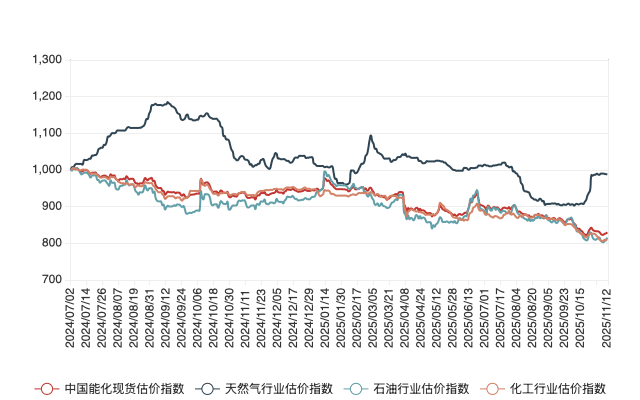
11月12日中国能化现货估价指数(CECSAI)较前一工作日上涨0.32%
Sou Hu Cai Jing· 2025-11-12 21:57
Core Insights - The China Energy and Chemical Spot Price Index reached 829.86 points as of November 12, 2025, reflecting an increase of 2.68 points or 0.32% from the previous day, but a decrease of 170.14 points or 17.01% from the base period of July 2, 2024 [1] Industry Summaries Oil Industry - The oil industry index reported at 815.66 points, with an increase of 6.16 points or 0.76% from the previous day [2] - The import price of crude oil at Shandong Port was 3724 yuan per ton, up from 3663 yuan, marking an increase of 61 yuan or 1.67% [8] - Gasoline prices in various regions showed slight increases, with North China at 7200 yuan per ton (up 25 yuan or 0.35%), Shandong at 7000 yuan (up 20 yuan or 0.29%), and East China at 7300 yuan (up 50 yuan or 0.69%) [8] Natural Gas Industry - The natural gas index stood at 987.77 points, experiencing a slight decline of 0.76 points or 0.08% from the previous day [3] - The price of LNG in Inner Mongolia was reported at 4415 yuan per ton, down 10 yuan or 0.23% [9] Chemical Industry - The chemical industry index was at 808.12 points, down 0.83 points or 0.1% from the previous day [4] - Prices for various chemical products showed mixed results, with propylene in Shandong remaining stable at 5765 yuan per ton, while ethylene glycol in Zhejiang decreased by 20 yuan or 0.50% to 3975 yuan [9][10] - The price of natural rubber in Qingdao was reported at 14575 yuan per ton, down 40 yuan or 0.27% [10] Market Context - The increase in the China Energy and Chemical Spot Price Index is attributed to uncertainties stemming from U.S. sanctions on Russian oil, which have led to rising international crude oil futures and subsequently increased domestic prices for refined oil and petrochemical products [7] - The index is developed by the Xinhua Index Research Institute, Jinlianchuang Network Technology Co., Ltd., and the China Price Association, monitoring 17 typical products in the oil and chemical industries across key regional markets [10]
受未来气温缓和预期影响 美国天然气期货回吐涨幅
Ge Long Hui A P P· 2025-11-12 15:03
Core Insights - The recent cold wave in the U.S. has led to a significant increase in natural gas consumption among residential and commercial sectors, resulting in a spike in prices [1] - Prior to the cold wave, daily consumption in these sectors ranged between 20 billion to 23 billion cubic feet, indicating a substantial jump in demand due to the weather event [1] - As a result of these developments, Nymex natural gas for December delivery fell by 1.4% to $4.503 per million British thermal units [1]
能源日报-20251112
Guo Tou Qi Huo· 2025-11-12 12:30
Report Industry Investment Ratings - Crude oil: ★★★ (indicating a more distinct upward trend and a relatively appropriate investment opportunity) [1] - Fuel oil: Not clearly defined by star rating in a standard way in the given context, but analysis provided [1][2] - Low - sulfur fuel oil: Not clearly defined by star rating in a standard way in the given context, but analysis provided [2] - Asphalt: Not clearly defined by star rating in a standard way in the given context, but analysis provided [1][3] - Liquefied petroleum gas: ★★★ (indicating a more distinct upward trend and a relatively appropriate investment opportunity) [1] Core View of the Report - The report analyzes the market trends and investment opportunities of various energy products including crude oil, fuel oil, low - sulfur fuel oil, asphalt, and liquefied petroleum gas. It provides insights into supply, demand, price movements, and suggests corresponding investment strategies based on different product fundamentals [2][3][4] Summary by Relevant Categories Crude Oil - Overnight international oil prices rebounded, with the SC12 contract rising 1.52% intraday. There is still downside potential for oil prices this year as the oil price spread and spot premium have weakened since November and the most relaxed balance sheet quarter (Q1 next year) is yet to come. However, short - term support exists due to the resolution of the US government shutdown and geopolitical concerns. Look for short - selling opportunities after the rebound [2] Fuel Oil & Low - sulfur Fuel Oil - High - sulfur fuel oil: Although supported by geopolitical situations, the increase in Middle - East high - sulfur supplies due to OPEC+ production increases and the entry into the off - season for Middle - East refining and power generation demand, along with the possible early issuance of 2026 crude oil quotas, will lead to a looser supply [2] - Low - sulfur fuel oil: Supply pressure has eased. There is uncertainty about the resumption of the Kuwait Azur refinery, and there are expectations of reduced low - sulfur arrivals in the Singapore market. The strong overseas diesel crack spreads support low - sulfur supply, and demand is also favorable. Consider gradually taking profits on the previous strategy of widening the high - low sulfur spread [2] Asphalt - The rebound in crude oil today drove asphalt to stop falling, with the 2601 contract rising 0.86%. The poor shipment volume not only disproves the "14th Five - Year Plan" end - of - term construction demand expectation but also signals that demand is lower than the same period last year. The slowdown in commercial inventory drawdown and the increase in the year - on - year difference in social inventory are negative factors for the asphalt market [3] Liquefied Petroleum Gas - The international liquefied gas market has been strong recently, with tight import supplies. The improvement in butane dehydrogenation device profitability has boosted downstream chemical enterprise operating rates, and the significant temperature drop in many places has increased combustion - end demand. With the decrease in refinery and port storage rates, LPG is expected to fluctuate strongly [4]