
Software

Search documents
The Great AI Squeeze: High Costs To Weight On Earnings Reports
See It Market· 2026-02-12 02:47
Group 1: AI Spending and Capital Expenditure - Alphabet reported record annual revenues exceeding $400 billion with a 48% surge in Google Cloud growth, but stock softened due to a 2026 capital expenditure forecast of up to $185 billion [1] - Amazon's Q4 results showed EPS of $1.95, slightly below expectations, and a boosted 2026 spending forecast to $200 billion, leading to a 7% drop in stock [1] - Wall Street is concerned that aggressive spending on data centers and compute capacity may be cannibalizing free cash flow faster than new returns can be generated [1] Group 2: Software Sector Concerns - A sell-off in the software sector, led by Salesforce and Adobe, was triggered by fears that AI could replace traditional Software-as-a-Service (SaaS) models [2] - New AI agents and vertical automation tools are raising concerns about the sustainability of traditional SaaS models [2] Group 3: Supply Chain and Hardware Costs - Qualcomm issued a warning about rising memory chip costs, echoing concerns from Apple regarding the impact of these costs on margins [3] - The AI infrastructure is consuming high-end memory supplies, affecting the broader hardware market [3] Group 4: Earnings Season Insights - As of now, 59% of S&P 500 companies have reported Q4 2025 earnings, showing profit growth of 13% and revenue growth of 8.8% [4] - Upcoming reports from Cisco and Applied Materials will be critical to assess if capital is flowing into hardware orders or if rising memory costs are impacting margins [4] Group 5: Market Reactions and Future Outlook - The software replacement panic is expected to influence upcoming earnings reports from Shopify and Cloudflare, with traders looking for signs that AI is a growth driver rather than a threat [5] - Consumer giants like McDonald's and Coca-Cola will provide insights into the health of American consumers, with mixed signals from previous reports [6] Group 6: Broader Market Implications - The upcoming earnings reports will serve as a reality check for the market's high valuations, with a focus on whether growth is spreading across sectors [13] - Investors are particularly interested in how supply chain issues and rising costs are affecting companies like Ford and their EV margins [11]




DeepSeek概念股集体上涨,首都在线涨超11%
Ge Long Hui· 2026-02-12 02:37
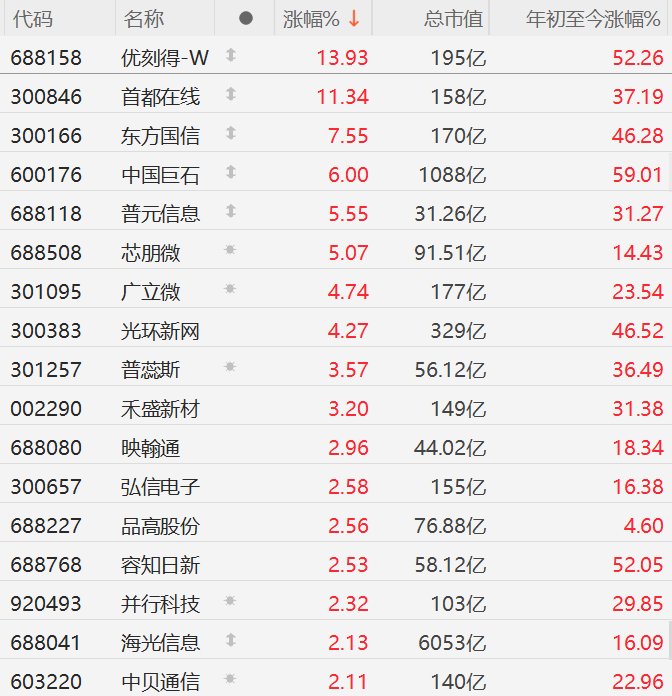
Group 1 - The A-share market saw a collective rise in DeepSeek concept stocks, with notable increases in shares such as Youkede-W up nearly 14% and Shoudu Online up over 11% [1] - DeepSeek updated its model, with user feedback indicating enhancements in both web and app versions, now supporting a maximum context length of 1 million tokens, an increase from the previous version's 128K tokens released in August last year [1] Group 2 - Specific stock performance includes Youkede-W with a market cap of 19.5 billion and a year-to-date increase of 52.26%, Shoudu Online with a market cap of 15.8 billion and a year-to-date increase of 37.19%, and Dongfang Guoxin with a market cap of 17 billion and a year-to-date increase of 46.28% [2] - Other notable stocks include China Jushi with a market cap of 108.8 billion and a year-to-date increase of 59.01%, and Puyuan Information with a market cap of 3.126 billion and a year-to-date increase of 31.27% [2]



大涨3%,节前AI主线领涨A股!“AI双子星”159363、589520携手齐舞
Mei Ri Jing Ji Xin Wen· 2026-02-12 02:18
科创人工智能ETF华宝(589520)及其联接基金(024560)重点布局国产AI产业链,成份股囊括国产 GPU龙头(如寒武纪),国产ASIC龙头(如芯原股份)、AI应用龙头(如金山办公),半导体行业权 重占比近一半,具备较强进攻性;软件行业权重占比超三成,有望受益于AI应用补涨行情。同时,该 ETF是融资融券标的,是一键布局国产算力的高效工具。 (文章来源:每日经济新闻) 国联民生证券表示,持续看好AI投资机会,从四维度验证行业高景气:①科技巨头资本开支增长; ②AI助手Clawdbot验证AI从对话工具向执行者转型,边缘AI产品前景广阔;③算力基础设施供需紧张 持续,推动上游通胀,云厂涨价、H100租赁价格上行,存储板块或延续涨价态势;④AI已进入应用落 地、需求加速与产业链景气共振阶段,全面看多AI产业趋势。 当AI发展正从算力建设转向应用落地,一键布局"算力+AI应用"的创业板人工智能ETF(159363)及场 外联接(023407),更直接受益于AI技术商业化爆发的增长红利。从赛道看,创业板人工智能约六成 仓位布局算力(光模块龙头+IDC龙头),约四成仓位布局AI应用,不止是"算力"核心,也是真正的 ...
【广发宏观文永恒】技术浪潮驱动,产业范式重构:中长期宏观环境展望
郭磊宏观茶座· 2026-02-12 02:09
Core Viewpoint - Each technological revolution initially enhances production efficiency, subsequently leading to changes in economic structure, industry patterns, and asset allocation models. The driving force behind technology's evolution from inception to widespread adoption is not merely a breakthrough in a single technology, but rather the penetration, diffusion, and deep integration of new technologies within the economic system [1][13]. Group 1: Technological Revolution Phases - Since the Industrial Revolution, global economies experience a "great wave" driven by significant technological clusters approximately every 50-60 years, establishing a new "technology-economy paradigm" that optimizes production, organization, and management models [2][17]. - Each technological revolution can be divided into two main phases: the Installation Period and the Deployment Period. The Installation Period is characterized by infrastructure reconstruction, trial-and-error business models, and financial capital accumulation, further divided into the outbreak and frenzy stages. The Deployment Period features comprehensive technology dissemination and the establishment of economic paradigms, further divided into the synergy and maturity stages [2][17]. Group 2: Capital Forms and Their Roles - The "great wave" theory distinguishes between two forms of capital: financial capital and production capital. Financial capital is adept at trend identification, flexibility, speculation, and short-term profit orientation, while production capital focuses on industry realization, stability, path dependence, and long-term investment orientation. During the Installation Period of technological revolutions, financial capital typically takes the lead, while production capital assumes a dominant role during the Deployment Period [3][20]. Group 3: Economic Impacts of Technological Revolutions - In the Installation Period of a technological revolution, the overall economy may face pressure, and the differentiation between new and old industries may widen. New technologies are still in the nurturing phase and may not broadly stimulate related industries, employment, or productivity [5][29]. - During the Deployment Period, overall economic pressure is expected to ease, and the differentiation between new and old industries may narrow. New technologies become widely applied, leading to new products, business forms, and industries, which can create new employment forms [5][30]. Group 4: Global Dynamics and Catch-Up Opportunities - The "great wave" theory indicates that the Installation Period of each technological revolution provides critical catch-up windows for latecomer countries. Historical examples include Germany and the U.S. surpassing the U.K. before World War II, and the post-war rise of Japan and other economies [7][40]. - Latecomer countries can leverage their "latecomer advantage" by utilizing labor cost and technology transfer advantages to achieve leapfrog development, mastering key core technologies that drive the development of leading industries [7][40]. Group 5: Future Implications and Trends - The emergence of AI as the core technology of the sixth technological revolution is expected to enhance productivity across all sectors, breaking traditional growth bottlenecks. The scenario of AI's application is anticipated to evolve significantly, particularly in countries with favorable conditions for technology integration [10][12]. - The theory also suggests that macroeconomic policies should promote overall rebalancing, including actively expanding total demand and ensuring employment stability during the technological revolution's Installation Period [12][13].

Microsoft's Post-Earnings Share Sell-Off Creates Opportunity For Long-Term Investors
Seeking Alpha· 2026-02-12 02:05
Core Viewpoint - Microsoft Corporation (MSFT) shares have experienced pressure due to concerns about its competitive position in the AI sector, especially as peer hyperscalers are significantly increasing their capital budgets for the upcoming period [1]. Group 1: Company Performance - Microsoft has faced challenges in its stock performance over the past year, primarily linked to its positioning in the AI race [1]. Group 2: Industry Context - Peer hyperscalers are reporting substantial increases in their capital budgets, indicating a competitive landscape in the AI sector that may impact Microsoft's market position [1].

Apple Taps Brakes on Siri AI Overhaul
PYMNTS.com· 2026-02-12 02:00
Core Insights - Apple is delaying the launch of several new capabilities for its Siri virtual assistant, with expected features now pushed from March to May and September [2][6] Group 1: Siri Delays - Features such as Siri's ability to access personal data and perform multiple in-app actions in response to a single command are among those being delayed [2] - The delays are attributed to issues with Siri's processing of queries and response times during testing [6] Group 2: AI Leadership and Development - Apple has revamped its artificial intelligence leadership amid ongoing delays with Siri, aiming to improve its AI roadmap after a series of setbacks [7] - Previous reports highlighted the need to delay key features for iOS and iPadOS to avoid releasing unstable code and the challenges faced in developing next-generation Siri [7] Group 3: Product Strategy Adjustments - Apple has scaled back plans for an AI-based health coach, opting to integrate features into its Health app over time instead of launching a standalone product [8] - Additionally, the company has reduced manufacturing and marketing efforts for the Vision Pro headset due to weak sales, choosing not to expand its rollout in 2025 [8]


Wall Street ends muted after strong jobs data nibbles at Fed rate cut bets
The Economic Times· 2026-02-12 01:45
Economic Indicators - The U.S. job growth in January was much faster than expected, with the unemployment rate falling to 4.3% [1][10] - The probability of the Federal Reserve holding rates steady in June increased to 41% from 24.8% [2][10] Market Reactions - The S&P 500 and Nasdaq initially rose to their highest levels in over a week but gains subsided as traders adjusted their rate cut expectations [1][10] - Julia Hermann from New York Life Investments noted that the strong jobs report was interpreted positively, indicating the economy's resilience [2][3] Sector Performance - The technology sector showed mixed results, with the Philadelphia semiconductor index rising by 2.3%, while the S&P 500 software index fell by 2.6% [6][11] - Microsoft and Alphabet were significant decliners in the software sector, with losses of 2.2% and 2.4% respectively [6][11] Company-Specific Developments - Generac shares surged by 17.9% following strong fourth-quarter results, making it the biggest percentage gainer in the S&P 500 [7][11] - Humana shares dropped by 3.3% after forecasting 2026 profits below Wall Street estimates [8][11] - Moderna shares fell by 3.5% after the FDA decided not to review its influenza vaccine application [8][11] Market Statistics - The S&P 500 recorded 99 new 52-week highs and 24 new lows, while the Nasdaq Composite had 123 new highs and 232 new lows [9][11] - On U.S. exchanges, 20.86 billion shares changed hands, slightly above the 20.79 billion moving average for the last 20 sessions [9][11]

桌面级智能体“LobsterAI”发布
Huan Qiu Wang Zi Xun· 2026-02-12 01:45
Core Insights - The recent launch of "LobsterAI" by NetEase Youdao marks a significant advancement in personal assistant agents, showcasing capabilities that extend beyond simple interactions to complex task execution [1][2] Group 1: Product Features - "LobsterAI" integrates innovative features, combining autonomous cross-application task execution similar to "OpenClaw" with a graphical user interface akin to "Claude Cowork" [2] - The product aims to enhance user experience by offering long-term memory and scheduled task functionalities, allowing for a more personalized interaction [2] - Users can interact with "LobsterAI" through mobile and PC platforms, enabling remote engagement via applications like DingTalk and Feishu [2] Group 2: Functionality and Use Cases - "LobsterAI" can perform various tasks such as information retrieval, schedule management, and in-depth data analysis through conversational commands [2] - The agent supports a timed task mechanism, allowing users to automate daily tasks like collecting industry news [2] - It possesses long-context memory capabilities, enabling it to understand user preferences over multiple interactions for a more efficient experience [2] Group 3: Security Measures - To address concerns regarding automated operations, "LobsterAI" employs a strict "local-first" strategy, operating within a sandbox environment to prevent system file damage [3] - The system supports local data processing to mitigate risks of cloud data leakage [3]

CNBC Daily Open: Better-than-expected U.S. jobs report and AI fears spook markets
CNBC· 2026-02-12 01:45
Group 1: Job Market Insights - U.S. jobs grew by 130,000 in January, significantly exceeding expectations of 55,000 additions, and marking an increase from December's revised 48,000 [1][2] - The strong jobs report has reduced the likelihood of interest rate cuts by the Federal Reserve, negatively impacting market sentiment [2] - Job gains remain concentrated in health care-related sectors, raising concerns about employment opportunities for displaced and new workers [2] Group 2: Market Reactions - U.S. stocks fell, with the Dow ending a three-day winning streak following the jobs report [1] - AI-related fears have negatively affected stock markets, particularly impacting software companies like ServiceNow and Salesforce, which saw declines of more than 5% and over 4%, respectively [4] - Bitcoin is on track for a fourth consecutive week of losses, hovering around the $67,000 mark, indicating ongoing challenges in the crypto market [4] Group 3: Economic Context - The revised Bureau of Labor Statistics report indicates job gains last year were only 15,000, leading to a cautious approach from investors regarding the jobs market [3]


HubSpot Q4 Earnings Call Highlights
Yahoo Finance· 2026-02-12 01:39
HubSpot ended 2025 with more than 288,000 customers, adding 9,800 net new customers in Q4 and more than 40,000 during the year. Average subscription revenue per customer was $11,700 in Q4, up modestly year-over-year. Net revenue retention increased sequentially to 105% in Q4, while full-year net revenue retention was 103.5%, up from 101.8% in 2024.Profitability also improved. Rangan said operating margin was 22.6% in Q4 and 18.6% for the full year. Bueker, speaking to non-GAAP metrics, reported Q4 operating ...
