
自动驾驶

Search documents
科技股普涨;千问App下载量突破1000万次,阿里巴巴涨逾3%;高盛:美联储12月将降息,明年再降两次【美股盘前】
Mei Ri Jing Ji Xin Wen· 2025-11-24 11:25
Market Overview - Dow futures decreased by 0.08%, while S&P 500 futures increased by 0.24% and Nasdaq futures rose by 0.47% [1] Chinese Stocks Performance - Chinese concept stocks saw a general increase, with Bilibili rising approximately 5%, NIO up about 4%, and Baidu increasing around 3% [2] Technology Stocks Performance - Technology stocks also experienced a rise, with Google up 2.51%, Tesla increasing by 1.77%, and Micron Technology rising by 1.75% [3] Alibaba's App Success - Alibaba announced that its Qianwen App surpassed 10 million downloads within a week of its public beta, outpacing the growth of ChatGPT and other AI applications. This has led to a 3.6% increase in Alibaba's stock [3] Autonomous Driving Revenue Growth - WeRide reported a 761% year-over-year increase in autonomous taxi revenue, contributing to a total revenue of 171 million yuan, which is a 144.3% increase year-over-year. The gross profit reached 56.3 million yuan, marking a 1123.9% increase [4] Federal Reserve Interest Rate Predictions - Goldman Sachs predicts that the Federal Reserve will implement its third consecutive interest rate cut in December, with two additional cuts expected in 2026, bringing the federal funds rate to a range of 3.00% to 3.25% [4] BHP's Acquisition Attempt - BHP has abandoned its pursuit of a merger with Anglo American, after multiple failed attempts, as it aimed to expand its copper business, which is crucial for energy transition [4] Tesla's AI Chip Recruitment - Tesla is actively recruiting for its AI chip engineering team, with plans to release a new AI chip design every 12 months, aiming for production levels that exceed all other AI chips combined [5]



雷军,抄底小米
中国基金报· 2025-11-24 11:17
Group 1 - Lei Jun, the founder and CEO of Xiaomi, invested over 100 million HKD to purchase 2.6 million shares of Xiaomi stock at an average price of approximately 38.58 HKD per share, increasing his shareholding to 23.26% [2] - The timing of Lei Jun's purchase coincides with a decline in Xiaomi's stock price, attributed to rising costs in core businesses due to global storage chip shortages and negative sentiment from hedge fund feedback regarding a lack of catalysts for the stock [4] - Xiaomi's third-quarter financial report showed total revenue of 113.1 billion CNY, a year-on-year increase of 22.3%, and an adjusted net profit of 11.3 billion CNY, reflecting an 80.9% year-on-year growth [6] Group 2 - Goldman Sachs reported that Xiaomi announced the open-sourcing of its MiMo-Embodied model, which integrates autonomous driving and embodied intelligence technologies, with approximately 473,000 active users of its enhanced autonomous driving system [6] - The upgrade of the HAD system indicates ongoing advancements in Xiaomi's autonomous driving technology, with plans to invest over 7 billion CNY in AI research and development by 2025 [6] - Goldman Sachs maintains a "Buy" rating for Xiaomi with a target price of 53.5 HKD, citing attractive risk-reward levels despite current market challenges [6]

自动驾驶教父Thrun预言,纯视觉路线决胜2026,空中机器人将成新蓝海
3 6 Ke· 2025-11-24 10:25
Core Insights - The discussion at Morgan Stanley's 24th Asia-Pacific Summit featured Sebastian Thrun, a key figure in autonomous driving, and analyst Adam Jonas, covering various aspects of autonomous driving technology, industry stages, and the evolution of companies like Waymo [1][3] Autonomous Driving Technology - The primary technical debate in autonomous driving is between "pure vision" and "multi-sensor fusion" approaches, with Thrun highlighting Tesla's pure vision FSD tests in Austin as a potential industry turning point [4][6] - The cost advantage of pure vision systems is significant, as high-end LiDAR costs thousands of dollars compared to camera costs of only tens of dollars, which could disrupt the multi-sensor fusion approach if proven safe [6] - Pure vision systems face challenges in adverse weather and low-light conditions, requiring advanced AI models to infer complete environmental states from limited visual information [7] Industry Development and Commercialization - Thrun considers the 2005 DARPA Grand Challenge a pivotal moment for the industry, and notes that approximately one-third of the 500 summit attendees had experienced autonomous vehicles, primarily from Waymo [9] - The industry is transitioning from Level 4 (L4) to Level 5 (L5) autonomy, with significant economic value in freeing up driving time, and Thrun predicts the next 3-5 years will be crucial for commercialization [9][11] - Waymo's expansion plans include manual driving tests in cities like Minneapolis and New Orleans, with a goal to extend fully autonomous services to 15 cities by 2026 [9][11] Robotics and Market Dynamics - Thrun expresses caution regarding humanoid robots, suggesting that market expectations may be overly optimistic while underestimating the technical challenges involved [12] - He emphasizes the potential of aerial robots, stating that their growth will surpass that of ground robots, with infrastructure being a key limiting factor [14] - The existing air traffic control systems in the U.S. require significant upgrades to accommodate large-scale aerial robot operations, presenting investment opportunities in eVTOL and air traffic management [16] Waymo's Historical Context and Future Plans - Thrun shared insights into Waymo's origins as a Google moonshot project focused on traffic safety, emphasizing the importance of team dynamics and iterative development [17][18] - Waymo's long-term goal is to achieve fully autonomous driving without human intervention, with a current focus on expanding testing areas and scenarios [18] - The company is adopting a dual-track strategy of validating consumer experiences while exploring B2B opportunities, aiming for sustainable commercialization [18][19] Challenges in Robotaxi Deployment - Despite the acceleration of companies like Waymo and Zoox, Thrun believes the robotaxi industry has not yet reached a critical mass to transform transportation [19][21] - Key factors for reaching this critical point include geographic coverage, healthy competition, and ecosystem spillover effects, with urban density being a significant indicator [21] - The technological challenges for robotaxis include high-precision navigation, obstacle avoidance, and reliability in extreme weather conditions [20][23]


产业链巨变,自动驾驶赛道迎来大逃杀时刻
3 6 Ke· 2025-11-24 10:08
Core Insights - The domestic autonomous driving unicorn, Haomo Zhixing, has announced a work stoppage for all employees starting November 24, indicating significant operational challenges in the industry [1] - The recent IPOs of two major autonomous driving companies, Pony.ai and WeRide, did not lead to a surge in stock prices, with both companies experiencing a decline of about one-third from their peak values [3][8] - The market sentiment towards the Robotaxi sector is shifting from a focus on technology to a more pragmatic approach centered on commercial viability and efficiency, suggesting a potential industry reshuffle [8][9] Company Developments - Pony.ai and WeRide, despite their friendly public interactions during their IPO, are facing similar stock market challenges, indicating a broader skepticism about the outsourcing model in the autonomous driving sector [3][8] - Xpeng Motors announced plans to launch three Robotaxi models by 2026, reflecting ongoing enthusiasm from traditional automakers for Robotaxi services [5][20] - Tesla showcased its Cybercab, a dedicated autonomous vehicle for its Robotaxi fleet, at the China International Import Expo, highlighting its commitment to the Robotaxi market [7] Market Trends - The autonomous driving industry is witnessing a shift from outsourcing to in-house development, with major automakers like Tesla and Xpeng increasingly opting for self-developed solutions [9][10] - The cost advantages of in-house models are becoming apparent, as evidenced by Tesla's significantly lower operational costs compared to competitors like Waymo [16][19] - The transition from modular to end-to-end technology in autonomous driving is reshaping the competitive landscape, with traditional players like Pony.ai and WeRide struggling to adapt [35][45] Financial Performance - Pony.ai has reported cumulative losses of approximately $868 million over four and a half years, with a peak loss of $274 million in 2024, indicating severe financial strain [25][28] - WeRide's financial situation is even more dire, with total losses of about $759.6 million during the same period, reflecting the challenges faced by outsourcing players in the current market [26][30] - Both companies have invested heavily in R&D, with Pony.ai's R&D expenditures reaching $784 million, underscoring the financial burden of keeping pace with rapid technological advancements [28][30] Industry Outlook - The autonomous driving and Robotaxi sectors are entering a phase of intense competition, with established players facing existential threats from both traditional automakers and new entrants like Nvidia [24][46] - The success of companies like Momenta, which have embraced end-to-end solutions, suggests that there may still be opportunities for outsourcing models, albeit in a redefined market context [46]


文远知行-W发布第三季度业绩,总收入同比增长144%至1.71亿元
Zhi Tong Cai Jing· 2025-11-24 09:54
Core Insights - The company reported a significant revenue increase of 144% year-on-year for Q3 2025, reaching RMB 171 million, marking one of the largest revenue growths in its history [1] - The net loss attributable to ordinary shareholders decreased by 70.53% to RMB 307 million, with a loss per share of RMB 0.34 [1] - The growth in revenue was primarily driven by the expansion of the global fleet and increased service penetration [1] Revenue Breakdown - Product revenue increased by 428% to RMB 79.2 million, while service revenue rose by 66.9% to RMB 91.8 million [1] - Revenue from autonomous taxi services surged by 761% to RMB 35.3 million, accounting for 20.7% of total revenue, up from 5.8% in Q3 2024 [1] Regulatory Achievements - The company achieved significant regulatory milestones, notably obtaining a commercial operating license for fully autonomous taxis in Abu Dhabi, allowing for unit economic breakeven [1] - The company has initiated public operations in Saudi Arabia and Belgium, and is conducting road tests in Zurich, Dubai, and Singapore [1] Fleet Expansion - As of October 31, 2025, the company operates a fleet of over 1,600 autonomous vehicles, with nearly 750 being autonomous taxis [2] - The company has secured operational permits for its autonomous vehicles in eight countries globally, including the latest regulatory approval in Switzerland [2]
美股异动丨文远知行盘前涨近8%,Q3自动驾驶出租车收入同比大增761%
Ge Long Hui· 2025-11-24 09:33
Core Insights - The company, 文远知行 (WRD.US), experienced a pre-market increase of nearly 8%, reaching $7.76 per share [1] Financial Performance - Total revenue for Q3 2025 was 171 million yuan, representing a year-over-year growth of 144.3% [1] - Product revenue surged by 428.0% to 79.2 million yuan, while service revenue increased by 66.9% to 91.8 million yuan [1] - Revenue from autonomous taxi services skyrocketed by 761.0% to 35.3 million yuan, accounting for 20.7% of total revenue, up from 5.8% in Q3 2024 [1] Profitability Metrics - Gross profit reached 56.3 million yuan, marking a significant year-over-year increase of 1,123.9% [1] - The gross margin stood at 32.9% [1]

季度营收同比增长144.3%,Robotaxi营收同比大幅增长761.0% | 文远知行发布Q3财报
Ge Long Hui· 2025-11-24 09:32
Core Viewpoint - WeRide reported significant growth in Q3 2025, with revenue reaching 171 million RMB, marking a 144.3% year-over-year increase, driven by strong performance in its Robotaxi business and improved gross margins [1][4][6]. Financial Performance - Q3 revenue was 171 million RMB, a record growth of 144.3% compared to the previous year [4][6]. - Robotaxi business revenue reached 35.3 million RMB, showing a remarkable year-over-year increase of 761.0% [6]. - Gross profit for the quarter was 56.3 million RMB, up 1,123.9% year-over-year, with a gross margin of 32.9%, an increase of 26.4 percentage points [6]. - Net loss for the quarter was 307 million RMB, a reduction of 70.5% year-over-year, with an adjusted net loss of 276 million RMB [6]. Commercialization Progress - WeRide has obtained autonomous driving licenses in eight countries, making it the only company with such a global presence [10][11]. - In October 2025, WeRide launched its Robotaxi service on the Uber platform in Abu Dhabi, marking the first commercial operation of fully autonomous Robotaxis outside the U.S. [14]. - The company is working towards achieving breakeven in vehicle utilization for its Robotaxi services in Abu Dhabi [15]. - WeRide's Robotaxi GXR began commercial operations in Guangzhou, completing up to 25 rides per vehicle per day [17]. - The company is also expanding its Robotaxi services in Beijing, with vehicles completing up to 23 rides during peak hours [20]. - WeRide's Robobus began trial operations in the UAE, and the company has also received the first L4 autonomous driving testing license in Belgium [25][27]. Leadership Insights - The CEO highlighted the achievements in obtaining licenses across eight countries and emphasized the path to scalable profitability through advanced technology and global execution capabilities [36]. - The CFO noted the significant growth trajectory and operational efficiency improvements, with a focus on diversifying services and regions to sustain growth [38].
小马智行与阳光出行达成合作
Mei Ri Jing Ji Xin Wen· 2025-11-24 09:28
(文章来源:每日经济新闻) 每经AI快讯,11月24日,据小马智行官方公众号消息,小马智行与阳光出行达成合作,扩大自动驾驶 车队规模。 ...
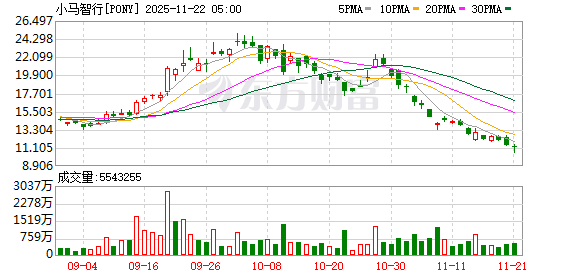
美股异动丨小马智行盘前涨超3.2%,与阳光出行达成战略合作
Xin Lang Cai Jing· 2025-11-24 09:28
Core Viewpoint - Pony.ai (PONY.US) has announced a strategic partnership with Sunshine Travel to develop a large-scale autonomous driving fleet, aiming to enhance autonomous mobility services in major Chinese cities and promote the "AI + Mobility" industry development [1] Group 1: Company Developments - Pony.ai's stock rose over 3.2% to $11.55 in pre-market trading following the announcement of the partnership [1] - The collaboration will focus on the deployment of Pony.ai's seventh-generation mass-produced autonomous vehicles to form the autonomous driving fleet, with the first fleet expected to launch this year [1] Group 2: Industry Implications - The partnership signifies a step towards the realization of autonomous driving services in first-tier cities in China, indicating a growing trend in the integration of AI technology within the transportation sector [1] - The initiative is expected to contribute to the overall development of the "AI + Mobility" industry, highlighting the increasing importance of autonomous driving solutions in urban mobility [1]
文远知行-W(00800)发布第三季度业绩,总收入同比增长144%至1.71亿元
智通财经网· 2025-11-24 09:28
Core Viewpoint - The company achieved significant revenue growth in Q3 2025, driven by fleet expansion and increased service penetration, despite reporting a net loss that decreased year-over-year. Group 1: Financial Performance - The company reported a revenue of RMB 171 million for Q3 2025, representing a year-over-year increase of 144% [1] - The net loss attributable to ordinary shareholders was RMB 307 million, a reduction of 70.53% compared to the previous year [1] - Earnings per share for ordinary shares was a loss of RMB 0.34 [1] Group 2: Revenue Breakdown - Product revenue increased by 428% to RMB 79.2 million, while service revenue grew by 66.9% to RMB 91.8 million [1] - Revenue from autonomous taxi services surged by 761% to RMB 35.3 million, accounting for 20.7% of total revenue, up from 5.8% in Q3 2024 [1] Group 3: Regulatory Achievements - The company received a commercial operating license for fully autonomous taxis in Abu Dhabi, achieving unit economic breakeven [1] - The company has initiated public operations in Saudi Arabia and Belgium, and is conducting road tests in Zurich, Dubai, and Singapore [1] Group 4: Fleet Expansion - As of October 31, 2025, the company operates a fleet of over 1,600 autonomous vehicles, including nearly 750 autonomous taxis [2] - The company has obtained operational permits for its autonomous vehicles in eight countries globally, including the latest regulatory approval in Switzerland [2]