
Robotics

Search documents
蓝思智能机器人公司增资至1.6亿,增幅约60%
Sou Hu Cai Jing· 2025-12-26 07:05
钛媒体App 12月26日消息,天眼查工商信息显示,12月24日,蓝思智能机器人(长沙)有限公司发生工 商变更,饶桥兵卸任法定代表人、董事长,由周群飞接任,新增蓝思国际(香港)有限公司、长沙锋云 企业管理合伙企业(有限合伙)为股东,同时,注册资本由1亿人民币增至约1.6亿人民币,增幅约 60%。蓝思智能机器人(长沙)有限公司成立于2016年7月,经营范围含工业机器人制造、智能机器人 的研发、软件开发、工业控制计算机及系统销售、智能机器人销售、人工智能硬件销售、服务消费机器 人制造等。股东信息显示,该公司现由蓝思科技及上述新增股东共同持股。(广角观察) ...

机器人日租金从3万元跌至3000元
21世纪经济报道· 2025-12-26 06:16
Core Viewpoint - The rental market for humanoid robots is experiencing a significant price drop, with rental fees now below 10,000 yuan, indicating a shift from speculative demand to a more sustainable market driven by real needs [1][4][9]. Group 1: Market Dynamics - The rental prices for humanoid robots have decreased from a peak of 8,000 to 10,000 yuan per day in March to a range of 3,000 to 6,000 yuan, with some basic models priced around 3,000 yuan and dance versions starting at 5,000 yuan [5][9]. - The demand for robot rentals has surged ahead of the New Year, with many businesses receiving prepayments for multiple units, indicating a robust interest in rental services [1][6]. - The rental market is transitioning from a focus on hardware to a comprehensive service model that includes software, data, and support, reflecting a change in customer expectations from novelty to value creation [1][9]. Group 2: Future Projections - The humanoid robot rental market is expected to exceed 10 billion yuan by 2025, with projections of reaching at least 100 billion yuan by 2026 as platform operations advance [13]. - The industry is anticipated to undergo structural changes, with a focus on rational pricing driven by increased supply and a shift in customer behavior towards value assessment [9][10]. - The rental model is seen as a viable pathway for commercializing humanoid robots, allowing businesses to test products at lower costs while providing feedback for product development [10][11]. Group 3: Industry Challenges - The current rental market faces challenges such as high operational costs, complex collaboration chains, and significant content homogeneity, which could hinder growth [17]. - The customization required for industrial robots makes them less suitable for a rental model, as they often need to be tailored for specific tasks, complicating the reuse of the same product [18]. - Despite the challenges, the demand for humanoid robots in domestic service and companionship is expected to grow, driven by societal changes such as aging populations [18].

专精特新第一城,为什么是深圳
2 1 Shi Ji Jing Ji Bao Dao· 2025-12-26 03:21
Core Viewpoint - Shenzhen has emerged as a vibrant hub for technological innovation, supported by a comprehensive financial service system that enhances the financing accessibility for technology-driven SMEs and directs financial resources towards key sectors like AI, semiconductors, and biomedicine [1][2][9] Group 1: Financial Support Mechanisms - Shenzhen's financial support for technology innovation has evolved beyond mere capital injection to a collaborative mechanism that stimulates vitality, diversifies risks, and accompanies growth [2] - The People's Bank of China in Shenzhen has introduced various financial products such as "Tengfei Loan," "Technology Startup Pass," and "Cross-Border Loan" to address the financing needs throughout the entire lifecycle of technology enterprises [3][5] - "Tengfei Loan" incorporates future revenue sharing into credit relationships, allowing banks to provide longer-term loans to high-growth tech companies, with 146 companies signing agreements totaling 8.63 billion yuan by November 2025 [3][4] Group 2: Innovative Financial Products - "Technology Startup Pass" has helped 5,037 enterprises secure loans totaling 8 billion yuan by utilizing data from social security, tax, and intellectual property to identify potential tech companies [5] - "Cross-Border Loan" facilitates rapid financing for growth-oriented companies lacking collateral, serving nearly 70 enterprises with a total of 200 million yuan [5] - The financial products are designed to support companies from the seed stage to growth, ensuring that they do not dilute ownership while receiving necessary funding [4][9] Group 3: Ecosystem Optimization - Shenzhen is building a collaborative "technology-industry-finance" ecosystem, enhancing the "stock-loan-debt-insurance-exchange" linkage in its financial service system [6][7] - The "Kowloon Technology Innovation Cooperation Zone" has pioneered the "Science and Technology Exchange" pilot program to facilitate cross-border flow of research funds, significantly improving the efficiency of foreign-funded research institutions [6][7] - The "Thousand Billion Financing Plan" in Nanshan District aims to alleviate financing difficulties for tech companies by creating a comprehensive service system that includes risk-sharing mechanisms [7][8] Group 4: Long-term Investment and Growth - Private equity firms are increasingly participating in funding rounds for tech companies, with tools like the "Technology Board" and risk-sharing instruments providing stable, low-cost funding sources [9] - The continuous growth in the number of "specialized, refined, distinctive, and innovative" enterprises and R&D investment in Shenzhen is supported by a financial service system that acts as a "co-builder" and "accompanying runner" for tech companies [9]
机器人大战挥别“草莽时代”
Bei Jing Shang Bao· 2025-12-26 01:41
动辄数十亿的资本联姻,参与者身份不尽相同。有的已是港股上市公司,有的没上市企业并未注入资产 和重组计划。有的是人形机器人,有的是四足机器人、特种机器人,并购对象更是涉及环保材料、园林 机械、能源运输、物流仓储等千行百业。 12月24日,优必选宣布收购A股上市公司园林机械制造商锋龙股份的43%股权,豪掷16.65亿元拿下后者 控股权。在此之前数月时间,进行了类似操作的还有智元机器人收购上纬新材、七腾机器人收购胜通能 源…… 算上反向操作的东杰智能收购遨博智能,以及明确IPO进展的宇树科技、云深处科技、乐聚机器人等, 机器人在资本市场的火爆持续到岁末年初。 从内测产品找风投,到秀舞蹈打比赛,再逐渐成为公开市场的香饽饽,以人形机器人破圈为标志的机器 人全链条迎来订单和财富的爆发期。 虽说上市只是又一个阶段的新起点,但能接受大众层级的检验,意味着机器人竞争告别了草根、草莽时 代。市场上有头部领跑者,有当红炸子鸡,有资本领域的长袖善舞,也有大厂明争暗斗和合纵连横—— 新进入者并非没有机会,竞争压力却远超过往。 近期还有市场传闻称,多家人形机器人企业正展开竞逐,不惜重金要拿下总台马年春晚亮相机会。一年 前略显笨拙的"春晚 ...

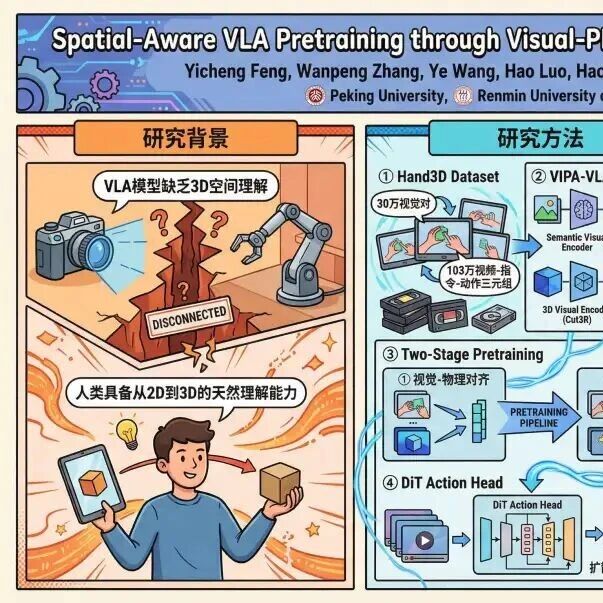
突破2D-3D鸿沟!北大提出VIPA-VLA,视频解锁机器人精准操控
具身智能之心· 2025-12-26 00:55
Core Insights - The article discusses a new approach to robot learning that addresses the challenge of aligning 2D visual information with 3D spatial understanding, which has been a significant limitation in existing visual-language-action (VLA) models [3][6][41] - The research introduces a novel pre-training paradigm that utilizes human demonstration videos to enhance robots' spatial perception capabilities, allowing them to infer 3D spatial relationships from 2D visual inputs [4][40] Research Background - Current VLA models face limitations due to reliance on expensive robot datasets and lack of explicit 3D spatial modeling, which hampers their ability to accurately map physical actions [6][7] - Human demonstration videos provide a solution by offering diverse scenarios and inherent visual-physical correspondences that serve as valuable supervision signals for robot learning [7][8] Hand3D Dataset - The Hand3D dataset, comprising Hand3D-visual and Hand3D-action components, is described as a "3D spatial textbook" for robots, enabling them to learn visual-physical alignment [8][9] - The dataset includes data from nine heterogeneous human manipulation datasets, ensuring a wide variety of scenes and tasks [8][9] Model Architecture: VIPA-VLA - The VIPA-VLA model features a dual-encoder architecture that integrates semantic visual features with 3D spatial features, enhancing the model's ability to understand both scene semantics and spatial structures [15][20] - The model employs a cross-attention fusion layer to combine these features, allowing for effective learning of 3D relationships from 2D inputs [17][20] Training Process - The training process consists of three phases: 3D visual pre-training, 3D action pre-training, and post-training for task adaptation, ensuring a gradual acquisition of 3D capabilities [21][22] - The first phase focuses on aligning semantic and spatial features, while the second phase teaches the model to predict 3D motion tokens based on visual-language inputs [22][23] Experimental Results - VIPA-VLA outperformed existing baselines in various tasks, achieving a success rate of 92.4% in single-view settings and 96.8% in dual-view settings on the LIBERO benchmark [27][28] - In the RoboCasa benchmark, VIPA-VLA achieved a success rate of 45.8%, surpassing other models, particularly in tasks requiring precise 3D positioning [30] - The model demonstrated strong performance in real-world tasks, achieving a 60% success rate in the Wipe-Board task, significantly higher than competing models [31][34] Significance and Future Directions - The research presents a new paradigm for robot learning that reduces reliance on costly robot data and enhances model generalization by leveraging human demonstration videos [40][41] - Future work aims to combine this pre-training paradigm with robot data pre-training and expand the Hand3D dataset to include more complex human-robot interaction tasks [40][41]
是清洁工也是特种兵,越来越“能打”的机器人如何炼成?
2 1 Shi Ji Jing Ji Bao Dao· 2025-12-26 00:31
从春晚,到全球首个人形机器人半程马拉松赛再到2025世界机器人大会、2025世界人形机器人运动会,今年以来,机器人产业发展可以说收获了大量的关 注。 从这些大赛、大会,我们得以见到机器人产业发展至今的成果,感觉好像机器人怎么突然发展得这么快了?其实在这里面,我们国家没少在里面"出招"。 21世纪经济报道记者冉黎黎 北京报道 2025年最受关注的产业是什么?不论大家的脑海里冒出了多少个答案,机器人或许在列。 "十四五"时期,《"十四五"机器人产业发展规划》《"机器人+"应用行动实施方案》《工业机器人行业规范条件(2024版)》等一系列政策接连出台。政策 做了这么多,那除了肉眼可见的机器人已经能跑能跳之外,机器人这个产业到底发展得怎么样了? ...
年初只会丢手绢 年末暴打创始人 具身智能企业今年融资370亿元
Shen Zhen Shang Bao· 2025-12-25 23:24
Core Insights - The industry of embodied intelligence is transitioning from the "proof of concept" phase to a new stage characterized by large-scale investments, concentration of leading companies, and expectations for industrialization [2][8] Investment Trends - In 2025, at least 165 embodied intelligence companies completed 303 financing rounds, accumulating nearly 37 billion yuan, a nearly 260% increase compared to the entire year of 2024 [2] - The number of companies receiving investment in 2025 reached 168, with a financing scale of 32.9 billion yuan, a year-on-year increase of 291% [3] - The total investment in the embodied intelligence sector from 2022 to 2025 amounted to 512 cases, with disclosed financing exceeding 48 billion yuan [4] Company Performance - Notable companies like ZhiYuan Robotics and Galaxy General have achieved significant financing milestones, with Galaxy General raising over 300 million USD (approximately 2.1 billion yuan) in December 2025, setting new records for single and cumulative financing [6] - ZhiYuan Robotics completed 11 financing rounds by August 2025, with a valuation reaching 15 billion yuan, and plans for an IPO in Hong Kong [6] Market Dynamics - The concentration of investment is evident, with the top 10 companies accounting for about 40% of the total financing in 2025, indicating a narrowing window for mid-tier projects [8] - The industry is experiencing a surge in entrepreneurial activity, with 53 new companies established in 2025, and 31 of them securing funding shortly after their inception [3] Future Outlook - 2025 is seen as a watershed year for financing in the embodied intelligence sector, marking a systematic increase in capital scale and a shift from "technology validation" to "pre-industrialization" [8] - The financing rhythm is expected to differentiate in 2026, with leading companies likely to secure large, low-frequency but high-certainty funding, while mid-tier companies may face a more challenging environment [8]
优必选斥资16.65亿元入主锋龙股份 人形机器人开始“借道A股”
Shen Zhen Shang Bao· 2025-12-25 23:22
深圳商报首席记者袁静娴 2025年末,人形机器人再迎来一则重大消息。 12月24日,"人形机器人第一股"优必选(9880.HK)发布公告,以"协议转让+要约收购"的组合方式共 收购深交所上市公司锋龙股份(002931)(002931.SZ)93957518股(占锋龙股份公司股份总数 43%)。 根据公告,本次控制权变更方案中的股份转让价格、要约收购价格均为17.72元/股(相比12月17日锋龙 股份停牌前19.68元/股折让10%),以此计算,合计总对价达16.65亿元。 交易完成后,优必选将成为锋龙股份的控股股东,其董事会主席、执行董事兼CEO周剑将成为锋龙股份 的实际控制人。周剑目前也是优必选单一第一大股东,直接持股比例达20.61%。 优必选表示,收购事项在战略上符合双方的长期目标,并能创造协同效应,加速公司人形机器人的开发 与商业化。 在优必选收购锋龙股份之前,今年的机器人与人工智能赛道,已出现数例并购案例。今年7月,智元机 器人入主上纬新材(688585.SH);12月,分别传来中昊芯英拿下天普股份(605255) (605255.SH)、七腾机器人控股胜通能源(001331)(001331.SZ) ...
“宇树们”这一年:一边台前狂秀,一边上市补血
3 6 Ke· 2025-12-25 23:19
年终岁末,机器人企业开始在为明年的演出舞台摩拳擦掌。前段时间,宇树科技和智元机器人为争夺春晚冠名权豪掷千万 的消息一度冲上热搜。 虽然,智元很快否认了这一传闻,宇树也表示"不予回应"。 但从今年宇树机器人登上春晚舞台那一刻起,机器人便以一 种大众可以直接感知的方式,卷起机器人的全民热潮。 而在舞台之下,超百万家机器人企业也在展开一场没有硝烟的战争。截至12月初,已有超过30家机器人企业向港交所递交 了上市申请。 一级市场同样火爆,2025年前三季度,国内机器人创业公司融资总额约达到500亿元,明星独角兽银河通用、它石智航 等,也纷纷刷新机器人行业的融资纪录。 然而,在机器人军团集体闯关IPO的同时,金沙江创投主管合伙人朱啸虎对"具身智能商业化路径不清晰"的批判仍言犹在 耳。热闹过后,机器人终究还是要先找到买单的人。 新老玩家,扎堆上市 今年初,金沙江创投主管合伙人朱啸虎曾抛出了"具身智能商业化路径不清晰""近期在退出一些具身智能项目"等一系列的 观点,引发了行业热议。 在近期的公开访问中,朱啸虎再次被问到如何看待"退出人形机器人公司",他表示"再谈没有意义,现在已经很贵了",并 提到自己过去一年也投资了一些差 ...
财经观察:“不再是机器人大国”,日本错过了什么?
Huan Qiu Shi Bao· 2025-12-25 22:48
Core Viewpoint - Japan is falling behind in the humanoid robot sector, which is now dominated by AI-driven technologies led by companies in the US and China [1][2][5]. Group 1: Current State of Humanoid Robotics in Japan - Japan was once a leader in humanoid robotics, having developed early models like WABOT-1 and ASIMO, but has not capitalized on AI advancements [4][5]. - Japanese robots are often perceived as industrial automation tools rather than humanoid robots, limiting their application in service sectors [2][5]. - The current humanoid robots in Japan, such as GROOVE X's LOVOT and MIXI's Romi, lack advanced AI capabilities compared to their Chinese counterparts [3][4]. Group 2: Challenges Facing Japan - Japan's reliance on industrial robots has hindered its transition to AI-driven humanoid robotics, missing early opportunities in the AI robot market [5][6]. - The conservative approach to software and AI ecosystems in Japan has resulted in a significant lag behind the more open and rapid developments in the US and China [6][7]. - Strict regulations and limited application scenarios in Japan restrict the practical deployment and iteration of robotic technologies, particularly in areas like autonomous driving [7][8]. Group 3: Future Prospects - Japanese companies are forming collaborations, such as the Kyoto Humanoid Robot Association, aiming to produce humanoid robots by 2026 [8][9]. - Despite Japan's advanced manufacturing capabilities for robot components, it struggles to integrate these into complete intelligent systems due to a lack of robust IT and AI infrastructure [8][9]. - Japan may increasingly adopt a role as a follower or investor in the global AI and robotics landscape, rather than a leader, due to political and economic dependencies on China and the US [9][10].