
T800

Search documents
光威复材20230331
2026-04-01 09:59
Summary of the Conference Call for Guangwei Composites (光威复材) Industry Overview - The company operates in the composite materials industry, focusing on carbon fiber products for aerospace, energy, and new materials sectors. The business structure is evolving towards a more diversified portfolio, with significant growth in energy new materials and aerospace applications. Key Points and Arguments Business Structure Optimization - By 2026, the revenue contribution from the fiber segment is expected to decrease to 51%, while the energy new materials (carbon beam) segment is projected to grow by 75.84%, increasing its revenue share to 33% [2][4][5]. Product Iteration and Applications - The T800G model has become a core growth driver due to its mass production. The T1,000 model meets performance standards for commercial aerospace applications, and the T1,100 model has achieved a production capacity of 100 tons, with small-scale applications starting in 2024 [2][4][5]. Commercial Aerospace Layout - The company anticipates aerospace revenue of 340 million yuan in 2025, with approximately 190 million yuan from satellite-related businesses. It supplies carbon fiber raw materials and composite components for rocket recovery [2][4][19]. Challenges in Baotou Project - The Baotou project is expected to incur a loss of 176 million yuan in 2025, with depreciation and amortization reaching 160 million yuan. The project faces challenges due to industry overcapacity and low-price competition, making it difficult to achieve breakeven in the short term [2][4][9][16]. Cost and Price Trends - The rise in acrylonitrile prices has a minimal impact on small tow products, as material costs account for about 17.5% of total costs. New military product models have locked in prices through three-year contracts, while older models adopt a "volume for price" strategy [2][11][15]. Future Growth Points - The domestic aircraft manufacturing sector is expected to drive demand for T300 and T800 products. The company plans to control new investments in 2026 and 2027, focusing on optimizing high-value product lines [3][21]. Financial Performance - In 2025, the company achieved revenue of 2.86 billion yuan, a year-on-year increase of 16.7%. However, net profit attributable to shareholders decreased by 18.59% to 603 million yuan, indicating a stable overall operation but challenges in profitability [4][16]. Market Dynamics - The carbon fiber industry is experiencing a shift from addressing supply issues to focusing on high-performance products. Domestic companies are capable of producing T1,200 and higher performance products, emphasizing the need for customized production [20][21]. Strategic Partnerships - The joint venture with Shanggong Shenbei aims to enhance the supply chain for civil aircraft components, focusing on domestic material substitution and production validation [18][21]. Challenges and Risks - The company faces significant pressure from depreciation costs and market competition. The Baotou project’s profitability is contingent on securing sales volume and controlling costs, with a challenging market landscape due to overcapacity [16][21]. Emerging Market Opportunities - The company is targeting growth in wind power, commercial aerospace, and low-altitude economy sectors, while also exploring opportunities in sports and leisure markets [21][22]. Investment Strategy - Future investments will be strategically paced based on market demand and sales growth, with a focus on high-end product lines to optimize the product structure [22][23]. Additional Important Information - The company’s carbon beam business primarily serves overseas clients, with minimal domestic sales [8]. - The aerospace business is expected to grow, with satellite-related revenue showing significant increases [19]. - The competitive landscape is characterized by aggressive pricing strategies, impacting overall profitability [15][17]. This summary encapsulates the key insights from the conference call, highlighting the company's strategic direction, financial performance, and market challenges.

深圳机器人八企突围记
2 1 Shi Ji Jing Ji Bao Dao· 2026-02-27 23:08
Group 1 - Cartwheel Robotics, a humanoid robot company founded in 2022, has ceased operations due to failed financing [1] - In contrast, Shenzhen's robot industry is thriving, with eight key companies achieving significant milestones in financing and technology commercialization [2][3] - The Shenzhen government aims to accelerate the development of a global AI hub, targeting over 10% growth in the AI industry cluster [2] Group 2 - The total financing in the embodied intelligence sector exceeded 50 billion yuan by October 2025, marking a growth of over 400% compared to the previous year [3] - Companies like Zhihui Square and Zhuji Dynamics have completed substantial funding rounds, with Zhihui Square's valuation surpassing 10 billion yuan [4] - UBTECH, recognized as the "first stock of humanoid robots," has raised over 7.4 billion HKD since its IPO, indicating strong market confidence in its commercial potential [4] Group 3 - Zhihui Square launched the GOVLA 0.5 model and the AlphaBot series, achieving over 50,000 hours of fault-free operation [5] - Zhuji Dynamics introduced the TRON 2 robot and the LimX COSA system, showcasing innovation in embodied intelligence [6] - UBTECH's Walker S2 robot features autonomous battery swapping technology, enhancing its operational efficiency in industrial settings [7] Group 4 - Shenzhen's "Robot Valley" benefits from a robust ecosystem of universities and research institutions, facilitating rapid development and innovation in robotics [8][9] - The city has established a financial service system to support the entire lifecycle of technological innovation, including a 2 billion yuan fund for AI and robotics [9][10] - By 2025, Shenzhen's robot industry is projected to achieve a 31.4% increase in added value, with industrial robot production expected to grow by 43.1% [10] Group 5 - Shenzhen's action plan aims to cultivate over 1,200 companies in the embodied intelligence sector by 2027, with a focus on creating more billion-dollar enterprises [10] - The city is committed to strengthening its position in AI technology, emphasizing the development of core technologies in algorithms, models, and intelligent robots [10]

一年分野,深圳机器人八企突围记
2 1 Shi Ji Jing Ji Bao Dao· 2026-02-26 07:58
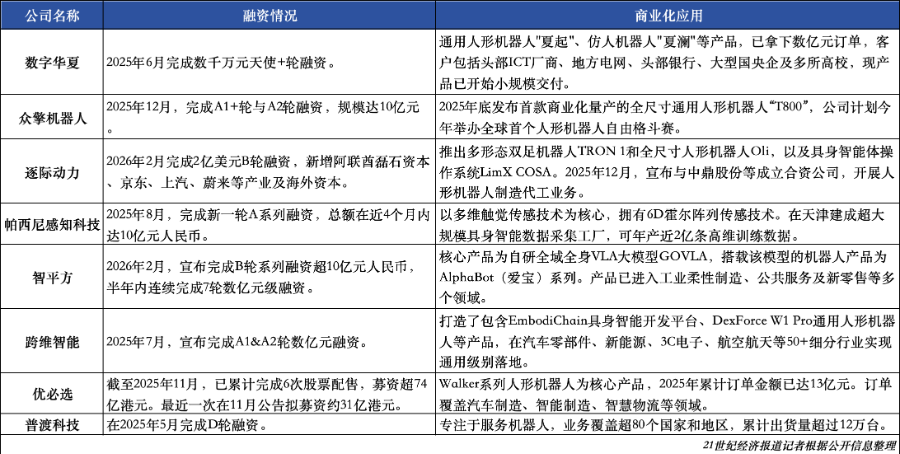
Core Insights - The article highlights the contrasting fortunes of robotics companies in the US and China, with Cartwheel Robotics ceasing operations due to funding failures, while Shenzhen's robotics sector thrives with significant investments and technological advancements [1][2][3]. Company Developments - Cartwheel Robotics, founded in 2022, has shut down due to unsuccessful financing efforts [1]. - Shenzhen's robotics companies, including Digital Huaxia, Zhongqing Robotics, Zhijijia, and others, have seen varied trajectories, with some achieving significant funding and commercial success [3]. - Zhijijia has completed 12 rounds of financing, surpassing a valuation of 10 billion yuan, becoming Shenzhen's first embodied intelligence company to reach this milestone [5]. - Zhongqing Robotics raised 1 billion yuan in multiple financing rounds and launched the T800 humanoid robot, marking a significant step in commercialization [5][9]. - Digital Huaxia has secured orders worth hundreds of millions for its humanoid robots, indicating strong market demand [8]. Industry Trends - The embodied intelligence sector has experienced explosive growth, with total financing exceeding 50 billion yuan, a 400% increase from the previous year [4]. - Shenzhen's government aims to establish the city as a global leader in artificial intelligence, with a target of over 1,200 related enterprises by 2027 [13]. - The robotics industry in Shenzhen has shown robust growth, with a 31.4% increase in added value in the first three quarters of 2025 [12]. Technological Advancements - Companies are focusing on practical applications of robotics, with significant innovations in product development and technology upgrades [6]. - Zhijijia launched the GOVLA 0.5 model, while Zhongqing Robotics introduced the T800 humanoid robot, showcasing advancements in robotics technology [6][9]. - Cross-dimensional Intelligence has developed a model that achieved over 100 million yuan in revenue, indicating successful market penetration [7]. Market Applications - Shenzhen's robotics companies are expanding into various sectors, including industrial manufacturing, commercial services, and household applications [9]. - Digital Huaxia's robots are being utilized in government and banking sectors, while Zhijijia's modular service space is set to deploy 1,000 units in three years [9]. - The industry is increasingly focused on real-world applications, with companies like Pudu Technology and others achieving significant sales and international reach [9].

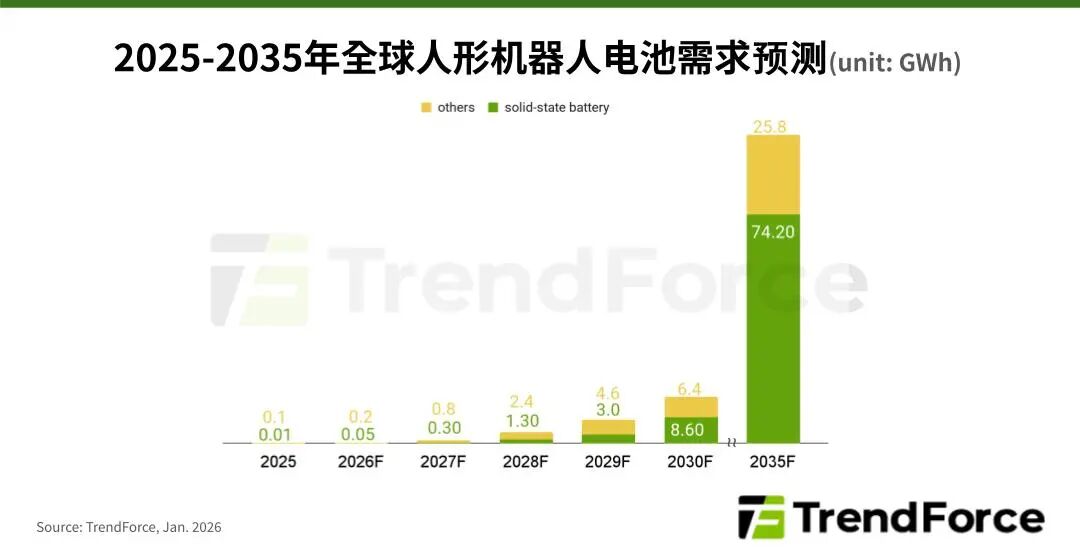
集邦咨询:预计人形机器人对固态电池的需求有望于2035年超74GWh
智通财经网· 2026-01-28 09:09
Core Insights - The development of humanoid robots is expected to reach a commercialization milestone by 2026, increasing the importance of batteries as an "energy supply" [1] - Solid-state lithium batteries are projected to become the mainstream solution due to their high energy density, with demand from humanoid robots expected to exceed 74 GWh by 2035, growing over a thousand times from 2026 [1] Group 1: Humanoid Robot Battery Market - Global humanoid robot shipments are forecasted to surpass 50,000 units in 2026, representing an annual growth of over 700% [4] - High-nickel ternary lithium batteries (NMC/NCA) are currently the mainstream choice for robot batteries due to their relatively high energy density, while lithium iron phosphate batteries (LFP) are used for lower endurance applications [4] - Most humanoid robots currently have a battery capacity below 2 kWh, with typical endurance ranging from 2 to 4 hours, such as Unitree's H1 with 0.864 kWh and Tesla's Optimus Gen2 with 2.3 kWh [4] Group 2: Challenges and Opportunities - The development of humanoid robot batteries faces two main challenges: the rapid iteration of core technologies affecting battery customization and the current focus on finding scalable commercial applications rather than improving endurance [5] - Despite these challenges, the demand for high energy density, high discharge rate, and high safety batteries in humanoid robots presents an opportunity for solid-state batteries to demonstrate their advantages [5] - Breakthroughs in solid-state battery technology and cost reductions are expected to help humanoid robots overcome power limitations [5]

为何股改?众擎机器人回应
Shang Hai Zheng Quan Bao· 2026-01-23 10:30
Core Viewpoint - Shenzhen Zhongqing Robot Technology Co., Ltd. has completed a share reform, changing its name to Shenzhen Zhongqing Robot Technology Co., Ltd. and its type to a joint-stock company (foreign investment, unlisted) [1] Group 1: Company Overview - Zhongqing Robot is a prominent player in the embodied intelligence sector, founded in October 2023 by Zhao Tongyang, who previously established Dogotix and Xiaopeng Pengxing Intelligent [1] - The company gained significant attention for its products SE01 and PM01, achieving global firsts in natural gait walking and humanoid robot front flips, respectively [1] Group 2: Purpose of Share Reform - The share reform aims to optimize the shareholder structure and capital framework, providing flexibility for future financing, equity incentives, and strategic investments [1] - It supports ongoing business expansion and global layout, ensuring capital for technology R&D, overseas market development, and supply chain resource integration [1] - The reform is designed to protect shareholder rights and create a better capital operation platform to attract core talent and quality resources for long-term development [1] Group 3: Business Focus and Strategy - The company will maintain its core strategy, main business, and management team, focusing on "empowering humans through technology and expanding capability boundaries" [1] - Zhongqing Robot will continue to deepen R&D in embodied intelligence technology, advance product iterations, and steadily expand into global markets [1] Group 4: Financing and Product Development - In December 2025, Zhongqing Robot announced the completion of A1+ and A2 financing rounds, raising a total of 1 billion yuan [2] - The company has established a product matrix covering various humanoid forms and sizes, recently launching the T800, a full-size humanoid robot [2] - The T800 features a height of 1.73 meters and a weight of 75 kilograms, designed for diverse applications including industrial collaboration, service, running, and combat [2] Group 5: Production Capacity - Zhongqing Robot has built its production line in the Honghuailing Industrial Zone of Nanshan District, Shenzhen, and plans to establish a global manufacturing center in Zhengzhou, Henan [3] - This setup is prepared for the mass delivery of PM01 and T800 robots [3]
众擎机器人CEO赵同阳:T800体能超过了90%的正常男人,先把“身强力壮”做好
Xin Lang Cai Jing· 2026-01-15 07:42
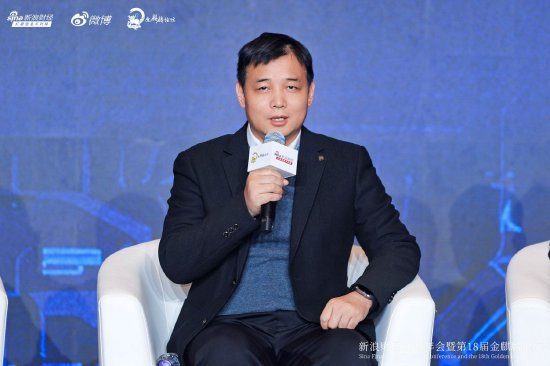
Group 1 - The "2025 Technology Wind List" annual event was held in Beijing, featuring discussions on "Embodied Intelligence Leap Moment" with key industry leaders [1][4]. - Zhao Tongyang, CEO of Zhongqing Robotics, emphasized the company's decade-long focus on developing humanoid robots that approach or exceed human capabilities, transitioning from general robotics to various fields [3][6]. - The company has developed the T800 humanoid robot, which stands at 1.73 meters tall and surpasses 80% of normal men in running and combat abilities, with claims that its physical capabilities exceed 90% of normal men [3][6]. Group 2 - Zhao highlighted the importance of foundational algorithms in humanoid robotics, comparing them to the essential role of GPUs in AI models, indicating that robust physical capabilities are a prerequisite for advanced embodied intelligence [3][6]. - The company aims to enhance balance and visual capabilities in its robots, which are critical for integrating advanced intelligence and large models in the future [3][6].
国泰海通:中国人形机器人公司在CES 2026表现亮眼 全球范围内商业化进程有望加速
Zhi Tong Cai Jing· 2026-01-13 07:05
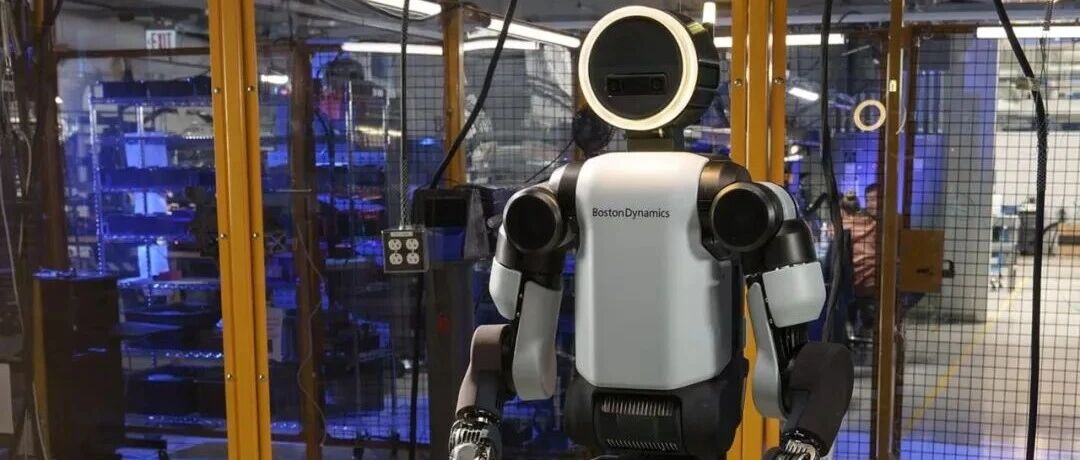
Group 1 - The humanoid robot industry is entering its initial commercialization phase, with significant progress observed in both domestic and international markets, indicating a potential acceleration in the global commercialization process of humanoid robots [1] - At CES 2026, over 4,000 companies participated, with nearly 25% being Chinese exhibitors, particularly in the humanoid robot sector, where at least 28 Chinese companies showcased their innovations, demonstrating China's technological capabilities [1] - Notable Chinese companies like Zhiyuan Robotics and Yushu Technology presented their flagship products, including the Lingxi X2 and the G1 humanoid robot, which showcased advanced functionalities and interactive capabilities [1] Group 2 - Several international companies also made strides in humanoid robotics at CES 2026, with LG introducing its first humanoid robot CLOiD for home applications, and Boston Dynamics unveiling the new electric Atlas robot with advanced features [2] - The Atlas robot, equipped with 56 degrees of freedom and a battery life of 4 hours, is set to collaborate with Google DeepMind for future enhancements, indicating a strong focus on innovation in the robotics field [2] Group 3 - Hangzhou Xinjian Electromechanical Transmission Co., Ltd. has initiated its listing guidance, with plans to prepare for an IPO, highlighting its role as a core component supplier for Tesla's humanoid robot, Optimus [3] - The company specializes in manufacturing various components, including worm gears and electric drive joints, and is recognized as a "little giant" enterprise in China [3]

美国CES,又被中国人形机器人包围了
机器人圈· 2026-01-08 10:13
Core Insights - The article highlights the significant presence of Chinese companies at CES 2026, particularly in the humanoid robot sector, showcasing a shift from isolated technology displays to a complete industrial chain structure [6][14]. Group 1: Chinese Companies at CES 2026 - A total of 598 exhibitors related to robotics participated in CES 2026, with 149 coming from China, accounting for nearly one-fourth of the total [3]. - In the humanoid robot segment, 38 exhibitors were recorded, with 21 from China, representing over half of the participants [3]. - Notable Chinese exhibitors included Yushu Technology, which showcased the mass production version of the G1 humanoid robot, and Cloud Deep Technology, which presented the upgraded X30 series [7][9]. - Other companies like ZhiYuan Robotics and ZhongQing Robotics displayed a range of humanoid and bionic robots, emphasizing their capabilities in various applications [7][12]. Group 2: Global Competitors - American companies, such as Boston Dynamics and Hyundai, focused on the industrial application of humanoid robots, with the Atlas robot demonstrating advanced motion capabilities [15][17]. - Korean firms, represented by the K-Humanoid Alliance, showcased their ambitions in humanoid robotics, emphasizing collaboration between research institutions and industry [18][19]. - European companies, including NEURA Robotics and Humanoid, targeted industrial applications, highlighting their engineering prototypes and modular systems [23][25]. Group 3: Industry Trends and Future Directions - The article notes a shift in the perception of humanoid robots, moving from feasibility discussions to practical applications in various sectors, including industrial, household, and service environments [31]. - Different countries are adopting distinct strategies: China focuses on product showcases and mass production, the U.S. emphasizes industrial deployment and system capabilities, Korea integrates research and industry through alliances, and Europe approaches the market through industrial humanoid robots [31].
具身智能,国产机器人为美好生活赋能
Xin Hua She· 2025-12-31 08:48
Core Insights - The article emphasizes the rapid integration of domestic robots into daily life by 2025, showcasing their diverse applications in various sectors such as entertainment, healthcare, and agriculture [1][12][21] Industry Developments - By 2025, domestic humanoid robots have achieved multiple breakthroughs, including the first human-like robot to perform a front flip and a marathon completion, indicating significant advancements in robotics technology [3][5] - The launch of the T800 humanoid robot by Zhongqing Robotics highlights the technological integration capabilities of domestic robots, featuring advanced materials and systems for enhanced performance [4][5] Technological Advancements - The core technological upgrades in humanoid robots are driven by the collaboration of their "brain," "small brain," and body design, which collectively enhance their operational capabilities [5][11] - The development of autonomous battery-swapping systems for humanoid robots by Youbixuan enables continuous operation without human intervention, significantly improving efficiency in industrial applications [9][10] Market Applications - The demand for humanoid robots in the elderly care sector is increasing due to the growing aging population in China, with robots being utilized for assistance in daily activities and health monitoring [12][13] - The industrial sector is identified as the primary training ground for humanoid robots, with significant orders and applications in assembly, transportation, and maintenance processes [10][11] Challenges and Opportunities - Despite the rapid growth, the industry faces challenges such as technological limitations, narrow application scopes, and the need for standardized practices across the sector [14][15][16] - The article suggests that policy support and market-driven initiatives are crucial for overcoming current obstacles and fostering high-quality development in the domestic robot industry [18][19] Future Outlook - The future of the domestic robot industry is projected to align with the growth of smart technologies, with expectations of significant advancements in the next 5 to 15 years [19][20] - The integration of robots into everyday life is anticipated to evolve gradually, starting with low-intelligence applications before expanding into more complex domestic roles [20][21]
年初只会丢手绢 年末暴打创始人 具身智能企业今年融资370亿元
Shen Zhen Shang Bao· 2025-12-25 23:24
Core Insights - The industry of embodied intelligence is transitioning from the "proof of concept" phase to a new stage characterized by large-scale investments, concentration of leading companies, and expectations for industrialization [2][8] Investment Trends - In 2025, at least 165 embodied intelligence companies completed 303 financing rounds, accumulating nearly 37 billion yuan, a nearly 260% increase compared to the entire year of 2024 [2] - The number of companies receiving investment in 2025 reached 168, with a financing scale of 32.9 billion yuan, a year-on-year increase of 291% [3] - The total investment in the embodied intelligence sector from 2022 to 2025 amounted to 512 cases, with disclosed financing exceeding 48 billion yuan [4] Company Performance - Notable companies like ZhiYuan Robotics and Galaxy General have achieved significant financing milestones, with Galaxy General raising over 300 million USD (approximately 2.1 billion yuan) in December 2025, setting new records for single and cumulative financing [6] - ZhiYuan Robotics completed 11 financing rounds by August 2025, with a valuation reaching 15 billion yuan, and plans for an IPO in Hong Kong [6] Market Dynamics - The concentration of investment is evident, with the top 10 companies accounting for about 40% of the total financing in 2025, indicating a narrowing window for mid-tier projects [8] - The industry is experiencing a surge in entrepreneurial activity, with 53 new companies established in 2025, and 31 of them securing funding shortly after their inception [3] Future Outlook - 2025 is seen as a watershed year for financing in the embodied intelligence sector, marking a systematic increase in capital scale and a shift from "technology validation" to "pre-industrialization" [8] - The financing rhythm is expected to differentiate in 2026, with leading companies likely to secure large, low-frequency but high-certainty funding, while mid-tier companies may face a more challenging environment [8]