
资产管理

Search documents
韩国基民投资理财新趋势:偏好高杠杆ETF 对中国资产关注度提升
Zheng Quan Shi Bao Wang· 2025-10-19 23:05
Core Viewpoint - The rise of retail investors, referred to as the "ant army," is significantly influencing the capital markets in South Korea, reflecting a shift in investment attitudes among the younger population [1] Group 1: Investment Trends - Investment and wealth management are increasingly viewed by young South Koreans as a means to change their fortunes, rather than just tools for asset appreciation [1] - There is a notable trend of South Korean investors pouring into capital markets through ETFs and showing a strong interest in high-risk leveraged products, indicating a willingness to take on significant risks for potentially high returns [1] Group 2: Market Focus - Since 2025, there has been a marked increase in South Korean investors' attention towards Chinese assets, particularly technology stocks listed in Hong Kong [1]
凯雷集团CEO:把美国信贷市场波动列入“担忧清单”,但仍看好市场韧性
Xin Lang Cai Jing· 2025-10-19 21:24
Core Insights - Carlyle Group's CEO, Harvey Schwartz, has included recent credit market volatility on his "worry list," but has not yet seen signs of a deteriorating market environment [1] - Despite some tension in the credit market following the bankruptcies of Tricolor Holdings and First Brands Group, Schwartz noted that businesses are growing and employment remains stable [1] - Alternative asset management firms are increasingly partnering with sports teams and athletes to enhance brand influence and reach traditional institutional investors [1] Credit Market Analysis - The credit market has been under pressure since the bankruptcies of Tricolor Holdings and First Brands Group [1] - JPMorgan CEO Jamie Dimon warned that such risk events may not be isolated incidents [1] - Recent disclosures of loan fraud by two regional banks in the U.S. led to a decline in their stock prices [1] Investment Strategies - Private equity firms are entering the retirement finance sector and attempting to tap into the individual investor market, spurred by an executive order signed by former President Donald Trump [1] - Sixth Street Partners' co-CIO, Josh Eastley, criticized some peers for focusing more on private equity marketing rather than performance [1]

中国中信金融资产管理股份有限公司四川省分公司与泉州市国投资产管理有限公司债权转让通知暨债务催收联合公告
Si Chuan Ri Bao· 2025-10-19 20:25
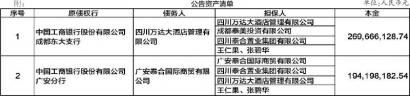
Core Points - The announcement involves the transfer of debt rights from China CITIC Financial Asset Management Co., Ltd. Sichuan Branch to Quanzhou Guotou Asset Management Co., Ltd. [1][2] - Debtors and guarantors are required to fulfill their repayment obligations to Quanzhou Guotou Asset Management Co., Ltd. as per the main debt contract and guarantee contract [2] Group 1 - The total amount of debt transferred includes significant sums, such as 269,666,128.74 RMB and 194,198,182.54 RMB associated with various debtors and guarantors [1] - The announcement specifies that the asset list reflects the loan principal balance as of the transfer benchmark date of July 30, 2025 [2] - Contact information for China CITIC Financial Asset Management Co., Ltd. Sichuan Branch is provided for further inquiries regarding the debt transfer [2] Group 2 - The announcement outlines that if debtors or guarantors undergo changes such as name changes, restructuring, or loss of civil subject qualification, relevant parties must fulfill obligations or liquidation responsibilities [2] - The list of guarantors includes various types such as guarantors, mortgagors, and pledgers, indicating a comprehensive approach to securing the debt [2]


毕盛资产创始人王国辉: 不可不投 全球正重估中国资产
Zhong Guo Zheng Quan Bao· 2025-10-19 20:21
Core Viewpoint - The world is reassessing Chinese assets, and it has reached a stage where investment in China is essential [1][2] Group 1: Investment Perspective - The founder of APS believes that the risk premium for Chinese assets has significantly decreased, leading to potential P/E ratio expansions of 20%-40% for many companies [2][9] - There is a strong fundamental basis for investing in Chinese stocks, contrary to some international opinions that question the investment value of China's capital markets [2][3] - The founder emphasizes that the perception of Chinese assets by foreign investors is less important than how Chinese investors view them [2][3] Group 2: Economic Strengths - China's GDP growth rate continues to outpace that of Germany, the UK, Japan, and the US, a trend expected to persist for many years [3] - China leads globally in various fields such as 5G, upcoming 6G, drones, lithium batteries, high-speed rail, electric vehicles, and the BeiDou navigation system [3] - The country has established a robust manufacturing ecosystem, producing 35% of the world's industrial products, with advantages expected to grow as AI is integrated into manufacturing [4][5] Group 3: MIT Advantage - The "MIT" framework represents Manufacturing, Innovation, and Talent, which are seen as China's competitive advantages [4][5][6] - Manufacturing in China is supported by a comprehensive infrastructure that is unlikely to be replicated by any other country in the next few decades [4] - Innovation is increasingly evident, with a significant portion of global semiconductor research originating from Chinese institutions, indicating a strong capacity for technological advancement [5] - The talent pool in China is characterized by hardworking and creative individuals, contributing to the country's economic potential [5][6] Group 4: Historical Context and Future Outlook - The founder's investment philosophy is shaped by historical experiences, including timely market exits during bubbles [7][8] - The current state of China is markedly different from the past, with a strong national power that mitigates external threats, leading to a further reduction in the risk premium for Chinese assets [9] - There is optimism that overseas investors will recognize the investment value of the Chinese market, potentially leading to renewed growth in the Chinese stock market [9]
奶酪基金总经理罗艳芳: 多元配置 打造财富稳健增长工具
Zhong Guo Zheng Quan Bao· 2025-10-19 20:16
Core Insights - The market environment is enhancing the value of FOF (Fund of Funds) allocation strategies, with private FOF strategies rapidly increasing their share in high-net-worth client asset allocation [1][2] - The FOF strategy is expected to become a mainstream asset allocation tool in the domestic market, driven by the evolution of risk awareness and investment tools [3][4] Group 1: FOF Development and Market Potential - The demand for wealth management is shifting from "single appreciation" to "stable diversification," making FOF strategies increasingly attractive due to their multi-asset and multi-strategy advantages [2][3] - Historical support for FOF strategies includes a large fund product market, long-term capital entering the market, and improved investor awareness transitioning from "high returns" to "stable returns" [2][3] - The domestic market has a rich base asset pool, with non-monetary public fund scale exceeding 22 trillion yuan and private fund scale exceeding 12 trillion yuan [2] Group 2: FOF Strategy Framework - The FOF strategy employs a three-tier framework: macro direction setting, strategy selection, and fund selection, focusing on risk tolerance and target volatility [4][5] - The strategy allows for dynamic balance through disciplined processes, enhancing the cost-effectiveness of investment portfolios compared to purely subjective or all-weather strategies [4][5] Group 3: Risk Control Mechanism - The core of FOF risk control lies in "double diversification," which isolates and dilutes risks more effectively than traditional funds [5] - The first layer of diversification involves asset dispersion within underlying funds, while the second layer focuses on diversifying strategies and managers to mitigate "same-source risk" [5] - FOF strategies can capture economic recovery gains through equity funds, provide stable foundations with bond funds, and hedge against market downturns with CTA strategies [5] Group 4: Future Outlook - The potential for domestic FOF products is significant, with expectations for the introduction of quantitative and hedging strategies to enhance risk-return profiles [6] - The industry anticipates that FOF allocation strategies will become essential tools for investors seeking stable wealth growth [6]
多元配置 打造财富稳健增长工具
Zhong Guo Zheng Quan Bao· 2025-10-19 20:13
Core Insights - The value of FOF (Fund of Funds) allocation strategies is being reinforced in the current market environment, with a rapid increase in its share among high-net-worth clients' asset allocations [1][2] - The FOF strategy is expected to become a mainstream asset allocation tool in the domestic market, driven by a large fund product market, long-term capital inflows, and improved investor awareness [2][3] FOF Development Potential - The demand for wealth management is shifting from "single appreciation" to "stable diversification," making FOF strategies increasingly attractive due to their multi-asset and multi-strategy advantages [1][2] - The domestic market has a rich base asset pool, with non-monetary public fund scale exceeding 22 trillion yuan and private fund scale exceeding 12 trillion yuan [2] Multi-Dimensional Allocation Framework - FOF strategies require investors to set target volatility based on their risk tolerance, forming a three-layer framework of "macro direction, mid-level strategy selection, and micro fund selection" [3] - The FOF strategy allows for diversified asset allocation and strategy dispersion, mitigating extreme risks from single assets while capturing multi-dimensional returns [2][3] Risk Control Mechanism - The core of FOF risk control lies in "double dispersion," which provides a more robust safeguard compared to traditional funds that only diversify single asset risks [4][5] - The first layer of dispersion involves diversifying underlying fund assets, while the second layer focuses on diversifying strategies and managers to avoid "same-source risk" [5] Future Outlook - The potential for FOF products in the domestic market is significant, with expectations for the introduction of quantitative and hedging strategies to enhance risk-return profiles and product attractiveness [5]
不可不投 全球正重估中国资产
Zhong Guo Zheng Quan Bao· 2025-10-19 20:13
Core Viewpoint - The world is reassessing Chinese assets, and it has reached a stage where investment in China is essential [1][2] Group 1: Investment Perspective - The founder of APS believes that the risk premium for Chinese assets has significantly decreased, leading to potential P/E ratio expansions of 20%-40% for many companies [2][7] - There is a strong fundamental basis for investing in Chinese stocks, contrary to some international opinions that question the investment value of China's capital markets [2][3] - The founder emphasizes that the perception of Chinese assets by foreign investors is less important than how Chinese investors view them [2][3] Group 2: Economic Strengths - China's GDP growth rate continues to outpace that of Germany, the UK, Japan, and the US, and this trend is expected to persist for many years [3][4] - China leads in various fields such as 5G, upcoming 6G, drones, lithium batteries, high-speed rail, electric vehicles, and the BeiDou navigation system [3][4] - The country has established a robust manufacturing ecosystem, producing 35% of the world's industrial products, which is expected to strengthen further with AI integration [4][5] Group 3: MIT Advantage - The "MIT" framework represents Manufacturing, Innovation, and Talent, which are seen as China's competitive advantages [4][5] - Manufacturing in China is supported by a comprehensive infrastructure that is unlikely to be replicated by any other country in the foreseeable future [4] - Innovation is increasingly evident in Chinese enterprises, with a significant number of STEM graduates contributing to research and development [5][6] Group 4: Historical Context and Future Outlook - The founder has a history of successful investments, including a notable contrarian investment in Chinese A-shares during a period of widespread pessimism [6][7] - The current strength of China's economy and its ability to withstand external pressures suggest a further reduction in the risk premium associated with Chinese assets [7] - There is optimism that overseas investors will recognize the investment value of the Chinese market, leading to renewed growth in the stock market [7]
上海市委常委、常务副市长吴伟稳步推进全球资产管理中心建设
Shang Hai Zheng Quan Bao· 2025-10-19 18:49
Group 1 - The core viewpoint is that Shanghai is steadily advancing the construction of a global asset management center under the guidance of national financial management authorities, showcasing new achievements and effectiveness [2][4] - Shanghai's financial market scale is steadily expanding, with a total trading volume of 29.6783 trillion yuan from January to September this year, representing a year-on-year growth of 12.7% [2] - The number of financial organizations is accelerating in Shanghai, with foreign banks, joint venture fund management companies, and foreign insurance companies headquartered in Shanghai accounting for about half of the total in the country [2] Group 2 - Financial reforms and opening-up are being comprehensively deepened, with mechanisms like "Bond Connect" being continuously improved to attract foreign investors to allocate RMB assets [2] - The financial legal environment is continuously optimized, with Shanghai being the first in the country to establish specialized institutions such as financial courts and arbitration courts [3] - The global wealth management forum highlighted the importance of Jing'an District as a key area for the construction of Shanghai's global asset management center, actively attracting quality financial institutions and building a financial development ecosystem [4]

指数化投资加速提质扩容,未来趋势如何?
Di Yi Cai Jing· 2025-10-19 16:18
Core Insights - The scale of index products in China has reached approximately 6.5 trillion yuan, reflecting a 43% increase compared to the end of the previous year [1] - The Shanghai Stock Exchange is committed to promoting index investment development through systematic layout and enhancing the index and quantitative investment ecosystem [2][3] - The rapid growth of index and quantitative investment is significantly impacting the asset management industry, with a focus on regulatory development and market ecology [1][2] Index Product Growth - The number of indices compiled by the Shanghai Stock Exchange and China Securities Index has exceeded 8,700, with tracking product scale surpassing 5 trillion yuan [2] - The scale of ETF products in the Shanghai market has increased from 0.9 trillion yuan to 4 trillion yuan over the past five years, representing a cumulative growth of nearly 350% [2] Technology and Thematic Indices - A diverse index system focusing on technology innovation, including 369 technology-related indices with a product scale of 900 billion yuan, has been established [2] - The Science and Technology Innovation Board has become the segment with the highest index investment ratio, with 33 indices and a tracking product scale exceeding 340 billion yuan [2] Market Trends and Investor Behavior - The penetration rate of index investment in the domestic market has significantly increased, with ETF trading volume accounting for over 7% of total A-share trading volume [3] - Factors driving the growth of index investment include the transparency, low cost, and diversification of index products, as well as the increasing effectiveness of the market [3] ETF Market Development - The domestic ETF market has experienced rapid growth, with the number of listed ETF products nearing 1,200 and a total scale exceeding 5.6 trillion yuan [5] - The domestic ETF market has surpassed Japan, becoming the largest ETF market in Asia, with a total scale exceeding 5.5 trillion yuan [4] Future Outlook - The focus on broad-based index products is expected to increase in importance, with thematic indices in artificial intelligence and other sectors becoming key areas for fund managers [5] - Multi-asset allocation indices are anticipated to play a more significant role in wealth management for residents in a declining interest rate environment [5]
城记 | 一场苏河畔的财智盛宴,激活上海国际金融中心建设“灵感源”
Zhong Guo Jin Rong Xin Xi Wang· 2025-10-19 13:49
Core Insights - The Global Wealth Management Forum 2025 held in Shanghai focused on topics such as digital transformation, technological benefits, global financial cooperation, and investment outlooks, showcasing Shanghai's financial innovation and openness [1][2]. Group 1: Investment Trends - AI and gold emerged as hot topics during discussions, with experts highlighting the importance of AI for business competitiveness and the historical correlation between inflation and gold prices [5][6]. - The Shanghai financial market saw a trading total of 2967.83 trillion yuan from January to September, marking a 12.7% year-on-year increase, with stock market capitalization and bond market size ranking among the top globally [6]. Group 2: Financial Ecosystem Development - Shanghai's Jing'an District reported a financial services industry value-added of 28.817 billion yuan in the first half of the year, indicating robust growth and a well-developed financial ecosystem [8]. - The establishment of the Shanghai AI-FI Laboratory was a notable outcome of the forum, aiming to integrate AI into financial services, with various financial institutions launching innovative AI-driven tools [11][13]. Group 3: Policy and Infrastructure - The forum emphasized the need for continuous dialogue among industry practitioners, institutional investors, and policymakers to navigate complex market conditions and seize emerging trends [6][7]. - Jing'an District has been proactive in enhancing its financial environment, establishing services like a comprehensive financing service center and a cross-border financial service center to facilitate international investments [9][10].
