
新能源发电

Search documents
追随电价市场化改革之路 探寻新能源产业发展趋势
Qi Huo Ri Bao Wang· 2025-07-14 00:53
Core Viewpoint - The article discusses the transition of China's renewable energy industry into a fully market-oriented pricing system, initiated by the "136 Document," which marks a significant shift from government-set prices to market-driven pricing, impacting the entire energy sector and creating both opportunities and challenges for renewable energy companies [1][2][3]. Group 1: Market Reform and Transition - The renewable energy industry in China has evolved through various phases, including a subsidy era and a "guaranteed quantity and price" era, leading to the current full market entry phase initiated by the "136 Document" [2][3]. - As of the end of 2024, the installed capacity of renewable energy is expected to reach approximately 1.41 billion kilowatts, accounting for over 40% of the total installed capacity in the country, surpassing coal power for the first time [2]. - The transition to market pricing is seen as a necessary step for the renewable energy sector, which has been supported by various policies since 2009, but fixed pricing has become inadequate for market demands [2][3]. Group 2: Impact on Renewable Energy Companies - The implementation of the "136 Document" on June 1 marks a turning point where new projects must operate under market pricing, increasing revenue uncertainty for renewable energy companies [3][4]. - A new price settlement mechanism has been introduced to stabilize revenue expectations for renewable energy firms, allowing for compensation when market prices fall below a certain threshold [3]. - The shift towards market competition is expected to eliminate inefficient capacities and drive technological innovation among companies, transitioning the industry from a policy-dependent model to a market-driven one [5]. Group 3: Storage Industry Implications - The "136 Document" ends the mandatory storage requirement for new renewable energy projects, shifting the focus from administrative mandates to market-driven demand for storage solutions [6]. - This change is anticipated to accelerate the restructuring of the storage industry, encouraging companies to seek storage solutions based on economic value rather than compliance with regulations [6]. Group 4: Future of Renewable Energy - As renewable energy becomes a dominant source in the power structure, it must enhance its capabilities to reduce reliance on traditional coal power for regulation [7]. - The industry is expected to mature by improving predictability and control over energy output through technological advancements and deeper participation in market mechanisms [7].
新股探寻(山大电力、技源集团、华电新能)
2025-07-14 00:36
Summary of Key Points from Conference Call Records Industry and Company Overview - **Electric Power Monitoring Companies**: These companies rely on a partnership with Shandong University and have established long-term cooperation with the State Grid, which contributes nearly 70% of their revenue [2][5]. - **Dietary Supplement Supplier (Jiyuan Group)**: This company is a leading global supplier of dietary additives, with over 50% of the global supply of HMB. Major clients include Abbott [6][8]. - **China Huadian New Energy**: This is the only integrated platform for wind and solar energy under China Huadian, ranking among the top in installed capacity [3][15]. Core Insights and Arguments - **Electric Power Monitoring Companies**: - Revenue growth over the past three years has been between 10% and 20%, with net profit showing stable growth, expected to reach 130 million in 2024 [1][5]. - The company plans to raise 590 million yuan for projects including fault analysis, R&D centers, and new energy vehicle charging stations [1][4]. - The market capacity for the substation side is approximately 2 billion yuan, while the transmission and distribution side ranges from 29 billion to 38 billion yuan [2]. - **Jiyuan Group**: - The company plans to raise 540 million yuan to enhance production capacity for HMB and other health food products [1][7]. - Revenue is projected to grow from 950 million yuan in 2022 to 1 billion yuan in 2024, with net profit increasing from 140 million yuan to 174 million yuan in the same period [12]. - The global HMB production is expected to reach 3,572 tons by 2024 and over 3,000 tons by 2030, with a compound annual growth rate of 11.5% [8][9]. - **China Huadian New Energy**: - The company is expected to complete projects with an installed capacity of over 17 million kilowatts by 2025-2026 [3][16]. - The fundraising of 18.2 billion yuan will be directed towards wind and solar base construction [3][15]. Additional Important Information - **Financial Performance**: - Electric Power Monitoring Companies: Revenue for the last three years was 480 million, 550 million, and 660 million yuan, with net profits of 80 million, 100 million, and 130 million yuan respectively [5]. - Jiyuan Group: Revenue is expected to grow by 15% to 27% in the first half of 2025, with net profit growth of 8.6% to 19.2% [12]. - China Huadian New Energy: Revenue from 2022 to 2024 was 24.7 billion, 29.6 billion, and 34 billion yuan, with stable growth around 15% [17]. - **Risks**: - Jiyuan Group faces risks related to dietary supplement quality, market acceptance of new products, and uncertainties in partnerships with key clients like Abbott [13]. - China Huadian New Energy is exposed to risks from changes in power generation policies and renewable energy subsidies, as well as potential natural conditions affecting power generation [18].
未来科学城又有重磅创新!海上“超大风车”来了
Bei Jing Ri Bao Ke Hu Duan· 2025-07-13 08:55
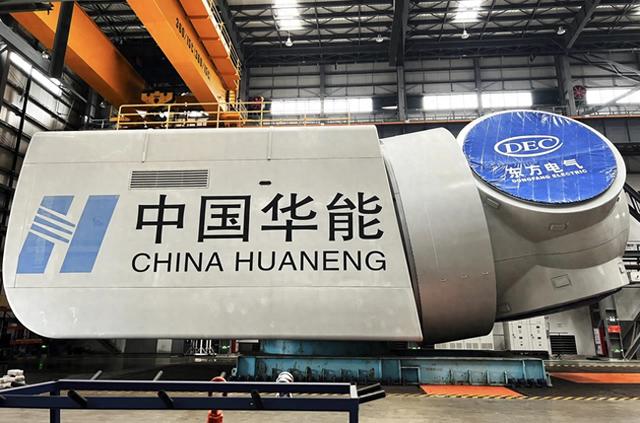
Core Viewpoint - The article highlights the launch of the world's largest direct-drive floating offshore wind turbine, developed by China Huaneng Clean Energy Research Institute, with a single unit power of 17 megawatts and a rotor diameter of 262 meters [1][3]. Group 1: Product Specifications - The newly launched wind turbine has a rotor diameter of 262 meters, with a swept area of approximately 53,000 square meters, equivalent to 7.5 standard football fields [3]. - The hub height of the turbine is about 152 meters, comparable to a 50-story residential building [3]. - The turbine boasts a utilization rate of over 99% and can withstand wave heights exceeding 24 meters and typhoons of level 17 [3]. Group 2: Technological Innovations - The wind turbine is a collaborative effort between China Huaneng and China Dongfang Electric Group, featuring domestically produced key components such as the main shaft bearing, blades, generator, inverter, and transformer [5]. - The research team has successfully overcome challenges in floating wind power system coupling simulation technology and high-fidelity model testing technology, as well as precision manufacturing and assembly processes for blades and low-speed permanent magnet direct-drive motors [5]. - An intelligent sensing system has been integrated into the turbine, enabling global stability control of the floating system, making it suitable for complex deep-sea environments with water depths exceeding 50 meters [5]. Group 3: Future Plans and Impact - The next step involves demonstrating the turbine in the Yangjiang sea area of Guangdong, aiming for early operational deployment [5]. - Once operational, the turbine is expected to generate 68 million kilowatt-hours of clean electricity annually, sufficient to meet the annual electricity needs of approximately 40,000 households [5]. - In addition to the wind turbine, the research institute has also developed China's first wave-resistant deep-sea floating photovoltaic platform, "Huaneng Huang Hai No. 1," which has completed its second phase of upgrades and testing [6].

公用环保行业周报:参考海外经验,英国容量市场规则是如何设计的?-20250713
SINOLINK SECURITIES· 2025-07-13 06:48
Investment Rating - The report suggests focusing on power generation assets in regions with tight supply-demand balance and favorable competition dynamics, particularly recommending companies like Anhui Energy and Huadian International in the thermal power sector [4]. Core Insights - The report highlights the performance of various sectors, with the carbon neutrality sector rising by 3.52% and the environmental protection sector increasing by 3.07% during the week [12]. - It emphasizes the importance of market dynamics and regulatory changes, such as the approval of the cross-grid electricity trading mechanism by the National Development and Reform Commission and the National Energy Administration [75]. Summary by Sections Market Review - The Shanghai Composite Index rose by 1.09% and the ChiNext Index increased by 2.36% during the week [12]. - The thermal power sector is recommended for investment due to its potential for asset value reassessment in regions with tight electricity supply [4]. Industry News - The report discusses the recent regulatory developments aimed at enhancing the electricity market's efficiency and interconnectivity, including the implementation of a market mechanism for cross-grid electricity trading [75]. - It also notes the ongoing reforms in the renewable energy sector, particularly in Hainan Province, to correct market interventions and ensure fair pricing for new energy projects [75]. Investment Recommendations - For thermal power, the report recommends Anhui Energy and Huadian International due to their strategic positioning in competitive markets [4]. - In the hydropower sector, it suggests focusing on Yangtze Power, while for nuclear power, China National Nuclear Power is highlighted as a key player [4]. - In the renewable energy segment, Longyuan Power is identified as a leading wind power operator worth monitoring [4].



增量项目90%煤电基准价+10%现货电价!浙江过渡期上网电价出台
中关村储能产业技术联盟· 2025-07-12 13:05
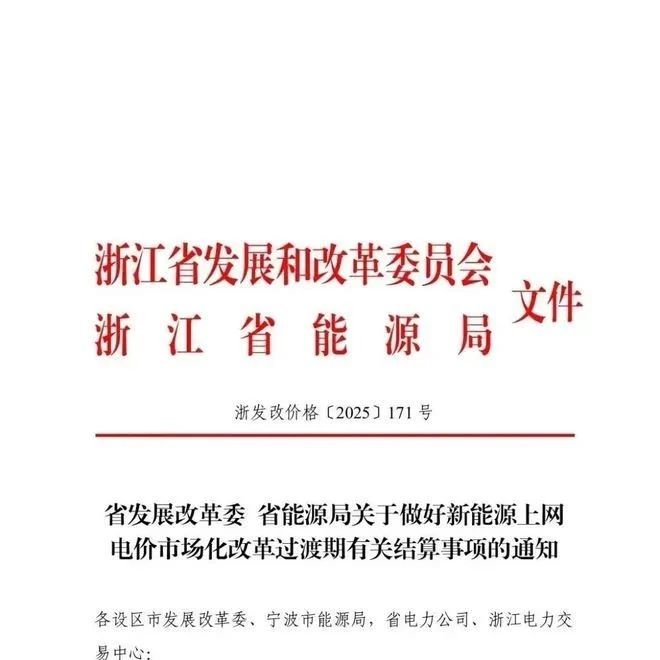
Core Viewpoint - The article discusses the implementation of a transitional pricing scheme for renewable energy grid connection in Zhejiang Province, which will be in effect until the new market-oriented pricing reform is introduced [1][2][10]. Summary by Sections Transitional Pricing Scheme - The transitional period for the pricing scheme is from June 1, 2025, until the new market-oriented pricing reform is implemented [3][9]. - For existing projects (those fully operational before June 1, 2025), the current pricing policies and market rules will continue to apply [3][9]. - For new projects (those fully operational on or after June 1, 2025), the pricing will be set at 90% of the coal-fired power benchmark price plus 10% based on the real-time spot market price, differentiated by wind and solar categories [4][9]. Definition of Full Capacity Connection - The determination of full capacity connection time for projects requiring a power business license will be based on the date indicated on the license; for multiple units, the date of the last unit's connection will be used [4][9]. - For projects not requiring a power business license, the first connection time recorded by the grid company will be used [4][9]. Green Power Trading - All types of renewable energy projects, including new projects, can participate in green power trading and settlement according to existing market rules [5][9].
北京科锐: 关于公司对外担保的公告
Zheng Quan Zhi Xing· 2025-07-11 16:25
Summary of Key Points Core Viewpoint - Beijing Keri Group Co., Ltd. has approved guarantees for its wholly-owned subsidiary, Gu'an Keri New Energy Technology Co., Ltd., for a distributed photovoltaic power generation project loan and for Hunan Changda Transmission and Transformation Construction Co., Ltd. for a project performance guarantee [1][2][6]. Guarantee Overview - The company will provide a joint liability guarantee for Gu'an Keri's loan for the cloud valley (Gu'an) technology company's distributed photovoltaic power generation project, with a guarantee amount not exceeding RMB 13.6 million, valid for 9 years from the board's approval date [1][2]. - A performance guarantee of up to RMB 780,000 will be provided for Hunan Changda's project, with a guarantee period of 6 months after the completion of the main debt obligations [2][4]. Financial Details - The total assets of Gu'an Keri as of June 30, 2025, are RMB 9,369.51 million, with total liabilities of RMB 6,301.83 million, resulting in net assets of RMB 3,019.43 million [3][4]. - Hunan Changda's total assets as of March 31, 2025, are RMB 9,078.79 million, with total liabilities of RMB 7,663.14 million, resulting in net assets of RMB 2,887.39 million [4][5]. Board's Opinion - The board believes that the guarantees are necessary to support the operational development of Gu'an Keri and that the financial risks are manageable, ensuring that the interests of the listed company and all shareholders are not compromised [6][8]. - The board has authorized the chairman or designated personnel to handle the guarantee matters and sign relevant contracts with financial institutions [6][8]. Compliance and Oversight - The guarantees comply with the Company Law and relevant regulations, and there are no overdue guarantee issues as of the resolution date, with the total external guarantees amounting to RMB 58.96 million, which is 3.49% of the latest audited net assets [7][8].

申华控股: 申华控股2024年年度报告(修订版)
Zheng Quan Zhi Xing· 2025-07-11 16:13
Core Viewpoint - The annual report of Liaoning Shenhua Holdings Co., Ltd. for 2024 indicates a significant recovery in net profit, despite a decline in revenue, highlighting the company's strategic adjustments and operational improvements in a challenging market environment [1][3]. Company Overview and Financial Indicators - The company reported a net profit attributable to shareholders of 38,598,756.24 yuan for 2024, a 119.42% increase from a loss of 198,775,447.12 yuan in 2023 [2][3]. - Total revenue for 2024 was 4,193,384,127.55 yuan, down 18.43% from 5,140,865,960.51 yuan in 2023 [2][3]. - The company's net assets at the end of the reporting period were 820,890,018.67 yuan, reflecting a 4.75% increase from 783,694,608.57 yuan in 2023 [2][3]. Business Performance - The automotive sales segment generated revenue of 41.44 billion yuan, maintaining stable sales despite market pressures [3][4]. - The company implemented measures such as optimizing vehicle structure and sales rhythm, which contributed to the reduction of losses and improved profitability [3][4]. - The company successfully cleared nine subsidiaries, recovering approximately 30 million yuan through asset management [3][4]. Industry Context - The automotive industry in China faced challenges, with total vehicle production and sales declining by 7.5% in 2024, while new energy vehicle sales reached 12.9 million units, accounting for 40.93% of total sales [5][6]. - The market for office buildings in Shanghai remains under pressure, with a shift towards high-quality projects and flexible office spaces expected to continue [6][7]. Competitive Advantages - The company is one of the largest BMW dealers in China, operating 14 BMW 4S stores, which positions it favorably in the automotive market [7][8]. - The company has enhanced the operational quality of its financial building, maintaining stable occupancy rates despite a sluggish market [7][8]. Financial Analysis - The company’s operating expenses decreased due to effective cost management, with sales expenses down by 17.12% and management expenses reduced by 7.41% [8][9]. - The net cash flow from operating activities increased by 11.85% to 73,781,875.19 yuan, attributed to improved management of receivables [8][9].

电投能源(002128) - 002128电投能源投资者关系管理信息20250711
2025-07-11 10:36
Group 1: Company Operations and Performance - The main source of alumina is from Shandong and Hebei, with an average inventory duration of about 20 days [1] - The company’s electrolytic aluminum production capacity will reach 1.61 million tons after the completion of the Zha Aluminum Phase II project [2] - The company has a low price-to-earnings ratio compared to peers, indicating it is undervalued despite being a comprehensive energy company [3] Group 2: Investor Relations and Transparency - The company adheres to regulatory policies by regularly disclosing quarterly reports but does not provide monthly operational updates [2] - There is a suggestion from investors for the company to improve transparency and provide more frequent operational data to enhance market valuation [2] - The company has a market value management system in place and is open to strategic investors joining [2] Group 3: Asset Management and Restructuring - The company is currently undergoing asset restructuring, with no specific timeline provided for completion [5] - Concerns were raised regarding the slow progress of the White Yin Hua coal power asset integration, which has been under management for several months [4] - The company is evaluating the assets involved in the restructuring, but the assessment process is still ongoing [5]

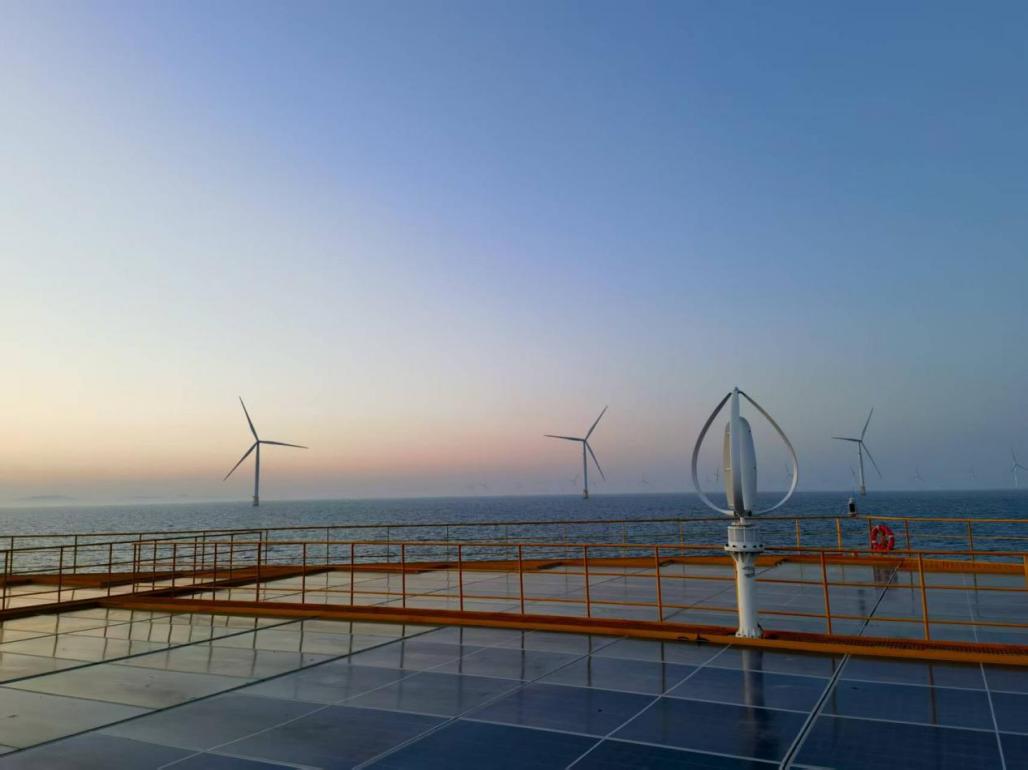
我国首套抗浪型漂浮式海上光伏平台“黄海一号”实现“风光共平台”融合应用
Zhong Guo Neng Yuan Wang· 2025-07-11 09:10
Core Insights - The Huaneng "Yellow Sea No. 1" floating photovoltaic platform has successfully completed its upgrade and debugging work, achieving the integration of vertical axis wind turbines and floating photovoltaic systems for efficient utilization of marine space [1][2]. Group 1: Platform Development - The "Yellow Sea No. 1" platform is China's first anti-wave deep-sea floating photovoltaic platform, constructed by Huaneng Shandong Yantai Power Plant and designed by Huaneng Clean Energy Technology Research Institute [2]. - The platform is set to be operational in October 2024 at the Huaneng Shandong Peninsula South No. 4 offshore wind farm, having undergone suitability tests to verify the reliability of its structural, electrical, and monitoring systems [2]. Group 2: Technological Integration - The platform features a co-platform design that integrates vertical axis wind turbines with floating photovoltaic systems, enhancing energy output efficiency per unit area of sea [2]. - Two "water droplet" vertical axis wind turbines, developed by China Huaneng, have been added to the platform, focusing on the interaction between platform structure, turbine layout, and buoyancy systems [2]. Group 3: Performance and Efficiency - The upgraded platform is designed to extend overall power generation time and smooth out fluctuations in power output, providing significant technical reference for future large-scale development of composite energy fields [2].

新能源发电装机扩容 清洁能源渐成“主力军”
Zheng Quan Ri Bao Wang· 2025-07-10 13:15
Group 1 - The core viewpoint of the articles highlights the significant shift in China's energy landscape, with renewable energy sources expected to account for over 45% of total installed capacity by 2025, driven by both economic growth and energy transition [1][2][5] - The National Energy Administration reported that the maximum electricity load reached a historical high of 1.465 billion kilowatts on July 4, 2025, an increase of approximately 200 million kilowatts from late June, and nearly 150 million kilowatts from the same period last year [1] - The report from the State Grid Energy Research Institute predicts that by the end of 2025, the total installed capacity in China will reach 3.99 billion kilowatts, with a 5% year-on-year increase in total electricity consumption expected to exceed 10 trillion kilowatt-hours [2] Group 2 - The increase in the share of renewable energy installations is seen as a necessary step for China to achieve its "dual carbon" goals, supported by technological advancements, policy frameworks, and market evolution [3] - The challenges remain, particularly in regions like East and Central China, where power supply and demand are still tight, necessitating the development of a new power system integrating renewable energy, storage, and digitalization [3] - The capital market is becoming increasingly active in supporting the expansion of renewable energy generation capacity, with state-owned power enterprises optimizing their capital structures and utilizing various financing tools such as green bonds and asset-backed securities [4][5]