
基金管理

Search documents
养元饮品拟向私募基金泉泓投资增资10亿元
智通财经网· 2025-10-15 13:04
Core Viewpoint - Yangyuan Beverage (603156.SH) has announced a partnership with Beijing Wenming Investment Fund Management Co., Ltd. to establish a private equity fund with an increased fundraising scale aimed at optimizing idle funds for investment returns [1] Group 1: Partnership and Fund Details - The private equity fund, named Wuhu Wenming Quan Hong Investment Management Partnership (Limited Partnership), was initially set up in May 2021 with a fundraising target of RMB 3 billion [1] - The company has increased its commitment to the fund, raising the total fundraising scale to RMB 4 billion, with an additional RMB 1 billion contributed by the company [1] - The company’s contribution to the fund amounts to RMB 2,997 million, while Wenming Fund acts as the general partner with a contribution of RMB 3 million [1] Group 2: Investment Focus - The private equity fund has made a significant investment of RMB 1.6 billion in Yangtze Memory Technologies Co., Ltd. [1]

中国瑞林(603257.SH)拟出资3000万元参与设立江钨矿业基金
智通财经网· 2025-10-15 11:34
Core Viewpoint - China Ruilin (603257.SH) has announced its intention to participate as a limited partner in the establishment of the Jiangxi Tungsten Mining Fund, with a total scale of 2 billion RMB, contributing 30 million RMB of its own funds [1] Group 1: Investment Details - The Jiangxi Tungsten Mining Fund is planned to be established in collaboration with several entities, including Jiangxi State-owned Capital Operation Holding Group Co., Ltd. and Jiangxi Tungsten Industry Holding Group Co., Ltd. [1] - The total scale of the fund is tentatively set at 2 billion RMB, with the company planning to invest 30 million RMB [1] Group 2: Strategic Intent - The company's participation in the fund aims to enhance its layout of high-quality mineral resources both domestically and internationally while ensuring the development of its main business [1] - The investment will be made using the company's own funds and is not expected to impact its production, cash flow, or overall financial health significantly [1]
上银基金陈博:低利率时代的新潮买手
点拾投资· 2025-10-15 11:00
Core Viewpoint - The article discusses how both technology and dividend assets benefit from a low interest rate environment, despite appearing to be conflicting asset classes [4][18]. Group 1: Investment Strategy - Chen Bo employs a "barbell strategy" combining both dividend and technology assets to provide a more adaptable product mix for investors [4][19]. - The investment framework emphasizes three key concepts: "small and beautiful" alpha, high ROE as a standard for excellent companies, and "high cut low" for dynamic portfolio adjustments [5][14]. - The strategy has shown strong performance during market fluctuations in 2023 and 2024, demonstrating the effectiveness of this approach [4][16]. Group 2: Investment Philosophy - Chen Bo's investment philosophy is influenced by notable figures such as Peter Lynch, Warren Buffett, and Charlie Munger, focusing on finding small-cap growth stocks with potential for significant returns [6][12]. - High ROE is considered a critical indicator of a company's long-term profitability and competitive advantage, with a benchmark of 15% ROE being highlighted [21][22]. - The article emphasizes the importance of adapting to macroeconomic conditions, distinguishing between bull and bear market strategies [15][31]. Group 3: Market Insights - The current low interest rate environment is expected to favor both growth and dividend-paying stocks, with a shift in focus from traditional assets to those that can provide better returns [19][20]. - The article notes that as the economy transitions, the focus should be on identifying new growth sources within the market, regardless of whether the assets are classified as dividend or technology [28][29]. - Chen Bo predicts a systemic revaluation of Chinese risk assets, suggesting that various styles of stocks will perform well in a true bull market [31].


中国瑞林:拟作为有限合伙人,参与设立江钨矿业基金
Xin Lang Cai Jing· 2025-10-15 10:18
Core Viewpoint - The company plans to participate as a limited partner in the establishment of the Jiangtong Mining Fund, with a maximum investment risk amounting to RMB 30 million [1] Group 1: Investment Details - The Jiangtong Mining Fund is currently in the preparatory stage, and some partners have not yet completed their investment decision-making processes [1] - The investment amount by the company is subject to the final signed partnership agreement [1] - The fund aims to engage in mining asset investments, which are characterized by long investment cycles and low liquidity [1] Group 2: Risks and Uncertainties - There is a risk of not finding suitable investment targets for the fund [1] - The partnership involves a related party transaction, as one of the signatories, Jiangxi State-owned Capital Operation Holding Group Co., Ltd., is the parent company of Jiangxi Copper Group, a shareholder of the company [1]
资金狂飙!连续41个月净流入后,ETF正改写华尔街的游戏规则
Jin Shi Shu Ju· 2025-10-15 09:43
Core Insights - Investors are rapidly channeling funds into U.S. ETFs, with inflows surpassing $1 trillion this year, indicating a significant shift from traditional mutual funds to lower-cost, more liquid ETFs [1] - This trend is expected to continue, potentially reaching an annual record of $1.4 trillion by the end of 2025, driven by a broad range of ETF categories benefiting from this influx [1] - The U.S. ETF industry has seen a consistent net inflow for 41 consecutive months, with assets reaching $12.7 trillion as of the end of September [1] Fund Flows and Market Dynamics - The momentum of ETF inflows has accelerated this year, with a nearly 23% increase in asset inflows year-to-date [1] - The outflow of funds from mutual funds, totaling $481 billion in the first nine months of 2025, is expected to continue driving higher ETF inflows [1] - The historical milestone of $1 trillion in ETF inflows was first achieved on December 11 of the previous year, marking a significant moment in the industry [1] Industry Perspectives - Industry experts emphasize the need for accelerated innovation, expanded market access, and enhanced investor education in light of the growing ETF market [1] - Discussions among asset managers about launching new ETFs or converting existing mutual funds into ETFs are becoming increasingly common, reflecting the industry's adaptive strategies amid market uncertainties [2]
量化基金2025前三季度收益10强出炉!冠军收益超70%!
Sou Hu Cai Jing· 2025-10-15 08:31
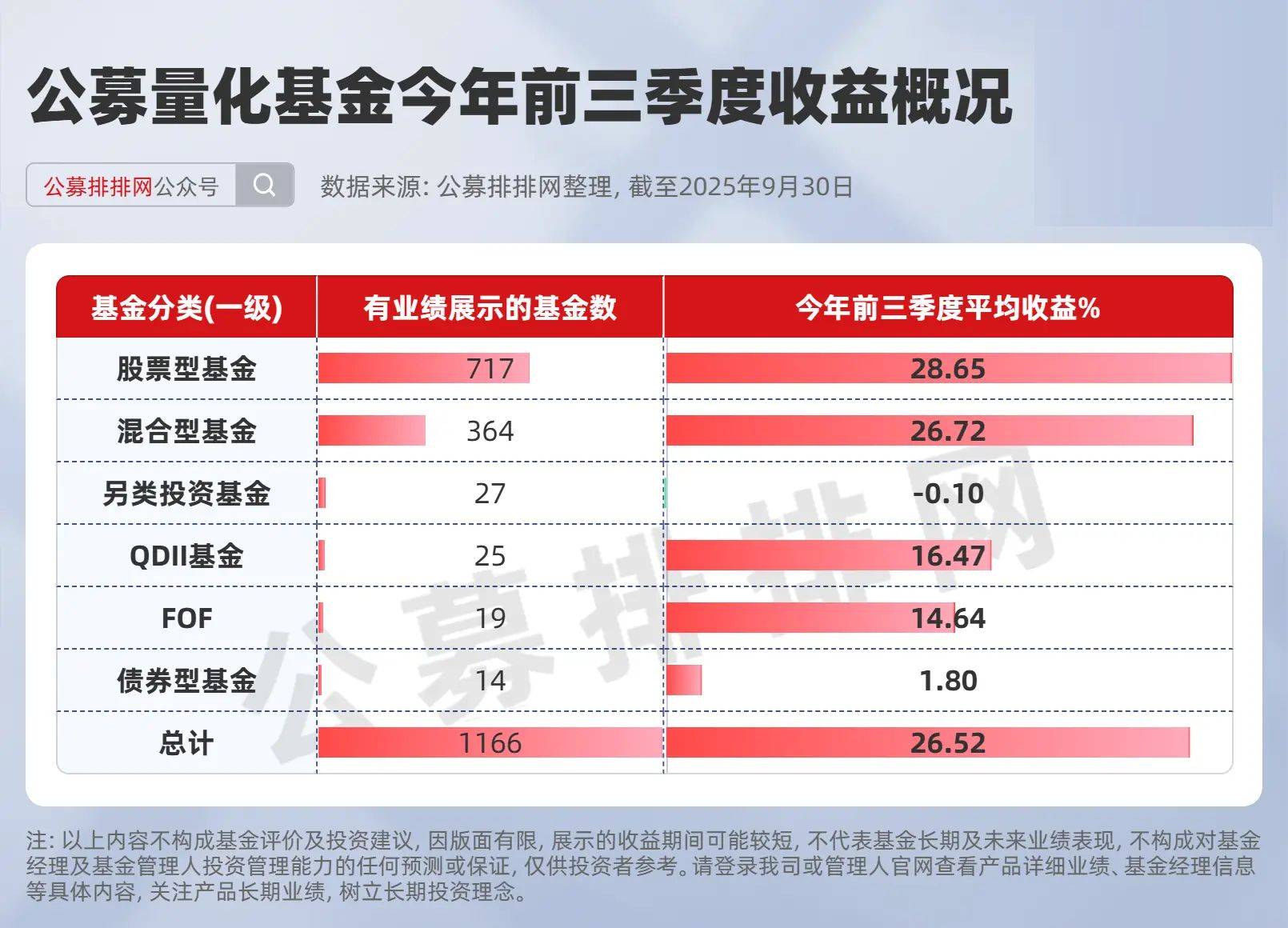
Core Viewpoint - The A-share market has experienced a structural rally characterized by "small-cap outperformance and high turnover" in the first three quarters of 2025, driven by "policy support and liquidity easing," leading to a significant recovery for public quantitative funds [1] Group 1: Performance of Quantitative Funds - A total of 1,166 public quantitative funds reported performance in the first three quarters, with an average return of 26.52% [1] - Among these, stock-type and mixed-type quantitative funds accounted for 1,081 funds (92.71%), with average returns of 28.65% and 26.72%, respectively [1] Group 2: Top Performing Stock-type Quantitative Funds - The threshold for the top 10 stock-type quantitative funds was set at a return of 57.64%, with 2 ordinary stock funds and 8 index stock funds making the list [3] - The top-performing funds are heavily focused on "hard technology" themes, including keywords like "semiconductors, ChiNext, and artificial intelligence" [3] - The top three stock-type quantitative funds are managed by Fu Guo Fund, Yongying Fund, and Jiashi Fund [3] Group 3: Top Performing Mixed-type Quantitative Funds - The threshold for the top 10 mixed-type quantitative funds was 55.09%, with 6 equity mixed funds and 4 flexible allocation funds [8] - The top three mixed-type quantitative funds are managed by Changxin Fund, Zheshang Securities Asset Management, and Beixin Ruifeng [8] Group 4: Notable Fund Managers - The "Yongying Shanghai Stock Exchange Science and Technology Innovation Board 100 Index Enhanced Initiation A" fund, managed by Qian Houxiang and Zhang Lu, achieved a return of 67.53% in the first three quarters [6] - The "Changxin Electronic Information Quantitative Mixed A" fund, managed by Zuo Jinbao and Song Hai'an, led with a return of 72.56% [11] - The top holdings of these funds include companies in innovative pharmaceuticals and semiconductors, with significant stock price increases noted [7][12]
一键配置港股龙头资产 摩根恒生港股通50ETF正在发行中
Zhong Guo Ji Jin Bao· 2025-10-15 07:41
Core Viewpoint - The Hong Kong stock market has gained significant attention this year, driven by substantial inflows of southbound capital and emerging industrial opportunities, leading to increased market activity [1] Group 1: Market Activity and Capital Inflows - As of September 30, 2025, southbound capital net purchases reached a record high of 1.17 trillion HKD, the highest since the establishment of the Hong Kong Stock Connect in 2014, indicating strong investor confidence in the market [1] - The Morgan Fund's Morgan Hang Seng Stock Connect 50 ETF was officially launched on October 13, allowing investors to subscribe through various brokerage channels [1] Group 2: Index Composition and Sector Distribution - The Hang Seng Stock Connect 50 Index, compiled by the Hang Seng Index Company, includes the top 50 stocks within the Stock Connect that have high liquidity and market capitalization, reflecting the overall performance of high-quality enterprises in the Hong Kong stock market [1] - The index covers 11 primary sectors, with the top three being Consumer Discretionary (28.51%), Financials (27.12%), and Information Technology (25.26%), balancing traditional finance and emerging growth sectors [1] - The top ten weighted stocks include leading companies from both new economy and financial sectors, collectively accounting for over 60% of the index, highlighting the potential for investors to capture growth in core Hong Kong assets [1] Group 3: Product Features and Management - The Morgan Hang Seng Stock Connect 50 ETF features a unique dividend mechanism, where if the ETF's excess return relative to the benchmark index is positive on the last trading day of each quarter, a mandatory dividend will be distributed, with at least 60% of the excess return allocated to investors [2] - As of June 30, 2025, Morgan Asset Management is the second-largest active ETF manager globally, with an ETF management scale of 276 billion USD, and ranked first in net inflows for active ETFs in 2024 [2] - The proposed fund manager, Wei Zhihao, has 11 years of experience in the securities industry and has been managing funds since February 2021, including the Morgan S&P Hong Kong Stock Connect Low Volatility Dividend ETF and the Morgan Hang Seng Technology ETF [2]
惠理集团三只货币市场ETF明日在港上市 主要投资短期优质货币市场工具
Zhi Tong Cai Jing· 2025-10-15 07:36
Core Viewpoint - 惠理集团 is set to launch three money market exchange-traded funds (ETFs) on the Hong Kong Stock Exchange, aimed at providing capital preservation, stable returns, and low volatility for investors [1] Group 1: ETF Launch Details - The three ETFs include 惠理港元货币市场ETF (03421), 惠理人民币货币市场ETF (03420 for HKD counter and 83420 for RMB counter), and 惠理美元货币市场ETF (03480 for HKD counter and 9480 for USD counter) [1] - These ETFs will primarily invest in short-term high-quality money market instruments issued by governments, quasi-governments, international organizations, financial institutions, and corporations [1] Group 2: Investment Strategy and Market Context - The ETFs are designed to allow daily trading without a lock-up period, enabling investors to quickly access their funds [1] - The Chief Investment Officer of Fixed Income at 惠理, 叶浩华, stated that the launch of these ETFs in the current favorable market environment will help investors utilize idle funds while balancing capital preservation and liquidity [1] - As of September 24, 2025, global money market funds have seen significant inflows, with assets under management reaching approximately $7.3 trillion [1]
晶品特装股价涨5.08%,中欧基金旗下1只基金位居十大流通股东,持有88万股浮盈赚取401.28万元
Xin Lang Cai Jing· 2025-10-15 07:22
Core Viewpoint - Jingpin Special Equipment Co., Ltd. has seen a stock price increase of 5.08% to 94.28 CNY per share, with a market capitalization of 7.133 billion CNY, indicating strong market interest in the company [1] Company Overview - Jingpin Special Equipment, established on July 9, 2009, and listed on December 8, 2022, is located in Changping District, Beijing. The company specializes in the research, production, and sales of optoelectronic reconnaissance equipment and military robots [1] - The revenue composition of the company includes: special robots (39.03%), intelligent manufacturing (23.71%), simulation and emulation (18.99%), intelligent sensing equipment (16.16%), technical services (2.10%), and others (0.02%) [1] Shareholder Information - Among the top ten circulating shareholders, a fund under China Europe Fund, specifically the China Europe Industry Outlook Mixed A (012390), has entered the list, holding 880,000 shares, which is 2.49% of the circulating shares. The estimated floating profit today is approximately 4.0128 million CNY [2] - The China Europe Industry Outlook Mixed A fund was established on June 16, 2021, with a current scale of 1.466 billion CNY. Year-to-date returns are 14.6%, ranking 4977 out of 8161 in its category, while the one-year return is 20.06%, ranking 3851 out of 8015 [2] Fund Performance - The fund manager of China Europe Industry Outlook Mixed A is Li Shuai, who has been in the position for 10 years and 84 days. The total asset scale of the fund is 4.479 billion CNY, with the best fund return during his tenure being 101.5% and the worst being -26.19% [3][5] Top Holdings - Another fund under China Europe Fund, the China Europe High-end Equipment Stock Initiation A (016847), has increased its holdings in Jingpin Special Equipment by 370,100 shares, totaling 500,100 shares, which constitutes 5.22% of the fund's net value. The estimated floating profit today is around 2.2803 million CNY [4] - The China Europe High-end Equipment Stock Initiation A fund was established on November 14, 2022, with a current scale of 170 million CNY. Year-to-date returns are 29.54%, ranking 1525 out of 4220, while the one-year return is 27.02%, ranking 1772 out of 3857 [4]

中国国新投资成立产投私募基金管理公司
Zheng Quan Shi Bao Wang· 2025-10-15 06:26
Group 1 - The establishment of Guoxin Chantuo Private Fund Management (Beijing) Co., Ltd. has been reported, with a registered capital of 100 million yuan [1] - The legal representative of the new company is Wu Jun, indicating a leadership structure [1] - The company's business scope includes private equity fund management and venture capital fund management services [1] Group 2 - Guoxin Chantuo is wholly owned by China Guoxin Holdings Co., Ltd., reflecting a strong backing from a significant state-owned enterprise [1]