
基金

Search documents
国投瑞银基金:将积极解决白银LOF投资者诉求
Qi Huo Ri Bao Wang· 2026-02-06 12:56
Core Viewpoint - Guotou Ruijin Fund has announced its commitment to actively address investor concerns regarding the valuation adjustment of the Silver LOF fund, emphasizing investor rights protection and transparency in the process [1] Group 1: Company Actions - On February 6, Guotou Ruijin Fund released an announcement regarding its proactive approach to resolving investor claims related to the Silver LOF fund [1] - The company has established a working group to develop relevant action plans to facilitate investor claims through mediation, arbitration, and other legal channels [1] - Guotou Ruijin Fund aims to ensure the effective execution of resolutions and has the capability to safeguard investors' legal rights [1]
白银LOF五连跌停,超1.7万人集体投诉
Di Yi Cai Jing Zi Xun· 2026-02-06 12:19
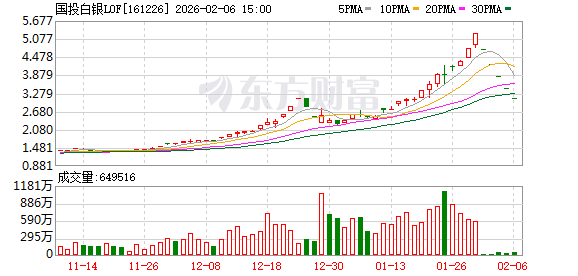
2026.02.06 本文字数:3315,阅读时长大约5分钟 作者 |第一财经 曹璐 当专业金融机构为"公平"而调整规则时,为何却引发了上万条"不公平"的集体投诉? 对于买了国投白银LOF的投资者来说,过去一周的体验大概是:眼看着单日净值"神秘"蒸发超30%,然 后在手机上挂单、排队,却怎么也"挤"不出那扇已经连续五天的跌停大门。一场由国际白银暴跌引发的 风波,正演变为一场规则、流动性与信任的连环考验。 短短数日,已有超过1.7万人维权投诉。从深夜的估值调整公告,到社交平台刷屏的维权教程,为何理 论上为了保护所有持有人的技术操作,最终却让众多投资者感觉自己成了"被困住的那一个"? 2月6日,针对投资者关注的问题,国投瑞银基金公告称,已成立工作小组,正在抓紧研究制定相关工作 方案,支持投资者便捷地通过和解、调解、仲裁等渠道或方式依法解决诉求,具体情况将另行公告。 从单日暴跌30%到连续五个跌停 2月6日,国投白银LOF开盘再度跌停,这已是该基金连续第五个交易日跌停。截至当日收盘,该基金封 单金额近23亿元,成交额超2亿元,溢价率仍高达28.73%。此前四个交易日同样呈现类似走势,每日封 单金额均在27亿元以上。 ...


事关白银基金!国投瑞银最新公告
Zhong Guo Ji Jin Bao· 2026-02-06 12:05
【导读】国投瑞银公告:积极解决白银(LOF)基金投资者诉求 国投白银LOF近期实施的估值调整及发布的相关公告,引发投资者高度关注。 国投瑞银表示,公司将高度重视并充分尊重每一位投资者,认真听取意见,继续通过热线电话、官方邮 件等方式与投资者积极沟通。 今日国投瑞银基金发布公告称,公司将秉持依法公开原则,积极回应投资者诉求,努力降低相关估值调 整对投资者的影响,保护投资者合法权益。同时,公司已成立工作小组,正在抓紧研究制定相关工作方 案,支持投资者便捷地通过和解、调解、仲裁等渠道或方式依法解决诉求,具体情况将另行公告。公司 将积极支持和解、调解、仲裁的有效执行,也有能力保障投资者的合法权益。 ...
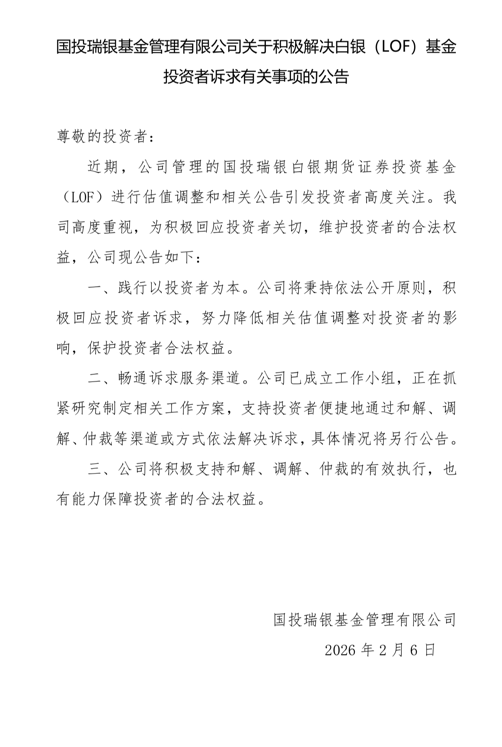
白银LOF五连跌停、逾1.7万人集体投诉 国投瑞银称“已成立工作小组”
Di Yi Cai Jing· 2026-02-06 11:55
Core Viewpoint - The crisis surrounding the Guotou Silver LOF fund has escalated due to a valuation adjustment that led to significant losses for investors, resulting in over 17,000 complaints and raising questions about fairness, liquidity, and trust in the financial system [2][4][6]. Group 1: Fund Performance and Investor Reaction - The Guotou Silver LOF fund experienced a 30% drop in a single day and has faced five consecutive trading days of trading halts, with a total order amount reaching nearly 2.3 billion yuan and a premium rate of 28.73% [3][4]. - Investors are struggling to sell their holdings, leading to widespread anxiety and the sharing of "escape guides" on various platforms [3][4]. - The fund's net asset value (NAV) dropped by 31.5% due to the adjustment in the valuation method, which was implemented in response to extreme market conditions [4][5]. Group 2: Valuation Adjustment and Its Justification - The valuation adjustment was made after a significant drop in silver prices on January 30, which prompted the fund to temporarily suspend trading and later adjust its valuation model to reflect the true market value [4][5]. - Guotou Ruijin Fund stated that the adjustment was necessary to prevent a "virtual high" NAV that could mislead investors about the fund's actual value [4][5]. Group 3: Communication and Compliance Issues - The fund management did not announce the valuation adjustment in advance, fearing it might lead to panic among investors and exacerbate liquidity issues [5][7]. - Industry experts have expressed mixed opinions on the compliance of the fund's actions, with some arguing that while the process may be compliant, it failed to consider investor experience and trust [7][8]. - The lack of timely communication has led to a significant erosion of trust among investors, who feel their right to information was compromised [8][9]. Group 4: Legal and Regulatory Considerations - Legal experts have raised concerns that the retrospective application of the valuation adjustment violates the principle of fair treatment for all fund shareholders, potentially leading to legal challenges [9][10]. - The principle of fair treatment is fundamental to the Securities Investment Fund Law, and any retrospective adjustments could undermine investor rights and trust in the fund management [10].
“独苗”产品遭遇极端行情:盘点国投白银LOF史诗级波动的八大争议漏洞
Xin Lang Cai Jing· 2026-02-06 11:32
Core Viewpoint - The recent drastic decline of the Guotou Ruijin Silver LOF fund, which fell by 31.5%, has raised significant concerns regarding valuation adjustments and the underlying flaws in product design, valuation, risk control, and communication within the public fund industry [1][11]. Group 1: Valuation Issues - The immediate trigger for the crisis was the fund's announcement on February 2 to switch its valuation benchmark from Shanghai Futures Exchange silver futures to international silver futures prices, leading to a significant drop in net asset value [1][11]. - The timing of the valuation adjustment has been widely criticized, as it occurred after a notable decline in international silver prices, raising questions about the fairness of the adjustment process [1][11]. - The fund's design did not adequately account for extreme market conditions where domestic and international silver prices diverge significantly, challenging the fairness of applying international price fluctuations directly to a portfolio primarily composed of domestic contracts [3][14]. Group 2: Communication and Transparency - The fund management's decision to announce valuation changes post-market hours has been criticized for creating information asymmetry, particularly affecting investors who were trading during the day [2][12]. - The official explanations provided by the fund company focused on technical processes rather than addressing the sudden nature of the valuation adjustment, leading to a loss of trust among investors [4][15]. Group 3: Investor Management and Risk - The fund's high volatility, characteristic of commodity futures, was not sufficiently communicated to investors, many of whom appeared unaware of the inherent risks associated with such products [5][16]. - The redemption mechanism during extreme market conditions revealed mismatches between estimated and confirmed net values, causing additional financial burdens for investors [6][17]. - The fund's design failed to effectively manage liquidity crises and the functioning of arbitrage mechanisms, which became ineffective during periods of significant price divergence [8][18]. Group 4: Systemic Issues in Product Design - The incident highlights broader systemic issues within the product category, particularly regarding valuation, risk control, and liquidity support for commodity-linked funds during extreme market fluctuations [9][19]. - The event serves as a critical lesson for fund managers about the importance of comprehensive risk management and the need for robust contingency plans in the face of market volatility [10][20].
视频|十年激荡,谁主沉浮?中国ETF市场TOP20阵营洗牌:华夏、易方达“双雄争霸” 华宝华安融通“掉队”
Xin Lang Cai Jing· 2026-02-06 11:31
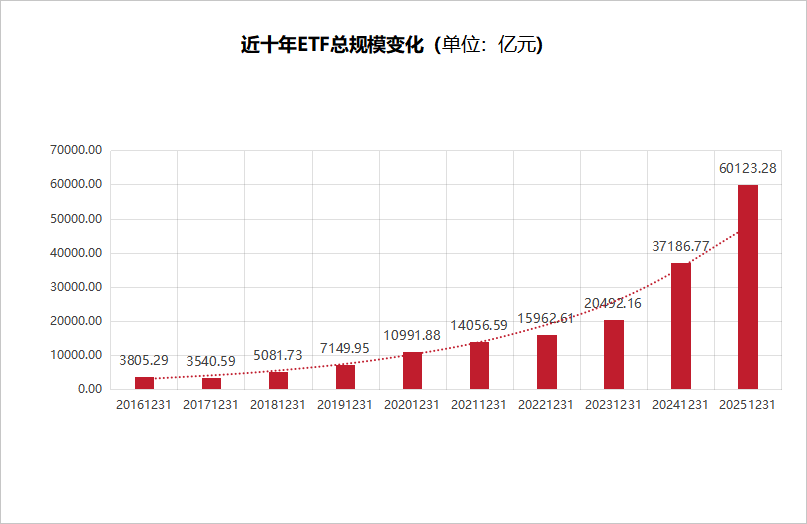
Core Insights - The past decade has been a golden era for the Chinese public fund industry, particularly for Exchange-Traded Funds (ETFs), which have transformed from niche investment tools to mainstream asset allocation options, accommodating trillions of yuan in funds and a wide variety of products [1][9] Market Overview - The total scale of the Chinese ETF market surged from approximately 380.5 billion yuan on December 31, 2016, to over 6.01 trillion yuan by December 31, 2025, marking a remarkable 15-fold increase over ten years [2][10] - Key milestones include the ETF market surpassing 1 trillion yuan in October 2020, reaching 2.05 trillion yuan by the end of 2023, and experiencing significant growth to exceed 3 trillion yuan by September 2024, with projections to break 4 trillion, 5 trillion, and 6 trillion yuan in 2025 [2][10] - The number of ETF products increased from 146 to 1,381, nearly a ninefold growth, providing investors with diverse options across domestic and international markets [4][12] - The number of fund companies managing ETFs rose from 33 to 57, indicating a growing interest from various institutions in this expanding market [4][12] Evolution of Top 20 Fund Companies - The rankings of leading fund companies have undergone significant changes, illustrating the market principle of "no progress means regression" [5][13] - Huaxia Fund and E Fund have emerged as the dominant leaders, with Huaxia's ETF management scale reaching 957 billion yuan (an 18.2-fold increase) and E Fund at 879.6 billion yuan (a 29.4-fold increase) by the end of 2025 [5][13] - Other notable performers include Haitong Securities, which rose from sixth to third place with a 26.1-fold growth, and Guotai Fund, which climbed from 16th to 7th place with a growth exceeding 53 times [5][13][6] - Some previously leading firms, such as Hua Bao Fund and Nan Fang Fund, have seen their rankings decline despite achieving growth, highlighting the competitive dynamics within the industry [6][14] Trend Insights - The changes in rankings among top companies reflect differences in product strategy and the ability to seize market opportunities [7][15] - Leading firms like Huaxia and E Fund have maintained their edge through comprehensive product line strategies and channel advantages [7][15] - Niche players have successfully carved out growth paths by focusing on specific areas such as Smart Beta and cross-border innovations, avoiding direct competition with giants [7][15] - By the end of 2025, 16 fund companies will have surpassed 100 billion yuan in scale, collectively accounting for 89.58% of the market, indicating a pronounced Matthew effect [7][16] Conclusion - The development of the Chinese ETF market over the past decade represents both a story of scale expansion and competitive evolution [8][17] - The current landscape features a "dual-super-multiple-strong" structure, but competition is far from over, with ongoing demands for product innovation and fee competition expected to intensify [8][17] - Continuous development of viable product lines and enhancement of investor experience will be crucial for market participants to secure their positions in the next decade [8][17]
高位成立难解套 金元顺安医疗健康成立4年半亏约6成
Zhong Guo Jing Ji Wang· 2026-02-06 11:29
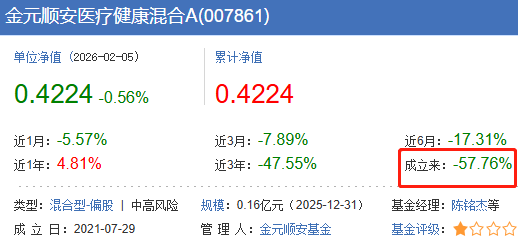
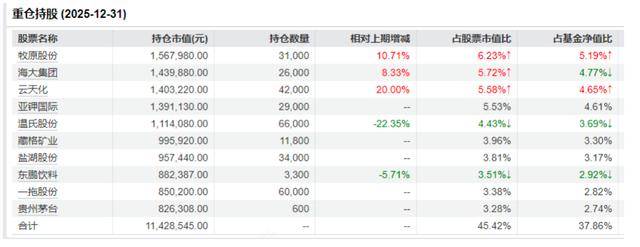
Core Insights - The article discusses the performance of actively managed equity funds established in 2021, revealing that over 50% of these funds are currently at a loss despite the A-share market being above 4000 points [1] - A total of 667 actively managed equity funds were analyzed, with approximately 362 funds showing negative returns since inception, including 86 funds with declines exceeding 30% and 34 funds with declines over 40% [1] - Specific funds such as Jin Yuan Shun An Medical Health and others have experienced significant losses, with some funds down over 50% since their inception [1] Fund Performance - Jin Yuan Shun An Medical Health Mixed A/C, established on July 29, 2021, has a cumulative return of -57.76% and -58.15% respectively as of February 5, 2026 [2] - The fund has undergone two manager changes, with no profitable returns recorded under any of the managers [1][2] - The fund's recent performance includes a -5.5% return in January and a -17.31% return over the past six months [2] Manager Changes - The current fund managers, Chen Mingjie and Zhang Haidong, have limited experience, with Chen having joined in June 2016 and Zhang starting in May 2025 [3] - Historical performance under different managers shows negative returns, with the most recent manager, Zhang, achieving a -9.20% return over 108 days [3] Top Holdings - As of the fourth quarter of 2025, the top ten holdings of the fund include companies such as Sangfor Technologies, Baidu Tianheng, and WuXi AppTec [4]
国投瑞银突发公告!回应“白银基金”估值调整
Shen Zhen Shang Bao· 2026-02-06 11:27
Group 1 - The company, Guotou Ruijin, has announced its commitment to address investor concerns following significant losses due to a sharp decline in net asset value [1] - A working group has been established to develop plans for facilitating resolutions for investors through mediation, arbitration, and other legal channels [1] - The company emphasizes its ability to protect investors' legal rights and will ensure fair pricing in fund operations and valuations [1] Group 2 - On February 6, Guotou Ruijin's silver LOF fund experienced its fifth consecutive trading halt, closing at 3.099 yuan, reflecting a weekly decline of 41% [1] - The fund's net asset value dropped by 31.5% on February 2, triggered by adjustments based on international silver price fluctuations [1] - The fund had a premium rate of 28.73% as of February 5, prior to the valuation adjustment announcement [1]

背靠农行陷发展困局 农银汇理基金业绩规模双承压 |基金观察
Sou Hu Cai Jing· 2026-02-06 11:25
Core Viewpoint - Agricultural Bank of China-backed fund company, Agricultural Bank of China Huiri Fund, has faced multiple development bottlenecks over the past year, including poor product performance, ineffective fund managers, continuous shrinkage in management scale, and failed shareholder meetings, leading to a significant decline in net profit from 648 million yuan to 248 million yuan, a drop of 61.7% [1] Performance Decline: Equity Products Hit Hard - Despite a recovering public fund market, Agricultural Bank of China Huiri Fund's performance remains sluggish, particularly in equity products, which have seen an absolute return rate of -32.43% over the past three years, placing it in the bottom 10% of the industry [2] - The Agricultural Bank of China Huiri Quality Agriculture Fund, launched in November 2022, has consistently underperformed, with its A-class share net value at 0.8485 and a one-year return of 16.76%, significantly lower than the benchmark of 22.74% and the CSI 300's 23.63% [2] Scale Shrinkage: Weakening Channel Advantage - The management scale of Agricultural Bank of China Huiri Fund has decreased from a peak of 267.9 billion yuan to 226 billion yuan, a nearly 13% reduction, with its industry ranking dropping to 38th [14] - The fund's equity assets have seen a dramatic decline from nearly 80 billion yuan to less than 30 billion yuan, with a 46% drop in equity fund scale and a 23.4% drop in bond fund scale [14] Fund Manager Turmoil: Core Talent Loss - The departure of key fund managers has contributed to the fund's performance decline, with former star manager Zhao Yi leaving after a year, leading to significant losses in the funds he managed [8] - Current fund manager Gu Chao has seen all four funds under his management incur losses, with a maximum loss of 24.11% [9] Fund Management Challenges: High Turnover and Lack of Stability - The fund's research and investment team is relatively small, with high turnover rates among core personnel, making it difficult to establish a stable investment logic and core competitiveness [15] - The company has attempted to launch new products, such as the Agricultural Bank of China Ruiheng Bond Fund, but market response remains to be seen [15]
白银LOF五连跌停、逾1.7万人集体投诉,国投瑞银称“已成立工作小组”
Di Yi Cai Jing Zi Xun· 2026-02-06 11:22
当专业金融机构为"公平"而调整规则时,为何却引发了上万条"不公平"的集体投诉? 对于买了国投白银LOF的投资者来说,过去一周的体验大概是:眼看着单日净值"神秘"蒸发超30%,然 后在手机上挂单、排队,却怎么也"挤"不出那扇已经连续五天的跌停大门。一场由国际白银暴跌引发的 风波,正演变为一场规则、流动性与信任的连环考验。 短短数日,已有超过1.7万人维权投诉。从深夜的估值调整公告,到社交平台刷屏的维权教程,为何理 论上为了保护所有持有人的技术操作,最终却让众多投资者感觉自己成了"被困住的那一个"? 2月6日,针对投资者关注的问题,国投瑞银基金公告称,已成立工作小组,正在抓紧研究制定相关工作 方案,支持投资者便捷地通过和解、调解、仲裁等渠道或方式依法解决诉求,具体情况将另行公告。 从单日暴跌30%到连续五个跌停 2月6日,国投白银LOF开盘再度跌停,这已是该基金连续第五个交易日跌停。截至当日收盘,该基金封 单金额近23亿元,成交额超2亿元,溢价率仍高达28.73%。此前四个交易日同样呈现类似走势,每日封 单金额均在27亿元以上。 "卖不出去"成为数万投资者的共同困境,"跌停逃生指南""挂单技巧"等内容在各大投资平 ...