
外卖

Search documents
最新!美团、淘宝闪购、饿了么、京东同日发文!
Sou Hu Cai Jing· 2025-08-01 04:22
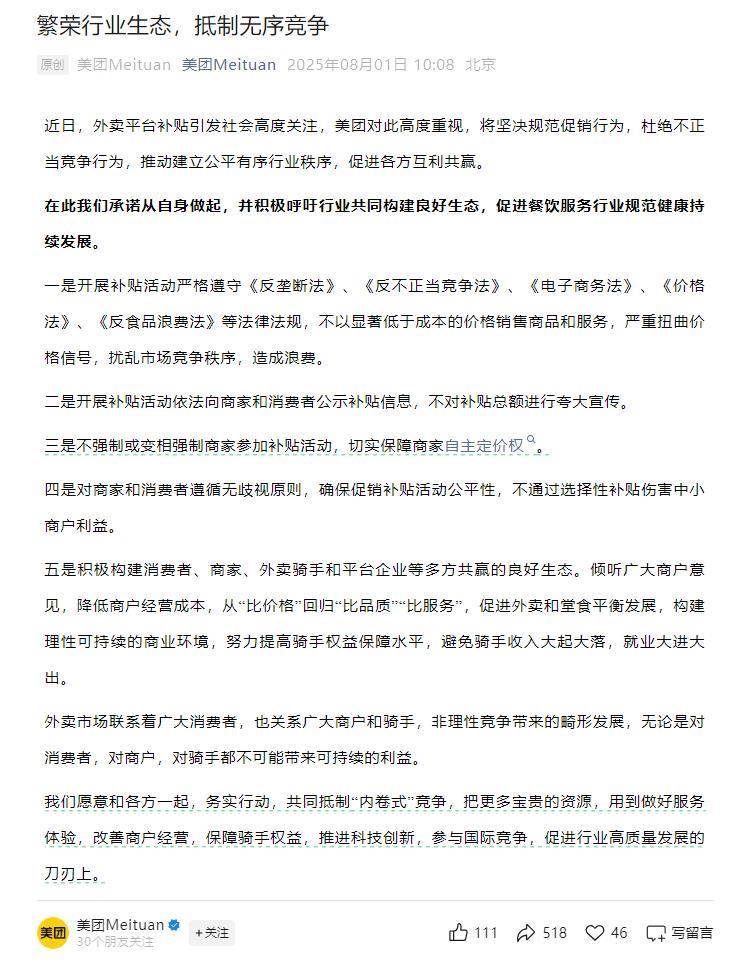
8月1日上午,美团发文《繁荣行业生态,抵制无序竞争》,淘宝闪购、饿了么发文《持续提升服务 推动良性竞争 激发消费烟火气》,京东 发文《践行主体责任和社会责任 共建外卖行业健康生态》,承诺将抵制恶性竞争、规范促销补贴、提升服务质量。 美团官微发文称,外卖平台补贴近日引发社会高度关注,美团对此高度重视,将坚决规范促销行为,杜绝不正当竞争行为,推动建立公平有 序行业秩序,促进各方互利共赢。承诺从自身做起,并积极呼吁行业共同构建良好生态,促进餐饮服务行业规范健康持续发展。其中包括, 开展补贴活动严格遵守相关法律法规,依法向商家和消费者公示补贴信息,不强制或变相强制商家参加补贴活动,切实保障商家自主定价权 等。 极目新闻记者 康旭阳 外卖平台纷纷发文,呼吁抵制恶性竞争、规范促销补贴! 美团方面称,愿意和各方一起,务实行动,共同抵制"内卷式"竞争,把更多宝贵的资源,用到做好服务体验,改善商户经营,保障骑手权 益,推进科技创新,参与国际竞争,促进行业高质量发展的刀刃上。 美团发文抵制无序竞争 淘宝App同日上午也在规则中心发文,承诺将构筑公平透明、各方共赢的机制。包括从消费者和商家需求出发,合理规划发放补贴;坚决抵 制恶性 ...



京东:抵制“0元购”等恶性补贴
Xin Lang Cai Jing· 2025-08-01 04:17
Core Viewpoint - The article emphasizes the need for a healthy ecosystem in the food delivery industry, advocating for the cessation of aggressive promotional practices like "0 yuan purchase" and promoting a focus on quality and service over subsidies [1][2] Group 1: Commitment to Industry Standards - The company commits to regulating subsidy practices, rejecting unfair competition, and eliminating harmful promotional tactics [1] - A transparent subsidy mechanism will be established, ensuring that marketing activities are publicly disclosed to merchants and consumers [1] Group 2: Quality and Service Enhancement - The company aims to resist vicious competition by focusing on differentiated products and improving service quality, thereby shifting the industry focus from "subsidy competition" to "quality and service competition" [1] - Continuous efforts will be made to uphold food safety and integrity in operations, enhancing the overall consumer experience [1] Group 3: Promoting Mutual Benefits - The company will provide various incentives to merchants, including commission incentives, advertising support, and delivery fee subsidies, to foster better business operations [2] - There will be an emphasis on improving the welfare of delivery riders, enhancing their professional dignity and sense of gain [2] - The goal is to create a win-win ecosystem involving consumers, merchants, riders, and the platform [2]
美团、淘宝闪购、饿了么、京东同日发文表态
财联社· 2025-08-01 04:10
同时,美团承诺从自身做起,并积极呼吁行业共同构建良好生态,促进餐饮服务行业规范健康持续发展。 具体 如下: 8月1日, 美团发文《繁荣行业生态,抵制无序竞争》,淘宝闪购及饿了么发文《持续提升服务 推动良性竞争 激 发消费烟火气》,京东发文 《 践行主体责任和社会责任 共建外卖行业健康生态 》 。 文章 先后提及,不以显著 低于成本的价格销售商品和服务,严重扭曲价格信号,扰乱市场竞争秩序,造成浪费。坚决抵制恶性竞争。 美团发文《繁荣行业生态,抵制无序竞争》称,外卖平台补贴近日引发社会高度关注,美团对此高度重视,将坚决 规范促销行为,杜绝不正当竞争行为,推动建立公平有序行业秩序,促进各方互利共赢。 同日,淘宝闪购及饿了么联合发文,称坚决抵制恶性竞争,合作促进生态共赢,并承诺将进一步重点做好以下四项 工作: 同日,"京东黑板报"也发文称,近期,外卖行业补贴引发社会广泛关注,不少行业协会、商家发声,希望停止"0 元购"等内卷式补贴促销行为,构建良好行业生态,实现多方互利共赢良性发展。 京东承诺: 一、规范补贴行为。 京东外卖将继续坚持反内卷立场,坚决杜绝不正当竞争,抵制"0元购"等恶性补贴,绝不以 冲单量体现市场地位 ...

美团、淘宝、饿了么、京东同日发声:抵制无序竞争
2 1 Shi Ji Jing Ji Bao Dao· 2025-08-01 04:09
Core Viewpoint - The takeaway from the articles is the collective commitment of major food delivery platforms to curb irrational competition and promote a healthier industry ecosystem through standardized promotional practices and enhanced service quality [1][2]. Group 1: Company Commitments - Meituan has publicly committed to regulating promotional activities, ensuring compliance with antitrust laws, and not selling below cost [1]. - Ele.me and Taobao have pledged to respect merchants' rights and avoid irrational promotions like "0 yuan purchases," focusing instead on improving delivery efficiency and service experience [1]. - JD.com has announced its strategy to resist vicious competition by enhancing product quality and service, aiming to shift the focus from subsidies to quality and service [2]. Group 2: Regulatory Environment - The Chinese regulatory authorities have previously intervened, with the State Administration for Market Regulation (SAMR) conducting discussions with major platforms to ensure fair competition and lawful operations [2]. - Multiple provincial and municipal restaurant industry associations have issued statements urging food delivery platforms to cease "involution-style" competition, indicating a broader industry push for reform [2].
抵制无序竞争!美团、淘宝闪购&饿了么同步发声
Sou Hu Cai Jing· 2025-08-01 04:00
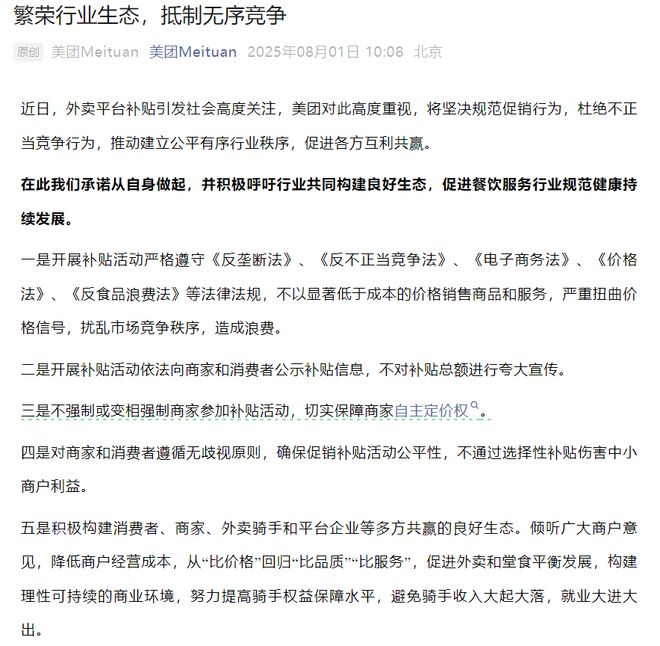
与此同时,饿了么、淘宝闪购同步发文《持续提升服务 推动良性竞争 激发消费烟火气》表示,将进一步重点做好以下四项工作:从消费者和商家需求出 发,合理规划发放补贴;坚决抵制恶性竞争;持续提升服务质量;合作促进生态共赢。 以下为美团《繁荣行业生态,抵制无序竞争》全文: 近日,外卖平台补贴引发社会高度关注,美团对此高度重视,将坚决规范促销行为,杜绝不正当竞争行为,推动建立公平有序行业秩序,促进各方互利共 赢。 在此我们承诺从自身做起,并积极呼吁行业共同构建良好生态,促进餐饮服务行业规范健康持续发展。 一是开展补贴活动严格遵守《反垄断法》、《反不正当竞争法》、《电子商务法》、《价格法》、《反食品浪费法》等法律法规,不以显著低于成本的价格 销售商品和服务,严重扭曲价格信号,扰乱市场竞争秩序,造成浪费。 来源:猎云网 "外卖大战",迎来拐点。 8月1日,美团发布《繁荣行业生态,抵制无序竞争》表示,"将坚决规范促销行为,杜绝不正当竞争行为",并积极呼吁行业共同构建良好生态,促进餐饮服 务行业规范健康持续发展。 对于补贴活动,美团将:不以显著低于成本的价格销售商品和服务,严重扭曲价格信号,扰乱市场竞争秩序,造成浪费;向商家和消 ...


京东:坚决杜绝不正当竞争 抵制“0元购”等恶性补贴
Xin Lang Ke Ji· 2025-08-01 03:53
Core Viewpoint - The article emphasizes the commitment of JD.com to establish a healthy ecosystem in the food delivery industry by resisting unhealthy competition and promoting transparency in subsidy mechanisms [1][2]. Group 1: Subsidy Regulation - JD.com will continue to oppose unhealthy competition and resist "0 yuan purchase" and other malicious subsidies, ensuring that market position is not reflected through order volume [2][3]. - The company aims to create a simple and transparent subsidy mechanism, legally disclosing marketing activities to merchants and consumers, allowing merchants to operate and participate in promotional activities autonomously [2]. Group 2: Quality and Service Improvement - The focus will shift from competing on subsidies to competing on quality and service, with an emphasis on differentiated specialty dishes and enhanced service quality [2][3]. - JD.com is committed to maintaining food safety and integrity in operations, promoting a quality consumption experience, and actively working against food waste [2]. Group 3: Mutual Benefit Promotion - The company will provide various incentives to merchants, including commission incentives, advertising support, traffic assistance, delivery fee subsidies, and exclusive after-sales services to help merchants operate better [3]. - There will be efforts to optimize rider protection, enhancing the dignity and sense of gain for delivery riders, aiming to create a win-win ecosystem for consumers, merchants, riders, and platforms [3].
美团、淘宝闪购、饿了么同日发文抵制恶性竞争,阿里、美团股价盘中涨超2%
Xin Lang Cai Jing· 2025-08-01 03:49
Core Viewpoint - Major companies in the food delivery and e-commerce sectors, including Meituan, Taobao, and Ele.me, have united to resist disorderly competition and promote fair industry practices, aiming for a sustainable and healthy development of the restaurant service industry [1][2]. Group 1: Company Commitments - Meituan has committed to adhering to various laws and regulations, including the Anti-Monopoly Law and the Electronic Commerce Law, to avoid selling goods and services at prices significantly below cost, which distorts market signals [1]. - Meituan will ensure transparency in subsidy activities by publicly disclosing subsidy information to merchants and consumers, avoiding exaggerated claims about total subsidies [1]. - Meituan will not force or indirectly compel merchants to participate in subsidy activities, thereby safeguarding merchants' pricing autonomy [1]. - The company emphasizes a non-discriminatory approach to merchants and consumers, ensuring fairness in promotional subsidy activities and protecting the interests of small and medium-sized businesses [1]. - Taobao and Ele.me have pledged to respect merchants' rights and establish a mechanism for strict oversight and governance regarding subsidy distribution [2]. Group 2: Industry Collaboration - Taobao and Ele.me aim to actively eliminate unfair competition and stimulate consumer potential in emerging markets while respecting market operation rules and ensuring merchants' profitability [2]. - The companies plan to enhance service quality continuously and collaborate with various stakeholders to maintain a healthy operating order in the offline market [2]. - A feedback system has been established to address core issues such as merchant participation, product quality, and rider rights, with ongoing discussions taking place across different regions [2]. Group 3: Market Reaction - Following the announcement on August 1, Meituan's stock price rose nearly 3%, while Alibaba's stock price increased by over 3% [3]. - The market regulatory authority had previously engaged with Meituan, Ele.me, and JD.com, urging them to comply with relevant laws and promote rational competition [3].
淘宝闪购、饿了么、美团共同发文表态
Di Yi Cai Jing Zi Xun· 2025-08-01 03:42
Core Viewpoint - The companies in the food delivery industry are emphasizing the need to establish a fair and orderly market environment, resisting irrational competition and promoting a healthy ecosystem for sustainable development [1][2][4]. Group 1: Company Initiatives - Meituan has committed to regulating promotional activities and eliminating unfair competition, aiming to foster a mutually beneficial industry order [1]. - Taobao Shangu and Ele.me have pledged to resist malicious competition and focus on four key areas: rational subsidy distribution, eliminating unfair competition, enhancing service quality, and promoting ecosystem cooperation [2][4]. - The companies are establishing a mechanism to respect merchants' rights and ensure transparency in promotional activities, including a compensation mechanism for merchants [4][5]. Group 2: Industry Collaboration - The industry is working together to enhance service quality by providing diverse consumption scenarios and improving delivery network efficiency [2][5]. - A "listening-consulting-optimizing-feedback" system has been established to address core issues such as merchant participation, product quality, and rider rights, with multiple discussion forums being held across various locations [2][5]. - The companies are advocating for rational consumption and promoting green consumption practices to minimize waste [5].
美团、淘宝饿了么接连表态:抵制不正当竞争!补贴大战“急刹车”
Di Yi Cai Jing· 2025-08-01 03:39
Core Viewpoint - The recent competition among food delivery platforms, characterized by significant subsidies, is being curtailed as companies like Meituan and Alibaba's Taobao aim to regulate promotional activities and combat unfair competition [1][3][8]. Group 1: Market Response - Following discussions, marketing efforts across platforms have been reduced, although variations of large subsidies, such as zero-yuan purchases and one-cent purchases, continue [1][8]. - As of the report, Meituan and Alibaba's stocks rose over 2%, while JD.com saw an increase of over 1% [2]. Group 2: Regulatory Actions - On August 1, Meituan and Taobao, in conjunction with Ele.me, announced their commitment to resist unfair competition and regulate promotional activities due to heightened societal concern [3]. - Meituan described the recent subsidy wars as "disorderly competition," while Taobao and Ele.me referred to it as "malicious competition" [3]. Group 3: Compliance and Standards - Meituan outlined five key areas to promote a healthy and sustainable development of the food service industry, including adherence to various laws and regulations, transparency in subsidy information, and ensuring fair treatment of merchants [4][5][6][7]. - The platforms aim to create a win-win ecosystem for consumers, merchants, delivery riders, and platform companies, emphasizing that irrational competition harms all parties involved [7][8]. Group 4: Merchant Perspectives - Merchants have expressed concerns that the subsidy wars create a "false prosperity," with many feeling pressured to participate in subsidy activities to maintain order volume, leading to unsustainable business practices [9][11]. - A representative from a chain restaurant noted that the drastic price reductions due to subsidies could alter consumer behavior, making it difficult to return to normal pricing once subsidies are reduced [11]. Group 5: Long-term Implications - Analysts suggest that while subsidies effectively drive traffic, the challenge lies in retaining users post-subsidy, indicating a shift from a "capital war" to an "efficiency war" in the competitive landscape [11]. - The long-term success of platforms will depend on balancing user demand for low prices, ensuring rider rights, and achieving sustainable profitability for merchants, rather than relying solely on price wars [11].
外卖补贴急刹车!美团、淘宝、饿了么同日发声:抵制无序竞争
2 1 Shi Ji Jing Ji Bao Dao· 2025-08-01 03:16
Core Insights - The takeaway from the articles is that major food delivery platforms, Meituan and Ele.me, are taking steps to address and regulate unhealthy competition within the industry, emphasizing the need for fair practices and a sustainable ecosystem [1][2]. Group 1: Company Commitments - Meituan has publicly committed to regulating promotional activities, ensuring compliance with antitrust laws, and avoiding sales below cost [1] - The company promises to provide transparent information about subsidies and not to coerce merchants into participating in promotional activities, thereby safeguarding their pricing autonomy [1] - Meituan aims to create a win-win ecosystem for consumers, merchants, delivery personnel, and the platform itself, shifting focus from price competition to quality and service [1] Group 2: Industry Regulations - Regulatory bodies have already intervened in the competition among food delivery platforms, with multiple discussions held with companies like JD, Meituan, and Ele.me to ensure lawful and fair operations [2] - The State Administration for Market Regulation has reiterated the need for rational competition and has called for a collaborative ecosystem among the platforms [2] - Over ten provincial and municipal restaurant industry associations have issued statements urging food delivery platforms to cease "involution-style" competition [2]