
无序竞争

Search documents
暴涨近7%!“反内卷”仍在持续,焦炭第五轮提价全面落地
券商中国· 2025-08-05 09:33
Group 1 - The core viewpoint of the articles highlights the significant price increases in coking coal and coke, driven by the latest round of price hikes implemented by major steel mills in East and North China, with coking coal prices rising by 250-275 yuan/ton [1] - The fifth round of coke price increases has been fully implemented, with wet and dry coke prices raised by 50 yuan/ton and 55 yuan/ton respectively, marking a substantial upward trend in the market [1] - Coking coal futures experienced a sharp rise, with the main contract reaching a near 7% increase, indicating strong market momentum [1] Group 2 - Recent statistics show a decrease in the inventory of premium coal at sample mines, reaching the lowest level since March 2024, while independent coking enterprises and steel mills have seen slight increases in their coal inventories, reaching six-month highs [2] - In July, the black series products in both the spot and futures markets experienced year-on-year price increases, with the national steel price rising by 247 yuan/ton, reflecting a 7.2% month-on-month increase [2] - The trading volume in the futures market saw a remarkable growth, with coking coal trading volume increasing over 19 times year-on-year and 112.48% month-on-month, indicating a robust market activity [2]


外卖大战“停火”?三大平台集体发声
2 1 Shi Ji Jing Ji Bao Dao· 2025-08-01 13:31
Core Viewpoint - The competition in the food delivery industry is shifting from price wars to a focus on service, quality, and efficiency, with major platforms calling for a halt to disorderly competition and emphasizing the protection of riders and merchants' interests [1][2][6]. Group 1: Industry Competition Dynamics - Major platforms including Meituan, Taobao Ele.me, and JD have publicly committed to resisting disorderly competition, indicating a collective effort to foster a healthier industry ecosystem [1][2]. - The "delivery war" intensified with JD's entry into the market in Q2 2025, leading to aggressive competition among the three platforms, particularly around rider welfare and merchant commissions [3][5]. - The recent "subsidy war" initiated by Taobao Flash Sale, which involved a 500 billion yuan subsidy plan, has significantly increased order volumes, but many merchants report that their profits have not improved despite higher order counts [3][4]. Group 2: Regulatory and Market Responses - Regulatory bodies have been urging the cessation of disorderly competition across various industries, emphasizing that while competition can benefit consumers, it must adhere to certain rules to avoid negative consequences [2][6]. - Following government pressure, the platforms have increased their efforts to improve rider benefits and support merchants, indicating a shift in focus from aggressive pricing strategies to enhancing service quality [7][8]. Group 3: Future Directions in Competition - The industry is moving towards a model that prioritizes rider welfare and food safety, with initiatives such as Meituan's "Raccoon Canteen" and JD's investment in rider benefits and food safety measures [8][9][10]. - Companies are expected to invest significantly in improving the overall ecosystem, with Meituan planning to invest 100 billion yuan over three years to enhance food safety and transparency in the delivery process [8][9].


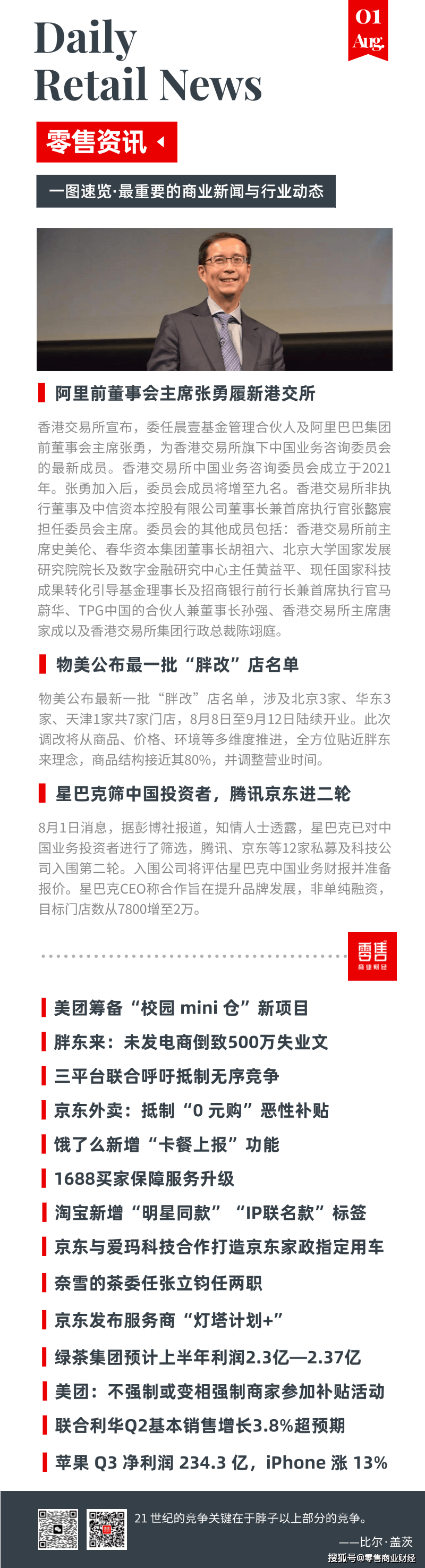
阿里前董事会主席张勇履新港交所;物美公布最一批“胖改”店名单
Sou Hu Cai Jing· 2025-08-01 12:25
Group 1 - Alibaba's former chairman Zhang Yong has been appointed as a new member of the Hong Kong Stock Exchange's China Business Advisory Committee, increasing the committee's membership to nine [6] - The committee was established in 2021 and is chaired by Zhang Jianchen, the non-executive director of the Hong Kong Stock Exchange [6][7] Group 2 - Wumart has announced the latest batch of "Fat Transformation" stores, involving seven locations across Beijing, East China, and Tianjin, set to open between August 8 and September 12 [8] - The transformation will focus on multiple dimensions including product offerings, pricing, and store environment, aiming to align closely with the Fat Donglai concept [8] Group 3 - Starbucks is reportedly screening investors for its China business, with Tencent and JD.com among the twelve companies advancing to the second round [10] - The collaboration aims to enhance brand development rather than merely seeking financing, with a target to increase store count from 7,800 to 20,000 [10] Group 4 - Meituan is preparing a new instant retail project called "Campus Mini Warehouse," targeting university campuses with small warehouses for high-frequency items [11] - The project will adopt a platform model, recruiting partners for warehouse and delivery services, prioritizing those with campus experience [11] Group 5 - The Green Tea Group expects a profit of approximately 230 million to 237 million yuan for the first half of 2025, a year-on-year increase of about 32% to 36% [22] - Adjusted net profit is anticipated to be around 247 million to 254 million yuan, reflecting a growth of 38% to 42% compared to the previous year [22] Group 6 - Unilever reported a 3.8% increase in underlying sales growth for Q2, exceeding expectations, with a slight decline in sales in the Chinese market [25] - The company is undergoing multiple transformations, including the planned spin-off of its ice cream business in November [25] Group 7 - Apple reported a net profit of $23.43 billion for Q3 2025, a 9% year-on-year increase, with revenue reaching $94.04 billion, up 9.6% [27] - iPhone revenue grew by 13% to $44.58 billion, and service revenue also increased by 13% to $27.42 billion, both exceeding market expectations [27]
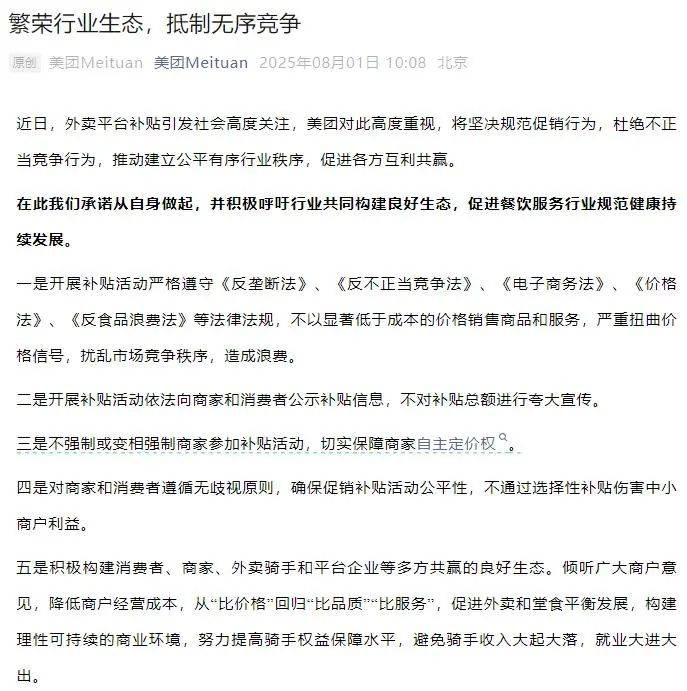
呼吁抵制无序竞争,美团、淘宝闪购、饿了么发文
Sou Hu Cai Jing· 2025-08-01 04:00
Core Points - Recent social concerns regarding subsidies from food delivery platforms have prompted Meituan to publish a statement advocating for a healthy industry ecosystem and resisting disorderly competition [1] - Meituan and other platforms like Taobao and Ele.me emphasize the negative impact of selling goods and services significantly below cost, which distorts price signals and disrupts market order [1] Group 1: Meituan's Commitment - Meituan has committed to regulating promotional activities and eliminating unfair competition to foster a fair and orderly industry environment [1] - The core commitments include strict adherence to various laws such as the Anti-Monopoly Law, Anti-Unfair Competition Law, E-Commerce Law, Price Law, and Anti-Food Waste Law [1] - Meituan will not sell goods and services at prices significantly below cost to avoid market disruption and waste [1] Group 2: Transparency and Fairness - The company will legally disclose subsidy information and avoid exaggerating the total amount of subsidies [1] - Meituan will not force or indirectly compel merchants to participate in subsidy activities, ensuring merchants' autonomy in pricing [1] - The platform will adhere to a non-discrimination principle for both merchants and consumers, avoiding selective subsidies that harm small and medium-sized businesses [1] Group 3: Sustainable Development - Meituan aims to create a win-win ecosystem for consumers, merchants, delivery personnel, and the platform by reducing merchant operating costs [1] - The focus will shift from price competition to quality and service competition, balancing the development of food delivery and dine-in services, and enhancing the rights and protections of delivery personnel [1]

外卖补贴急刹车!美团、淘宝、饿了么同日发声:抵制无序竞争
2 1 Shi Ji Jing Ji Bao Dao· 2025-08-01 03:16
Core Insights - The takeaway from the articles is that major food delivery platforms, Meituan and Ele.me, are taking steps to address and regulate unhealthy competition within the industry, emphasizing the need for fair practices and a sustainable ecosystem [1][2]. Group 1: Company Commitments - Meituan has publicly committed to regulating promotional activities, ensuring compliance with antitrust laws, and avoiding sales below cost [1] - The company promises to provide transparent information about subsidies and not to coerce merchants into participating in promotional activities, thereby safeguarding their pricing autonomy [1] - Meituan aims to create a win-win ecosystem for consumers, merchants, delivery personnel, and the platform itself, shifting focus from price competition to quality and service [1] Group 2: Industry Regulations - Regulatory bodies have already intervened in the competition among food delivery platforms, with multiple discussions held with companies like JD, Meituan, and Ele.me to ensure lawful and fair operations [2] - The State Administration for Market Regulation has reiterated the need for rational competition and has called for a collaborative ecosystem among the platforms [2] - Over ten provincial and municipal restaurant industry associations have issued statements urging food delivery platforms to cease "involution-style" competition [2]
北京大学经济学院教授苏剑:以制度突破破解市场壁垒 推动统一大市场建设向纵深发展
Shang Hai Zheng Quan Bao· 2025-07-30 14:38
Group 1 - The core viewpoint of the article emphasizes the need to deepen the construction of a unified national market to optimize market competition and lay a solid institutional foundation for high-quality economic development [1] - The current market faces issues such as local trade protection, high industry entry barriers, and household registration system restrictions, which hinder the free flow of goods and factors [1] - To improve market economic efficiency and release scale effects and division of labor dividends, it is essential to eliminate these barriers [1] Group 2 - The article discusses the importance of regulating "disorderly competition" among enterprises, suggesting that a clear definition of "disorderly competition" is necessary to avoid a one-size-fits-all approach in governance [1] - It is recommended to refine rules to distinguish between legitimate and malicious competition, aiming to curb disruptive market behaviors while protecting corporate innovation vitality [1] - In terms of capacity governance, addressing excess capacity and reducing low-level competition is crucial for stabilizing macroeconomic conditions and promoting high-quality industry development [2] Group 3 - The article highlights the need for standardized policies to regulate local government investment attraction behaviors, as excessive competition among local governments can burden finances and disrupt fair market conditions [2] - Establishing a unified policy benchmark is necessary to prevent local governments from engaging in harmful competition through "policy lowlands," ensuring that all enterprises compete on an equal footing [2] - Emphasizing the importance of the "two unwavering" principles, the article suggests that enhancing the operational confidence of private enterprises is vital for current economic development [2]
环球时报快评:走出“不得不卷”,外卖平台才能行稳致远
Huan Qiu Shi Bao· 2025-07-18 13:36
Group 1 - The market regulatory authority has summoned major platform companies like Ele.me, Meituan, and JD.com, urging them to comply with laws and regulations and to engage in rational competition [2] - The competitive landscape has been characterized by intense rivalry, with companies feeling compelled to engage in battles that may not be sustainable, leading to a distorted market mechanism [2] - The ongoing "burning money" strategies by some leading companies are creating market bubbles and harming overall industry and consumer interests, indicating a need for a more sustainable approach to competition [2] Group 2 - The platform economy should focus on service rather than capital competition, and the current subsidy wars among delivery platforms could serve as an opportunity to optimize industry competition [3] - Regulatory bodies are encouraged to play a more active role in defining subsidy limits based on company size and operational status, and to scrutinize practices like excessive spending to capture market share [3] - Companies are advised to move away from the mindset of "having to compete" and instead engage in rational competition for long-term stability and growth [3]

冠通每日交易策略-20250702
Guan Tong Qi Huo· 2025-07-02 11:06
Report Industry Investment Rating No relevant information provided. Core Views - Copper prices are mainly driven by the tight supply - demand situation caused by cross - regional flow due to the copper tariff, and future price fluctuations will be affected by the Fed's interest - rate cut expectations [10]. - For crude oil, with the easing of Middle - East geopolitical risks and seasonal factors, the supply - demand situation has improved marginally. It is recommended to cautiously buy bearish options [11][12]. - For asphalt, as it enters the peak season, it is recommended to buy the 09 - 12 spread at low prices while operating cautiously [13]. - PP, plastic, and PVC are all expected to be in a low - level oscillation pattern due to factors such as high inventory, weak demand, and falling crude oil prices [15][16][18]. - The upward momentum of soybean oil has weakened, and it is expected to maintain a range - bound oscillation [19]. - For rebar, if the production - restriction rumors continue to ferment or materialize, there is still room for an upward movement, but the risk of a pull - back due to rumor falsification should be watched out for [21]. - For hot - rolled coils, if production restrictions are intensified and demand does not weaken significantly, it may maintain a strong oscillation pattern; otherwise, weak demand may limit its upward space [22]. - For coking coal, although there is a tight supply expectation, the upward space is limited due to weak demand [24]. - For urea, it is mainly in a consolidation phase and still faces downward pressure [25][26]. Summary by Variety Carbonate Lithium - The average price of battery - grade and industrial - grade carbonate lithium has increased. The supply side shows that upstream prices are firm, and the production cost and output of domestic carbonate lithium are rising. The demand side indicates that downstream acceptance of high prices is low, and the overall production capacity is loose. The upward trend is mainly due to market sentiment, and the upward space is limited [3]. Soybean Meal - The main 09 contract of soybean meal closed down 0.57%. Internationally, the new US tax bill may benefit US soybean growers, and the soybean good - to - excellent rate is lower than expected. Domestically, the inventory of imported soybeans and soybean meal has increased. It is expected to show an oscillatory adjustment pattern [4][5]. Copper - The Shanghai copper market showed a strong trend. The US manufacturing PMI has been in contraction for four months. The supply of copper is still increasing, and the inventory in most regions is decreasing. The export demand has increased due to the copper tariff event, but the overall demand is weak. The main logic for the price increase is the tight supply expectation caused by cross - regional flow [9][10]. Crude Oil - After the US military's intervention in Iran, the subsequent retaliatory actions and cease - fire have affected market sentiment. The supply - demand situation has improved marginally, but the Middle - East geopolitical risks still need to be monitored. It is recommended to cautiously buy bearish options [11][12]. Asphalt - The supply side shows that the start - up rate has rebounded, and the expected output in July has increased. The demand side indicates that the start - up rate of downstream industries has fluctuated, and the inventory is at a low level. With the easing of geopolitical risks, it is recommended to operate cautiously and buy the 09 - 12 spread at low prices [13]. PP - The downstream start - up rate has decreased, and the enterprise start - up rate has increased. The inventory pressure is high. With the sharp drop in crude oil prices, it is expected to be in a low - level oscillation [14][15]. Plastic - The start - up rate has decreased, and the downstream start - up rate is at a low level. The inventory pressure is high. With the sharp drop in crude oil prices, it is expected to be in a low - level oscillation [16]. PVC - The start - up rate has decreased, and the downstream start - up rate is low. The export is restricted, and the inventory is high. With the sharp drop in crude oil prices, it is recommended to short at high prices [17][18]. Soybean Oil - The main 09 contract of soybean oil closed up 0.63%. Internationally, the US soybean planting area is slightly lower than expected, and the quarterly inventory is higher. Domestically, the oil - mill start - up rate has increased, and the inventory has accumulated. It is expected to maintain a range - bound oscillation [19]. Rebar - The main contract showed a trend of "bottom - fishing and upward movement". The supply contraction expectation has increased due to production - restriction rumors, but the demand is weak. The raw material prices have rebounded. If the rumors materialize, there is upward space, but there is also a risk of a pull - back [20][21]. Hot - Rolled Coils - The main contract showed an "oscillatory upward and breakthrough" pattern. The supply - demand structure is characterized by "continued inventory reduction and rigid - demand support". The production has slightly increased, the inventory pressure is small, and the demand has improved. It is recommended to focus on production - restriction implementation and policy trends [22]. Coking Coal - The price closed up more than 3%. The supply side is expected to contract due to safety inspections and capacity - clearance expectations. The demand side is relatively weak. The upward space is limited due to weak demand [24]. Urea - The futures price showed a strong oscillation. The supply side has both maintenance and resumption of production, and the daily output fluctuates slightly. The demand side is weak, and the inventory is mainly reduced through exports. It is mainly in a consolidation phase and faces downward pressure [25][26].
智能驾驶浪潮下的竞合博弈:从“无序竞争”到“产业质变”|直击百人会论坛2025
2 1 Shi Ji Jing Ji Bao Dao· 2025-03-31 12:36
Core Insights - The Chinese electric vehicle (EV) industry has experienced rapid growth over the past decade, with production and sales increasing from 78,500 and 74,800 units in 2014 to 12.88 million and 12.87 million units in 2024, representing over a hundredfold increase [1][2] - The industry is currently facing challenges such as declining profitability, with overall profits down 8% in 2024 and profit margins dropping to 4.3% [3] - The emergence of new players like Xiaomi, which delivered nearly 200,000 units of its first model in just one year, is reshaping the competitive landscape [1][2] Industry Growth and Challenges - The Chinese EV market accounted for 65% of global production in 2024, maintaining its position as the world's largest producer for ten consecutive years [2] - The average range of EVs has reached nearly 500 kilometers, and fast-charging technology allows for 80% charge in 15 minutes [3] - Despite technological advancements, the industry is experiencing unprecedented pain points, including a price war that threatens long-term profitability and innovation [3][5] Policy and Market Dynamics - Strong government support has been crucial for the rapid expansion of the EV sector, but future growth should focus on market-driven strategies [4] - The National Development and Reform Commission emphasizes the need for fair competition and regulatory measures to address issues like false advertising and market manipulation [4] - Industry leaders advocate for a shift from price competition to enhancing technological capabilities and product quality [5] Technological Innovation and Smart Driving - Intelligent driving technology is seen as a key area for breakthrough, with predictions that L2 and above smart driving vehicles will exceed 90% market penetration by 2030 [5][6] - The integration of AI and advanced communication technologies is expected to redefine the automotive landscape, making collaboration essential for success [7] - Safety and regulatory frameworks are critical for the advancement of autonomous driving technologies, with calls for clear legal guidelines to support development [6][7]
