新能源

Search documents
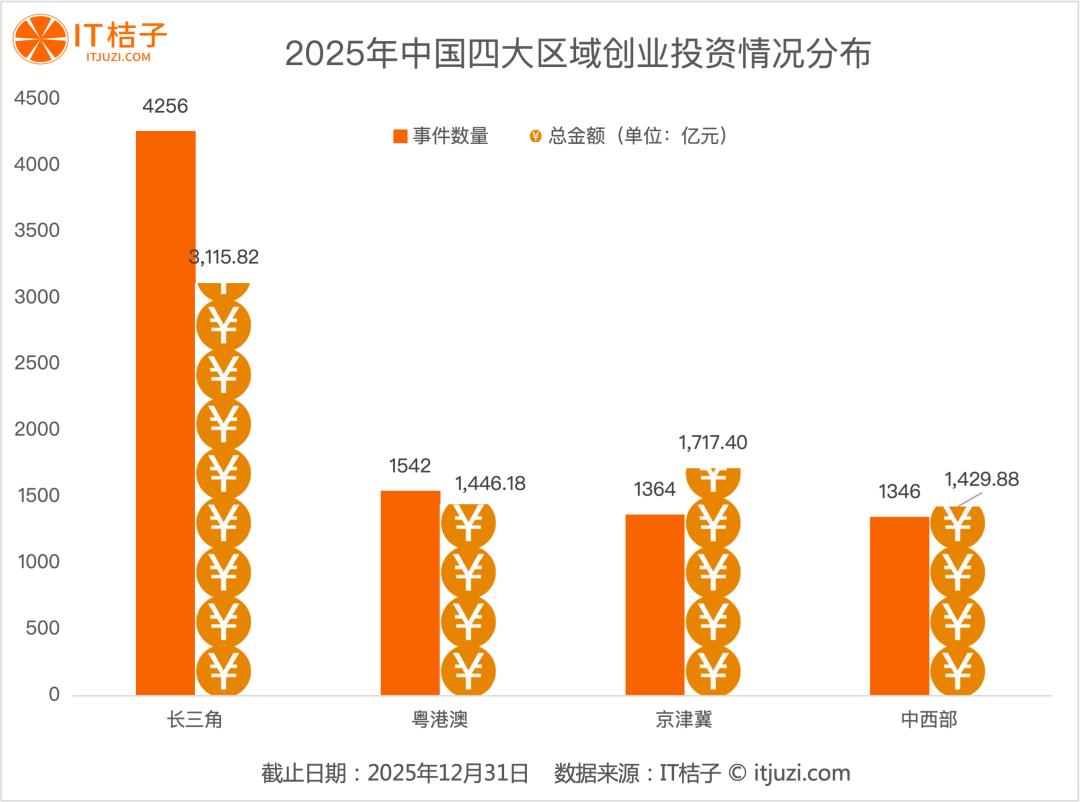
长三角融资占了全国的近半,京津冀屈居第2 梯队
3 6 Ke· 2026-01-13 12:16
Core Insights - The investment landscape in China's venture capital is characterized by a "one strong, many strong" and "similarity with differences" pattern, with the Yangtze River Delta leading significantly [1] - The article analyzes four major economic regions, highlighting their scale, investment consensus, and unique sectors, creating a comprehensive view of capital flow [1] Regional Investment Landscape - The primary market in China has formed a clear tiered structure, with the Yangtze River Delta as the most active venture capital center, recording 4,256 investment events and attracting 311.58 billion yuan [2][4] - The second tier includes the Beijing-Tianjin-Hebei, Guangdong-Hong Kong-Macau, and Central-Western regions, with investment events close in number: 1,364, 1,542, and 1,346 respectively, indicating increasing competition among these regions [4] Core Investment Consensus - Despite regional differences, there is a strong national consensus on seven key investment sectors: artificial intelligence applications, pharmaceuticals, biotechnology, medical devices, new energy, integrated circuits, and robotics [5][7] - Integrated circuits have the highest consensus, ranking among the top two investment hotspots in the Yangtze River Delta (597 events), Guangdong-Hong Kong-Macau (160 events), and Central-Western regions (110 events) [5] Unique Regional Advantages - Each region has developed differentiated sectors based on local resources, creating unique competitive advantages: - **Beijing-Tianjin-Hebei**: Notable for aerospace (76 events), AIGC (60 events), and AI foundational technologies (52 events), showcasing its role as a national technology innovation center [8][10] - **Yangtze River Delta**: Strong industrial chain collaboration, with new materials (332 events) as a significant sector, complementing the leading integrated circuit industry [10][13] - **Guangdong-Hong Kong-Macau**: Focus on intelligent equipment (88 events), reflecting a deep foundation in precision manufacturing and the integration of cutting-edge technology with industry [15] - **Central-Western Regions**: Actively converting local resource advantages into industrial momentum, with new materials (104 events) emerging as a key growth area [18] Conclusion - The 2025 venture capital landscape in China illustrates a dynamic picture of "concentration with dispersion, consensus with uniqueness," defining the direction of capital flow and presenting opportunities for entrepreneurs and investors [19]

新型储能纳入政府投资基金投向!国家首次作出系统规范
中关村储能产业技术联盟· 2026-01-13 12:15
Core Viewpoint - The article discusses the implementation of a new regulatory framework for government investment funds in China, aimed at optimizing their layout and guiding investment directions to support national strategies and industrial upgrades [2][3][4]. Group 1: Government Investment Fund Overview - Government investment funds are established by various levels of government to guide social capital in supporting industry development and innovation through market-oriented methods such as equity investment [2][12]. - The new framework includes a systematic approach to fund layout and investment direction, marking the first national-level regulation of government investment funds [2][4]. Group 2: Supported Investment Areas - The framework identifies key investment areas, including: - Emerging and future industries such as information technology, new energy, advanced manufacturing, and artificial intelligence [2][3]. - Upgrading traditional industries and supporting high-quality development in manufacturing [3][4]. - Promoting the digital economy through initiatives like "AI+" and the application of 5G technology [3][4]. Group 3: Policy Measures - The framework outlines 14 policy measures focusing on three main aspects: where to invest, how to invest, and who manages the funds [3][4]. - It emphasizes early, small, long-term investments in hard technology and aims to prevent homogeneous competition and crowding out of social capital [11][12]. Group 4: Evaluation Management - An evaluation management method has been established to assess the investment direction of government funds, focusing on compliance with national planning and industry directories [4][5]. - The evaluation system includes three main indicators: policy compliance (60% weight), optimization of productivity layout (30% weight), and policy execution capability (10% weight) [6][7]. Group 5: Specific Evaluation Indicators - The evaluation indicators cover aspects such as support for new productivity, technology innovation, green development, and the promotion of private investment [29][33]. - Specific metrics include the proportion of investments in encouraged industries, the effectiveness of fund management, and the impact on social welfare [29][33][40].
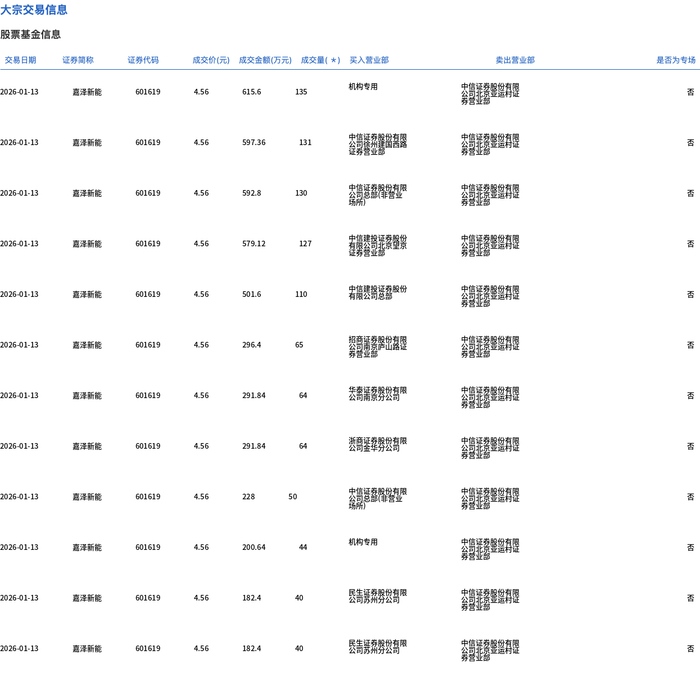
嘉泽新能1月13日现12笔大宗交易 总成交金额4560万元 其中机构买入816.24万元 溢价率为-8.98%
Xin Lang Cai Jing· 2026-01-13 10:32
第1笔成交价格为4.56元,成交64.00万股,成交金额291.84万元,溢价率为-8.98%,买方营业部为华泰 证券股份有限公司南京分公司,卖方营业部为中信证券股份有限公司北京亚运村证券营业部。 第2笔成交价格为4.56元,成交135.00万股,成交金额615.60万元,溢价率为-8.98%,买方营业部为机构 专用,卖方营业部为中信证券股份有限公司北京亚运村证券营业部。 第3笔成交价格为4.56元,成交64.00万股,成交金额291.84万元,溢价率为-8.98%,买方营业部为浙商 证券股份有限公司金华分公司,卖方营业部为中信证券股份有限公司北京亚运村证券营业部。 第4笔成交价格为4.56元,成交127.00万股,成交金额579.12万元,溢价率为-8.98%,买方营业部为中信 建投证券股份有限公司北京望京证券营业部,卖方营业部为中信证券股份有限公司北京亚运村证券营业 部。 第5笔成交价格为4.56元,成交44.00万股,成交金额200.64万元,溢价率为-8.98%,买方营业部为机构 专用,卖方营业部为中信证券股份有限公司北京亚运村证券营业部。 第6笔成交价格为4.56元,成交40.00万股,成交金额18 ...

锚定五万亿,工业名城苏州再展硬核实力
Xin Lang Cai Jing· 2026-01-13 10:28
Core Insights - Suzhou aims to achieve an industrial output value of 4.89 trillion yuan by 2025, with a target of surpassing 5 trillion yuan by 2026, positioning itself as the second city in China to reach this milestone after Shenzhen [1][3] - The city's industrial growth has shown remarkable resilience despite global economic pressures, with an average annual increase of nearly 300 billion yuan over the past five years [3][4] Industrial Growth - Suzhou's industrial output surpassed 3.5 trillion yuan in 2020 and reached 4.43 trillion yuan in 2023, with projections of 4.7 trillion yuan in 2024 and 4.89 trillion yuan in 2025 [3][4] - The city has maintained an impressive growth rate, even amid external trade challenges, with an average annual increase exceeding 200 billion yuan in recent years [3][4] Industry Structure - Suzhou's industrial strength lies in its balanced multi-pillar industry system, which includes electronics, high-end equipment, and advanced materials, unlike Shenzhen's focus on electronics [3][4] - The electronic information, equipment manufacturing, and new materials sectors achieved output values of 1.36 trillion yuan, 1.47 trillion yuan, and 937.1 billion yuan respectively in 2025, all showing positive growth [4] Economic Drivers - Suzhou effectively combines foreign investment and domestic growth, hosting over 18,000 foreign enterprises with cumulative foreign investment exceeding 160 billion USD, while also nurturing local giants in emerging sectors [5][6] - The city is characterized by a strong industrial presence across various districts, with specialized industrial parks focusing on biomedicine, nanotechnology, and automotive components, creating a robust industrial landscape [5][6] Future Strategies - The city plans to leverage artificial intelligence to enhance industrial production, with initiatives such as the "Top Ten Actions for Suzhou Intelligent Manufacturing" aimed at elevating industrial capabilities [5][6] - Despite the ambitious targets, challenges remain, including the need for traditional industries to adapt and the increasing constraints on land and environmental resources [5][6] Competitive Landscape - Suzhou faces intense regional competition from cities like Shenzhen, Chongqing, Guangzhou, and others, as well as from neighboring cities within the Yangtze River Delta [6] - The city's industrial resilience is supported by a vast network of 160,000 industrial enterprises across 34 major industrial categories, highlighting its competitive edge in the global market [6]
鉴往知来的产业脉络与机遇航图:“十五五”规划:循迹探新
Dongguan Securities· 2026-01-13 09:46
Group 1 - The "15th Five-Year Plan" emphasizes a transition from scale expansion to connotative development, focusing on high-quality growth and systemic integration [12][25] - The plan aims to establish a modern industrial system, highlighting the importance of the real economy and technological self-reliance [12][30] - Key areas of focus include technological innovation, expanding domestic demand, and building a robust security framework for industries and supply chains [12][30] Group 2 - The "15th Five-Year Plan" is positioned as a critical period for consolidating the foundation for achieving socialist modernization by 2035 [25][26] - Compared to the "14th Five-Year Plan," the "15th Five-Year Plan" places greater emphasis on quality and resilience in development, reflecting a cautious approach to international environments [25][28] - The plan outlines specific goals for economic growth, including a significant increase in the resident consumption rate and enhancing the role of domestic demand in driving economic growth [30][33] Group 3 - The capital market is expected to benefit from the policy catalysis effect of the "15th Five-Year Plan," with historical data indicating that planning periods often coincide with market uptrends [12][29] - Investment themes are centered around technological self-reliance, modernization of the industrial system, and sectors that boost domestic demand [12][30] - The manufacturing sector is anticipated to receive support from policy, funding, and fundamental improvements, particularly in advanced manufacturing [30][31]
嘉泽新能今日大宗交易折价成交1000万股,成交额4560万元
Xin Lang Cai Jing· 2026-01-13 09:45
Group 1 - On January 13, 2026, Jiazhe New Energy executed a block trade of 10 million shares, with a transaction value of 45.6 million yuan, accounting for 5.14% of the total trading volume for that day [1] - The transaction price was 4.56 yuan, representing an 8.98% discount compared to the market closing price of 5.01 yuan [1] Group 2 - The trading data indicates multiple transactions for Jiazhe New Energy on the same date, all at the price of 4.56 yuan, with varying transaction amounts and volumes [2] - The largest transaction recorded was 615.6 million yuan for 135 shares, categorized under institutional trading [2]
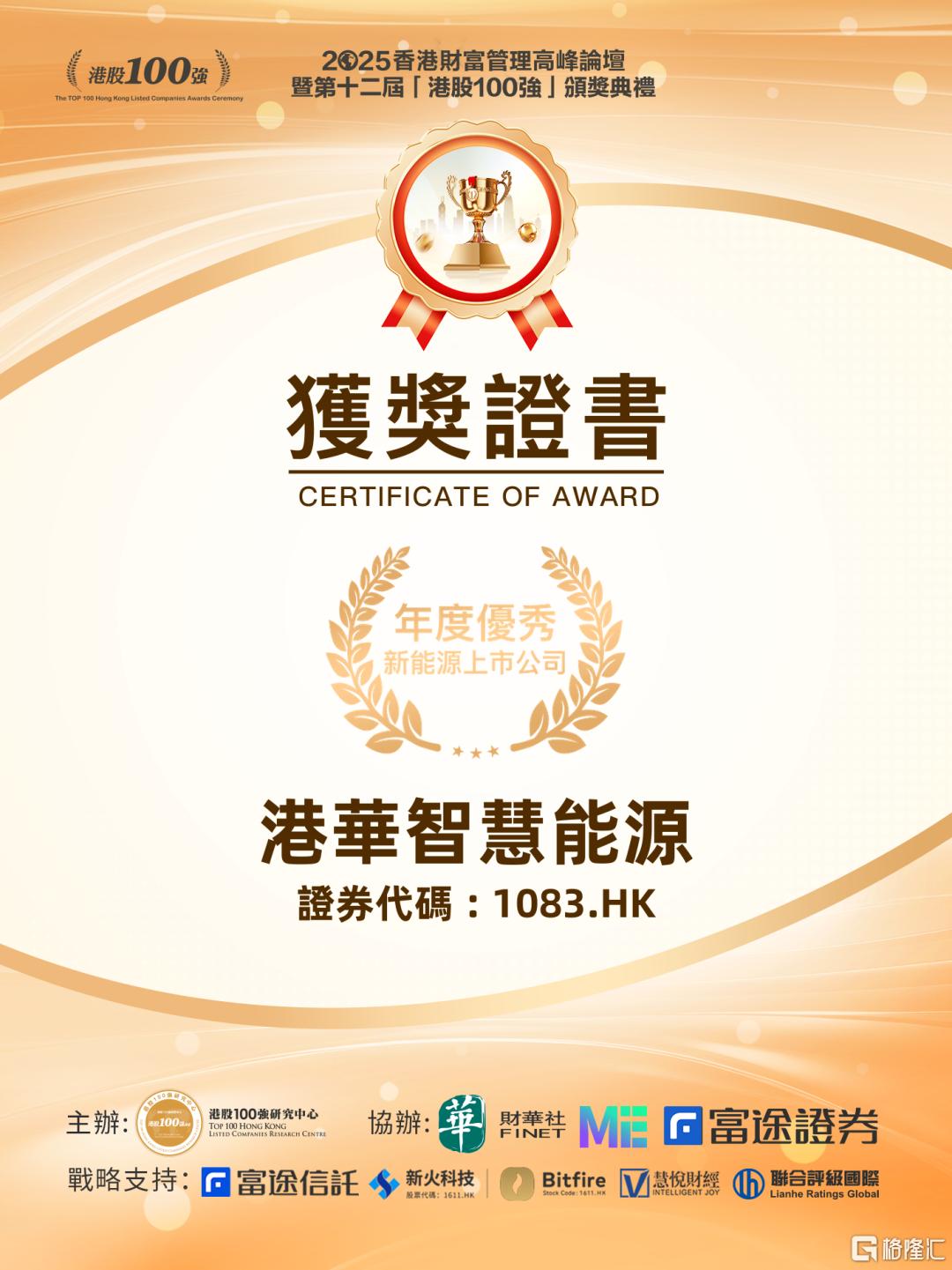
港华智慧能源荣获"年度优秀新能源上市公司"大奖
Ge Long Hui· 2026-01-13 09:20
Core Viewpoint - Honghua Smart Energy has been awarded the "Outstanding New Energy Listed Company" at the "2025 Hong Kong Wealth Management Summit and the 12th (Top 100 Hong Kong Stocks) Award Ceremony," highlighting its strategic positioning, business growth, and technological innovation in the new energy sector [1][4]. Group 1 - The "Top 100 Hong Kong Stocks" selection has evolved over twelve sessions, becoming a significant benchmark for assessing the comprehensive competitiveness and sustainable development capabilities of Hong Kong-listed companies [3]. - This year's evaluation focused on themes of energy revolution and low-carbon transformation, assessing companies across multiple dimensions including strategic foresight, business growth, technological innovation, and environmental social benefits [3]. - The award signifies the company's solid foundation and breakthrough progress in the new energy field, gaining widespread attention and professional recognition from the capital market [4]. Group 2 - The recognition reflects the company's strategic execution and business growth, as well as its industry influence in promoting energy cleanliness and intelligence [4]. - With a clear business model, enhanced technological integration capabilities, and replicable project experience, the company has gradually become a market benchmark in the domestic smart energy sector with systematic solution capabilities [4]. - Looking ahead, Honghua Smart Energy aims to continue exploring energy digitalization and market transaction innovations, striving to become a leading smart energy service provider and create lasting value for shareholders while contributing to society's low-carbon transition [4].
华自科技:公司具备为数据中心在内的工商业园区提供分布式新能源、储能及智能配电产品及系统方案的能力
Zheng Quan Ri Bao Wang· 2026-01-13 09:09
Core Viewpoint - The company, Huazi Technology (300490), is actively expanding its business capabilities to provide distributed renewable energy, energy storage, and intelligent distribution products and system solutions for data centers and commercial parks [1] Group 1 - The company has the capability to offer solutions for distributed renewable energy and energy storage [1] - The company is focusing on the development of intelligent distribution products and systems [1] - The company is currently in the process of actively expanding its related business [1]

海博思创(688411.SH):目前公司未持有卫蓝新能源股份
Ge Long Hui· 2026-01-13 08:40
Core Viewpoint - Haibo Si Chuang (688411.SH) does not currently hold shares in Weilan New Energy, but is collaborating with Weilan New Energy Technology Co., Ltd. and Zibo Jingneng Technology Co., Ltd. to establish a joint venture focused on semi-solid battery development [1] Group 1 - The company has formed a joint venture named Weilan Haibo (Zibo) New Energy Technology Co., Ltd. with Weilan New Energy and Zibo Jingneng [1] - The collaboration aims to research and develop semi-solid batteries that prioritize large capacity, long lifespan, and low cost while ensuring the inherent safety of energy storage batteries [1] - The semi-solid batteries currently under development have already been applied in actual energy storage projects [1]
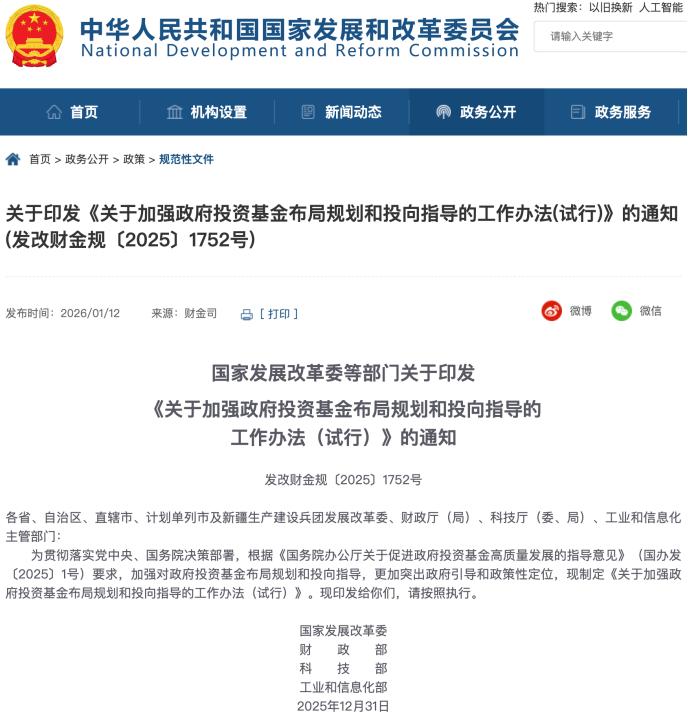
万亿级“国家队”投资方向,明确了
3 6 Ke· 2026-01-13 08:27
Core Viewpoint - The article discusses the newly released "Work Method" which systematically regulates the layout and investment direction of government investment funds for the first time at the national level, aiming to guide the development of trillion-level government investment funds in China [1][7]. Group 1: Policy Measures - The "Work Method" proposes 14 policy measures focusing on three aspects: where to invest, how to invest, and who manages the funds [2][3]. - It emphasizes optimizing fund allocation to support major strategies, key areas, and weak links in resource allocation, promoting deep integration of technological and industrial innovation, and nurturing emerging pillar industries [2]. Group 2: Investment Guidance - Funds must align with national major plans and encourage industries listed in the national industrial directory, avoiding investments in restricted, eliminated, or prohibited sectors [3]. - Provincial development and reform departments are tasked with creating local priority investment lists to optimize fund allocation and direction [3]. Group 3: Evaluation Indicators - The "Management Method" establishes three primary and thirteen secondary indicators for evaluating fund performance, with a focus on policy compliance (60% weight), optimization of productivity layout (30% weight), and policy execution capability (10% weight) [4][6]. - The evaluation will consider whether fund investments support the development of new productive forces, including emerging and future industries such as AI, quantum information, and advanced manufacturing [4][5]. Group 4: Regional Strategy Alignment - The evaluation also assesses the alignment of fund investments with national regional strategies, including support for various regional development initiatives like the Western Development and Northeast Revitalization [6]. - Funds that meet these regional strategy requirements will receive higher evaluation scores [6]. Group 5: Differentiated Development - The National Development and Reform Commission highlights the need for differentiated development of government investment funds, addressing issues like mismatched local resources and homogeneous investment directions [7][8]. - National funds are to focus on supporting the construction of a modern industrial system and overcoming key technological challenges, while local funds should align with local industry foundations and development realities [8].