Robotics

Search documents
机器人竟也能3D打印了!上海交大如何一次造出会感知、能行走的完整机器人?|《Science Advances》
机器人大讲堂· 2025-12-21 08:04
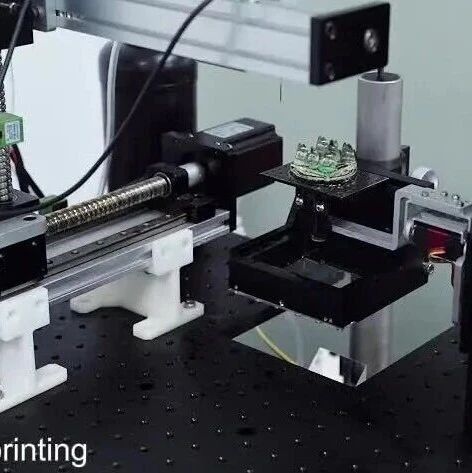
长期以来,制造一个功能完整的软体机器人是一项繁琐的工程:柔软的驱动结构、精密的传感器和刚性的电子 电路,通常需要在不同的地方分别制作,再像拼装模型一样小心翼翼地组合起来。这个过程不仅耗时,还容易 在软硬材料结合的脆弱界面处产生故障。 最近 , 上海交大 的研究团队在《 Science Advances 》 上发表了一项突破性研究,他们开发了一种集成 化的多材料 3D 打印 技术 ,能够像 "一体化成型"那样,自动制造出集驱动、传感、电路和通信功能于一身 的自主软体机器人。 一个由柔软材料制成、仅手掌大小的六足机器人,正灵巧地在桌面上前进、转弯。它不仅能通过手势遥控,还 能在遇到障碍时自主绕开,甚至能感觉到被触摸的位置 。 更令人惊奇的是,这个集成了传感器、电路和驱动 器的复杂机器人主体,是在一台机器上一次性、无需组装打印完成的。 这项技术让复杂软体机器人的制造,从精密的手工组装活,变成了高效、可靠的自动化生产过程。 ▍ 制造困境:为何完整的软体机器人如此难造? 软体机器人因其出色的柔顺性和对复杂环境的适应性,在搜救、检测和人机交互等领域前景广阔。然而,一个 能真正自主工作的软体机器人,需要将柔软的驱动结构、各 ...

具身智能商业化的“机遇”与“挑战”,这场圆桌说透了
机器人大讲堂· 2025-12-21 08:04
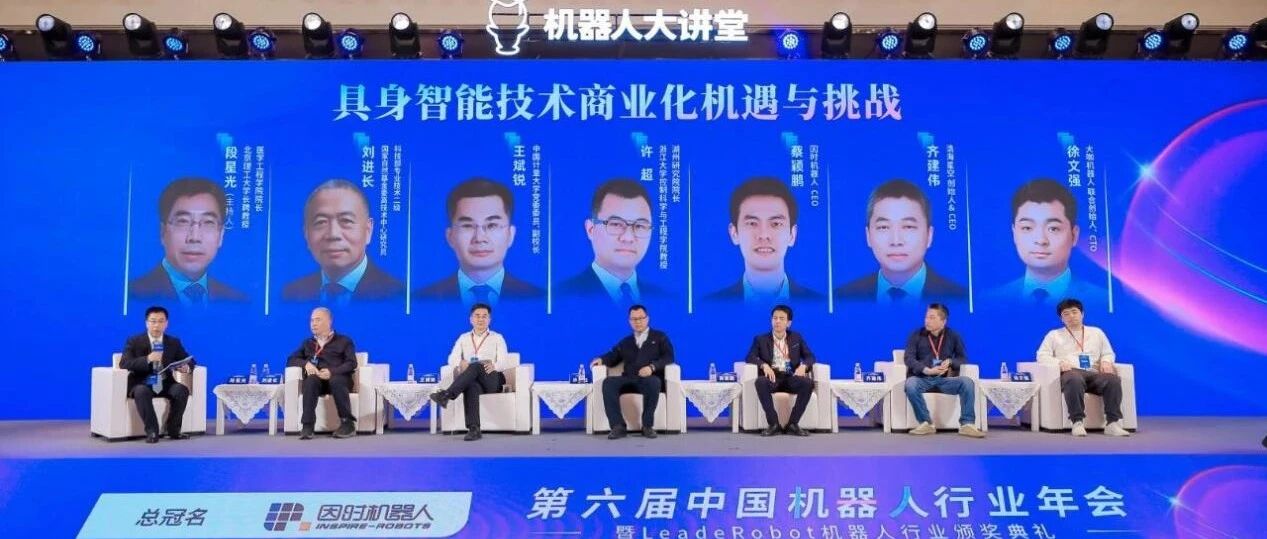
Core Insights - The roundtable forum focused on the commercialization opportunities and challenges of embodied intelligence technology in the humanoid robot sector, highlighting the need for collaboration among policy, technology, data, and industry [1][23]. Policy Outlook: National Strategic Layout and Global Competition - The discussion began with insights on China's development opportunities and policy trends in the global competition landscape, emphasizing that the robotics sector is crucial for China's national rejuvenation [4][7]. Technological Breakthroughs: Pathways from Rigid Motors to Biomimetic Muscles - The forum highlighted the need to transition from rigid motor drives to biomimetic muscle drives, which are essential for integrating robots into daily life scenarios [10][11]. Data Scarcity: Solutions from "Hand-Holding" to "Opening the Granaries" - The issue of data scarcity in embodied intelligence was addressed, with suggestions for transitioning from manual data collection to utilizing existing data from human activities and developing high-fidelity simulations [11][12]. Dexterous Manipulation: From Diverse Approaches to Industrial Balance - The current state of dexterous hand technology was discussed, with a focus on the need for industry-wide investment in foundational technology and market-driven product iterations [18][19]. Commercialization Pathways: Dual Challenges from Technological Breakthroughs to Large-Scale Implementation - The forum concluded with insights on the indicators for the large-scale breakthrough of embodied intelligence, emphasizing the importance of balancing short-term commercialization with long-term technological innovation [19][22].
“王力宏演唱会伴舞机器人”视频,俄媒转发,马斯克也转发了
Sou Hu Cai Jing· 2025-12-21 07:47
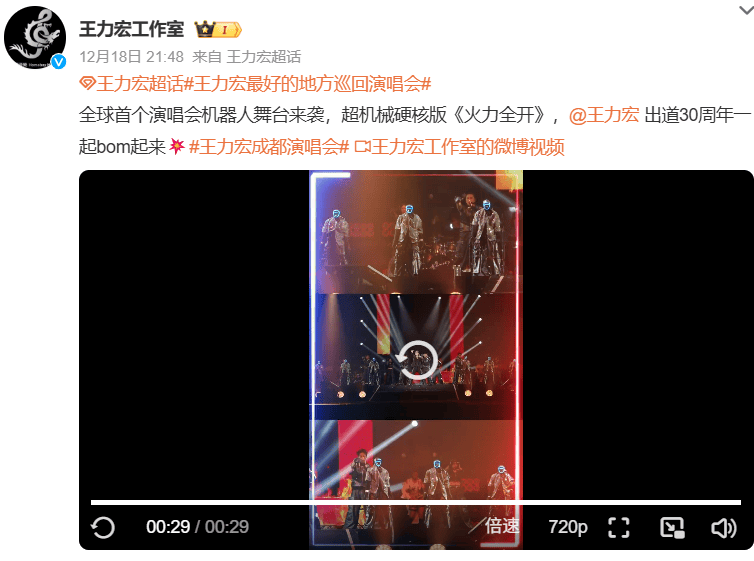
Core Viewpoint - The introduction of humanoid robots as backup dancers at Wang Leehom's concert has garnered significant attention, showcasing advancements in robotics and their integration into live performances [1][3]. Group 1: Event Highlights - On December 18, Wang Leehom's concert in Chengdu featured humanoid robots from Yuzhu Technology, performing synchronously with the artist during the song "Firepower Fully Open" [3]. - The performance included six G1 robots dressed in silver sequined outfits, executing precise movements in time with the music, culminating in a complex "Webster" flip [3]. - The event was recognized as the "world's first concert robot stage," as confirmed by Wang Leehom's studio [3]. Group 2: Public and Media Reaction - The event gained international attention, with RT sharing videos on social media and expressing amazement at the synchronization between the robots and human performers [1][3]. - Elon Musk, CEO of Tesla, also shared the performance video, describing it as "impressive," further amplifying its visibility [3]. - Many international viewers commented on the video, praising the elegance and rhythm of the robots' movements, highlighting the fusion of engineering and art [5].


转发“王力宏演唱会伴舞机器人”视频,俄媒感叹:这不是科幻,这是中国!
Huan Qiu Wang· 2025-12-21 07:10
Core Viewpoint - The introduction of humanoid robots as backup dancers at Wang Leehom's concert has garnered significant attention, showcasing advancements in robotics and their integration into live performances [1][3]. Group 1: Event Highlights - Wang Leehom's concert in Chengdu on December 18 featured humanoid robots from Yushutech, performing synchronized dance routines to the song "Firepower Unleashed" [3]. - The performance included six G1 robots dressed in silver sequined outfits, executing precise movements in time with the music and concluding with a complex "Webster" flip [3]. - The event was recognized as the world's first concert to incorporate robotic dancers, as confirmed by Wang Leehom's studio [3]. Group 2: Public and Media Reaction - The performance was widely shared on social media, with notable figures like Tesla CEO Elon Musk praising the robots as "impressive" [3]. - International reactions included comments from viewers expressing amazement at the robots' elegance and the fusion of engineering and art [6]. - Many online users reflected on the rapid advancement of technology, speculating on how future live performances might evolve [9].

圆桌论坛:具身数据如何塑造行业未来?丨GAIR 2025
雷峰网· 2025-12-21 03:05
Core Viewpoint - The article discusses the current state and future potential of embodied intelligence, particularly focusing on the challenges and opportunities in data collection methods and the maturity of the industry [2][25]. Data Quality and Collection - High-quality data is becoming a bottleneck for breakthroughs in embodied intelligence performance and cost control [2]. - The roundtable forum at the GAIR conference emphasized the importance of data quality, with consensus that the effectiveness of models and the benefits to robots depend on the quality of data collected [2][4]. - Different data collection methods, such as UMI (Universal Manipulation Interface), remote operation, motion capture, and simulation data, are being explored, with a focus on adapting to various scenarios and hardware [3][4]. Industry Maturity and Challenges - The data collection industry is still in its early stages, with companies in data, embodiment, and modeling still aligning their needs and capabilities [4][7]. - There is a lack of a unified approach in the industry, with varying demands from different model companies, indicating that data companies need to understand models and provide suggestions to improve collaboration [7][8]. - The current focus on data collection methods is shifting, with a notable rise in interest in remote operation and UMI, particularly influenced by developments in North America [9][10]. In-the-Wild Data Collection - In-the-wild data collection is seen as a challenging yet promising approach, requiring advanced technical capabilities and effective management of hardware and software [3][21]. - The article highlights the need for low-friction, high-precision, and multi-modal data collection devices to effectively utilize in-the-wild data [3][21]. - The maturity of in-the-wild data collection is still developing, with current efforts primarily focused on improving data collection technology before addressing human resource management [21][22]. Government Support and Industry Dynamics - Government support for data collection factories is prevalent in China, which may influence the direction of data collection methods and industry growth [10][17]. - The article suggests that while government-backed data collection initiatives can stimulate the industry, they may not always align with the most effective technological advancements [17][18]. - The cost structure of data collection is critical, with significant portions attributed to equipment depreciation and labor costs, indicating a need for strategic investment in data collection methods [19][20]. Future Outlook - The industry is expected to evolve, with a potential shift towards more diverse data collection methods as companies adapt to changing demands and technological advancements [18][19]. - The article expresses skepticism about the current maturity of the embodied intelligence industry compared to other tech sectors, suggesting that significant challenges remain before widespread adoption can occur [25][26]. - Companies are encouraged to collaborate and share insights to enhance data collection processes and improve overall industry knowledge [28][30].

从 Gen0 的精细操作到 RTC 的持续工作,具身智能 Just needs execution?
机器之心· 2025-12-21 01:30
Group 1 - The article discusses the advancements in embodied intelligence, highlighting the need for execution in humanoid robots to effectively serve humans, despite significant training hours and scaling laws [1][5] - It emphasizes the rapid improvement in humanoid robots' capabilities, such as parkour, dancing, and basketball, while noting the lack of real-world deployment in service roles [6][7] - The article mentions that the number of humanoid robot companies and funding is increasing, but skepticism remains regarding their market integration [6][7] Group 2 - Morgan Stanley estimates that by 2050, the number of humanoid robots could exceed 1 billion, creating a market valued at $5 trillion, although achieving this goal is uncertain [7] - The article points out that the future focus may shift towards deploying fewer robots capable of performing multiple tasks rather than many robots for single tasks [8] - Despite challenges in large-scale commercial deployment, significant technical progress has been made in areas such as fine manipulation, long-range tasks, and continuous operation [8][9] Group 3 - The article highlights the achievements in fine manipulation, with DexterityGen demonstrating a 10-100 times improvement in stability for robotic hands using reinforcement learning [9] - The Generalist AI Gen0 model, trained for 270,000 hours, showcases a wide range of operational skills applicable across different robotic platforms [9]

具身智能老炮再获数亿融资,移动多臂机器人已批量工业落地|36氪首发
3 6 Ke· 2025-12-21 01:26
Financing Information - The company recently completed A++ and A+++ financing rounds, raising several hundred million yuan [1] - The funding will be allocated as follows: 40% for technology research and development, 30% for overseas market expansion, 15-20% for smart manufacturing production line construction, and the remainder for working capital [1] Company Overview - Founded in 2018 and headquartered in Shanghai, the company specializes in intelligent robotics, offering single-arm, dual-arm, and four-arm robots, as well as AMR mobile robots [1] - The company has developed the SAGE-OS robot operating system and the SAGE-Brain integrated controller, addressing traditional automation challenges in flexibility and intelligence [1] Market Potential - The global industrial robot market is currently valued in the hundreds of billions, with traditional robots serving only 30% of production processes, leaving a significant opportunity in the 70% of discrete manufacturing that requires flexible and intelligent solutions [4] - The demand for intelligent robots is surging as industries like new energy vehicles and high-end electronics shift towards flexible manufacturing models [4] Company Performance - The company has achieved profitability for several years, with revenue growth rates between 50% and 120%, and a projected growth of 300% next year [5] - Current annual shipment volume is approximately 1,000 units, with plans to expand production capacity to 5,000 units [5] Team Background - The founder and CEO, Zhang Jianzheng, holds a PhD in robotics from Shanghai Jiao Tong University and has 21 years of R&D experience, previously working at FANUC [6] - Other core team members have extensive backgrounds in automation and robotics, averaging over 15 years of industry experience [6] Technological and Market Strategy - The company aims to enhance its technology in three areas: body intelligence, group intelligence, and scalable intelligence, with plans to release a new generation of intelligent robots next year [9] - The company is also focusing on global expansion, with current overseas revenue exceeding 20% and a target of 50% in the future [9] Investor Insights - Investors recognize the company's technological capabilities and practical experience, noting its successful integration into the supply chains of major global clients [10] - The company is viewed as a key player in the shift towards flexible manufacturing, expected to drive significant efficiency improvements in the real economy [10]

马斯克点赞宇树机器人!助演王力宏演唱会,完成高难度空翻
Sou Hu Cai Jing· 2025-12-21 00:51
Core Viewpoint - The integration of humanoid robots from Yushutech into Wang Leehom's concert in Chengdu has garnered significant attention both domestically and internationally, marking a milestone in the use of robotics in live performances [1][4]. Group 1: Event Highlights - Wang Leehom's concert featured six Yushutech G1 robots dressed in silver sequined costumes, performing synchronized dance routines with high precision to the music [1]. - The performance concluded with the robots executing a complex "Webster" flip, which energized the audience [1]. Group 2: Industry Impact - This event is noted as the "world's first concert robot stage," showcasing the potential for robotics in the entertainment industry [1]. - The performance attracted attention from notable figures, including Elon Musk, who described the event as "Impressive" after sharing the video on social media [4].
“十四五”前四年GDP增速居一线城市首位 广东深圳交出高质量发展高分答卷
Sou Hu Cai Jing· 2025-12-20 18:31
Core Viewpoint - Shenzhen has achieved significant economic and social development during the "14th Five-Year Plan" period, focusing on high-quality development and innovation as key drivers of growth [3][6][16]. Economic Performance - Shenzhen's GDP increased from 2.78 trillion yuan in 2020 to 3.68 trillion yuan in 2024, with an average annual growth rate of 5.5%, leading among first-tier cities [8]. - The total fixed asset investment during the "14th Five-Year Plan" is projected to reach 4.5 trillion yuan, approximately 1.5 times that of the "13th Five-Year Plan" [8]. - Retail sales of consumer goods are expected to rise from 866.4 billion yuan in 2020 to 1.06 trillion yuan in 2024 [8]. - The total import and export volume is anticipated to grow from 3.05 trillion yuan in 2020 to 4.5 trillion yuan in 2024, maintaining the top position among Chinese cities [8]. Infrastructure and Urban Development - Shenzhen has enhanced its urban infrastructure, including major transportation projects like the Ganshen High-speed Railway and the Shenzhen-Zhongshan Corridor, improving its status as an international transportation hub [9]. - The city has invested significantly in public services, with nearly 70% of fiscal expenditure allocated to nine categories of livelihood spending, including education and healthcare [9]. Innovation and Technology - R&D investment in Shenzhen rose from 151.08 billion yuan in 2020 to 245.31 billion yuan in 2024, with an annual growth rate of 12.9%, ranking second among Chinese cities [10]. - The city leads in PCT international patent applications for 22 consecutive years, indicating a strong innovation ecosystem [10]. - Strategic emerging industries have seen an average annual growth of over 10%, contributing to 42.3% of GDP [12]. Industrial Growth - The production value of strategic emerging industries is expected to grow significantly, with the new energy vehicle sector projected to increase by 38.8% in 2024 [13]. - Shenzhen's industrial robot production is forecasted to reach 133,900 units in 2024, reflecting the city's focus on automation and robotics [15]. Policy and Reform - Shenzhen has implemented various reforms to enhance its business environment, being recognized as a national pilot city for business environment innovation [16]. - The city has attracted 41,000 new foreign-invested enterprises, accounting for 15.7% of the national total, and has seen a significant increase in foreign direct investment [18]. Talent Development - Shenzhen's talent pool has reached 7.19 million, with a focus on high-level talent, including over 2,650 top scientists [18]. - The city has optimized its talent introduction policies, significantly increasing the number of national-level talents in local universities [19]. Future Outlook - Shenzhen aims to expand domestic demand, foster new productive forces, deepen reforms, and enhance the quality of urban development in the upcoming "15th Five-Year Plan" [21].

机器人学习现状!Physical Intelligence内部员工分享(从数采到VLA再到RL)
具身智能之心· 2025-12-20 16:03
Core Insights - The article discusses the current state of robot learning as of December 2025, emphasizing that most systems rely on behavior cloning (BC) and the challenges associated with it [5][40][39] - It highlights the importance of data collection from human demonstrations and the limitations of existing methods in achieving robust performance in real-world applications [6][10][12] Group 1: Behavior Cloning and Its Challenges - As of December 2025, all robot learning systems primarily utilize behavior cloning, where human demonstrations are used to train models to mimic actions [5] - The data for behavior cloning comes from human demonstrations and various other sources, but the need for extensive data collection poses significant challenges [7][10] - The limitations of behavior cloning include the inability to generalize well to out-of-distribution (OOD) states, leading to performance degradation in real-world scenarios [16][23][40] Group 2: Data Collection Methods - Data collection methods include using human operators with smart demo gloves and video platforms to gather diverse task execution data [11][13] - The challenges in data collection include ensuring the data is representative of the tasks and the need for extensive training for operators to provide usable data [9][10] - The article emphasizes the importance of high-quality data for training models and the difficulties in achieving this at scale [10][19] Group 3: Future Directions in Robot Learning - The article predicts that within two years, video model backbones will replace current VLA methods, and within ten years, world models will effectively simulate general open-world interactions [73] - It suggests that traditional simulation and game engines will serve as data generators for world models, emphasizing the continued importance of expert demonstration data [73] - The need for robust Q/V functions that can operate effectively in OOD states is highlighted as a critical area for future research [72]