
农业机器人

Search documents
在变局中追问奇瑞:一家中国车企如何理解“技术之治”
财富FORTUNE· 2026-03-16 13:05
Core Insights - Chery achieved significant milestones in 2025, including its IPO and a leap in the Fortune Global 500 rankings from 385th to 233rd, marking it as the fastest-rising automotive company globally [1] - The automotive industry in China is facing two major uncertainties: the technological overhaul driven by AI and smart technologies, and the reshaping of market rules due to global trade protectionism and geopolitical tensions [1] Capital Market Perspective - Becoming a public company has led to a structural shift in Chery's operational logic, with increased scrutiny from shareholders and investors regarding stock price fluctuations and profitability metrics [3] - This external pressure compels the management to reassess resource allocation and emphasizes the need to create greater social value with fewer resources [5] Technological Challenges - AI and smart technology are central themes, with Chery's chairman actively testing autonomous driving systems to ensure competitive performance against industry leaders like Tesla and Waymo [5][6] - The introduction of end-to-end models in AI presents challenges due to their unpredictable nature, prompting Chery to isolate safety-related components while allowing more aggressive iterations for non-critical features [6] Organizational Evolution - Chery is undergoing a "fission" process to enhance organizational capabilities, breaking down its innovation system into multiple specialized directions to remain agile and responsive [7] - The company has established a framework with 17 L1, 79 L2, and approximately 500 L3 directions to ensure flexibility and continuous improvement [7] Globalization Strategy - As a leader in automotive exports, Chery recognizes the unsustainability of traditional vehicle exports and aims to contribute locally in global markets, reflecting a shift in its role from an exporter to a collaborator [11] - The company emphasizes a dual trade approach, aiming to not only sell globally but also to source globally, enhancing its position in international markets [11] Response to Geopolitical Uncertainty - Chery views current geopolitical tensions as temporary waves in the globalization process and advocates for a pragmatic approach focused on self-improvement and establishing rules to mitigate irregularities in the global landscape [11][13] - The company is committed to using technology to address global challenges, aiming to leverage Chinese cultural strengths to influence the world positively [13]


专访丨农业是连接法中两国的重要纽带——访法国农业专家托马·帕维
Xin Hua Wang· 2026-02-24 08:34
Core Insights - Agriculture serves as a vital link between France and China, encompassing not only food production but also cultural and civilizational exchanges [1][2] Group 1: Agricultural Cooperation - The 62nd International Agricultural Show in Paris highlighted the importance of showcasing Chinese culinary traditions, emphasizing that this is not just product display but a dialogue between civilizations [1] - France's reputation as the "country of ham" includes contributions from Chinese genetics, with modern French pigs having some Chinese lineage, showcasing the benefits of cross-national breeding programs [2] - The collaboration in breeding new pig varieties combines the strengths of both countries, leading to a positive feedback loop where improved French breeds are exported to China, enhancing local farming practices [2] Group 2: Economic and Technological Integration - The integration of Chinese seafood products into the French market illustrates the deep interconnection and complementarity of agricultural structures between the two nations [2] - The strategic significance of agricultural cooperation is underscored by challenges such as climate change and geopolitical uncertainties, making collaboration essential [2] - France and China can enhance efficiency and sustainability in agriculture through technology exchange, particularly in areas like agricultural robotics and precision farming [2]
“新农具”变“新动能”
Ke Ji Ri Bao· 2026-02-06 08:32
Group 1 - The core viewpoint of the articles emphasizes the integration of emerging technologies such as drones, artificial intelligence, and digital technologies into agricultural practices, which is recognized as a significant advancement in modernizing agriculture in China [1][2][3] - The Central Document No. 1 for this year highlights the importance of developing new agricultural productivity through the application of artificial intelligence and technology, marking the first time drones have been explicitly mentioned in this context [1] - The number of agricultural drones in China has exceeded 300,000, with an annual operational area surpassing 460 million mu, indicating a rapid increase in the adoption of smart agricultural equipment [1] Group 2 - The contribution rate of agricultural science and technology progress in China has surpassed 64%, reflecting the significant impact of technological advancements on agricultural modernization [1] - The "Smart Min Grain" provincial grain storage information management system in Fujian serves as a benchmark for digital grain storage management, showcasing the potential of digital technologies in enhancing agricultural efficiency [2] - Challenges such as digital disempowerment, lagging institutional support, insufficient agricultural technology investment, and fragmented platforms hinder the integration of new technologies into agriculture [2][3] Group 3 - Recommendations for future strategies include enhancing data governance, increasing agricultural technology investment, and strengthening cross-departmental collaboration to facilitate the development and application of artificial intelligence and digital technologies in agriculture [3]
互联网普及率超80% 数智生活向新向好
Xin Hua She· 2026-02-06 01:24
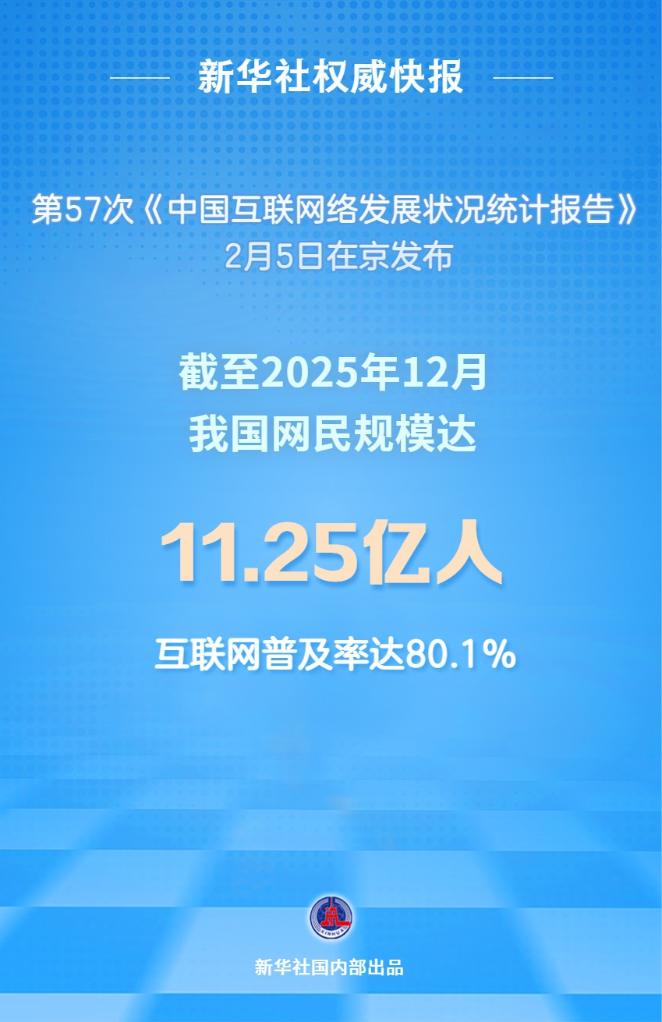
Core Insights - The report indicates that by December 2025, China's internet user base is projected to reach 1.125 billion, with an internet penetration rate of 80.1% [3][5] - The user base for generative artificial intelligence is expected to reach 602 million, reflecting a growth of 141.7% compared to the end of 2024 [6] Group 1: Internet Infrastructure Development - China has established the world's largest and technologically advanced information and communication network, enhancing the connectivity for economic and social development [5] - As of December 2025, the internet penetration rate has increased by 9.7 percentage points since the beginning of the 14th Five-Year Plan, with rural internet penetration at 69.5% and internet usage among individuals aged 60 and above at 53.7% [5] Group 2: Artificial Intelligence Integration - AI applications are becoming increasingly prevalent across various sectors, including steel, electricity, and telecommunications, enhancing product development, quality inspection, and customer service [7] - The integration of AI into daily life and production is seen as a key driver for the digital and intelligent transformation of society [6] Group 3: Digital Services and Quality of Life - By December 2025, the number of online government service users is expected to reach 940 million, providing efficient services throughout the lifecycle of enterprises and individuals [8] - The online healthcare user base is projected to be 411 million, with over 200 inter-recognition projects for medical examination results across all provinces [8] - Online education users are expected to reach 327 million, with an increasing number of digital educational resources available on the national smart education public service platform [8]
生成式人工智能用户规模超6亿人
Sou Hu Cai Jing· 2026-02-06 00:07
Core Insights - As of December 2025, China's internet penetration rate reached 80.1%, with a total of 1.125 billion internet users, marking a 9.7 percentage point increase since the beginning of the 14th Five-Year Plan [4][6] - The user base for generative artificial intelligence (AI) has grown to 602 million, representing a penetration rate of 42.8% and a significant increase of 141.7% compared to the end of 2024 [6][4] Internet Infrastructure Development - China has established the world's largest and most advanced information and communication network, with 4.838 million 5G base stations built, covering over 330 cities [3][4] - Two-thirds of prefecture-level cities have achieved gigabit city standards, and pilot projects for 10-gigabit optical networks have begun in some areas [3] User Connectivity Expansion - The internet penetration rate in rural areas stands at 69.5%, with 53.7% of internet users aged 60 and above, indicating broader access to digital services across various demographics [4][6] AI Application Acceleration - AI technologies are increasingly integrated into daily life and production, serving as a key driver for digital and intelligent transformation in society [5][6] - Generative AI applications are now present in critical industries such as steel, electricity, and telecommunications, enhancing product development, quality inspection, and customer service [6] Digital Inclusion and Quality of Life - Online government service users have reached 940 million, providing efficient services that cover the entire lifecycle of businesses and individuals [7] - The online healthcare user base is at 411 million, with over 200 projects for mutual recognition of medical examination results across cities [7] - Online education has attracted 327 million users, with digital educational resources becoming more accessible through national platforms [7]
数智生活向“新”向“好”
Xin Lang Cai Jing· 2026-02-05 18:10
Group 1: Internet Development - As of December 2025, the number of internet users in China is projected to reach 1.125 billion, with an internet penetration rate of 80.1%, reflecting a 9.7 percentage point increase since the beginning of the 14th Five-Year Plan [2][5] - The construction of a leading global information and communication network has been completed, with 4.838 million 5G base stations built, covering over 330 cities, significantly enhancing network service penetration [2][3] Group 2: AI Application Growth - The user base for generative artificial intelligence is expected to reach 602 million by December 2025, representing a 141.7% increase from the end of 2024 [4] - AI applications are increasingly integrated into key industries such as steel, electricity, and telecommunications, enhancing product development, quality inspection, and customer service [4][3] Group 3: Digital Inclusion and Quality of Life - Online government service users are projected to reach 940 million, providing efficient services that cover the entire lifecycle of businesses and individuals [5] - The online healthcare user base is expected to reach 411 million, with over 200 projects for mutual recognition of medical examination results among local medical institutions implemented across all provinces [5] - Online education users are anticipated to reach 327 million, with a growing number of digital educational resources available on the national smart education public service platform [5]
互联网普及率超80%!数智生活向“新”向“好”
Xin Hua She· 2026-02-05 14:07
Group 1: Internet Development in China - As of December 2025, the number of internet users in China is projected to reach 1.125 billion, with an internet penetration rate of 80.1% [1][3] - The internet penetration rate has increased by 9.7 percentage points since the beginning of the 14th Five-Year Plan, with rural internet penetration at 69.5% and internet usage among individuals aged 60 and above at 53.7% [5] Group 2: 5G Infrastructure and Network Services - China has built 4.838 million 5G base stations, covering over 330 cities, significantly enhancing the penetration of various network services [5] - Two-thirds of prefecture-level cities have achieved gigabit city standards, and pilot projects for 10-gigabit optical networks have been initiated in some cities [5] Group 3: Artificial Intelligence Adoption - The user base for generative artificial intelligence in China is expected to reach 602 million by December 2025, representing a growth of 141.7% compared to the end of 2024 [7] - AI applications are increasingly penetrating key industries such as steel, electricity, and telecommunications, impacting product development, quality inspection, and customer service [7][6] Group 4: Digital Services and Quality of Life - The number of online government service users is projected to reach 940 million, providing efficient services that cover the entire lifecycle of businesses and individuals [8] - Online healthcare users are expected to reach 411 million, with over 200 projects for mutual recognition of inspection results among medical institutions across all provinces [8] - The online education user base is anticipated to reach 327 million, with more digital educational resources available on the national smart education public service platform [8]
新华鲜报 | 互联网普及率超80%!数智生活向“新”向“好”
Xin Hua She· 2026-02-05 13:53
Group 1: Internet Penetration and Infrastructure - As of December 2025, the number of internet users in China is projected to reach 1.125 billion, with an internet penetration rate of 80.1%, an increase of 9.7 percentage points since the beginning of the 14th Five-Year Plan [2][5] - China has built a leading global information and communication network with 4.838 million 5G base stations, covering over 330 cities, significantly enhancing network service penetration [2][3] - The rural internet penetration rate is 69.5%, and the internet usage rate among individuals aged 60 and above is 53.7%, indicating broader access to digital services [2] Group 2: AI Application and Growth - The user base for generative artificial intelligence is expected to reach 602 million by December 2025, representing a growth of 141.7% compared to the end of 2024 [4] - AI applications are increasingly integrated into key industries such as steel, electricity, and telecommunications, enhancing product development, quality inspection, and customer service [4][3] - AI is becoming a crucial driver for the digital and intelligent transformation of society, with applications ranging from personalized travel planning to agricultural robotics [3] Group 3: Digital Inclusion and Quality of Life - The number of users for online government services is projected to reach 940 million by December 2025, providing efficient services that cover the entire lifecycle of businesses and individuals [5] - Online healthcare services are expected to have 411 million users, with over 200 projects for mutual recognition of medical examination results across cities [5] - The online education user base is anticipated to reach 327 million, with more digital educational resources becoming available through the national smart education public service platform [5]
新华鲜报丨互联网普及率超80%!数智生活向“新”向“好”
Xin Hua She· 2026-02-05 12:56
Core Insights - As of December 2025, the number of internet users in China is projected to reach 1.125 billion, with an internet penetration rate of 80.1% [1][3] - The user base for generative artificial intelligence is expected to grow to 602 million, representing a 141.7% increase from the end of 2024 [7] Group 1: Internet Development - China has established the world's largest and technologically advanced information and communication network, facilitating economic and social development [5] - The country has built 4.838 million 5G base stations, covering over 330 cities, which supports the penetration of various network services [5] - By December 2025, the internet penetration rate is expected to increase by 9.7 percentage points from the beginning of the 14th Five-Year Plan, with rural internet penetration at 69.5% and 53.7% of internet users aged 60 and above [5] Group 2: Artificial Intelligence Integration - AI applications are rapidly integrating into daily life and production, serving as a key driver for digital and intelligent transformation [6] - Generative AI is being applied across key industries such as steel, electricity, and telecommunications, enhancing product development, quality inspection, and customer service [7] Group 3: Digital Inclusion and Quality of Life - The online government service user base is expected to reach 940 million, providing efficient services throughout the lifecycle of enterprises and individuals [8] - Online healthcare users are projected to reach 411 million, with over 200 projects for mutual recognition of inspection results among medical institutions across all provinces [8] - The online education user base is anticipated to grow to 327 million, with more digital educational resources becoming available on the national smart education public service platform [8]
“新农具”有新机遇!无人机、机器人首次写入中央一号文件
Xin Hua She· 2026-02-04 08:11
Group 1 - The 2026 Central Document emphasizes the expansion of applications for drones, IoT, and robotics in agriculture, marking the first inclusion of drones and robots in this key policy document [1] - The integration of rapidly advancing information technology and AI with agricultural production is highlighted, showcasing drones and agricultural robots as effective tools that can replace labor-intensive tasks [1] - The mechanization rate for crop farming has reached 76.7%, with over 300,000 agricultural drones operating on more than 460 million acres annually, indicating significant advancements in agricultural modernization [1] Group 2 - The intelligent picking robot developed by Qiaogeli Technology is designed to autonomously identify ripe fruits using a multi-sensor fusion system, overcoming challenges in agricultural automation [2] - The company aims to replicate its technology across various crops, including tomatoes and strawberries, and is optimistic about reducing R&D costs and market entry barriers for agricultural robots [2] - DJI has applied drone technology in agriculture since 2012, with over 600,000 units sold globally and significant operational metrics in China, reflecting the growing acceptance and recognition of drones in the agricultural sector [3] Group 3 - The mention of drones in the Central Document is seen as a strong endorsement of their value in agriculture, providing momentum for future industry development [3] - The "14th Five-Year Plan" period is identified as a critical phase for the acceleration of new productive forces, with a focus on the development of smart agricultural equipment [3]
