
石化化工

Search documents
化工板块遇冷,化工ETF(516020)盘中跌超1%!充电设施三年倍增计划带来新风口,布局时机或至?
Xin Lang Ji Jin· 2025-10-16 03:22
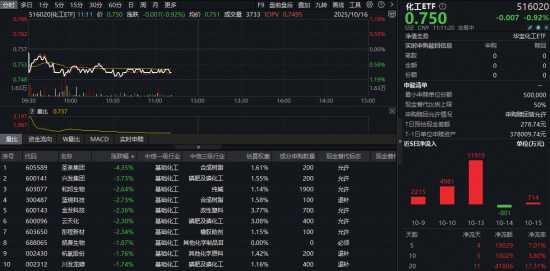
Group 1 - The chemical sector is experiencing a pullback, with the chemical ETF (516020) showing a decline of 0.92% as of the latest report, reflecting a broader downturn in the sector [1][3] - Key stocks in the sector, including Shengquan Group and Xingfa Group, have seen significant declines, with Shengquan Group dropping over 4% and several others falling more than 2% [1] - The chemical ETF's price-to-book ratio is at 2.3, indicating a relatively low valuation compared to the past decade, suggesting potential for medium to long-term investment [3] Group 2 - The National Development and Reform Commission has launched a three-year plan to double the service capacity of electric vehicle charging facilities by 2027, aiming for 28 million charging points and over 300 million kilowatts of public charging capacity [3] - The used car market in China saw a transaction volume of 1.7944 million units in September, reflecting a month-on-month increase of 5.1% and a year-on-year increase of 8.2%, with a total transaction value of 110.466 billion yuan [3] - Long-term outlook for the petrochemical industry remains positive, with expectations of recovery driven by policy adjustments and improved supply-side conditions [4] - Investment strategies suggest focusing on sectors benefiting from supply-side improvements, such as pesticides and organic silicon, as well as resource-rich sectors like potassium and phosphate fertilizers [4] - The chemical ETF (516020) tracks the CSI sub-industry index, providing exposure to major players in the chemical sector, with nearly 50% of its holdings in large-cap stocks [4]

石化行业存在结构性矛盾 未来两年稳增长目标锁定
Zhong Guo Neng Yuan Wang· 2025-10-15 02:25
Core Viewpoint - The Ministry of Industry and Information Technology, along with six other departments, has issued a plan to stabilize growth in the petrochemical industry, targeting an average annual growth of over 5% in value added from 2025 to 2026 through various measures including technological innovation and investment optimization [1][2] Group 1: Industry Challenges - The petrochemical industry, a crucial pillar of the national economy, faces structural contradictions such as intensified competition in basic organic raw materials, insufficient supply of high-end fine chemicals, and slowing domestic demand [2][3] - In 2024, the petrochemical industry's value added is projected to account for 14.9% of industrial value added, with a growth rate of 6.6% [2] Group 2: Development Pathways - The plan outlines five key directions to create a dual driving force for stable growth and transformation, emphasizing the importance of technological innovation and effective investment [3] - Specific measures include strict control over new refining capacity, scientific regulation of ethylene and paraxylene capacity, and promoting the upgrade of old facilities through initiatives like "AI + petrochemicals" [3] Group 3: Policy Signals - The plan signals a shift towards refined regulation in the petrochemical industry, focusing on quality and efficiency rather than mere scale expansion [4] - It emphasizes the development of electronic chemicals and high-performance materials, alongside the acceleration of automation and pollution reduction technologies [4] Group 4: Market Implications - The plan is expected to create differentiated impacts on the futures market for chemical products, shifting trading logic from simple supply-demand dynamics to a deeper integration of policy and industry [5] - For products like ethylene and methanol, while short-term high inventory levels may persist, long-term capacity constraints are anticipated to ease supply pressure and elevate future contract valuations [5] Group 5: Long-term Outlook - The plan's impact on the petrochemical industry is seen as medium to long-term, focusing on capacity control and structural optimization to guide high-quality development [6] - The industry is expected to experience a new round of value reassessment, moving towards greener, smarter, and more efficient development stages [6]
“反内卷”再发力,哪些行业ETF将受益
Sou Hu Cai Jing· 2025-10-15 00:33
Core Insights - The recent "anti-involution" policies in China aim to combat unhealthy competition and promote high-quality economic development through a series of measures targeting ten key industries [1][3][4] Group 1: Policy Initiatives - The Ministry of Industry and Information Technology has released new growth plans for ten major industries, which collectively account for approximately 70% of the industrial economy [1] - These plans set clear quantitative growth targets, such as an annual average growth of 5% in the petrochemical and non-ferrous metal industries from 2025 to 2026 [1] - The National Development and Reform Commission and the State Administration for Market Regulation have issued guidelines to address chaotic pricing competition while maintaining fair market conditions [1][3] Group 2: Economic Indicators - In August, profits of industrial enterprises showed a significant turnaround, increasing by 20.4% year-on-year, marking the highest growth rate since December 2023 [3] - The Producer Price Index (PPI) remained stable month-on-month in August, ending an eight-month decline, with a narrowing year-on-year decrease of 0.7 percentage points [3] - Profit growth was particularly noted in upstream industries such as coal, steel, and non-ferrous metallurgy, indicating a positive initial response to the "anti-involution" policies [3] Group 3: Investment Opportunities - Investors are encouraged to consider ETFs that align with the "anti-involution" policies, which span both traditional and emerging industries [4][5] - Specific sectors highlighted for investment include non-ferrous metals, petrochemicals, steel, cement, lithium batteries, and photovoltaic industries, each with supportive policy measures and improving fundamentals [5] - The ongoing "anti-involution" policies are expected to enhance gross margins and capacity utilization, thereby improving the long-term investment value of related sectors [5]

湖北三家企业入选“国家队” 制造业数字化转型驶入快车道
Chang Jiang Shang Bao· 2025-10-14 00:14
Core Insights - The Ministry of Industry and Information Technology has announced the first batch of manufacturing digital transformation promotion centers, with 62 units selected nationwide, including three from Hubei, marking a significant recognition of Hubei's digital transformation efforts [1][4] Group 1: Digital Transformation Centers - The three selected institutions from Hubei include Gechun Dongzhi Technology Co., Ltd., Hubei Sanning Chemical Co., Ltd., and Hubei Zhongke Industrial Technology Research Institute Co., Ltd., representing a diverse ecosystem that supports digital transformation [1][3] - The selection reflects a strategic layout for supporting digital transformation capabilities in key industries, establishing a "Hubei model" that is demonstrative and replicable [1][3] Group 2: Company Contributions - Gechun Dongzhi is a pioneer in "platform empowerment," providing AI-driven industrial intelligent solutions and serving over 30,000 enterprise clients across 22 sectors, significantly improving operational efficiency for clients like TCL [2] - Hubei Sanning Chemical exemplifies "industry benchmark" practices, achieving substantial quality improvements through AI integration, with product quality rates rising from 95% to 99% [2] - The Zhongke Industrial Technology Research Institute focuses on foundational technology research and talent development, addressing market gaps in basic research and providing essential support for digital transformation [3] Group 3: Digital Transformation Statistics - As of early August 2025, 6,490 large-scale industrial enterprises in Hubei have initiated digital transformation, accounting for nearly one-third of the province's total [4][5] - Hubei has implemented various policies to promote digital transformation, aiming for over 50% of large-scale industrial enterprises to undergo digital upgrades by 2025 [4][5]
“十五五”将推进石化行业高质量转型升级,石化ETF(159731)持续获益
Mei Ri Jing Ji Xin Wen· 2025-10-13 07:13
Core Viewpoint - The petrochemical industry in China is experiencing a decline in profitability due to overcapacity and insufficient demand growth, leading to a competitive environment characterized by "involution" [1] Industry Summary - During the "14th Five-Year Plan" period, the production capacity of basic petrochemical products is expanding rapidly, but the growth in terminal demand is lagging behind, resulting in significant "revenue without profit" characteristics in the industry [1] - The current period is seen as a strategic window for restructuring the global petrochemical industry chain, with expectations for the "15th Five-Year Plan" period to focus on high-quality transformation and upgrading through self-discipline, policy guidance, and enhancing industry chains [1] ETF and Market Data - The petrochemical ETF (159731) is closely tracking the China Petrochemical Industry Index, which has seen a decline of approximately 1.9% recently [1] - The basic chemical industry accounts for 61.93% and the oil and petrochemical industry accounts for 30.84% of the Shenwan first-level industry distribution [1] - The top ten weighted stocks in the index include Wanhua Chemical, China Petroleum, and Sinopec, collectively accounting for 55.12% of the index [1]

“反内卷”再发力,哪些行业ETF或将受益?
Xin Lang Ji Jin· 2025-10-13 06:21
Core Insights - Recent policies in China aim to combat "involution" and promote high-quality economic development through various measures targeting ten key industries [1][3][7] - The Ministry of Industry and Information Technology has released new growth plans for ten major industries, which collectively account for approximately 70% of the industrial economy [1][3] - The National Development and Reform Commission and the State Administration for Market Regulation have issued guidelines to address chaotic pricing competition, emphasizing fair market practices [1][3] Group 1: Policy Initiatives - The ten industries targeted for growth include steel, non-ferrous metals, petrochemicals, chemicals, building materials, machinery, automotive, electrical equipment, light industry, and electronic information manufacturing [1] - Each industry has been assigned specific quantitative growth targets, such as a 5% annual increase in value added for the petrochemical and non-ferrous metals sectors from 2025 to 2026 [1][3] - The recent announcement of measures to regulate pricing competition indicates a systematic approach to governance, moving from recognition to execution at both central and local levels [1][3] Group 2: Economic Indicators - In August, profits of industrial enterprises showed a significant turnaround, increasing by 20.4% year-on-year, marking the highest growth rate since December 2023 [3][4] - The Producer Price Index (PPI) remained stable in August, ending an eight-month decline, with a narrowing year-on-year drop of 0.7 percentage points [3][4] - Profit growth was particularly noted in upstream industries such as coal, steel, non-metallic minerals, and chemicals, suggesting a positive impact from the "involution" policies [3][4] Group 3: Investment Opportunities - Investors are encouraged to consider ETFs that align with the sectors benefiting from the "involution" policies, as these can provide efficient exposure to the relevant industries [5][6] - Specific ETFs are highlighted for sectors such as non-ferrous metals, petrochemicals, coal, and new energy vehicles, reflecting the anticipated benefits from the policy measures [6][7] - The ongoing "involution" policies are expected to enhance gross margins and capacity utilization, thereby improving the long-term investment value of related sectors [7]

石化行业未来两年稳增长目标锁定
中国能源报· 2025-10-13 03:35
Core Viewpoint - The article discusses the "Stabilization and Growth Work Plan for the Petrochemical Industry (2025-2026)" issued by seven government departments, aiming for an average annual growth of over 5% in the industry's added value through various measures such as technological innovation, investment optimization, and demand expansion [3][4]. Group 1: Industry Overview - The petrochemical industry is a crucial sector for the national economy, accounting for 14.9% of industrial added value in 2024, with a growth rate of 6.6% [3]. - The industry faces significant structural contradictions, including intensified competition in basic organic raw materials, insufficient supply of high-end fine chemicals, and slowing domestic demand [3][4]. Group 2: Policy Objectives - The plan aims to balance growth and transformation by fostering new growth drivers while updating old ones, enhancing supply quality, and expanding both domestic and international demand [4]. - Key tasks include strengthening technological innovation and effective supply capabilities, controlling new refining capacity, and promoting the upgrade of old facilities [6]. Group 3: Implementation Measures - Specific measures include the implementation of "AI + Petrochemical" initiatives, promoting high-end, green, and digital transformation within the industry [6]. - The plan emphasizes the evaluation of chemical park competitiveness and intelligence levels, guiding parks to focus on strengthening industrial chains and enhancing regional economic growth [6]. Group 4: Market Implications - The plan signals a shift towards refined regulatory policies, moving from scale expansion to quality and efficiency improvements, with a focus on developing high-end products like electronic chemicals and high-performance materials [8]. - The impact on the futures market for petrochemical products will be differentiated, with a shift in trading logic towards a deeper integration of policy and industry [8]. Group 5: Future Outlook - The industry is expected to undergo a new round of value reassessment, breaking through long-standing structural contradictions and moving towards greener, smarter, and more efficient development [9].
广西钢铁产业2024年产值3599亿元
Zhong Guo Xin Wen Wang· 2025-10-13 00:47
Core Viewpoint - Guangxi is in a critical stage of development, gradually becoming an industrial hub for China facing ASEAN, with significant growth in various industrial sectors [1][2]. Industrial Growth - From 2021 to 2024, Guangxi's industrial added value is expected to grow at an average annual rate of 6.8%, with a year-on-year increase of 7.6% from January to August this year, ranking ninth in China [1]. - High-tech manufacturing in Guangxi has seen a remarkable year-on-year growth of 27.2%, while total profits of industrial enterprises increased by 20.9% [1]. Key Industries - Guangxi has established ten major industries with an output value exceeding 100 billion RMB, particularly in materials industries such as steel, non-ferrous metals, and petrochemicals, with the materials industry surpassing 1 trillion RMB in output [1]. - The non-ferrous metal industry in Guangxi is projected to reach an output value of 393.7 billion RMB in 2024, with refined copper and alumina production ranking third in China [1]. - The steel industry is expected to achieve an output value of 359.9 billion RMB in 2024, with stainless steel production ranking second in China [3]. - The petrochemical industry is projected to reach an output value of 235.7 billion RMB in 2024, with major companies like Huayi, PetroChina, and Hengyi contributing to the sector [3]. Strategic Initiatives - Guangxi is focusing on developing a comprehensive pilot zone for high-quality development of key metals in Hechi and Nandan, promoting the high-end, intelligent, green, large-scale, and park-based development of the non-ferrous and key metal industries [2]. - The region is set to benefit from national policies that support industrial collaboration, tax incentives, and resource guarantees, particularly in the development of high-end chemical and metal new materials [3]. Future Plans - Guangxi aims to create a high-quality development plan for the industrial and information sectors, leveraging its unique geographical and resource advantages to build an advanced manufacturing base for China facing ASEAN [3].
写在蔚蓝之上的绿韵新篇——连云港“十四五”生态环境跃迁回眸
Xin Hua Ri Bao· 2025-10-12 23:28
Core Viewpoint - The article highlights the significant transformation of Lianyungang City, which has shifted from a heavy chemical and coal-based economy to a model of green development, aligning with the "Two Mountains" theory proposed by Xi Jinping, emphasizing the harmony between economic growth and ecological preservation [1][2]. Environmental Restoration and Achievements - Lianyungang has undertaken extensive ecological restoration projects since 2020, including the remediation of the Lianyungang Port area and the establishment of 31,000 square meters of ecological landscape forests [2]. - The city has successfully reduced the area of seaweed farming to 100,000 acres while promoting sustainable aquaculture practices, leading to improved marine ecology and stable incomes for fishermen [2]. - By early 2025, Lianyungang's "Lianyungang-Port Area" was selected as a national-level beautiful bay, marking a historic achievement in ecological civilization construction [2]. Marine and Biodiversity Initiatives - The city has implemented various marine ecological protection plans, achieving a significant increase in the proportion of excellent coastal water quality from 63.1% in 2020 to a projected 100% by 2025 [3]. - Lianyungang has developed ecological safety buffer zones and "ecological island" experimental areas, enhancing biodiversity with 3,673 species recorded, including 135 rare and endangered species [4]. Green Energy and Low-Carbon Development - The city is advancing its green energy initiatives, including the operation of China's first nuclear energy industrial steam project, which will supply 4.8 million tons of zero-carbon steam annually, reducing coal consumption by 400,000 tons [6]. - The construction of the world's largest offshore photovoltaic project is underway, expected to generate an average of 2.234 billion kilowatt-hours of electricity annually [6]. Innovative Financial Mechanisms - Lianyungang has introduced carbon emission rights mortgage loan policies to facilitate green financing, successfully securing a 100 million yuan loan for infrastructure development in the Xu Hui New Area [8]. - The city has actively promoted green financial products, assisting 40 enterprises in obtaining over 10.7 billion yuan in environmental loans since 2021 [8]. Future Development Plans - Lianyungang aims to integrate green low-carbon development into its urban planning, focusing on optimizing industrial and energy structures, enhancing transportation, and promoting sustainable urban construction [10]. - The city plans to develop a "5+N" future industry system, prioritizing low-carbon energy, deep-sea development, health, advanced materials, and general intelligence industries [10].


广西工业跑出“加速度” 打造中国面向东盟产业枢纽
Zhong Guo Xin Wen Wang· 2025-10-12 14:06
Core Insights - Guangxi is transitioning into a key industrial hub for China facing ASEAN, with significant growth in various sectors [1][2] - The region has implemented two rounds of industrial revitalization actions since 2021, leading to accelerated high-quality industrial development [1] - Guangxi's industrial output value is projected to grow significantly, with specific sectors like high-tech manufacturing and non-ferrous metals showing remarkable increases [1][2] Industrial Growth - From 2021 to 2024, Guangxi's industrial added value is expected to grow at an average annual rate of 6.8% [1] - In the first eight months of this year, the industrial added value increased by 7.6%, ranking ninth in China, with high-tech manufacturing growing by 27.2% [1] - The total profit of industrial enterprises increased by 20.9% year-on-year [1] Key Industries - Guangxi has established ten major industries with over 100 billion RMB in output, including automotive, machinery, and electronic information [1] - The non-ferrous metals industry is projected to reach a value of 393.7 billion RMB in 2024, with refined copper and alumina production ranking third in China [2] - The steel industry is expected to generate 359.9 billion RMB in 2024, with stainless steel production ranking second nationally [2] - The petrochemical industry is projected to reach 235.7 billion RMB in 2024, with major companies like Huayi and Sinopec involved [2] Strategic Initiatives - Guangxi is focusing on developing a comprehensive pilot zone for high-quality development of critical metals in Hechi and Nandan [2] - The region aims to enhance the high-end, intelligent, green, large-scale, and park-based development of the non-ferrous and critical metals industries [2] - National policies are supporting industrial collaboration between eastern regions and Guangxi, with tax incentives and resource guarantees [2] Future Plans - Guangxi plans to develop a high-quality industrial and information technology development plan for the 14th Five-Year Plan, leveraging its unique geographical and resource advantages [2] - The focus will be on meeting national needs, regional capabilities, and ASEAN expectations to build an advanced manufacturing base facing ASEAN [2]