资产管理

Search documents
低利率时代日本资管行业如何应对|财富与资管
清华金融评论· 2025-08-31 09:43
Core Viewpoint - The article discusses Japan's "lost 30 years," highlighting the challenges faced by the asset management industry in a prolonged bear market and low interest rate environment, and how these conditions have shaped the industry's evolution and strategies [3][4]. Macro Perspective - Japan transitioned from a phase of anti-inflation to a deflationary spiral in the 1990s, following the asset price bubble burst in the late 1980s. The economy's potential growth rate plummeted from approximately 4% in 1990 to about 1% in 1995 due to weak domestic and external demand [6]. - The government's restrictive policies and corporate cost-cutting measures led to a vicious cycle of reduced consumer spending and increased unemployment, further entrenching the economy in stagnation and deflation [6]. Financial System Perspective - The banking sector faced escalating non-performing loans as real estate and construction companies struggled financially. The Japanese banks opted for "evergreen" loans to mask these bad debts, which ultimately exacerbated the financial crisis [7]. - Regulatory bodies were slow to address the bad debt issues, hoping for a recovery in real estate prices, which led to a prolonged deterioration of the financial environment and wasted public resources [7]. Capital Market Perspective - The collapse of asset prices initiated a "balance sheet recession," shifting the focus of private sectors from profit maximization to debt minimization. This shift resulted in a significant decline in financing demand, leading to a "capital shortage" in the market [8]. - Despite interest rates dropping to near zero since 1995, financing demand remained low, causing a concentration in government bonds and highlighting the "asset shortage" faced by Japanese financial institutions [8]. Resident Asset Allocation Perspective - In a challenging investment environment, Japanese residents favored cash and foreign investments, particularly in foreign bonds and forex trading. The participation of Japanese households in the forex market was notable, with retail investors accounting for 20% to 30% of total trading volume [9]. - The popularity of Uridashi bonds, which provide exposure to foreign currencies, reflected the search for higher yields amidst domestic low-interest rates [9]. Asset Management Strategies - In a low-return environment, asset management institutions adopted various strategies to cope with the challenges. Banks increased their holdings in government bonds and extended bond durations to secure positive returns [11][12]. - Insurance companies shifted towards foreign securities and extended the duration of their domestic bond holdings to improve returns, especially after several mid-sized life insurers collapsed in the late 1990s due to unsustainable promised returns [13]. - Public funds saw a significant decline in the scale of medium- to long-term bond funds, with money market funds becoming dominant as low-interest rates persisted, leading to a shrinking number of bond fund managers [14][15].

中基协:7月备案私募资管产品同比增加113.44%
Huan Qiu Wang· 2025-08-31 01:44
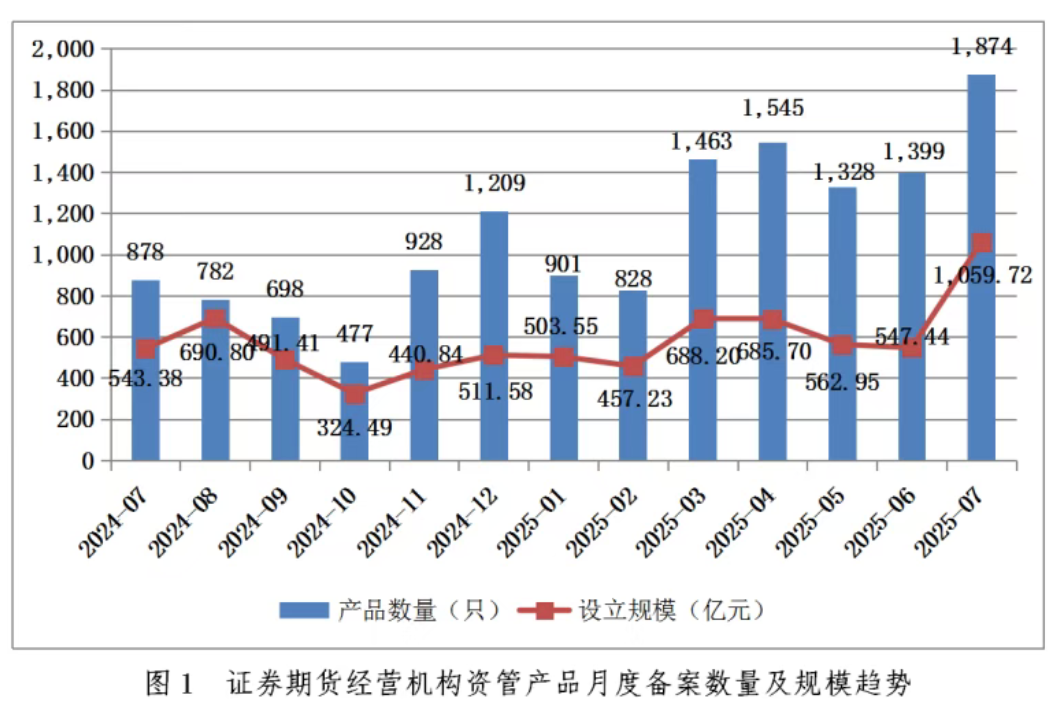
Group 1 - The core viewpoint of the news is the significant growth in private asset management products in July, with a total of 1,874 products registered, marking a month-on-month increase of 33.95% and a year-on-year increase of 113.44% [1] - The total establishment scale reached 105.97 billion yuan, reflecting a month-on-month growth of 93.58% compared to June's 54.74 billion yuan [1] - Securities companies and their asset management subsidiaries accounted for the highest proportion of registered products and establishment scale, with 1,209 products registered and a scale of 53.87 billion yuan, representing over 50% of the total [3] Group 2 - In terms of product types, collective asset management plans accounted for over 70% of the establishment scale, with 859 collective plans and 1,015 single plans registered, with establishment scales of 78.53 billion yuan and 27.45 billion yuan respectively [3] - The mixed product category had the highest number of registrations at 892, while fixed income products had the largest establishment scale at 68.93 billion yuan, and equity products had the lowest registration and scale [3] - As of the end of July, the total scale of private asset management products reached 12.48 trillion yuan, an increase of 385.38 billion yuan from the previous month, reflecting a month-on-month growth of 3.19% [4] Group 3 - The number of existing collective and single asset management plans was 19,661 and 18,145 respectively, with collective plans accounting for 52% of the total number and 50.75% of the total scale [4] - The average management scale for various types of institutions was as follows: securities companies and their asset management subsidiaries at 60.79 billion yuan, private subsidiaries at 8.49 billion yuan, and fund management companies at 35.12 billion yuan [4]
大曝光!中央汇金,大举增持ETF(名单)
中国基金报· 2025-08-30 13:36
Core Viewpoint - Central Huijin has significantly increased its holdings in stock ETFs, reflecting its role as a stabilizing force in the market and boosting investor confidence [2][11]. Summary by Sections Central Huijin's Investment Actions - In the first half of the year, Central Huijin increased its stock ETF holdings to a total market value of 1.28 trillion yuan, a nearly 23% increase from the end of last year [2][4]. - The total number of stock ETFs held by Central Huijin reached 3,756.34 billion shares, up 21.23% from 3,098.41 billion shares at the end of last year [4][9]. Major Holdings and Increases - Central Huijin's top five stock ETFs include Huatai-PB CSI 300 ETF, E Fund CSI 300 ETF, and others, with significant market values exceeding 1,420 billion yuan for Huatai-PB CSI 300 ETF and over 1,065 billion yuan for E Fund CSI 300 ETF [5][6]. - Central Huijin Asset Management also maintained its position among the top ten holders of 15 stock ETFs, with a total holding of 1,785.14 billion shares and a market value exceeding 600 billion yuan [6][9]. Specific Increases in ETF Holdings - Central Huijin Asset Management increased its holdings in 12 stock ETFs, with notable increases in Huatai-PB CSI 300 ETF (112.37 billion shares), Huaxia CSI 300 ETF (94 billion shares), and E Fund CSI 300 ETF (89 billion shares) [9][10]. - The overall increase in holdings by Central Huijin Asset Management was approximately 658.86 billion shares, reflecting a nearly 60% growth [9][10]. Market Impact - The actions of Central Huijin have effectively boosted investor confidence and provided crucial support for the stable operation of the market [11]. - Looking ahead, the continued role of Central Huijin as a market stabilizer, combined with market valuation recovery and industrial upgrades, is expected to attract long-term capital into the market, promoting steady progress towards high-quality development in the A-share market [11].

资金“出逃”科技股,“标普500等权指数”创2021年来最长连涨记录
Hua Er Jie Jian Wen· 2025-08-30 02:15
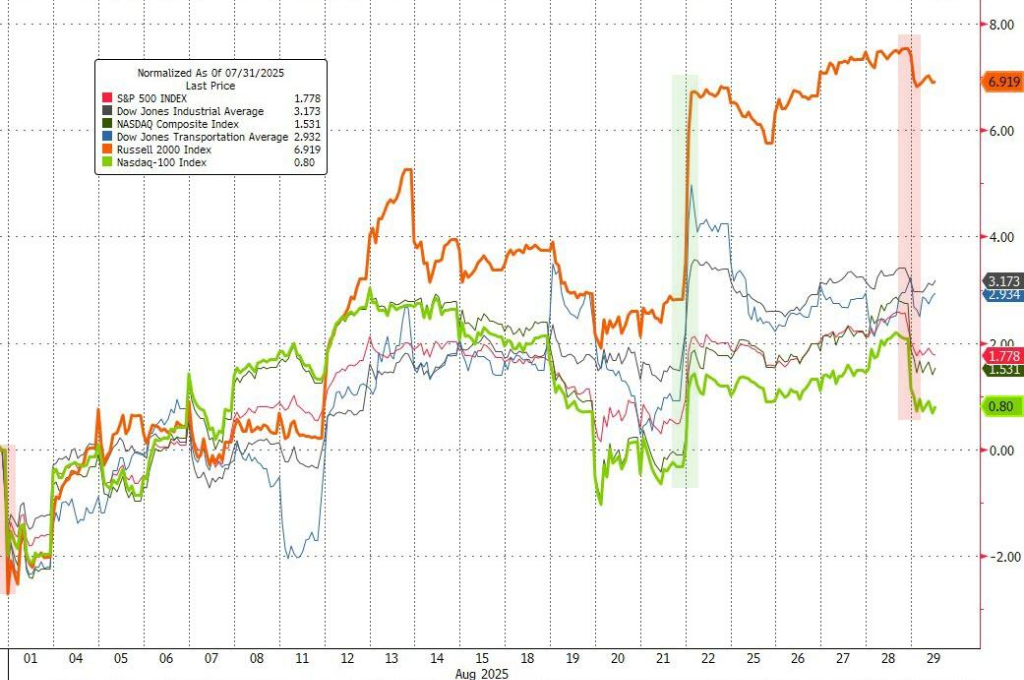
Group 1 - The market is increasingly anticipating a rate cut by the Federal Reserve in September, leading to a broader rally in U.S. stocks beyond just the tech giants [1] - Liz Ann Sonders, Chief Investment Strategist at Charles Schwab, noted that the participation rate in the S&P 500 is steadily rising, indicating a less concentrated market rally [2] - The Invesco S&P 500 Equal Weight ETF rose by 2.7% in August, marking its longest streak of consecutive monthly gains since May 2021 [2] - The Roundhill MAGS ETF, which bundles the "Magnificent Seven" tech stocks, increased by approximately 2% in August, achieving its longest consecutive monthly gain since March 2024 [2] - Despite a slight decline in major indices on Friday, the S&P 500 recorded its fourth consecutive month of gains, the longest streak since September 2024 [2] Group 2 - José Torres, Senior Economist at Interactive Brokers, indicated that investors appear to be taking profits, as September is typically the worst-performing month for U.S. stocks [3]
降息预期升温+“美联储独立性战役”打压信心 美元熊市正在上演
智通财经网· 2025-08-29 11:32
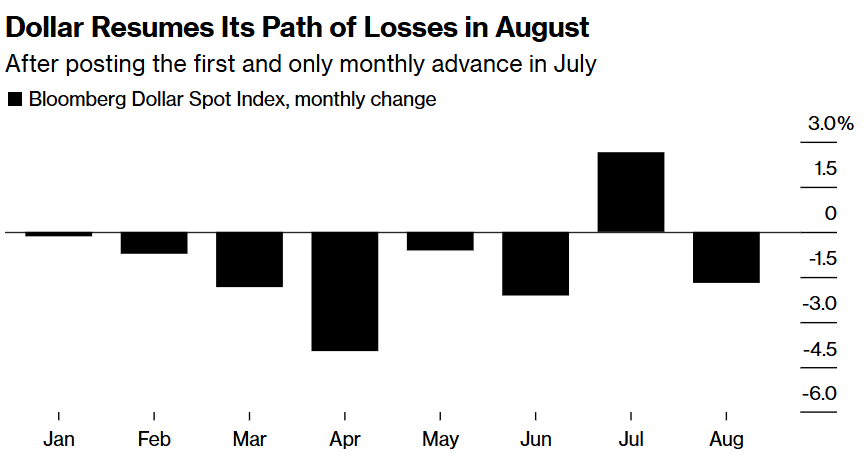
Core Viewpoint - The US dollar index has shown a decline in August after a strong performance in July, as investors prepare for a weakening US economy and potential interest rate cuts by the Federal Reserve [1][4]. Group 1: Dollar Performance - The Bloomberg Dollar Spot Index has decreased by 1.6% in August, reversing the 2.7% increase recorded in July, which was the best monthly performance since January 2025 [1]. - Analysts expect the dollar to continue its downward trend for the remainder of the year, potentially declining by 8% overall, reflecting a "bear market-like" trajectory [4]. Group 2: Impact of Government Actions - Recent actions by the US government are expected to have a long-term negative impact on the dollar's status as a safe-haven investment, with risk premiums likely to weigh heavily on it [5]. - The independence of the Federal Reserve's monetary policy is being threatened by the Trump administration, further diminishing the attractiveness of the dollar and US assets [4][5]. Group 3: Federal Reserve and Interest Rate Expectations - There is a high probability (80%) that the Federal Reserve will announce interest rate cuts as early as September 17, with market expectations for a total of 125 basis points of cuts by September 2026 [8]. - The anticipation of stronger rate cuts is contributing to the decline in US Treasury yields and the dollar index, with expectations of continued weakness in the dollar [8]. Group 4: Investor Behavior and Market Sentiment - Market sentiment is shifting towards increased hedging against US assets, with international investors raising their foreign exchange hedge ratios due to rising policy uncertainty [9]. - If the hedge ratios return to normal levels, potential dollar sell-off could amount to approximately $1 trillion, indicating significant pressure on the dollar [9].
法国债市企稳迹象显现 东方汇理CIO:利差水平已具吸引力
智通财经网· 2025-08-29 11:22
Group 1 - The French bond market shows signs of stabilization amid political turmoil, with the 10-year government bond yield reaching 3.55%, the highest since March, and the yield spread with German bonds widening to 82 basis points before retreating to around 79 basis points [1] - Vincent Mortier, Chief Investment Officer of Amundi, noted that the current yield spread is attractive and could help stabilize market sentiment, emphasizing France's ability to improve its fiscal situation through tax adjustments [1] - Since President Macron dissolved the parliament in June last year, French financial assets have been under pressure, with the CAC 40 index declining by 3.2% while the broader STOXX 600 index rose by 5.1% [1] Group 2 - The French Debt Management Agency has raised the upper limit for the issuance of 10 to 30-year government bonds to €11 billion, contrasting with the reduced issuance following Macron's parliamentary dissolution last year [2] - This move is seen as a positive signal to alleviate debt concerns, although the market still needs to monitor the impact of political risks on long-term financing costs [2]

解码平安理财五周年:以价值创造为主线,打造科技型资管机构
券商中国· 2025-08-29 10:32
Core Positioning - The company aims to build a "technology-driven asset management institution" and is advancing the digital application of cutting-edge technologies in investment research, advisory, and business operations [1] - Since its establishment in August 2020, the company has created over 110 billion yuan in investment returns for clients and has invested more than 260 billion yuan annually to support the real economy [1] Investment Research Capability - The company emphasizes a "customer-centric" approach and has developed a robust investment research capability, focusing on absolute returns and value creation [2] - It has established a dual-pillar investment research capability system centered on asset allocation and portfolio investment, adopting an "industrialized and platformized" investment management model [2] Product Development - As of July 2025, the company has launched a new product brand system called "An+Xin Stable and Far-reaching," which includes four product series targeting different investment needs [4] - The product system aims to respond to the increasingly diverse wealth management needs of investors with clearer product positioning and richer functional scenarios [4] AI and Digital Transformation - The company is leveraging AI technology to enhance its investment research capabilities, including policy interpretation and report generation, thereby improving investment decision-making [7] - It has developed a digital infrastructure that supports various business processes, enhancing efficiency and decision-making across investment research, product operations, and customer service [6] Support for Real Economy - The company is committed to providing high-quality financial services and has increased its support for the real economy, focusing on technology innovation and strategic emerging industries [8] - As of June 2025, it has invested over 25 billion yuan in technology finance and over 15 billion yuan in green finance, contributing to the national "dual carbon" goals [8][9] ESG and Green Finance - The company has been proactive in developing green finance and ESG-related businesses, launching various green financial products and participating in sustainable investment initiatives [9] - It aims to integrate its development with national high-quality growth objectives, enhancing its core investment research capabilities and supporting new productive forces [9]

中基协:7月私募资管产品设立规模1059.72亿元 环比增加93.58%
Sou Hu Cai Jing· 2025-08-29 10:30
Core Insights - The China Securities Investment Fund Association reported significant growth in private asset management products, with a total of 1,874 products registered by securities and futures institutions as of July 2025, marking a month-on-month increase of 33.95% and a year-on-year increase of 113.44% [1] - The total establishment scale of these products reached 105.972 billion yuan, reflecting a month-on-month increase of 93.58% and a year-on-year increase of 95.02% [1] - As of the end of July 2025, the total scale of private asset management products by securities and futures institutions amounted to 12.48 trillion yuan (excluding social security funds and corporate annuities), which is an increase of 385.384 billion yuan from the previous month, representing a month-on-month growth of 3.19% [1]
中基协:截至7月底证券期货经营机构私募资管产品规模合计12.48万亿元
Zheng Quan Shi Bao Wang· 2025-08-29 10:21
Core Insights - The China Securities Investment Fund Association reported a significant increase in private asset management products, with a total of 1,874 products registered as of July 2025, marking a month-on-month increase of 33.95% and a year-on-year increase of 113.44% [1] - The total established scale of these products reached 105.97 billion yuan, reflecting a month-on-month increase of 93.58% and a year-on-year increase of 95.02% [1] - As of the end of July 2025, the total scale of private asset management products by securities and futures institutions amounted to 12.48 trillion yuan, excluding social security funds and corporate annuities, which is an increase of 385.38 billion yuan from the previous month, representing a month-on-month growth of 3.19% [1]
洵真集团创始人兼董事长李婷:在历史的褶皱中寻找投资洞见
Sou Hu Cai Jing· 2025-08-29 09:47
Core Insights - The global economic landscape is undergoing unprecedented changes, with China entering a new development stage, presenting both challenges to traditional models and opportunities for transformation [2] - Leaders with unique insights and foresight, such as Li Ting, are positioned to seize new opportunities in this evolving environment [2] Group 1: Investment Philosophy - Li Ting's investment philosophy is shaped by her experiences, particularly the 9/11 crisis, which taught her to view events through a long historical lens [3][4] - She emphasizes the importance of understanding the deeper historical and macroeconomic contexts behind seemingly random events, which aids in making informed investment decisions [4] - Her investment approach is structured into three levels: company financials, industry landscape, and future insights, with a focus on qualitative judgments over mere quantitative predictions [11][13] Group 2: Current Economic Opportunities in China - Li Ting believes that the Chinese economy is not in a downturn but rather in a transformation phase, driven by its resilience and potential [15] - Key areas of investment opportunity include the consumption potential of the aging population, underappreciated markets, and the rise of inland provinces due to new trade routes [16][17] - The infrastructure achievements in China, particularly in ensuring equitable access to resources, are seen as foundational for social stability and economic growth [15] Group 3: Emerging Trends and Challenges - The re-evaluation of the Renminbi's value amidst geopolitical shifts is highlighted, with Li Ting suggesting that the currency is undervalued based on purchasing power parity [17] - The ongoing wave of digitalization and the necessity for traditional businesses to embrace smart technologies are identified as critical for survival in a rapidly changing market [17][18] - Li Ting posits that China's advanced hydropower infrastructure will play a crucial role in supporting the energy demands of the AI industry [18] Group 4: Advice for the Younger Generation - Li Ting encourages the younger generation to embrace opportunities abroad, particularly in emerging markets, as a means to expand their horizons and career prospects [20][21] - She stresses the importance of having a deep understanding of investment principles and maintaining a self-consistent investment framework to achieve long-term success [21][25]