有色金属冶炼和压延加工业

Search documents
创新实业20260319
2026-03-20 02:27
Summary of Conference Call Notes Company and Industry Overview - The conference call discusses the developments and future plans of an aluminum production company, particularly focusing on its projects in Saudi Arabia and Inner Mongolia, as well as its financial strategies and operational efficiencies. Key Points and Arguments Saudi Project Developments - The first phase of the "Super Aluminum City" in Saudi Arabia is expected to produce 500,000 tons by H1 2027, with a 10-year electricity price agreement at 3.2 cents per kWh, significantly lower than domestic costs by over 1,000 RMB per ton [2][3][12]. - The project is strategically located 1,200 km away from conflict zones, ensuring minimal impact from regional geopolitical tensions [3][11]. - The project aims to extend into downstream processing, targeting high-end aluminum products for the automotive and apple supply chains, aligning with Saudi Arabia's Vision 2030 [3][12]. Financial Performance and Dividend Policy - For 2025, the company announced a dividend of HKD 0.77 per share, totaling HKD 1.598 billion, representing 51.5% of net profit [4]. - The company commits to maintaining a stable dividend policy while considering operational performance, capital expenditure, and cash flow [4]. Green Energy Initiatives - The Inner Mongolia green energy project plans to install 1,750 MW, with expected annual electricity generation exceeding 5 billion kWh by 2027, surpassing 50% of total electricity consumption [2][4]. - The cost of electricity from wind and solar in Inner Mongolia is significantly lower than coal-fired power, with projections to reduce overall electricity costs to approximately 0.275 RMB per kWh by 2026 [4]. Strategic Acquisitions - The company has acquired 100% of Tongliao Smart Mining and plans to produce 6 million tons of coal annually by the end of 2028, which will lower thermal power costs to 0.24 RMB per kWh [2][5][6]. - The acquisition of remaining shares in Shandong Chuangyuan aims to achieve 100% self-sufficiency in alumina production, enhancing the company's competitive edge [5]. Capital Expenditure and Future Plans - The capital expenditure for 2026 is projected at around 1.5 billion RMB, primarily focused on the Saudi project and green energy initiatives [7][8]. - The company plans to reduce its debt by 15-20 billion RMB annually, targeting a debt-to-asset ratio below 50% by 2026 [8][9]. Production Capacity and Cost Structure - In 2025, the company expects to produce 788,100 tons of electrolytic aluminum and 2.55 million tons of alumina [7]. - The total cost of producing electrolytic aluminum in Saudi Arabia is estimated to be over 900 USD per ton, benefiting from local raw material availability and low energy costs [10][12]. Long-term Strategic Vision - The company is considering expanding its production capacity in Saudi Arabia to 1 million tons if the energy supply and pricing remain favorable [11][12]. - The focus on downstream processing differentiates the company from competitors, aligning with Saudi Arabia's industrial development goals [12][13]. Additional Important Information - The company has implemented measures to mitigate geopolitical risks, ensuring the safety of personnel and operations in Saudi Arabia [11]. - The coal mine acquisition is expected to stabilize coal supply and reduce operational risks associated with price volatility [5][6]. This summary encapsulates the key developments, financial strategies, and future plans of the company, highlighting its focus on sustainable growth and operational efficiency in the aluminum industry.
国家统计局:国际油价波动对中国输入影响还需观察
21世纪经济报道· 2026-03-16 12:15
Core Viewpoint - The overall trend of industrial producer prices (PPI) in China is showing a narrowing decline, with a year-on-year decrease of 0.9% in February, which is a 0.5 percentage point improvement from the previous month, marking the third consecutive month of narrowing decline [4]. Group 1: PPI Trends - In February, the PPI increased by 0.4% month-on-month, maintaining the same growth rate as the previous month [4]. - The average PPI for January-February decreased by 1.2% compared to the same period last year [4]. Group 2: Factors Influencing PPI - The narrowing decline in PPI is attributed to several factors, including expanded demand in certain domestic industries, growth in new economic drivers, and rising prices of some international bulk commodities [4]. - The demand for high-end equipment has increased due to industrial upgrades, leading to a 7.7% year-on-year price increase in aircraft manufacturing in February, closely related to the development of domestic commercial aviation [4]. - The development of artificial intelligence and green transformation has also driven price increases, with electronic components and specialized materials rising by 4.9% year-on-year, and biomass fuel processing prices increasing by 3.2% [4]. Group 3: Market Competition and Price Improvement - Optimized market competition has led to price improvements in certain industries, with the price declines in cement manufacturing and black metal smelting narrowing by 1.5 and 0.3 percentage points, respectively [5]. - The prices in the non-ferrous metal smelting and rolling industry increased by 22.1% year-on-year, significantly contributing to the recovery of industrial producer prices [5]. Group 4: External Factors and Future Outlook - Geopolitical conflicts in the Middle East have led to fluctuations in international oil prices, raising market concerns; however, China's energy supply security is strong, providing a solid foundation to cope with external market volatility [6]. - The government aims to continue expanding domestic demand, optimizing supply, and promoting the construction of a unified national market to facilitate the return of industrial prices to a reasonable range and improve economic circulation [6].

2月通胀超预期上涨
Ge Lin Qi Huo· 2026-03-09 09:08
1. Report Industry Investment Rating - No information provided in the content. 2. Core View of the Report - In February, China's overall inflation level rebounded unexpectedly. It is expected that in March, the CPI will decline slightly month - on - month due to post - Spring Festival seasonal factors, while the year - on - year CPI will remain at a relatively high level. The conflict between the US, Israel and Iran in March has pushed up the prices of crude oil and energy - chemical products, and it is expected that the PPI will continue to rise month - on - month in March, with the year - on - year PPI possibly rebounding to around 0% [5][18]. 3. Summary by Relevant Catalogs CPI Analysis - **Year - on - Year Data**: In February, the national consumer price index (CPI) rose 1.3% year - on - year, higher than the market expectation of 0.9% and the previous value of 0.2%. The main reasons for the large year - on - year increase were the misaligned Spring Festival holidays compared to last year and the recovery of consumer demand. Food prices rose 1.7% year - on - year, affecting the CPI to rise by about 0.30 percentage points. Non - food prices rose 1.3% year - on - year. Core CPI rose 1.8% year - on - year. Service prices rose 1.6% year - on - year, affecting the CPI to rise by about 0.75 percentage points. Consumer goods prices rose 1.1% year - on - year [2][7]. - **Month - on - Month Data**: In February, the CPI rose 1.0% month - on - month, compared with a 0.2% increase in the previous month. Food prices rose 1.9% month - on - month. Non - food prices rose 0.8% month - on - month. Consumer goods prices rose 0.8% month - on - month. Service prices rose 1.1% month - on - month. Core CPI rose 0.7% month - on - month. The Spring Festival holiday in 2026 had one more day than in 2025, leading to a concentrated release of consumer demand [2][8]. - **Eight - Category Classification**: In February, food, tobacco, alcohol and dining - out prices rose 1.4% month - on - month, affecting the CPI to rise by about 0.40 percentage points. Among the other seven major categories, five rose, one was flat, and one declined month - on - month. Transportation and communication prices rose 2.2% month - on - month, medical care prices rose 0.1% month - on - month, education, culture and entertainment prices rose 1.6% month - on - month, clothing prices fell 0.1% month - on - month, household goods and services prices rose 0.2% month - on - month, and other goods and services rose 2.3% month - on - month [9]. PPI Analysis - **Year - on - Year Data**: In February, the national industrial producer price index (PPI) fell 0.9% year - on - year, better than the market expectation of a 1.2% decline and the previous value of a 1.4% decline. Production material prices fell 0.7% year - on - year, affecting the overall industrial producer price level to fall by about 0.55 percentage points. Mining industry prices fell 5.3% year - on - year. Raw material industry prices fell 1.9% year - on - year. Processing industry prices rose 0.3% year - on - year, the first year - on - year increase since August 2022. Some industries with large year - on - year price declines included the oil and gas extraction industry and the oil, coal and other fuel processing industry. Some industries with large year - on - year price increases included the non - ferrous metal mining and dressing industry and the non - ferrous metal smelting and rolling processing industry. Living material prices fell 1.6% year - on - year [3][14][15]. - **Month - on - Month Data**: In February, the PPI rose 0.4% month - on - month, rising for the fifth consecutive month. Production material prices rose 0.5% month - on - month. Mining industry prices rose 1.2% month - on - month. Raw material industry prices rose 0.2% month - on - month. Processing industry prices rose 0.6% month - on - month, rising for the fifth consecutive month. Some industries with large month - on - month price increases included the non - ferrous metal mining and dressing industry, the oil and gas extraction industry, and the non - ferrous metal smelting and rolling processing industry. The automobile manufacturing industry's prices fell 0.2% month - on - month. Living material prices were flat month - on - month, with durable consumer goods prices rising 0.3% month - on - month, rising for two consecutive months after seven consecutive months of decline last year [4][15][16].
有色早报-20260305
Yong An Qi Huo· 2026-03-05 03:05
Group 1: Report Industry Investment Rating - No information provided Group 2: Core Views of the Report - Maintain a mid - term bullish view on copper as it has increasing demand and limited supply under the current market environment [1] - Aluminum prices may surge in the short - term due to potential production cuts in the Middle East, and attention should be paid to post - holiday inventory reduction [1] - Zinc prices are expected to be supported in the short - term despite general domestic fundamentals, considering long - term capital investment and supply disturbances [2] - Nickel prices are expected to fluctuate within a range under the influence of bearish fundamentals and bullish supply - side policy interventions [4] - Stainless steel prices are expected to follow nickel prices and fluctuate within a range under similar conditions [8] - Lead prices are expected to maintain a weak and volatile trend, affected by overseas inventory and scrap lead profit [11] - Tin prices are still regarded as strong, but large fluctuations may occur, and potential callback risks should be noted [14] - Industrial silicon prices are expected to fluctuate with costs in the short - term and bottom - oscillate seasonally in the long - term [18] - The fundamentals of lithium carbonate are expected to be strong in the short - term, and there is a large space for positive spreads between months if intermediate inventories are further reduced [20] Group 3: Summary by Metal Copper - Copper prices oscillated in the first half of the week and increased slightly with positions in the second half. Downstream point - pricing was weak due to post - Spring Festival recovery. LME North American warehousing continued, suppressing the LME cash - 3m structure. The market is concerned about China's consumption ability. The conflict between Iran and the US may increase market attention to copper [1] Aluminum - Aluminum prices may be affected by the Middle East situation. The inventory accumulation of domestic aluminum ingots and aluminum products is in line with seasonality but at a higher absolute level. Attention should be paid to post - holiday inventory reduction [1] Zinc - On the supply side, zinc ore supply is expected to be tight in the medium - term, and domestic and imported TC are at low levels. On the demand side, downstream复产 is slow, and inventory has increased during the holiday. Long - term capital investment is limited, and there are supply disturbances, which may support short - term zinc prices [2] Nickel - On the supply side, pure nickel production increased in January. On the demand side, it is weak. Inventory is accumulating both in China and LME. There are many supply - side disturbances, and nickel prices are expected to fluctuate within a range [4] Stainless Steel - Supply decreased slightly, demand is in the off - season, costs are relatively stable, and inventory is accumulating seasonally. Affected by supply - side disturbances, it is expected to follow nickel prices and fluctuate within a range [8] Lead - On the supply side, primary lead production is resuming, and secondary lead is expected to resume production in mid - March. On the demand side, battery production is weak, and inventory is accumulating. Lead prices are expected to be weak and volatile [11] Tin - Tin prices rose significantly this week. On the supply side, production in Wa State is recovering, but there are supply - side risks. On the demand side, domestic and overseas consumption is mixed. Inventory is high, and tin prices are strong but may be volatile [14] Industrial Silicon - Southwest production enterprises are mostly shut down. Supply and demand are approaching balance, and prices are expected to fluctuate with costs. In the long - term, prices are expected to bottom - oscillate seasonally [18] Lithium Carbonate - The market was strong last week. On the supply side, there are potential disturbances, and on the demand side, it is strong. In the short - term, supply and demand are both strong, and there is a large space for positive spreads between months if intermediate inventories are further reduced [20]
天工股份:消费电子钛材龙头蓄势,布局3D打印抢占发展先机——北交所信息更新-20260304
KAIYUAN SECURITIES· 2026-03-04 00:25
Investment Rating - The investment rating for the company is "Outperform" (Maintain) [1] Core Views - The company reported a revenue of 631 million yuan for 2025, a year-on-year decrease of 21.25%, and a net profit attributable to the parent company of 140 million yuan, down 18.83% year-on-year. The company expects a significant improvement in profitability in Q4 2025, leading to an upward revision of profit forecasts for 2025, while maintaining forecasts for 2026 and 2027 [1] - The company is a pioneer in titanium alloy materials for consumer electronics, with products being used by leading brands in high-end models. The demand for titanium and titanium alloys is expected to recover as the consumer electronics market stabilizes [1] - The 3D printing industry is entering a rapid expansion phase, with the company strategically investing in titanium powder materials for 3D printing applications, aiming for an annual production capacity of 1,000 tons [2] Financial Summary - The company’s revenue and profit are projected to recover in the coming years, with expected revenues of 988 million yuan in 2026 and 1,125 million yuan in 2027, reflecting a year-on-year growth of 56.6% and 13.9% respectively [4] - The net profit attributable to the parent company is forecasted to be 214 million yuan in 2026 and 269 million yuan in 2027, indicating a significant recovery from the 140 million yuan expected in 2025 [4] - The company’s earnings per share (EPS) are projected to increase from 0.21 yuan in 2025 to 0.33 yuan in 2026 and 0.41 yuan in 2027, with corresponding price-to-earnings (P/E) ratios of 98.9, 64.7, and 51.4 respectively [4][7]
天工股份(920068):北交所信息更新:消费电子钛材龙头蓄势,布局3D打印抢占发展先机
KAIYUAN SECURITIES· 2026-03-03 14:11
Investment Rating - The investment rating for the company is "Outperform" (Maintain) [1] Core Insights - The company reported a revenue of 631 million yuan for 2025, a year-on-year decrease of 21.25%, and a net profit attributable to the parent company of 140 million yuan, down 18.83% year-on-year. The company expects a significant improvement in profitability in Q4 2025, leading to an upward revision of profit forecasts for 2025, while maintaining forecasts for 2026 and 2027 [1][2] - The company is a pioneer in titanium alloy materials for consumer electronics, with products being used by leading brands in high-end models. The demand for titanium and titanium alloys is expected to recover as the consumer electronics market stabilizes [1] - The 3D printing industry is entering a rapid expansion phase, with a 52.5% year-on-year increase in domestic 3D printing equipment production in 2025. The company is strategically investing in titanium powder materials for 3D printing applications, aiming for an annual production capacity of 1,000 tons [2] Financial Summary - For 2025, the company expects revenues of 631 million yuan, with a projected recovery to 988 million yuan in 2026 and 1,125 million yuan in 2027, reflecting year-on-year growth rates of 56.6% and 13.9% respectively [4][7] - The net profit attributable to the parent company is forecasted to be 140 million yuan in 2025, increasing to 214 million yuan in 2026 and 269 million yuan in 2027, with corresponding EPS of 0.21, 0.33, and 0.41 yuan [4][7] - The company's gross margin is expected to improve from 27.6% in 2025 to 30.2% in 2026 and 32.8% in 2027, indicating a positive trend in profitability [4][7]
有色金属行业ESG白皮书
荣续智库· 2026-03-02 09:25
Investment Rating - The report does not explicitly provide an investment rating for the colored metal industry. Core Insights - The colored metal industry plays a crucial role in national economic development and faces multiple ESG challenges, necessitating a focus on sustainable practices and high-quality development [4][6][7]. - The report emphasizes the importance of ESG performance in the colored metal industry, highlighting the need for improved disclosure and addressing core ESG issues [7][10]. - The industry is experiencing significant growth, with China's production of major metals accounting for 58% of global output, indicating its dominant position in the market [27][30]. Summary by Sections Section 1: Overview of the Colored Metal Industry - The colored metal industry includes the mining, smelting, and processing of non-ferrous metals such as copper, aluminum, lead, zinc, nickel, tin, and rare earth elements, which are vital to the national economy [15][20]. - The industry is characterized by a clear value chain, with upstream activities involving resource extraction and energy supply, while downstream activities focus on manufacturing and recycling [32][36]. Section 2: ESG Development in the Colored Metal Industry - The report identifies key ESG issues that the industry must address, including environmental impact, social responsibility, and governance practices [7][10]. - It highlights successful ESG practices from leading companies like Zijin Mining and China Aluminum, which serve as benchmarks for others in the industry [7][66][68]. Section 3: Leading Companies in the Colored Metal Industry - Zijin Mining is recognized as a benchmark enterprise in the industry, with significant copper production and a commitment to sustainable practices [66][67]. - China Aluminum is noted for its substantial production capacity and efforts in green transformation, controlling 20% of global alumina production [68][70]. - Huayou Cobalt is highlighted as a key player in the battery materials sector, demonstrating strong market penetration and innovative practices [70]. Section 4: Development Trends in China's Colored Metal Industry - The industry is undergoing structural changes characterized by a shift towards high-quality development, increased focus on ESG compliance, and technological innovation [67][73]. - The report indicates that the demand for colored metals, particularly in the renewable energy sector, is expected to grow significantly, driven by the rise of electric vehicles and other technologies [27][30].




湖南湘投金天钛业科技股份有限公司2025年度业绩快报公告
Shang Hai Zheng Quan Bao· 2026-02-27 21:26
Core Viewpoint - The company reported a significant decline in its financial performance for the year 2025, with major metrics showing substantial decreases compared to the previous year, primarily due to market demand fluctuations and strategic investments in new markets [1][2][3]. Financial Performance Summary - The company achieved operating revenue of 614.08 million RMB, a year-on-year decrease of 24.04% [1]. - Operating profit was 60.34 million RMB, down 64.11% year-on-year [1]. - Total profit amounted to 62.18 million RMB, reflecting a 63.43% decline compared to the previous year [1]. - Net profit attributable to the parent company was 59.27 million RMB, a decrease of 60.93% year-on-year [1]. - Net profit attributable to the parent company after deducting non-recurring gains and losses was 48.77 million RMB, down 64.35% year-on-year [1]. Factors Affecting Performance - The decline in operating revenue was primarily due to a 24.98% reduction in main business income, leading to a decrease in gross profit of 116.07 million RMB [3]. - The gross margin fell from 38.85% to 32.00%, a drop of 6.85 percentage points, attributed to reduced profitability in certain products and initial competitive strategies in emerging markets [3]. - Research and development expenses increased to 54.46 million RMB, a 3.20% rise from the previous year, representing 8.87% of operating revenue, up from 6.53% [4]. - Sales expenses rose by 16.39% due to the need for market expansion, alongside credit impairment losses and asset impairment losses, contributing to the significant decline in profit metrics [4]. Earnings and Returns - Basic earnings per share decreased by 68.14% year-on-year [4]. - The weighted average return on net assets fell by 5.89 percentage points, driven by the decline in net profit and an increase in total share capital [4].
芳源股份(688148.SH):2025年度净亏损9778.06万元
Ge Long Hui A P P· 2026-02-27 15:56
Core Viewpoint - Fangyuan Co., Ltd. (688148.SH) reported its 2025 annual performance, showing a revenue increase while significantly narrowing its net loss compared to the previous year [1] Financial Performance - The company achieved an operating revenue of 2,277.8833 million yuan in 2025, representing a year-on-year growth of 5.39% [1] - The net profit attributable to the parent company's shareholders was -97.7806 million yuan, indicating a substantial reduction in the loss compared to the same period last year [1]

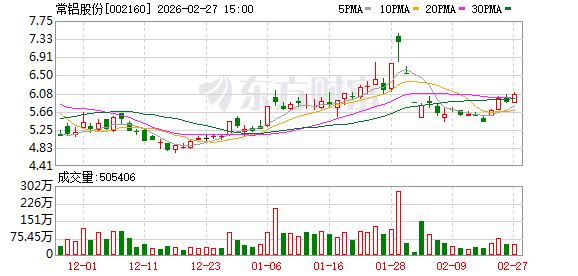
常铝股份:常铝股份长期开展家用空调用高性能铝合金材料研发,为行业提供优质铝合金材料
Zheng Quan Ri Bao· 2026-02-27 13:12
Core Viewpoint - Chang Aluminum Co., Ltd. is actively involved in the "aluminum-saving copper" initiative for household air conditioning, aligning with national industrial policies and trends, while emphasizing the need for a long-term strategy for successful implementation [2] Group 1: Company Involvement - Chang Aluminum is a member of the "Air Conditioning Aluminum Reinforcement Application Research Working Group," recognized by the China Household Electrical Appliances Research Institute and the China Refrigeration Society [2] - The company is the inventor of hydrophilic coated aluminum foil for household air conditioning and has been engaged in the research and development of high-performance aluminum alloy materials [2] Group 2: Industry Trends - The "aluminum-saving copper" strategy is in line with China's industrial policy direction and development trends, indicating a shift towards more efficient materials in the air conditioning sector [2] - The implementation of this strategy requires a relatively long-term layout and execution to achieve the ultimate industrial goals [2] Group 3: Commitment to R&D - Chang Aluminum will continue to focus on the research and development of aluminum alloy technology for air conditioning, contributing positively to the implementation of the national strategy [2]