
生态保护与环境治理

Search documents
视频丨从防沙、固沙到治沙、用沙 看他们如何阻止两大沙漠合拢→
Yang Shi Xin Wen Ke Hu Duan· 2025-12-01 03:34
Group 1 - The core viewpoint of the articles highlights the efforts of forest rangers in Xinjiang to combat desertification and protect the ecological environment between the Taklamakan and Kumtag deserts, creating a green corridor that has successfully widened from less than 2 kilometers to 5.6 kilometers [1][9][39] - The ecological restoration and desertification control project in the Aixi Man area has transformed previously barren land into a thriving ecosystem, utilizing a "water password" approach to manage water resources effectively [23][29][38] - The establishment of a comprehensive protective system against wind and sand in the Taklamakan desert has been achieved through scientific research and practical applications, demonstrating a shift from "people retreating from sand" to "people advancing against sand" [39][50][57] Group 2 - The Aixi Man area has implemented a water recycling system, introducing 50 million cubic meters of reclaimed water annually for afforestation, significantly improving vegetation cover from 4.5% to 45% [32][38] - The research station in the Taklamakan desert has developed a multi-layered ecological protection strategy, combining natural and artificial vegetation to stabilize the environment and promote biodiversity [46][50][55] - The local agricultural practices have been enhanced through the introduction of various economic crops suitable for desert conditions, contributing to the economic benefits for local farmers and improving their livelihoods [53][55][62]


一江碧水映荆楚 万里安澜筑底色——湖北以高水平保护推动长江经济带高质量发展
Zhong Guo Huan Jing Bao· 2025-11-28 05:19
Core Viewpoint - Hubei Province prioritizes the restoration of the Yangtze River's ecological environment, focusing on building a resilient modern water network and promoting comprehensive watershed management, with a commitment to the "ten-year fishing ban" on the Yangtze River [1][8]. Group 1: Ecological Restoration and Environmental Protection - Hubei has implemented a series of measures for precise pollution control, including the closure, transformation, and relocation of 478 chemical enterprises along the Yangtze River, effectively addressing the "chemical encirclement" issue [2]. - The province has completed the remediation of 12,480 pollution discharge outlets and has improved the water quality of 66 urban areas, with over 16,000 rural villages undergoing environmental remediation [2]. - The province has achieved a comprehensive utilization rate of over 79% for livestock and poultry manure, and the treatment rate for ship waste is maintained at over 95% [2][9]. Group 2: Green Development Initiatives - Hubei has launched an ecological environment rights trading platform, enhancing its functionality to support green industry financing and development [4][5]. - The province has issued loans totaling 446.69 billion yuan for carbon reduction projects, leading to a reduction of 893 million tons of CO2 equivalent emissions [7]. - Hubei is advancing its carbon market, achieving a transaction volume of 4.19 billion tons and a transaction value of 10.358 billion yuan, accounting for 42.7% of the national pilot market [7]. Group 3: Future Directions and Goals - The province aims to enhance the ecological carrying capacity and ensure the safety of the Yangtze River, focusing on high-level protection to support high-quality development [8][9]. - Hubei will continue to implement the "three-year action plan" for the protection of the Yangtze River and promote the comprehensive management of lakes and pollution sources [8][9]. - The province emphasizes the integration of ecological governance across various landscapes, including mountains, rivers, forests, fields, lakes, and grasslands, to foster sustainable development [9].
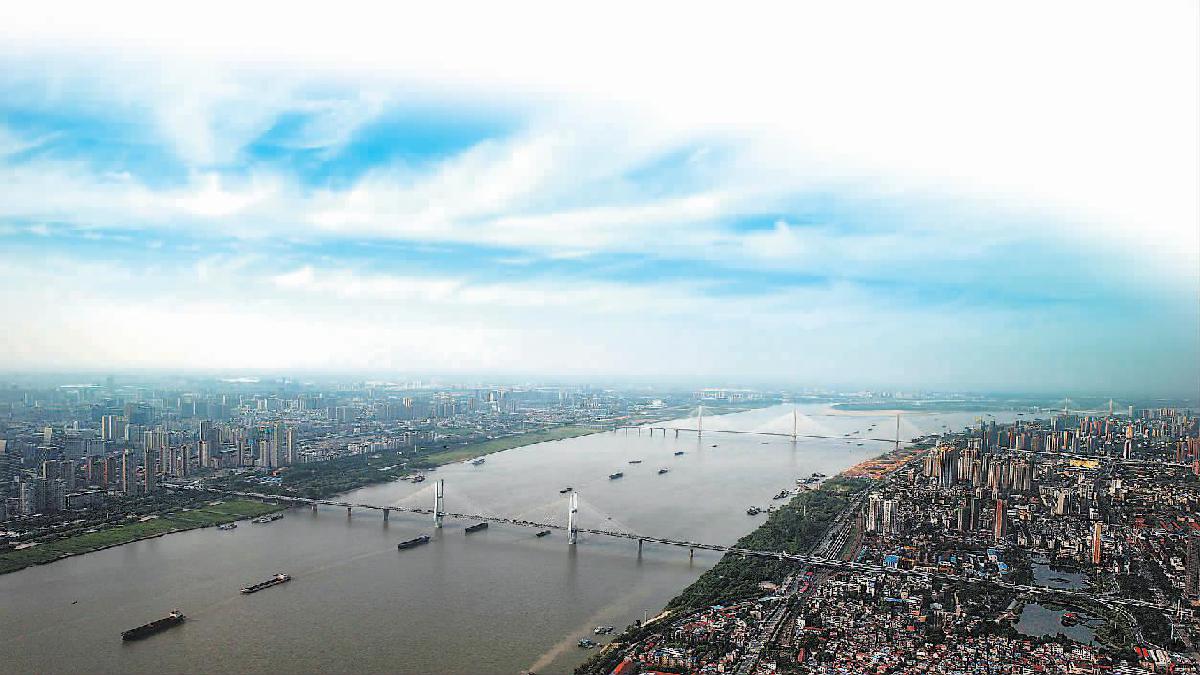
福地怀化绘就生态新画卷
Zhong Guo Huan Jing Bao· 2025-11-19 01:05
Core Viewpoint - Huaihua City has made significant progress in ecological protection and environmental improvement over the past five years, demonstrating the principle that "lucid waters and lush mountains are invaluable assets" through various initiatives and policies aimed at sustainable development [2][4][23] Group 1: Ecological Achievements - Huaihua has maintained air quality at the national secondary standard for five consecutive years, with "Huaihua Blue" becoming a norm [2] - The city ranks 22nd among 337 prefecture-level cities in China for surface water quality as of September this year [2] - Public satisfaction regarding the ecological environment has ranked first in the province for three consecutive years, reflecting the effectiveness of environmental protection efforts [2] Group 2: Institutional Framework - The city has established a robust legal framework for ecological protection, including the "Huaihua Dust Pollution Prevention Regulations," which clarifies responsibilities and standards for pollution control [6] - A comprehensive system of accountability has been implemented, with various committees overseeing environmental protection efforts and ensuring that responsibilities are clearly defined [5] Group 3: Pollution Control Initiatives - Huaihua has launched a systematic pollution prevention campaign, achieving a reduction of nearly 13,000 tons in four major pollutants during the "14th Five-Year Plan" period [9] - The city has completed the precise remediation of 251 river pollution outlets and resolved 408 issues related to rural drinking water sources [9] Group 4: Economic and Environmental Synergy - The city has streamlined environmental approval processes, reducing the time for project approvals significantly, which has enhanced the business environment while maintaining ecological standards [13][14] - Innovative measures such as "deficient acceptance" and "synchronous review" have been adopted to facilitate faster project implementation [14] Group 5: Community Engagement and Value Realization - Huaihua has actively involved the public in ecological protection, rewarding citizens for reporting environmental violations, which has fostered community participation [6] - The city has implemented mechanisms for realizing the value of ecological products, allowing local farmers to benefit financially from carbon reduction efforts [21][22]
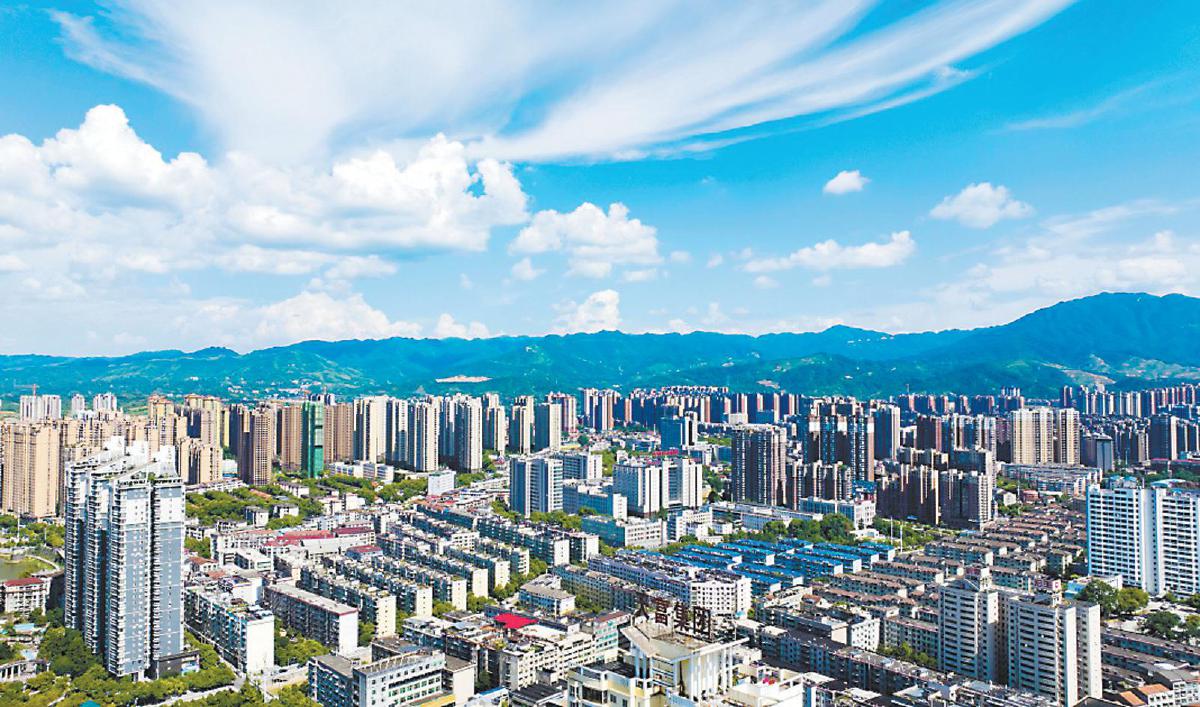
十四五”时期广西筑牢南方生态安全屏障 生态“高颜值”转化为发展“高价值
Zhong Guo Fa Zhan Wang· 2025-10-31 03:47
Core Viewpoint - The Guangxi Zhuang Autonomous Region government emphasizes the importance of ecological environment protection and sustainable development, showcasing significant achievements in ecological civilization construction during the "14th Five-Year Plan" period [3][4][5]. Group 1: Achievements in Ecological Civilization - Guangxi has created 19 national ecological civilization demonstration zones and 6 "Green Mountains and Clear Waters are Invaluable Assets" innovation bases, enhancing its ecological brand [3]. - The region's ecological environment quality remains in the "first tier" nationally, with air quality good days ratio above 95.1% since 2021, projected to reach 97.1% in 2024, and PM2.5 concentration decreasing to 25.4 µg/m³ by 2024 [4]. - The proportion of good surface water quality remains stable at over 98.2%, with several cities ranking high nationally in water quality [4]. Group 2: Green Development Initiatives - Over 17,000 environmental impact assessments have been approved since the start of the "14th Five-Year Plan," with total investments exceeding 4.2 trillion yuan [5]. - Clean energy accounts for over 70% of installed capacity, with 2 out of every 3 kilowatt-hours consumed coming from clean energy sources [5]. - The region has established 105 national-level green factories and 11 green parks, with green investment agreements totaling approximately 75 billion yuan [5]. Group 3: Biodiversity and Regional Cooperation - Guangxi has implemented a positive and negative list for ecological protection, showing zero tolerance for illegal activities, and ranks third nationally in biodiversity richness [5]. - The region has discovered 249 new animal species during the "14th Five-Year Plan," with significant population growth in endangered species like the white-headed leaf monkey and the eastern black-crowned gibbon [5]. - Guangxi has deepened environmental cooperation with the Guangdong-Hong Kong-Macao Greater Bay Area and neighboring provinces, signing a memorandum of understanding with Vietnam for environmental protection [5]. Group 4: Future Plans - The government aims to ensure the successful completion of the "14th Five-Year Plan" and lay a solid foundation for the "15th Five-Year Plan," focusing on harmonious coexistence between humans and nature [6].
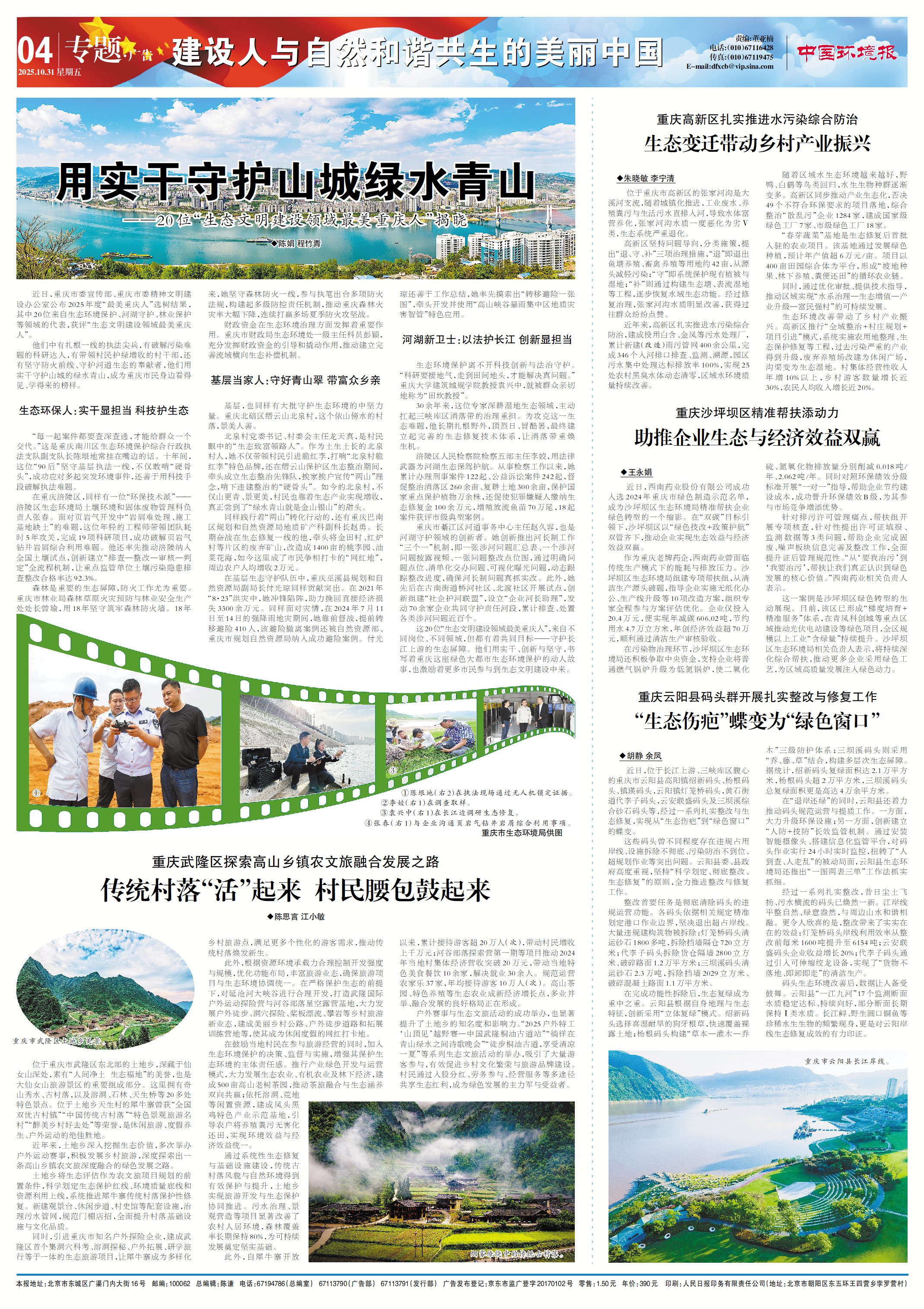
重庆用实干守护山城绿水青山
Zhong Guo Huan Jing Bao· 2025-10-31 00:10
Core Viewpoint - The article highlights the recognition of 20 individuals as the "Most Beautiful Chongqing People" in the field of ecological civilization construction, showcasing their contributions to environmental protection, community engagement, and sustainable development in Chongqing [2][13]. Group 1: Environmental Protection Efforts - Chen Yandi, deputy head of the ecological environment protection team in Nanchuan District, emphasizes thorough investigations in environmental cases, demonstrating commitment to grassroots enforcement [3][14]. - Zhang Chun, head of soil and solid waste management in Fuling District, led a team to solve challenges in shale gas development, completing 19 research projects and achieving a soil pollution remediation compliance rate of 92.3% [3][14]. - Zeng Yu, director of the Forest Fire Prevention and Forestry Safety Production Department, has dedicated 18 years to forest fire prevention, significantly reducing fire incidents in Chongqing [3][14]. Group 2: Community Engagement and Economic Development - Long Tianzhen, the village head of Beiquan Village, has successfully introduced a local specialty brand and led ecological restoration efforts, resulting in increased income for villagers [5][16]. - Zhao Yong, deputy section chief in the Planning and Natural Resources Bureau of Banan District, transformed abandoned mines into 1,400 acres of fruit gardens, boosting local farmer incomes by 20,000 yuan per person [5][16]. Group 3: Disaster Response and Risk Management - Fu Guangqiong, deputy director of the Planning and Natural Resources Bureau in Wuxi County, played a crucial role in disaster response during severe weather events, helping to prevent economic losses of over 33 million yuan [6][17]. - She developed a disaster management application to enhance risk assessment and response strategies [6][17]. Group 4: Legal and Technological Innovations - Professor Yuan Xingzhong from Chongqing University has focused on wetland ecology and established a comprehensive ecological restoration system for the Three Gorges Reservoir area [7][18]. - Li Jiao, head of the Fifth Department of the Fuling District People's Procuratorate, has handled numerous environmental cases, promoting ecological restoration and legal accountability [7][18]. Group 5: Collaborative Initiatives - Zhao Jiurong, director of the River Affairs Center in Qijiang District, implemented a "three-in-one" mechanism for river management, enhancing transparency and accountability in environmental governance [7][19]. - The establishment of the "Community-Enterprise River Protection Alliance" has mobilized over 70 companies to participate in river conservation efforts [7][19].
潍坊奋力谱写人与自然和谐共生新篇章
Zhong Guo Huan Jing Bao· 2025-10-30 01:56
Core Viewpoint - The city of Weifang in Shandong Province is actively implementing the concept of "Lucid waters and lush mountains are invaluable assets," focusing on ecological protection and high-quality development, aiming to become a leader in green and low-carbon development in the province [2][19]. Group 1: Ecological Development Initiatives - Weifang has been recognized as one of the first national pilot cities for coordinated innovation in pollution reduction and carbon reduction, with several districts awarded as national ecological civilization demonstration areas [2][3]. - The city has achieved significant improvements in air quality, with PM2.5 average concentration improving by 30.6% compared to 2020, ranking first in the province [3][15]. - The city has completed the transformation of rainwater and sewage systems in counties, with the proportion of good water bodies in national and provincial controlled rivers reaching 71.4% and 60% respectively by 2024 [4][16]. Group 2: Pollution Control and Environmental Protection - Weifang has implemented a comprehensive approach to pollution control, focusing on air quality, water quality, and soil safety, with a commitment to achieving a "waste-free city" by 2024 [4][16]. - The city has completed the treatment of wastewater in 3,945 administrative villages, achieving dynamic clearance of rural black and odorous water bodies [17]. - The city has established a multi-dimensional governance system for pollution prevention, integrating air, water, soil, and solid waste management [12][18]. Group 3: Economic and Financial Support for Green Development - Since the 14th Five-Year Plan, Weifang has secured 1.22 billion yuan in pollution prevention funds and 20 million yuan in emission reduction subsidies, promoting green financial projects [18]. - The city has implemented an environmental performance rating system, with 82 enterprises rated as A or B, promoting self-driven transformation and upgrades among businesses [18]. - Weifang has pioneered a cross-city adjustment mechanism for environmental factor indicators, facilitating project acceleration and addressing resource bottlenecks [18].
“十五五”时期,四川生态环境保护工作如何发力?
Zhong Guo Huan Jing Bao· 2025-10-28 00:20
Core Points - The "15th Five-Year Plan" period is crucial for Sichuan Province to achieve socialist modernization and advance the construction of a beautiful China, emphasizing ecological protection and high-quality development [1] Group 1: Carbon Neutrality and Emission Control - Sichuan aims to achieve carbon peak goals by transitioning to dual control of carbon emissions and intensity, establishing a comprehensive evaluation system for carbon neutrality [2] - The province will expand the carbon trading market and innovate regional carbon management mechanisms to promote low-carbon development [2] - Key areas will focus on collaborative innovation in pollution reduction and carbon reduction, ensuring completion of national carbon peak pilot tasks [2] Group 2: Green Economic Transformation - The province will optimize spatial structure through ecological environment zoning and enhance management of environmental factors [3] - Sichuan will adjust its industrial structure by promoting green upgrades and developing strategic emerging industries [3] - Energy structure will be optimized by promoting clean energy and implementing the "Electric Sichuan" initiative [3] Group 3: Pollution Prevention and Control - Comprehensive air quality management will be strengthened, focusing on the control of NOX and VOCs emissions [4] - Water environment governance will be enhanced through integrated management of water resources and ecosystems [5] - Soil safety will be prioritized with strict management of agricultural land and pollution remediation [5] Group 4: Ecosystem Protection and Restoration - Sichuan will establish a robust ecological safety framework and enhance the protection of critical ecosystems [6] - Biodiversity protection efforts will be intensified, focusing on rare and endangered species [6] - Regulatory measures for ecological protection will be reinforced, ensuring compliance with ecological red lines [6] Group 5: Major Projects and Reforms - The province will plan significant projects with national and regional impacts, including ecological protection and environmental quality improvement initiatives [7] - Reforms will focus on ecological damage compensation and resource environment rights trading [7] - Major policies will address critical ecological and environmental issues, enhancing management and compensation mechanisms [7]
生态文明建设实现新进步(新时代画卷·决战决胜“十四五”)
Ren Min Ri Bao· 2025-10-05 21:52
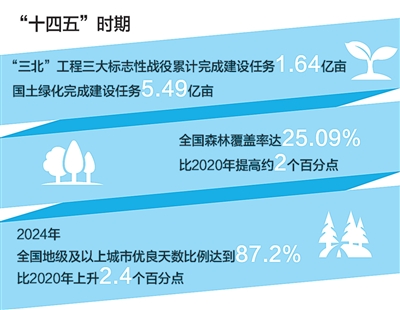
Core Viewpoint - The article emphasizes the continuous improvement of ecological system quality and environmental conditions across various regions in China, highlighting specific initiatives and achievements in ecological protection and restoration efforts. Group 1: Enhancing Ecosystem Quality and Stability - Shandong Dongying has been improving the Yellow River protection mechanism and enhancing ecological environment governance during the 14th Five-Year Plan period [3] - The water quality of the Yangtze River has been improving, with an increase in the population of key protected species [4] - National forest coverage reached 25.09% during the 14th Five-Year Plan period, an increase of approximately 2 percentage points from 2020, making China the fastest-growing country in terms of greening [5] Group 2: Continuous Improvement of Environmental Quality - In Xinjiang, the Koksu Wetland National Nature Reserve has seen ecological improvements and an increase in migratory bird populations due to enhanced protection efforts [7] - Systematic governance in Tongwei County, Gansu, has led to picturesque terraced fields on the Loess Plateau [9] Group 3: Accelerating Green Transformation of Development Methods - As of May 2023, Ningxia has completed governance over 4.22 million acres in the "Three North" project along the Yellow River [10] - Zhejiang Jiaxing is leveraging its hydrogen energy resources to expand the hydrogen energy application chain [12] - Jiangxi Fuzhou is promoting waste classification education among students through hands-on experiences [14]
黄河流域再度横向“赌水” 区域协同治理格局初显
Zhong Guo Xin Wen Wang· 2025-09-21 06:14
Core Viewpoint - The signing of the horizontal ecological compensation agreement among Henan, Shanxi, and Shaanxi marks a significant step in establishing a comprehensive ecological protection compensation mechanism along the Yellow River, promoting regional collaborative governance [1][2] Group 1: Agreement Details - The agreement specifies that the compensation will be based on water quality categories and indices, with specific financial implications tied to the water quality status at the Fenglingdu Bridge control section [2] - If the annual water quality is classified as II, there will be no compensation between upstream and downstream provinces; if classified as I, Henan will compensate Shanxi and Shaanxi 60 million yuan; for each deterioration in water quality category, Shanxi and Shaanxi will compensate Henan 60 million yuan [2] - Monthly compensation is also outlined, where a 1% decrease in key pollutant indices results in a 50,000 yuan compensation from Henan to Shanxi and Shaanxi, while an increase results in a 50,000 yuan compensation from Shanxi and Shaanxi to Henan, with a monthly cap of 2 million yuan [2] Group 2: Significance and Impact - This agreement is viewed as a breakthrough in the construction of the horizontal ecological protection compensation mechanism along the Yellow River, emphasizing shared responsibilities and collaborative governance among provinces [2] - Experts highlight that despite differing governance focuses in the Yellow River's middle and lower reaches, they function as an organic whole, indicating the importance of integrated ecological management [2] - The agreement is expected to enhance ecological protection efforts and serve as a model for measuring the value of ecological products in the future [2]
内蒙古上半年完成防沙治沙1550余万亩 污染防治攻坚成效显著
Zhong Guo Chan Ye Jing Ji Xin Xi Wang· 2025-08-28 00:52
Group 1 - Inner Mongolia has prioritized ecosystem protection and pollution prevention as key tasks to strengthen the ecological security barrier in northern China, achieving positive progress [1] - In the first half of the year, Inner Mongolia completed 15.516 million acres of desertification control tasks, accounting for 77.6% of the annual target [1] - The implementation of the "Grass and Livestock Balance and Grazing Ban" regulation has led to a 12 percentage point decrease in illegal grazing rates [1] Group 2 - A total of 398 green mines have been established in Inner Mongolia, ranking among the top in the country, with 97.86 square kilometers of historical mining ecological restoration completed in 2023 [2] - The average PM2.5 concentration in Inner Mongolia decreased by 11.1% year-on-year, with the proportion of good air quality days rising to 87.8% [2] - The proportion of surface water quality in the first three categories reached 73.7%, with only 2.6% in the worst category, exceeding national assessment targets [2]