电池回收

Search documents
金圆股份(000546.SZ):公司暂无废旧电池回收业务
Ge Long Hui· 2026-01-26 14:48
Group 1 - The company, Jinyuan Co., Ltd. (000546.SZ), stated on the investor interaction platform that it currently does not have any business related to the recycling of used batteries [1]

废旧电池回收新规出台 现存电池回收相关企业超20万家
Zhong Guo Neng Yuan Wang· 2026-01-26 11:40
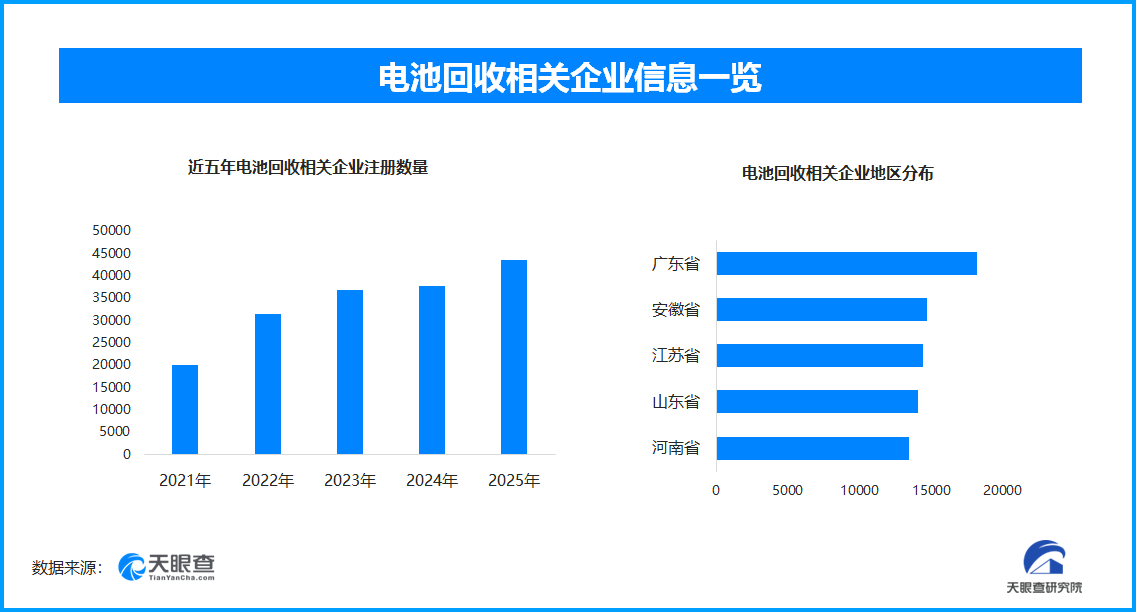
Core Viewpoint - The new regulations for the recycling and comprehensive utilization of used power batteries in the new energy vehicle sector signify a new phase of standardized management across the entire chain in China [1] Group 1: Regulatory Framework - The new regulations impose responsibilities on all parties involved, including battery manufacturers, vehicle companies, and recycling firms, with administrative penalties to enhance supervision [1] - Compliance records of these entities will directly affect their business qualifications and partnership opportunities, making it essential to verify their operational scope and check for any environmental penalties, safety incidents, or major legal disputes [1] Group 2: Industry Integration and Investment Opportunities - The regulations are expected to integrate multiple resources, promoting the transformation of the industry towards standardization, efficiency, and sustainability, thereby supporting the long-term development of the new energy vehicle sector [2] - Understanding the capital backgrounds and control relationships of key enterprises in the industry is crucial for investors and researchers, as it allows for a clearer view of the investment institutions, control levels, and associated networks behind these companies [2] Group 3: Market Trends - As of now, there are over 204,000 battery recycling-related enterprises in China, with more than 43,000 new registrations expected by 2025, indicating a consistent annual growth trend in the number of registered companies over the past five years [2] - The peak in the number of registered battery recycling enterprises is projected to occur in 2025 [2] Group 4: Regional Distribution - Guangdong, Anhui, and Jiangsu provinces lead in the number of battery recycling-related enterprises, with over 18,000, 14,000, and 14,000 companies respectively, followed by Shandong and Henan provinces [3]

港股异动丨晋景新能涨5%,旗下公司建锂电池再生黑粉生产线助香港绿色转型
Ge Long Hui· 2026-01-26 03:42
Core Viewpoint - Jin Jing New Energy (1783.HK) experienced a strong performance today, with a peak increase of 5% reaching HKD 3.32 per share, driven by the announcement of the construction of Hong Kong's first intelligent lithium battery black powder production line dedicated to processing retired electric vehicle batteries [1] Group 1 - The project is managed and operated by Jin Yang International (Hong Kong) Limited, a subsidiary of Jin Jing New Energy Group [1] - The project has received funding from the Hong Kong SAR Government's Innovation and Technology Commission under the "New Industrialization Funding Scheme," with an expected funding amount of approximately HKD 15 million [1] - The facility will be located within the Hong Kong EcoPark and is described as the "first power battery processing facility" in Hong Kong [1]
格林美(002340):公司动态研究报告:正极材料不断突破,镍钴自供能力强化
Huaxin Securities· 2026-01-25 13:17
Investment Rating - The report assigns a "Buy" investment rating for the company, indicating a positive outlook for its stock performance in the coming months [2][8]. Core Insights - The company is expected to benefit from the structural upgrade in demand for ternary materials, with continuous technological breakthroughs in high-nickel and ultra-high-nickel ternary precursors [5]. - The company's self-sufficiency in nickel and cobalt is strengthening, showcasing resilience amid tightening supply due to external factors such as export bans [6]. - The recycling of power batteries is projected to grow significantly, with the company actively participating in this emerging market [7]. - Revenue forecasts for the company are optimistic, with projected revenues of 39.27 billion, 48.18 billion, and 59.51 billion yuan for 2025, 2026, and 2027 respectively, alongside increasing earnings per share (EPS) [8][11]. Summary by Sections Market Performance - The company's stock price has shown a range from 5.85 to 9.66 yuan over the past 52 weeks, with an average daily trading volume of approximately 1.1 billion yuan [2]. Business Operations - In the first three quarters of 2025, the company shipped over 120,000 tons of nickel-cobalt precursors and 17,000 tons of cathode materials, indicating strong operational performance [5]. - The company has achieved significant production milestones, including the mass production of ultra-high nickel precursors and the establishment of a low-carbon recycling innovation lab for power batteries [7]. Financial Projections - The company is projected to see substantial growth in net profit, with estimates of 1.66 billion, 2.31 billion, and 3.53 billion yuan for 2025, 2026, and 2027 respectively, reflecting a robust growth trajectory [11]. - The report anticipates a decrease in the price-to-earnings (P/E) ratio from 30 times in 2025 to 14 times by 2027, suggesting increasing valuation attractiveness [8][11].

直击新能源汽车废电池黑产链:激光焊接+无证拼装
Mei Ri Jing Ji Xin Wen· 2026-01-21 12:57
Core Viewpoint - The article discusses the rising demand for "disassembled batteries" sourced from retired electric vehicle batteries, highlighting the regulatory challenges and market dynamics surrounding their use in electric bicycles and other applications [1][4][5]. Group 1: Market Dynamics - The demand for disassembled batteries is driven by their lower cost and higher performance compared to original batteries, appealing particularly to delivery riders and couriers [1][2]. - A disassembled battery can provide a range of up to 80 kilometers, significantly more than the original battery's 40 kilometers [1]. - The price of a disassembled battery is approximately 3,000 yuan, which is about 500 yuan cheaper than a new battery of the same specifications [2]. Group 2: Regulatory Environment - The Ministry of Industry and Information Technology has issued new regulations prohibiting the use of retired batteries in electric bicycles, effective from April 1, 2026 [1][5]. - The concept of "cascade utilization" for retired batteries has been eliminated, which previously allowed for their use in various applications [5]. - The new regulations emphasize the "vehicle-battery integration" requirement for the scrapping of electric vehicles, mandating that batteries must be included during the scrapping process [5]. Group 3: Industry Challenges - A significant portion of retired batteries, estimated at 80%, is reportedly missing from vehicles before they reach authorized recycling facilities, indicating a leakage into unregulated markets [4]. - The recycling capacity of legitimate battery recycling companies is underutilized, with estimates suggesting that only 25% of their capacity is currently being used [4]. - The rapid growth of the electric vehicle market has led to an urgent need for a robust battery recycling infrastructure to manage the increasing volume of retired batteries [6][9]. Group 4: Future Projections - The domestic battery recycling volume is projected to exceed 300,000 tons by 2024, with the number of retired lithium batteries expected to reach 981,600 tons by 2026 [7][8]. - The market for recycled materials from lithium batteries is anticipated to grow significantly, with sales expected to reach 856,100 tons by 2025 and 1,204,500 tons by 2026 [10].
中国碳中和与中国铁塔及中国再生资源签署三方战略合作协议 联合打造锂电循环经济生态圈
Zhi Tong Cai Jing· 2026-01-07 11:18
Core Viewpoint - The strategic cooperation agreement signed between China Carbon Neutrality, China Tower Corporation, and China Recycled Resources Development Group aims to explore innovative collaboration models under the carbon neutrality goal, focusing on building a lithium battery recycling ecosystem and contributing to national carbon peak and neutrality strategies [1][2]. Group 1: Strategic Cooperation - The three parties will leverage their respective strengths in resources, technology, market, and industrial synergy to establish a standardized, high-coverage, and efficient lithium battery recycling system [1]. - The collaboration will focus on creating a sustainable lithium circular economy ecosystem and enhancing resource disposal capabilities to build a low-carbon circular industrial cluster [1][2]. Group 2: Future Outlook - The partnership will explore deep cooperation in areas such as energy storage station construction, carbon asset management, and green energy services, aiming to create a green industrial chain covering the entire lifecycle of battery production, usage, recycling, and regeneration [1][2]. - The cooperation is seen as a benchmark initiative for implementing the national dual carbon strategy, aligning with global energy transition and circular economy trends [2]. Group 3: Industry Impact - The collaboration is expected to enhance the group's comprehensive competitiveness in the carbon neutrality industry chain by addressing challenges such as the fragmentation of the lithium battery recycling industry and difficulties in traceability [2]. - By replacing primary minerals with recycled resources, the partnership aims to significantly reduce carbon emissions throughout the battery lifecycle and foster new business models like battery swapping and battery banks, thereby generating sustainable business growth and financial returns for the group [2].

中国碳中和(01372)与中国铁塔及中国再生资源签署三方战略合作协议 联合打造锂电循环经济生态圈
智通财经网· 2026-01-07 09:08
Core Viewpoint - The strategic cooperation agreement signed between China Carbon Neutrality (01372), China Tower Corporation, and China Recycled Resources Development Group aims to explore innovative collaboration models under the carbon neutrality goals, focusing on building a lithium battery recycling ecosystem and supporting national carbon peak and neutrality strategies [1][2]. Group 1: Strategic Cooperation - The three parties will leverage their respective strengths in resources, technology, market, and industrial synergy to establish a standardized, high-coverage, and efficient lithium battery recycling system [1]. - The collaboration will focus on creating a sustainable lithium battery circular economy ecosystem, enhancing resource disposal capabilities, and developing low-carbon circular industrial clusters [1][2]. Group 2: Future Outlook - The partnership will explore deep cooperation in areas such as energy storage station construction, carbon asset management, and green energy services, aiming to create a green industrial chain covering the entire lifecycle of battery production, usage, recycling, and regeneration [1]. - This cooperation is seen as a benchmark initiative for implementing the national dual carbon strategy, aligning with global energy transition and circular economy trends [2]. Group 3: Industry Impact - The collaboration is expected to enhance the group's comprehensive competitiveness in the carbon neutrality industry chain by addressing challenges such as the fragmentation of the lithium battery recycling industry and difficulties in traceability [2]. - By replacing primary minerals with recycled resources, the partnership aims to significantly reduce carbon emissions throughout the battery lifecycle and foster new business models such as battery swapping services and battery banks [2].
中国碳中和(01372) - 自愿公告联合打造鋰电循环经济生态圈 中国碳中和与中国铁塔及中国再生资...
2026-01-07 08:59
香港交易及結算所有限公司及香港聯合交易所有限公司對本公告之內容概不負責,對其準確性或完 整 性亦不發表任何聲明,並明確表示,概不就因本公告全部或任何部分內容而產生或因依賴該等 內容而引致之任何損失承擔任何責任。 (於開曼群島註冊成立之有限公司) 1372) 三方秉持「優勢互補、合作共贏、綠色發展」原則,整合各自核心資源:依託中國鐵塔 全國通信基建網絡與退役物資儲備、中國再生資源覆蓋城鄉的實體回收網絡及資質優勢、本 本公告乃中國碳中和發展集團有限公司(「中國碳中和」或「本公司」,連同其附公司 統稱「本集團」)作出之自願公告,以知會本公司股東及有意投資者關於本集團業務發展之 最新消息。 本公司董事會(「董事會」)欣然宣佈,於近期,本集團與中國鐵塔股份有限公司(「中 國鐵塔」)及中國再生資源開發集團有限公司(「中國再生資源」)簽署戰略合作協議(「 協議」)。三方本著「優勢互補、合作共贏、綠色發展」的原則,將充分發揮各自在資源、 技術、市場及產業協同方面的優勢,共同探索碳中和目標下的創新合作模式,共同推動鋰電 循環經濟生態圈建設,落實國家「碳達峰、碳中和」戰略目標。 ● 合作核心內容 - 1 - 集團線上回收平台「尋 ...
格林美:公司已建成5万吨磷酸铁锂黑粉回收利用示范线,可直接产出高品质的电池级磷酸铁
Mei Ri Jing Ji Xin Wen· 2026-01-04 10:32
Core Viewpoint - The company has established a 50,000-ton lithium iron phosphate recycling demonstration line, producing high-quality battery-grade lithium iron phosphate, which is competitive in performance and cost compared to directly produced commercial products [1]. Group 1: Production Capacity and Output - The company has built a demonstration line capable of recycling 50,000 tons of lithium iron phosphate black powder [1]. - The current annual output of lithium iron phosphate from the recycling line is not specified in the provided information [1]. Group 2: Product Performance and Market Position - The core performance of battery-grade lithium iron phosphate produced from recycled materials is comparable to that of commercially produced products [1]. - The company emphasizes advantages in production costs and the green premium associated with using recycled materials [1]. - Continuous research and development efforts will be made to adapt to market demands [1].
1000万吨蜂拥而至!中科院博士撬动千亿电池回收市场
创业邦· 2026-01-04 03:48
Core Viewpoint - The article discusses the urgent need for efficient recycling solutions for the rapidly increasing volume of discarded lithium batteries, particularly in the context of the booming electric vehicle market. It highlights the challenges and opportunities in the battery recycling industry, focusing on the company BOCUI Recycling and its innovative approaches to address these issues [3][4][5]. Group 1: Industry Overview - The volume of retired lithium batteries in China is projected to reach approximately 500,000 tons by 2030, contributing to a global total of 10 million tons [4]. - In 2024, the estimated amount of discarded batteries in Shanghai alone could reach 400,000 tons, indicating significant pressure on recycling systems [3]. - The global battery recycling market is expected to reach a scale of hundreds of billions by 2030 [7]. Group 2: Company Profile - BOCUI Recycling - Founded in 2019, BOCUI Recycling specializes in providing technology solutions for the recycling of new energy batteries and has secured several rounds of financing totaling hundreds of millions of RMB from notable investors [5][6]. - The company adopts a "light asset" operational model, focusing on providing recycling technology solutions rather than building its own recycling facilities [7][23]. - BOCUI's technology boasts a recovery rate of over 99% for key metals like nickel and cobalt, significantly higher than the industry average of 85%-90% [25]. Group 3: Market Strategy - BOCUI Recycling has shifted its focus to overseas markets, particularly in Europe, where battery recycling capacity is still scarce, and demand is increasing due to regulatory changes [13][18]. - The company has established over 50 projects in 15 countries, with overseas clients outnumbering domestic ones [7][15]. - BOCUI's strategy involves identifying specific needs in the overseas market and providing tailored technical solutions, leveraging its strong R&D capabilities [15][19]. Group 4: Technological Innovations - BOCUI has developed a new recycling technology called "Nickel-Cobalt Co-Extraction," which reduces the extraction process from four steps to two, achieving a 30% cost reduction while maintaining high recovery rates [25][27]. - The company is also exploring the production of new battery cathode materials directly from recycled metals, addressing a gap in the market for local processing capabilities [27]. Group 5: Challenges and Future Outlook - The company faces challenges in expanding into the European market, including lengthy project cycles and regulatory hurdles related to environmental assessments [17][20]. - BOCUI aims to support the local recycling of Chinese-manufactured lithium batteries in key markets, emphasizing the importance of local partnerships to navigate regulatory landscapes [19][21]. - The company is preparing for the anticipated surge in battery waste by developing comprehensive recycling solutions and infrastructure [22][26].