
设备制造业

Search documents
镇江祥利晟设备科技有限公司成立 注册资本200万人民币
Sou Hu Cai Jing· 2025-10-23 00:11
Core Viewpoint - Zhenjiang Xiangli Sheng Equipment Technology Co., Ltd. has been established with a registered capital of 2 million RMB, focusing on various equipment manufacturing and technology services [1] Company Summary - The company is legally represented by Zhou Zhixiang [1] - The registered capital is 2 million RMB [1] - The business scope includes general projects such as mechanical equipment research and development, manufacturing of mechanical and electrical equipment, pumps and vacuum equipment, refrigeration and air conditioning equipment, fans, motors, pneumatic and electric tools, molds, and maintenance of electronic and mechanical equipment [1] Industry Summary - The company operates in multiple manufacturing sectors including general equipment, communication equipment, and specialized equipment [1] - It also provides technology promotion and application services, along with technical services, development, consulting, exchange, transfer, and promotion [1]
多项数据印证 “两新”政策激活消费动能
Zhong Guo Zheng Quan Bao· 2025-10-22 22:18
Core Insights - The "Two New" policy, which includes subsidies for replacing old consumer goods and updating equipment, has shown significant positive effects on consumption and investment in related industries [1][2][5]. Group 1: Consumer Goods Market - In the first three quarters, retail sales of household appliances, such as refrigerators, increased by 48.3%, while sales of home audio-visual equipment grew by 26.8% [3][4]. - The furniture retail sector also experienced growth, with sales increasing by 21.3% for furniture and 25.3% for home appliances and audio-visual equipment [2][3]. - The number of applications for vehicle trade-ins has surpassed 8.3 million, averaging over 30,000 applications per day [2]. Group 2: Equipment Investment - The investment in machinery and equipment by industrial enterprises rose by 9.4% year-on-year, with high-tech manufacturing seeing a 14% increase [5][6]. - The investment in tools and equipment for the manufacturing sector grew by 14%, with specific sectors like general equipment manufacturing and aerospace seeing increases of 11.8% and 22.3%, respectively [5][6]. - The energy sector also reported a 10.5% increase in machinery purchases, with thermal energy production seeing a notable 16.4% rise [5]. Group 3: Policy Impact and Future Outlook - The ongoing implementation of the "Two New" policy is expected to further drive the transformation of industries towards high-end, intelligent, and green solutions [6]. - Experts anticipate additional consumer stimulus measures, including potential increases in subsidy amounts and the introduction of consumption vouchers [6]. - Future mechanisms will focus on equipment updates, consumer goods replacement, recycling, and standard enhancements, supported by long-term special bonds [6].
前三季度GDP公布!|宏观经济
清华金融评论· 2025-10-20 02:30
Core Viewpoint - The article emphasizes that despite facing complex external and internal challenges, China's economy has shown resilience and achieved a GDP growth of 5.2% in the first three quarters of 2025, indicating a stable and progressive economic performance [4][6][8]. Economic Performance - China's GDP for the first three quarters of 2025 reached 10,150.36 billion yuan, with a year-on-year growth of 5.2%, which is an acceleration of 0.2 and 0.4 percentage points compared to the previous year and the same period last year, respectively [5]. - The average urban unemployment rate remained stable at 5.2%, while the Consumer Price Index (CPI) slightly decreased by 0.1%, with the core CPI (excluding food and energy) rising by 0.6% [5][10]. - The total import and export volume reached a historical high, with a year-on-year growth of 6.0% in the third quarter, and foreign exchange reserves remained above 3.3 trillion USD [5][10]. High-Quality Development - The article highlights the ongoing efforts towards high-quality development, with significant advancements in new production capacities and economic structure optimization [6][18]. - The proportion of added value from equipment manufacturing and high-tech manufacturing reached 35.9% and 16.7%, respectively, indicating a shift towards more advanced industries [6]. - The share of non-fossil energy consumption in total energy consumption increased by approximately 1.7 percentage points year-on-year, reflecting progress in green and low-carbon transformation [6][18]. Economic Resilience - China's economy demonstrated strong resilience, achieving a 5.2% growth rate despite global economic uncertainties and trade protectionism [7][10]. - The article notes that this growth rate is among the highest compared to other major economies, showcasing China's role as a stable and reliable driver of global economic growth [7][10]. Policy Implementation - The implementation of proactive macroeconomic policies has played a crucial role in stabilizing the economy, with measures aimed at expanding domestic demand and enhancing market vitality [13][14]. - The contribution of final consumption expenditure to economic growth reached 53.5%, an increase of 9.0 percentage points compared to the previous year, highlighting the effectiveness of consumption-boosting policies [13][14]. New Quality Productivity - The development of new quality productivity has been emphasized as a key driver for high-quality growth, with significant investments in R&D and innovation leading to advancements in various sectors [16][17]. - The added value of high-tech manufacturing increased by 9.6%, with notable growth in industries such as integrated circuits and industrial robots [16][17]. Green Transformation - The article discusses the steady progress in green transformation, with significant increases in renewable energy production and the adoption of green technologies [18][23]. - The production of new energy products, such as electric vehicles and solar batteries, has seen substantial growth, contributing to a more sustainable economic model [18][23].


星云股份:约2649.75万股限售股10月20日解禁
Mei Ri Jing Ji Xin Wen· 2025-10-14 09:45
Group 1 - The company Xingyun Co., Ltd. announced that approximately 26.4975 million restricted shares will be unlocked and available for trading on October 20, 2025, representing 15.2% of the total share capital [1] - For the first half of 2025, the revenue composition of Xingyun Co., Ltd. is as follows: equipment manufacturing accounts for 90.25%, testing services account for 9.66%, and other businesses account for 0.1% [1] - As of the report date, the market capitalization of Xingyun Co., Ltd. is 7.3 billion yuan [1]

科瑞技术:9月18日召开董事会会议
Sou Hu Cai Jing· 2025-09-19 04:51
Group 1 - Core viewpoint: Keri Technology (SZ 002957) announced the convening of its 25th meeting of the fourth board of directors on September 18, 2025, to review the proposal for amendments [1] - Revenue composition for Keri Technology in the first half of 2025: Equipment manufacturing accounted for 99.09%, while other businesses made up 0.91% [1]

反内卷影响详细测算:牛市的逻辑:产能过剩下行拐点到来
Xinda Securities· 2025-08-29 02:04
Group 1: Industrial Capacity and Economic Trends - As of Q2 2025, China's industrial capacity reached 186.7 trillion yuan, accounting for 135.7% of GDP, down from 144.9% in Q4 2022[11] - China's industrial capacity has undergone three expansion phases: 2018, 2021, and 2023-2024[14] - The first capacity surplus occurred in 2015-2016, the second in 2020 due to the pandemic, and the third began in 2023, driven by capacity expansion and weak demand[30] Group 2: "Anti-Involution" Policy Impacts - The "anti-involution" policy is expected to create a turning point for declining capacity surplus and rising PPI, improving corporate profitability[7] - Historical data shows that each resolution of capacity surplus and recovery of PPI has led to a bull market in capital markets[61] - The capital market is anticipated to enter a bull market as a result of the "anti-involution" policy, similar to past instances in 2016-2017 and 2020-2021[61] Group 3: Risks and Future Considerations - Risks include slower-than-expected progress on "anti-involution," geopolitical risks, and potential deviations from historical patterns[3] - The need for demand-side measures to balance growth dynamics is emphasized, as reliance on manufacturing growth may weaken[60] - Enhancing non-manufacturing dynamics is crucial for achieving balanced growth, with potential strategies including infrastructure investment and boosting consumer spending[60]
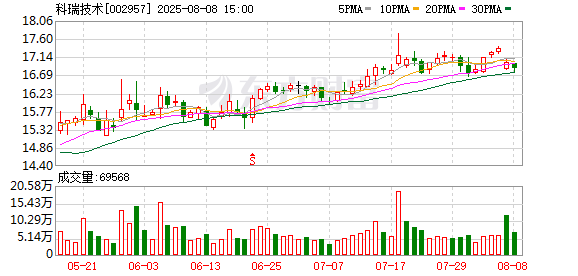
科瑞技术:拟向激励对象授予权益总计176.73万份
Mei Ri Jing Ji Xin Wen· 2025-08-08 15:23
Group 1 - The core point of the news is that Keri Technology announced an incentive plan involving stock options and restricted stock for 104 individuals, with a total of 1.7673 million options granted, representing 0.42% of the company's total equity at the time of the announcement [1] - The exercise price for the stock options is set at 12.63 yuan per share, while the grant price for the restricted stock is 8.42 yuan per share, with a maximum validity period of 36 months for the restricted stock incentive plan [1] - For the year 2024, Keri Technology's revenue composition is predominantly from the equipment manufacturing sector, accounting for 99.2%, with other businesses contributing only 0.8% [1] Group 2 - As of the report, Keri Technology has a market capitalization of 7.1 billion yuan [2]
科瑞技术:8月8日召开董事会会议
Mei Ri Jing Ji Xin Wen· 2025-08-08 14:36
Group 1 - The company, Kory Technology (SZ 002957), announced that its fourth board meeting will be held on August 8, 2025, to discuss the employee stock ownership plan [2] - For the year 2024, Kory Technology's revenue composition is 99.2% from equipment manufacturing and 0.8% from other businesses [2]
国家发改委宏观经济研究院白泉:节能增效成为绿色转型升级的金钥匙
Jing Ji Ri Bao· 2025-07-30 08:23
Core Viewpoint - Energy conservation and efficiency enhancement have become strategic choices for sustainable economic development and the future of humanity, rather than mere environmental initiatives [1] Group 1: Energy Consumption and Challenges - In 2024, China's primary energy consumption reached 5.96 billion tons of standard coal, with oil and natural gas import rates exceeding 70% and 40% respectively, indicating increasing energy security risks [2] - Energy consumption intensity in China decreased by 3.8% year-on-year in 2024, with a cumulative reduction of 11.6% over the first four years of the 14th Five-Year Plan [2] - The focus on energy conservation and efficiency is essential for alleviating energy supply pressure, reducing carbon emissions, and promoting industrial upgrades [2] Group 2: Policy Initiatives and Economic Impact - In 2024, a new round of large-scale equipment updates and consumer product exchanges was initiated, with the aim of enhancing standards for technology, energy consumption, and emissions [3] - The "Two New" policy, which includes subsidies for various household appliances and digital products, is expected to accelerate the green transformation of society [3][4] - By May 31, 2025, the consumer product exchange program generated sales of 1.1 trillion yuan, with approximately 1.75 billion subsidies distributed to consumers [3] Group 3: Investment and Industrial Upgrades - Equipment investment grew by 15.7% in 2024, contributing 2.2 percentage points to overall investment growth [4] - The manufacturing sectors related to the "Two New" policy saw significant growth, with the equipment manufacturing industry's added value increasing by 7.7% in 2024 [4] - New technologies and equipment are rapidly replacing traditional equipment, with notable growth in sectors such as new energy vehicles and solar cells [4] Group 4: Environmental Impact and Future Outlook - The "Two New" policy is projected to save approximately 28 million tons of standard coal and reduce carbon dioxide emissions by about 73 million tons in 2024 [5] - The transition from energy consumption control to carbon emission control is set to occur during the 14th Five-Year Plan, with a target to peak carbon emissions before 2030 [6] - The vision for the future includes transforming factories into resource-recycling "green gardens" and cities into eco-friendly habitats, promoting a lifestyle of simplicity and low carbon [6]
书写传统制造业转型答卷
Zhong Guo Hua Gong Bao· 2025-06-04 02:11
Core Insights - The company has implemented a smart welding system that allows real-time monitoring of 152 welding machines, improving management efficiency and quality control [1][3] - The introduction of advanced equipment, such as welding robots and CNC machines, has significantly enhanced operational efficiency and product quality [2][3] Group 1: Smart Welding System - The smart welding system creates a digital link from the operational level to the management level, allowing for real-time task assignment and monitoring [1] - The system collects electrical data automatically and triggers alarms when parameters exceed limits, improving quality control [1] Group 2: Equipment Upgrades - The first pipe and plate welding robot was introduced in June 2024, completing tasks 30%-50% faster than traditional methods, with a 95% pass rate in non-destructive testing [2] - The company has also introduced two intelligent cladding workstations, increasing efficiency by 30% and allowing one welder to operate two machines simultaneously [2] - Additional equipment, such as CNC laser cutting machines and CNC machining centers, has been adopted to enhance manufacturing quality and efficiency [2] Group 3: Transformation of Management Practices - The shift from traditional management to data-driven precision control marks a significant transformation in the company's operational practices [3] - The company is focusing on high-end, green, and intelligent manufacturing as part of its upgrade strategy [3]