量化交易

Search documents
缴纳5.64亿美元巨额保证金后,Jane Street获准恢复印度市场交易
Hua Er Jie Jian Wen· 2025-07-21 13:36
Core Viewpoint - The confrontation between quantitative trading giant Jane Street and Indian regulatory authorities has seen a turning point, allowing the company to resume trading in India after depositing a significant amount of funds, but the investigation into its alleged market manipulation continues [1][2]. Group 1: Regulatory Developments - Jane Street was permitted to resume trading in India after depositing 48.4 billion rupees (approximately $564 million) into a custodial account, which was labeled as "illegal gains" by the Indian Securities and Exchange Board (SEBI) [1]. - SEBI notified Jane Street of this decision via email, although the company does not plan to immediately return to the options market despite the lifting of the ban [1][2]. - The ongoing investigation by SEBI into Jane Street's alleged manipulation practices remains active, focusing on the company's trading activities in both the options and spot markets [2][5]. Group 2: Allegations and Financial Impact - SEBI's allegations against Jane Street include claims that the company established a short position in options that was seven times larger than its long position in the BANKNIFTY index, leading to significant profits [2]. - The regulatory body detailed in a 105-page interim order that Jane Street's trading strategy involved buying heavily into bank stocks to inflate the index, followed by shorting through options, resulting in a profit of $86 million on a single day in January 2024 [2]. - Jane Street reportedly earned approximately 365 billion rupees (around $4.3 billion) from its trading activities in India from January 2023 to March 2025, according to SEBI's investigation [5]. Group 3: Legal and Strategic Responses - Jane Street has the option to appeal SEBI's charges to the Securities Appellate Tribunal in Mumbai and must submit a written response to the regulatory body by the end of the week to defend itself and request a personal hearing [4]. - The company has expressed strong opposition to SEBI's temporary order, arguing that the alleged "intraday index manipulation" is a common practice known as "fundamental index arbitrage trading" in financial markets [5].

43亿美元打水漂,印度对准华尔街开火!美国集体沉默,背后不简单
Sou Hu Cai Jing· 2025-07-13 05:44
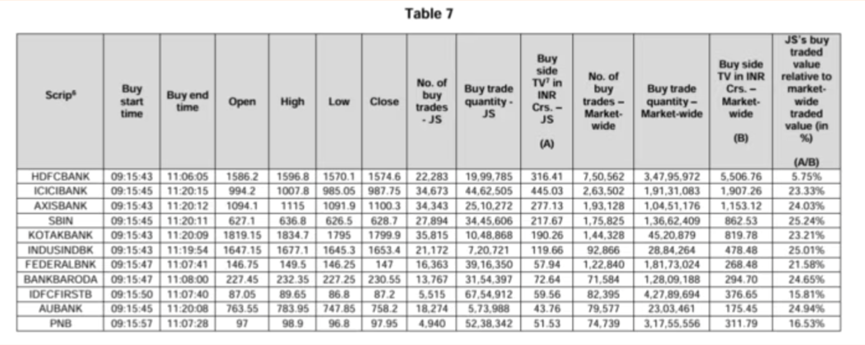
Group 1 - India has taken a strong stance against US financial firms, specifically targeting JaneStreet with significant fines and trading bans, indicating a shift in its approach to foreign investment [1] - JaneStreet earned $4.3 billion in profits within two years in India but faced a temporary trading ban and the confiscation of $5.8 billion (484 crore INR) due to alleged market manipulation, leading to total losses of approximately $4.87 billion [1] - The incident reflects a broader trend where foreign companies are struggling in the Indian market, with 2,783 foreign firms shutting down operations in the past seven years, averaging one exit every eight hours [5][4] Group 2 - The Indian market has become increasingly hostile for foreign businesses, with significant challenges such as tax intimidation and regulatory hurdles, exemplified by Xiaomi's assets being frozen and high-profile executives being arrested [7] - In 2024, foreign direct investment in India plummeted to just $2.6 billion, a nearly 90% decrease year-on-year, indicating a severe decline in investor confidence [8] - Major companies like Ford and Disney have exited the Indian market after incurring substantial losses, highlighting the difficulties faced by foreign enterprises [5] Group 3 - India's regulatory environment is perceived as a double-edged sword, as it seeks to attract Western capital while simultaneously fearing loss of economic sovereignty, with foreign ownership constituting 18% of the Indian stock market [12] - The country is experiencing a capital flight risk, with external debt significantly exceeding foreign exchange reserves, raising concerns about potential financial crises [12] - The Indian government's attempts to stimulate manufacturing through initiatives like the Production-Linked Incentive (PLI) scheme have largely failed, with over half of the participating companies not meeting their targets [10][11]
遭印度监管指控市场操纵,量化巨头发内部信否认
第一财经· 2025-07-08 23:44
Core Viewpoint - The conflict between Jane Street and the Securities and Exchange Board of India (SEBI) has escalated, with Jane Street denying all allegations of market manipulation and asserting that its trading practices are legitimate and beneficial to market liquidity [1][3]. Group 1: Allegations and Responses - SEBI issued a temporary ban on Jane Street, accusing the firm of "malicious market manipulation" and freezing its funds amounting to 48.4 billion rupees (approximately 4 billion yuan) in India [1]. - Jane Street refuted SEBI's claims, stating that its trading activities are based on standard arbitrage and hedging strategies aimed at ensuring price consistency across financial instruments [1][3]. - The firm highlighted a specific trading incident on January 17, 2024, where it engaged in index arbitrage to correct significant price discrepancies between the BANKNIFTY index in the stock and options markets [3][5]. Group 2: Trading Practices and Market Impact - Jane Street emphasized that its role as a liquidity provider is crucial for the health of the Indian derivatives market, arguing that without such participants, there would be no economic connection between the derivatives market and the underlying economy [3]. - The company defended its practices regarding the "extended closing price manipulation" accusation, explaining that its risk management strategies are standard globally and not intended to manipulate the market [5]. Group 3: Communication and Legal Actions - Jane Street criticized SEBI for claiming a lack of cooperation, asserting that it has been responsive and transparent since SEBI's request for trading information in August 2024 [7]. - The firm expressed disappointment over SEBI's failure to engage in dialogue despite multiple attempts to communicate, stating that it is preparing a formal response to the allegations and will utilize all available legal means to protect its interests [7][6].
华尔街巨头简街集团被印度禁入,没收484亿卢比非法所得!
Sou Hu Cai Jing· 2025-07-06 05:34
Core Viewpoint - The major quantitative trading firm Jane Street Group faces significant regulatory action in the Indian market, with the Securities and Exchange Board of India (SEBI) imposing a market ban and accusing the firm of market manipulation, leading to the seizure of illegal profits amounting to 48.4 billion Indian Rupees [1][3]. Group 1: Regulatory Actions - SEBI issued a temporary order against Jane Street Group, marking a pivotal shift in the regulatory stance towards foreign quantitative trading firms in India [1]. - The investigation was prompted by a legal dispute between Jane Street Group and Millennium Management, which revealed details that led to SEBI's scrutiny of the firm's trading practices [3]. Group 2: Profitability and Manipulation - Jane Street Group reportedly made approximately 365 billion Indian Rupees in profits from trading in the Indian derivatives and spot markets between January 2023 and March 2025, equivalent to about 30.6 billion Chinese Yuan [3]. - The firm employed a strategy that involved significant capital deployment on weekly index options expiration days to manipulate prices in lower-volume futures and spot markets, misleading retail investors and establishing larger positions in more liquid index options [3][4]. Group 3: Specific Trading Strategies - The manipulation strategy consisted of three phases: 1. Accumulation phase, where the firm bought a large volume of bank stock index components, pushing the index up by over 1% [4]. 2. Arbitrage phase, where Jane Street aggressively sold call options and bought put options, accumulating short positions totaling 8.75 trillion Indian Rupees [4]. 3. Profit-taking phase, where the firm systematically closed and sold its long positions as stock prices fell, realizing overall profits [4]. - On January 17, 2024, Jane Street achieved a remarkable profit of 86 million USD in a single day, with a net trading value of approximately 511 million USD, making it the second-largest trader in the market, accounting for 15% to 25% of total market trading value [4].

硅谷掀AI人才争夺战:Meta开四年3亿美元薪酬,全球顶尖专家不足千人;“大而美”法案如何影响美国各行业;日本驳斥“毁灭性地震”预言 | 一周国际财经
Mei Ri Jing Ji Xin Wen· 2025-07-05 05:54
Group 1 - Meta is offering a compensation package of up to $300 million over four years to attract AI researchers from companies like OpenAI, intensifying the competition for top AI talent in Silicon Valley [1][3][4] - The number of top AI experts globally is reported to be less than 1,000, leading to a significant scarcity of talent [4][18] - Salaries for AI engineers at Meta range from $186,000 to $3.2 million, surpassing those at OpenAI, which range from $212,000 to $2.5 million [6][4] Group 2 - The average annual salary for senior AI research scientists has surged to between $3 million and $7 million, with some top scientists earning over $10 million [7][10] - The disparity in salaries is stark, as senior software engineers without AI experience typically earn between $180,000 and $220,000 [10][14] - The "30k Club" in Silicon Valley indicates that a significant portion of employees earn over $300,000 annually, with Meta's median salary projected at $379,000 for 2024 [15][14] Group 3 - The "Big and Beautiful" tax and spending bill signed by President Trump is expected to increase the national debt by $4.1 trillion by 2034, raising concerns about fiscal deficits [20][21] - The bill will impact various industries, including electric vehicle manufacturers and AI companies, by eliminating certain tax incentives [22][20] - Chip manufacturers, energy companies, and real estate developers are anticipated to benefit from the new legislation [23][20] Group 4 - Jane Street, a quantitative trading firm, has been banned from the Indian market due to alleged market manipulation, with the Indian regulator seizing approximately $570 million in illegal profits [29][28] - The firm reportedly made $4.3 billion in profits from its Indian operations since starting in 2020 [29][28] Group 5 - Nvidia's market capitalization briefly surpassed $3.92 trillion, making it the first company to achieve this milestone, reflecting strong performance in the tech sector [34][33] - The stock market indices, including the S&P 500 and Nasdaq, reached new historical highs, indicating robust market conditions [34][33]






印度监管部门SEBI官员:印度将继续调查量化巨头Jane Street(在印度金融市场)的交易行为。
news flash· 2025-07-04 14:57
Group 1 - The Indian regulatory body SEBI is continuing its investigation into the trading activities of the quantitative giant Jane Street in the Indian financial markets [1]
创纪录!全球巨头出手
Zhong Guo Ji Jin Bao· 2025-06-15 09:10
Group 1 - Jane Street has signed a lease agreement to occupy 223,437 square feet of office space in the Central Waterfront flagship project, marking the largest single office leasing transaction in Hong Kong's Central business district in decades [1][2] - The rental price for the leased space is set at HKD 137 per square foot per month, which translates to a monthly rent of several tens of millions of Hong Kong dollars for Jane Street [2] - The Central Waterfront project will feature a total of 700,000 square feet of Grade A office and ancillary space, along with over 900,000 square feet of retail space, with the first phase expected to be completed by Q4 2026 [2] Group 2 - Jane Street has experienced explosive growth, with trading revenue projected to reach USD 20.5 billion in 2024, a 94% increase from 2023, and net profit expected to be USD 12.96 billion, significantly up from USD 5.9 billion in 2023 [3] - In Q1 2025, despite global market volatility due to tariff policies, Jane Street's trading revenue further increased to approximately USD 7.2 billion, representing over 60% year-on-year growth [3] - The company currently employs around 400 staff in Hong Kong and is actively recruiting for over 50 positions, indicating its expansion ambitions in the region [3]
创香港CBD数十年来最贵记录,“华尔街最不知名的大佬”天价租楼,要大干一场?
Hua Er Jie Jian Wen· 2025-06-14 02:29
Group 1: Core Insights - Jane Street has signed the largest Grade A office lease in Hong Kong since the pandemic, leasing a building in Central with a total area of 223,000 square feet at a monthly rent exceeding HKD 30 million (approximately USD 3.8 million), which is a 50% premium over the current average rent [1] - The lease will commence in 2028 for a duration of five years, with an option to renew for an additional four years at market rates [1] - This transaction is considered the largest office leasing deal in Hong Kong's Central business district in decades [1] Group 2: Company Expansion - Jane Street is actively expanding its office space globally, planning to double its office area in London to approximately 500,000 square feet and increase its New York office space to about 1 million square feet [2] - The recent lease in Hong Kong is part of Jane Street's global expansion strategy [2] - Jane Street, established in 2000, is recognized as one of the strongest market-making firms globally, with trading revenues expected to exceed USD 20 billion in 2024, ranking just behind Goldman Sachs and JPMorgan [2] Group 3: Market Context - The timing of Jane Street's lease coincides with a shift in perception regarding Hong Kong's status as a global financial center, following a period of weak demand and oversupply in Grade A office space [3] - Since 2022, rental prices for Grade A offices in Central have dropped over 20%, with the current average rent at approximately HKD 89.8 per square foot [3] - Recent significant IPOs, such as CATL's USD 5.3 billion listing, have enhanced Hong Kong's position as a leading listing venue, contributing to increased market activity [3]
30人团队管70亿量化基金,全靠AI操盘!倍漾量化创始人冯霁解密
Sou Hu Cai Jing· 2025-05-21 14:27
Core Insights - The core viewpoint of the article is that the quant trading industry in China is undergoing a transformation driven by artificial intelligence, with firms like DeepSeek leveraging machine learning to redefine trading strategies and operations [2][9]. Group 1: Industry Landscape - The first wave of quant trading in China began around 2013, driven by talented Chinese traders returning from Wall Street and regulatory changes that allowed quant trading to flourish [4]. - The current quant trading landscape in China is characterized by a new generation of traders, primarily computer scientists without financial backgrounds, who view quant trading as a pure AI task [4][8]. - The industry is attracting top AI talent and providing fertile ground for startups like DeepSeek, which is focused on enhancing trading strategies through advanced technology [2][4]. Group 2: Technological Approach - The application of AI in quant trading differs from traditional methods by treating all stages of the trading process as a single machine learning task, rather than dividing them into separate functions [5][6]. - The company manages approximately 7 billion RMB (around 970 million USD) in assets with a team of about 30 members, two-thirds of whom are focused on research [7]. - The firm emphasizes the importance of real-time data analysis and short-term trading, leveraging AI to predict price movements within minutes to hours [10][11]. Group 3: Competitive Advantage - The holistic approach to quant trading allows for systematic upgrades and cost efficiency, as fewer personnel are needed to achieve better results through advanced algorithms [6][9]. - The firm believes that within three years, quant fund managers who do not adopt AI will be eliminated from the market due to increasing competition [9]. - The quant trading sector is seen as a highly technical field, with a significant concentration of top machine learning talent, particularly in Wall Street [15][18]. Group 4: Future Aspirations - The company aims to establish itself as a world-leading AI-native quant fund, expanding from the Chinese market to key overseas markets [23]. - The long-term vision includes evolving into a computational company that applies its technology across various fields, beyond just quant trading [23].

量化交易新纪元:倍漾量化冯霁如何用AI管理70亿资产?
Sou Hu Cai Jing· 2025-05-21 14:20
Core Insights - Quantitative trading is undergoing a revolution led by artificial intelligence, with Dr. Feng Ji as a pioneer in China [1][6] - The team at Beiyang Quantitative Fund integrates machine learning deeply into every aspect of quantitative trading, redefining its future [1][3] Company Overview - Beiyang Quantitative Fund is managed by a team of computer scientists without traditional financial backgrounds, focusing on treating quantitative trading as an AI task [3][5] - The fund has achieved significant recognition in the Chinese quantitative trading sector, managing assets close to 7 billion RMB [5] Industry Trends - The first wave of quantitative trading in China was led by Chinese traders returning from Wall Street, while Beiyang represents the second generation of traders with strong computer science foundations [1][5] - The reliance on AI for short-term price predictions marks a shift away from traditional fundamental analysis, focusing on minute-to-hour time frames [3][6] Technological Integration - The team employs a holistic approach by integrating various stages of the trading process into a single machine learning task, enhancing efficiency and reducing costs [3][5] - Significant advancements in AI over the past decade have aligned well with the needs of quantitative trading, particularly in time series data modeling [3][6] Future Outlook - Dr. Feng predicts that quantitative fund managers who do not complete their AI transformation within the next three years will be eliminated from the market [6] - The success of Beiyang Quantitative Fund is attributed not only to its performance but also to its deep understanding of the industry and innovative practices [6]