无人驾驶

Search documents
利好催化!汽配板块逆市走强 这家公司“20CM”涨停
Zheng Quan Ri Bao Zhi Sheng· 2025-12-16 04:57
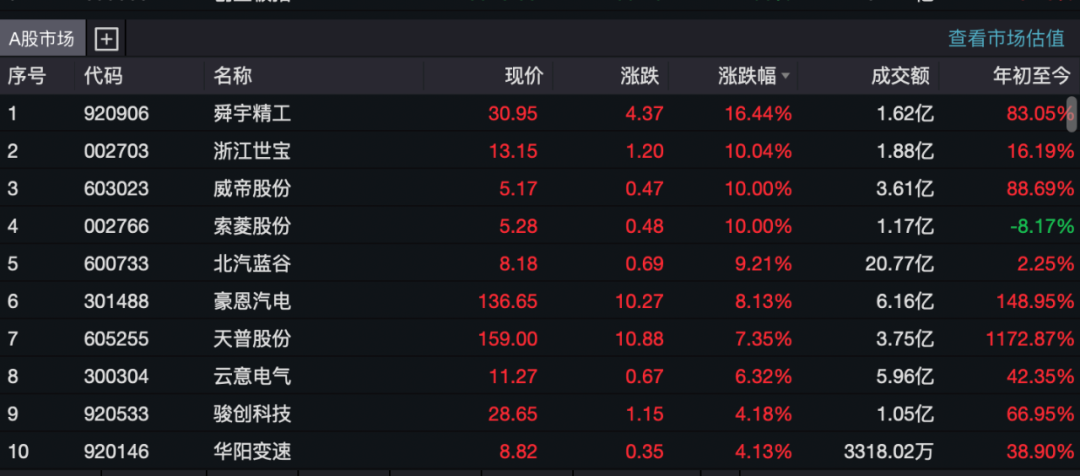
Market Overview - On December 16, the A-share market opened lower across all three major indices, influenced by external market conditions, while sectors such as retail, education, and auto parts showed resilience [1] - The automotive and components sector saw significant gains, with stocks like Zhejiang Shibao, Weidi Co., and Suoling Co. hitting the daily limit, and Shunyu Precision Engineering rising over 16% [1] Stock Performance - Shunyu Precision Engineering (920906) closed at 30.95, up 16.44% with a trading volume of 162 million, marking an 83.05% increase year-to-date [2] - Zhejiang Shibao (002703) rose 10.04% to 13.15, with a trading volume of 188 million, reflecting a 16.19% increase year-to-date [2] - Weidi Co. (603023) increased by 10% to 5.17, with a trading volume of 361 million, showing an 88.69% year-to-date increase [2] - Other notable performers included North Vehicle Blue Valley (600733) and Haoen Automotive Electric (301488), with the latter seeing a year-to-date increase of 148.95% [2] Industry Developments - Recent favorable policies have positively impacted the automotive and autonomous driving sectors, with the Ministry of Industry and Information Technology granting the first L3-level conditional autonomous driving vehicle permits [3] - The introduction of regulations for intelligent connected vehicles is expected to enhance the industry environment, with projections indicating that the market for Robotaxi could reach 270 billion yuan by 2030 [3] - The National Market Supervision Administration's draft guidelines aim to standardize pricing behavior in the automotive industry, which could have significant implications for new car sales and after-sales markets [4]


1分钟,20%涨停!两大板块,掀涨停潮!
Zheng Quan Shi Bao· 2025-12-16 04:53
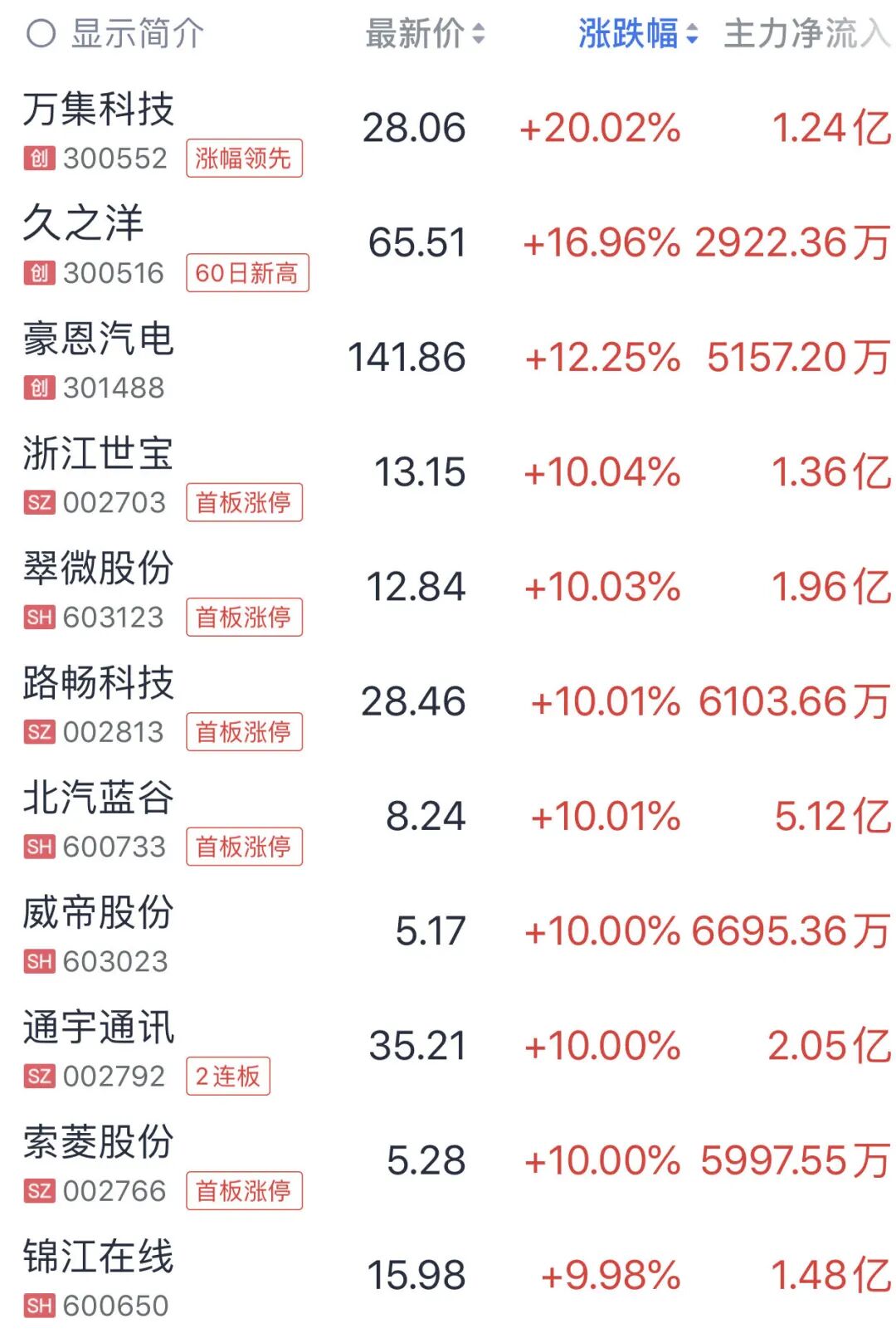
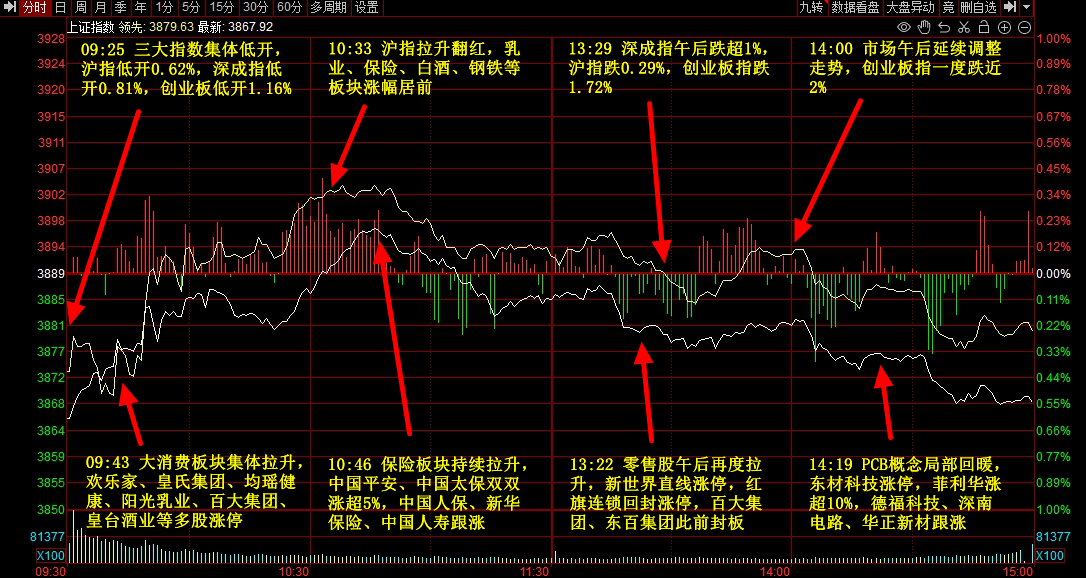
两大板块逆势活跃,个股掀涨停潮。 A股市场今天(12月16日)上午整体走低,创业板指跌势明显。截至中午收盘,上证指数跌超1%,创业板指跌超2%,北证50指数一度涨超2%。 盘面上,A股无人驾驶概念股表现活跃,多股涨停。港股相关概念股也大涨,其中浙江世宝(002703)港股盘中涨幅超过20%。 此外,商贸零售板块也逆势走强,板块内个股掀涨停潮。 两大板块个股掀涨停潮 今天上午A股市场整体调整,主要指数不同程度下跌,其中上证指数盘中跌幅超过1%,深证成指跌破13000点整数关口,创业板指跌幅超过2%。 行业板块和赛道方面,若按照申万一级行业划分,多数行业出现调整,其中有色金属板块跌幅超过3%,银邦股份(300337)盘中跌幅超过11%,中国铀 业(001280)盘中触及跌停,安泰科技(000969)、隆达股份、东方钽业(000962)等多股盘中跌幅超过5%。 通信板块盘中跌幅也超过3%,实达集团(600734)、超讯通信(603322)等盘中跌幅超过9%,特发信息(000070)、联特科技(301205)等多股盘中跌 幅超过8%。德科立、中瓷电子(003031)、国盾量子等多股盘中跌幅超过5%。 综合、电力设备、 ...
1分钟,20%涨停!两大板块,掀涨停潮!
证券时报· 2025-12-16 04:46
两大板块逆势活跃,个股掀涨停潮。 A股市场今天(12月16日)上午整体走低,创业板指跌势明显。截至中午收盘,上证指数跌超1%,创业板指跌超2%,北证50指数一度涨超2%。 盘面上,A股无人驾驶概念股表现活跃,多股涨停。港股相关概念股也大涨,其中浙江世宝港股盘中涨幅超过20%。 此外,商贸零售板块也逆势走强,板块内个股掀涨停潮。 两大板块个股掀涨停潮 今天上午A股市场整体调整,主要指数不同程度下跌,其中上证指数盘中跌幅超过1%,深证成指跌破13000点整数关口,创业板指跌幅超过2%。 行业板块和赛道方面,若按照申万一级行业划分,多数行业出现调整,其中有色金属板块跌幅超过3%,银邦股份盘中跌幅超过11%,中国铀业盘中触及跌停,安泰 科技、隆达股份、东方钽业等多股盘中跌幅超过5%。 通信板块盘中跌幅也超过3%,实达集团、超讯通信等盘中跌幅超过9%,特发信息、联特科技等多股盘中跌幅超过8%。德科立、中瓷电子、国盾量子等多股盘中跌 幅超过5%。 综合、电力设备、国防军工、传媒等多个板块盘中跌幅居前。 无人驾驶概念盘中表现活跃,其中,万集科技开盘1分钟20%涨停,久之洋涨近17%,浙江世宝A股、路畅科技、北汽蓝谷、威帝股 ...


板块异动 | 特斯拉股价创一年新高 A股无人驾驶板块掀涨停潮
Xin Lang Cai Jing· 2025-12-16 03:33
来源:上海证券报·中国证券网 上证报中国证券网讯(记者 刘怡鹤)12月16日上午,无人驾驶板块掀涨停潮。截至11时11分,汉鑫科 技30cm涨停,万集科技20cm涨停,多伦科技、浙江世宝、翠微股份、北汽蓝谷、路畅科技、威帝股 份、索菱股份等涨停。 当地时间周一,美股大型科技股多数下跌,特斯拉涨超3%,创近一年新高,市值一夜增加超530亿美 元。根据福布斯数据,公司CEO马斯克也成为了历史上首位身家达到或超过6000亿美元的人。 ...


A股早评:三大指数集体低开,沪指低开0.17%,无人驾驶板块盘初活跃;贵金属、影视院线、白酒板块低开
Ge Long Hui· 2025-12-16 01:45
格隆汇12月16日|A股开盘,三大指数集体低开,沪指跌0.17%报3861.51点,深证成指跌0.21%,创业 板指跌0.23%。盘面上,首批L3级自动驾驶车型获准入许可,无人驾驶板块盘初活跃;贵金属、影视院 线、白酒板块低开。 ...
A股盘前播报 | 高层发声扩内需!建立和完善扩大居民消费的长效机制
智通财经网· 2025-12-16 00:54
Industry Insights - The domestic and international autonomous driving sector is experiencing significant positive developments, with the Ministry of Industry and Information Technology granting approval for the first batch of L3 autonomous driving models, including vehicles from Chongqing Changan Automobile and BAIC Blue Valley Magna [2] - Tesla is set to initiate road testing of its Robotaxi without safety drivers, indicating a shift in the industry's core logic from "electrification" to "intelligentization and embodiment" [2] - The domestic computing power sector is witnessing a wave of capital activity, with companies like Molybdenum Thread, Muxi Co., and Biran Technology making strides in the market, although they are still in the early stages of commercialization [4] Macro Insights - The China Securities Regulatory Commission (CSRC) is focusing on deepening capital market reforms to support employment, enterprises, and market stability, with 12 key measures identified for reform, particularly in the ChiNext and STAR Market [3] - The recent economic work conference emphasized the need for a comprehensive domestic demand system and a long-term mechanism to enhance consumer spending, which is crucial for sustainable economic growth [1]
晚报 | 12月16日主题前瞻
Xuan Gu Bao· 2025-12-15 14:20
Group 1: Lithium Iron Phosphate - The lithium iron phosphate (LFP) industry is experiencing a price increase, with major manufacturers negotiating price hikes of 2000-3000 yuan per ton, expected to continue until Q4 2026 [1] - Current orders for LFP products are booked until Q1 2026, with some companies halting new orders due to tight supply of high-end products [1] - The supply side is constrained by the slow release of new capacity and the accelerated exit of low-end production, leading to a clear upward trend in processing fees [1] Group 2: Carbon Fiber - Toray Industries announced a price increase of 10% to 20% for its carbon fiber products starting January 2026, indicating a recovery phase in the global carbon fiber market [2] - The carbon fiber industry is recovering from a previous downturn, with demand in wind power and aerospace sectors showing strong growth [2] Group 3: Autonomous Driving - China has approved its first L3-level conditional autonomous driving vehicles for commercial testing in designated areas, marking a significant step towards commercialization [3] - Major companies are accelerating the commercialization of high-level autonomous driving technologies, supported by favorable policies in major cities [3] Group 4: Manganese - The domestic electrolytic manganese market has seen significant price increases, with prices rising by 300 yuan per ton recently, and a cumulative increase of 1800 yuan per ton over the past month [4] - The market is characterized by a supply-demand imbalance, with strong support for price increases due to rising raw material costs and seasonal demand [4] Group 5: Brain-Computer Interface - China's brain-computer interface industry is making significant progress, with advancements in core technologies and applications expected to support large-scale development by 2025 [5] - Breakthroughs in core components and decoding algorithms are enhancing the technology's stability and precision, paving the way for broader applications [5] Group 6: Outsourcing Services - The Ministry of Commerce and other departments have issued an action plan to promote high-quality development in the outsourcing services sector, aiming to cultivate competitive enterprises by 2030 [6] - The integration of emerging technologies like AI and cloud computing is expected to drive the transformation of the outsourcing industry towards digitalization and high-end services [6] Group 7: Elderly Care - A new action plan aims to enhance elderly care services in China by 2027, focusing on expanding resources and improving service quality [7] - The aging population is driving growth in the elderly care industry, with predictions indicating a market size exceeding 19.5 trillion yuan by 2029 [7]


哈啰“双线翻车”:电动车大规模断服
Xin Lang Ke Ji· 2025-12-15 02:04
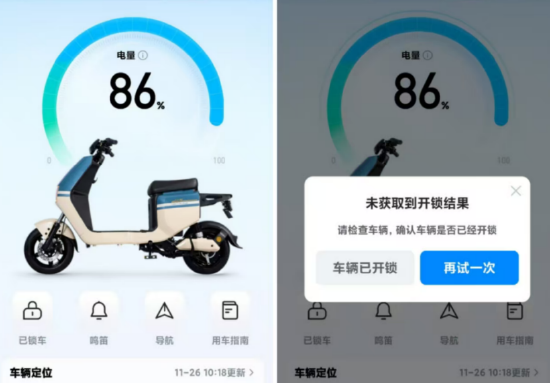
Core Viewpoint - The company faces significant backlash from users due to the discontinuation of 2G network services, which has rendered many smart features of its electric bikes inoperable, leading to safety concerns and potential legal issues [1][5][7]. Group 1: User Experience and Feedback - Numerous users reported their electric bikes experienced sudden "lockout" and "power loss" while riding, raising safety concerns [1][3]. - The company attributed these issues to the nationwide 2G network shutdown, affecting models with EB11 and EB20 smart chips, and offered limited solutions such as Bluetooth unlocking or upgrading to a 4G smart chip at a cost [3][4]. - Users expressed frustration over the lack of prior notification regarding the use of 2G technology when purchasing their bikes, which they believe violates their right to be informed [5][10]. Group 2: Regulatory and Industry Context - The company began its electric bike business in July 2020, shortly after a government directive in August 2020 advised against using 2G/3G networks for new IoT devices [7][9]. - Despite the regulatory guidance, the company continued to release new electric bike models utilizing outdated 2G technology, which is seen as a significant oversight given the expected lifespan of electric bikes [10][11]. Group 3: Legal and Ethical Implications - Legal experts suggest the company's actions may infringe on consumer rights, including the right to be informed and the right to fair trade, as consumers were not made aware of the implications of the 2G network shutdown [10][12]. - The company's failure to provide adequate information about the technology used in its products has led to accusations of short-sightedness and a lack of responsibility towards consumers [5][11]. Group 4: Robotaxi Business and Safety Concerns - The company recently entered the Robotaxi market but faced a serious incident where a self-driving vehicle struck pedestrians, raising questions about the safety of its AI and hardware capabilities [12][13]. - This incident has sparked concerns about the company's ability to ensure safety in its new ventures, paralleling the issues faced in its electric bike business [13].
哈啰“双线翻车”:电动车大规模断服,Robotaxi当街撞人,CEO"成熟AI"被打脸? | BUG
Xin Lang Cai Jing· 2025-12-15 01:32
Core Viewpoint - The company Hello has faced significant backlash from electric bike users due to the discontinuation of 2G network services, which has rendered many smart features in their bikes unusable, leading to safety concerns and customer dissatisfaction [2][18][20]. Group 1: User Feedback and Issues - Many users reported that their Hello electric bikes experienced sudden power loss and locking issues while riding, which posed safety risks [2][20]. - Users were not informed at the time of purchase that the bikes relied on 2G communication, and now they are required to pay for upgrades to continue using smart features [2][6][22]. - The company has offered a solution that includes using Bluetooth to unlock the bikes or paying for a 4G upgrade, which has frustrated many customers [20][21]. Group 2: Regulatory Context - In August 2020, the Ministry of Industry and Information Technology issued a notice urging the discontinuation of 2G/3G networks for new IoT devices, yet Hello continued to release models using 2G technology [8][24][26]. - The company’s decision to use outdated 2G technology raises questions about its compliance with regulatory guidelines and consumer rights [27][28]. Group 3: Legal and Ethical Concerns - Legal experts suggest that Hello's actions may violate consumer rights, including the right to be informed about the implications of using 2G technology [24][27]. - The failure to disclose the potential for service disruption due to the 2G network shutdown is seen as a breach of consumer trust and fair trading practices [27][28]. Group 4: Robotaxi Business and Safety Incidents - Hello's Robotaxi service recently experienced a serious incident where a vehicle struck pedestrians, raising concerns about the safety of its autonomous driving technology [13][15][31]. - The CEO had previously claimed that the technology was mature and ready for deployment, but this incident has led to skepticism about the company's readiness and safety protocols [13][32].

哈啰「双线翻车」:电动车大规模断服,Robotaxi当街撞人,CEO「成熟AI」被打脸?
Xin Lang Ke Ji· 2025-12-15 01:32
Core Viewpoint - The company Hello has faced significant backlash from electric vehicle owners due to the discontinuation of 2G network services, which has rendered many smart features in their electric bikes inoperable, leading to safety concerns and customer dissatisfaction [2][3][10]. Group 1: Network Issues and Customer Impact - Hello's electric bikes have experienced service interruptions due to the shutdown of 2G networks, affecting features like remote locking and battery monitoring, which were marketed as part of the "permanent membership" benefits [2][3][6]. - Users were not informed at the time of purchase that the bikes relied on 2G communication, and now they face additional costs to upgrade to 4G technology [4][10]. - The company has offered limited solutions, such as using Bluetooth to unlock the bikes or paying for a 4G upgrade, while only partially refunding membership fees [6][10]. Group 2: Regulatory and Industry Context - The Ministry of Industry and Information Technology had issued a notice in August 2020, urging the discontinuation of 2G/3G networks for new IoT devices, yet Hello continued to release models using 2G technology [4][12][16]. - The company launched its electric bike business in July 2020, shortly before the regulatory notice, and has since introduced several models that still utilize outdated communication technology [12][13]. Group 3: Legal and Ethical Concerns - Legal experts have indicated that Hello's actions may violate consumer rights, including the right to be informed about the implications of using 2G technology, which could lead to legal repercussions [14][16]. - The failure to disclose the potential for service disruption due to network changes raises questions about the company's commitment to consumer transparency and fair trading practices [14][16]. Group 4: Robotaxi Business and Safety Issues - Hello's Robotaxi service has recently encountered a serious safety incident, marking a significant concern for the company's new venture into autonomous driving [18][19][21]. - The CEO had previously claimed that advancements in AI and hardware justified the launch of the Robotaxi service, but the recent accident has cast doubt on these assertions and raised concerns about the safety protocols in place [18][19][21]. - The incident has led to fears that Hello's approach to the Robotaxi market may mirror the issues faced in their electric bike segment, potentially damaging the company's reputation and consumer trust [21].